I love the colors and vibrancy of India.


I love the colors and vibrancy of India.
The second stage of the sales cycle was to show us how they made a carpet.

Hand woven and then burned with a torch to remove the extra silk.

An intricate process of burning (to tighten and seal the knots) and shaving. With the wool carpets he took a blade to the fibers to finish the process.


While it is all staged to facilitate the sales process just like in other places such as Murano, Italy, it was interesting to watch. The problem I have as a “tourist” is what is the right price? This vendor was pitching us rugs that ran from $5K-$12K USD. While I know silk rugs in downtown Toronto often go for that price (or more), I was instantly on the defensive. Certainly they send those to foreign markets at a fraction of the cost – so what is the right price?
In the end, that is why we did not buy. Perhaps we would have if we felt there was a compelling reason and a deal to be had due to the “buy from the source” scenario.
Being Expats our propensity to “consume” is quite low. Beside the fact that we are living in Tokyo, we have entered into a phase in our lives where we are getting rid of things – not adding. It has to be pretty special to get into our suitcase on a trip.

Our guide had scheduled a stop at a textile shop which is a collective and one that he trusts. I have a long sales background and appreciate a good selling process. Their process is all about creating that emotional tie, letting us know the background on the collective and walking us through how the carpets are made.
The selling process started with showing us how they print silk by hand. Amazing to watch.


The finished process.

Made me wish that we needed something. Carpets, their high price item, were next.
I kept seeing these sidewalk barbershops as we traveled the roads of India – often too late (our van had already whizzed by). On our last couple days in India I set a goal – get a few shots before it is too late.
Config: Canon 5D Mark III, Canon 28-300mm f/28 USM. Having the 300mm helped.

I think that the blue chair might be a barbershop standard.

This is the only barbershop that I spotted inside – on the way from Jaipur to Delhi.
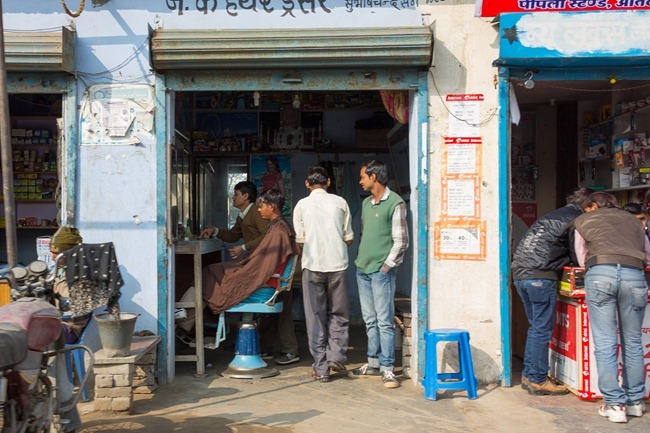
Incredible India! I just loved having a camera there.
Another TripAdvisor advised detour in India, we stopped at our second step well. Throughout the trip it never ceased to amaze me how advanced Indian engineering was. Abhaneri was built for one reason, to harvest rain water.
Stepwells, also called kalyani or pushkarani (Kannada: ), bawdi (Hindi: बावड़ी) or baoli (Hindi: बावली), barav (Marathi: बारव), vaav (Gujarati: વાવ) are wells or ponds in which the water may be reached by descending a set of steps. They may be covered and protected and are often of architectural significance. They also may be multi-storied having a bullock which turns the water wheel ("rehat") to raise the water in the well to the first or second floor.
I wonder when the last time this step well was full?
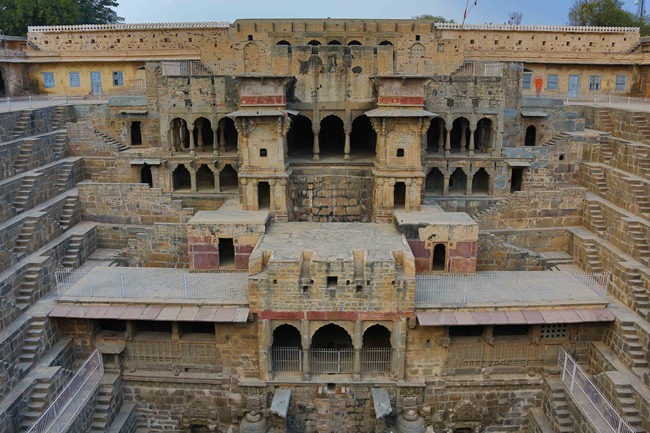
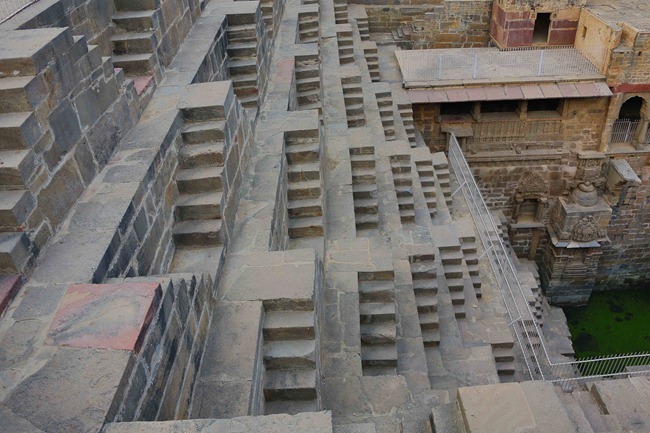
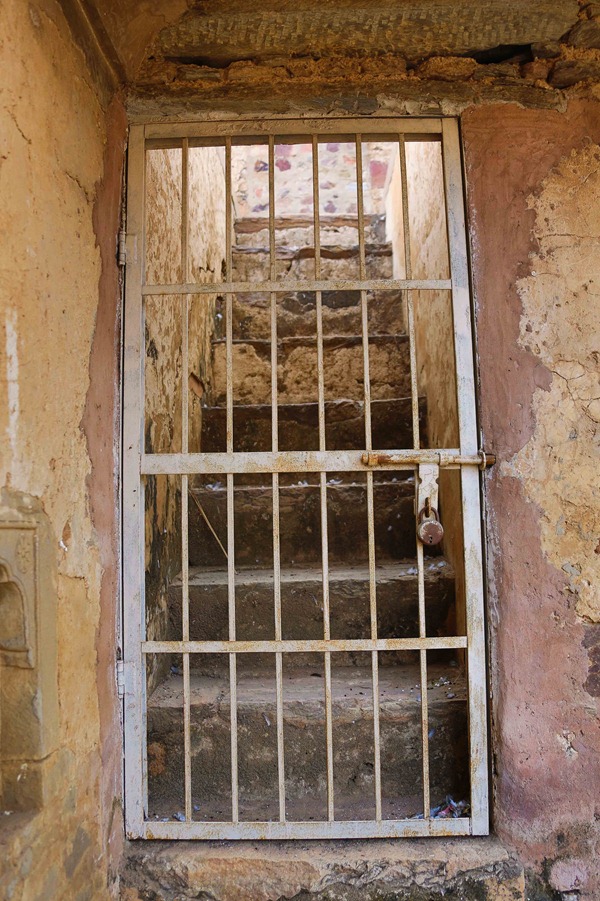
We were not allowed down.
Beautiful green water with thousands of steps and I counted 14 levels. Amazing piece of 8th century work.
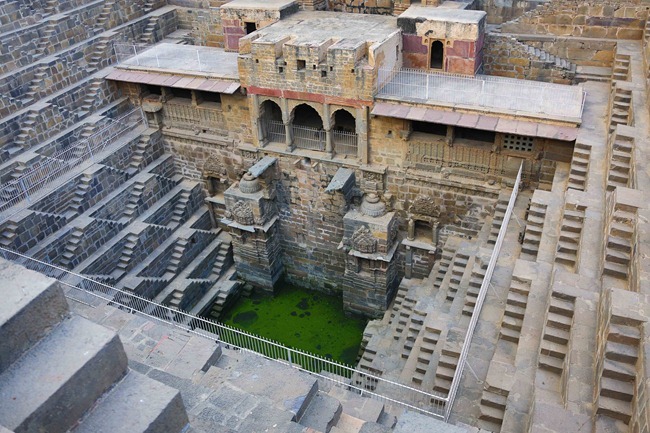
The architecture around the well was stunning.
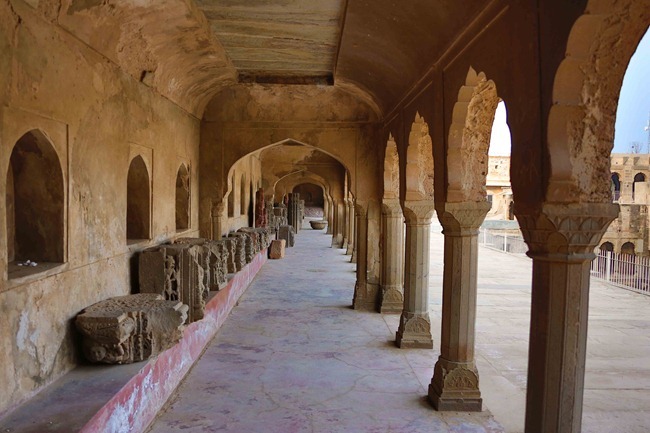
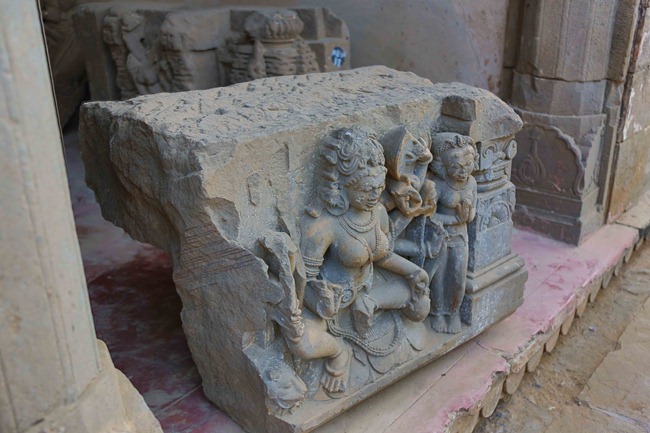
Random chunks of block filled the corridors, from temples in the area.
For the traveller moving from Agra to Jaipur (or vice versa), it is an interesting detour.
As we approached the potter’s home his family gathered around. It was a simple demonstration, showing us his craft.

I love the bright colors of the community.
With no signs of electricity into the home, it was all done the old fashioned way – by hand.
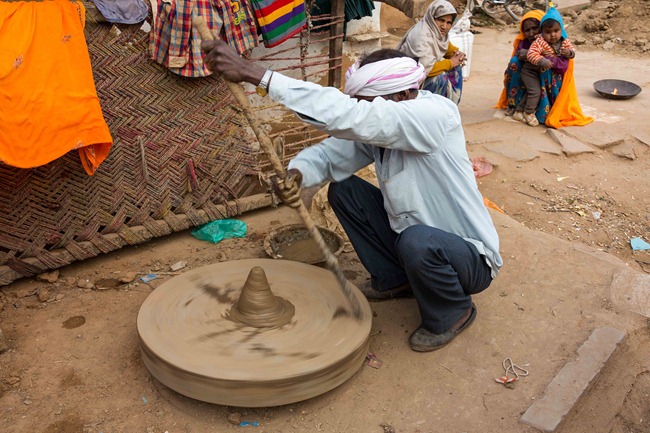
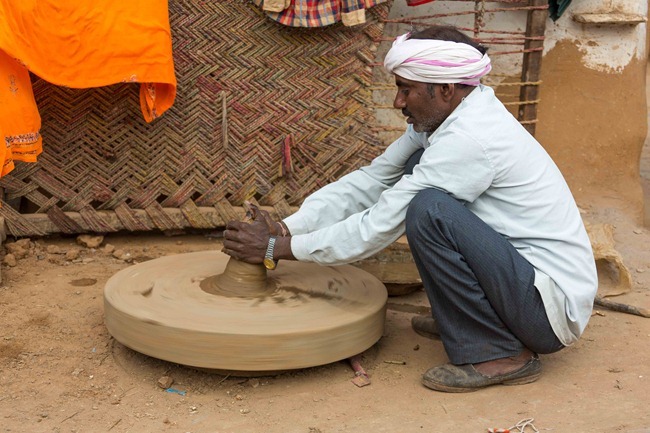
His watch seemed an odd contrast to the surroundings.

While traveling from Agra to Jaipur we detoured into a small town. We went to see how the locals live and to see a potter. Config: Canon 5D Mark III, Canon 28-300mm f/2.8 USM.
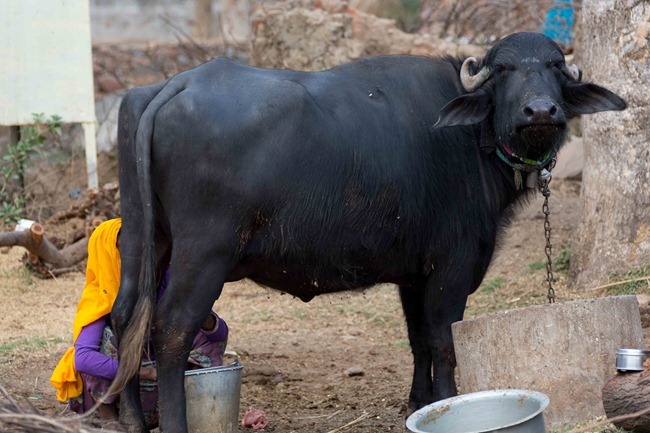
Every street, regardless of location, has one thing in common – water buffalo and cows.

The potters house.

Cow dung was spread out on the roofs of many of the houses – they use it for fuel.


I was allowed to look inside one of the homes (below), and it was as you would expect. Simple open rooms, with a fire pit and sleeping quarters on mats. It was also filled with smiling children, staring at the gaijin.

The potter was next.
It occurred to me recently that I have never brought my camera along for the commute. The other week I did. Config: Canon 5D Mark III, Canon 50mm f/1.2.
The subways have some old fashion elements – like white gloved conductors who hop on and off to guide the crowds.

My commute to work is a short one. It starts at Hiroo station – stop number 3. I change trains at stop number 8.

I seem to go against the flow of the commuters. This station fills up with people getting off the train, not on to it. Very clean.

Note the face masks. I found that very odd when I first moved to Tokyo – people on the train, in the street and in the office wearing facemasks.
As an insight into the Japan culture, often people wear masks not to avoid getting sick – but to stop themselves from getting others sick. Very polite. I have even started wearing a mask when ill (garnering a few looks) and on airplanes; it is fantastic for your throat as the air is dryer than a dessert on a plane and the worst place to catch a cold. I travelled a significant amount in 2013 (often 10 hour flights) and seemed to be catching a cold every other flight – the mask helped.
Another common reason for wearing a mask is allergies (blogged about previously).

The train flying by.

The Tokyo rush hour can become very crowded.
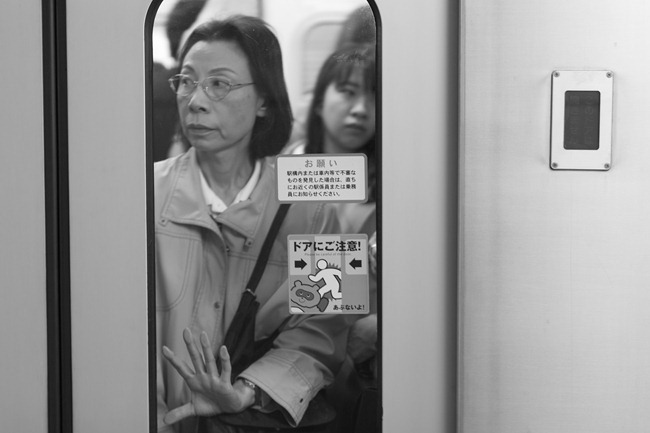

I think this is my favorite shot of the morning.

Next stop Ginza.
When we moved to Tokyo I found it very hard to figure out. As expatriate assignments go, Japan is like moving to Mars and dramatically more complex than when we moved to Europe.
As a public service announcement, I share a few key learnings in the hope that it helps others in the future.
Tokyo is the safest and cleanest city in the world. It has beautiful parks and perplexing rules. The Japanese people are incredibly friendly and will openly try to help you out as a foreigner.
But it can be daunting, as I described in this post. I hope this helps others.
At the back of the Fatehpur Sikri complex is a large water basin. There were two men at the base of the wall working hard to get our attention. They yelled an offer to our guide – money for a dive.
That is a long drop, but I admire their entrepreneurial approach and agreed. Config: Canon 5D Mark III, Canon 28-300mm f/2.8 USM.

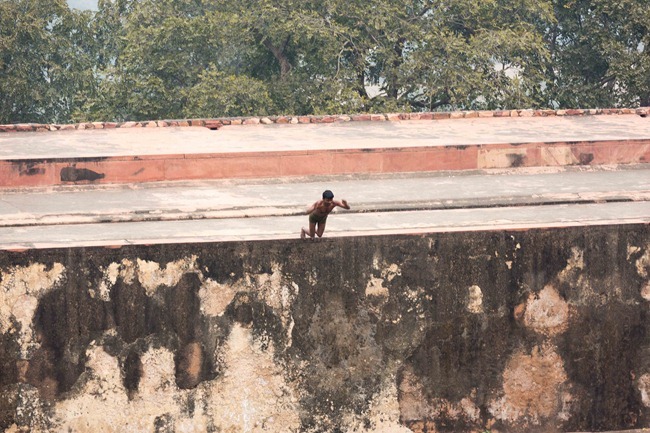
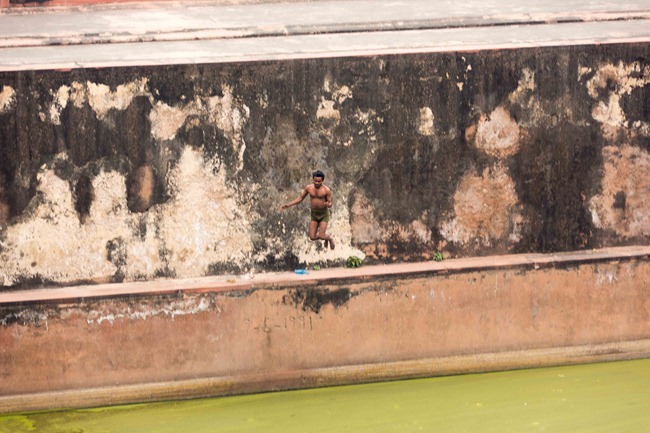
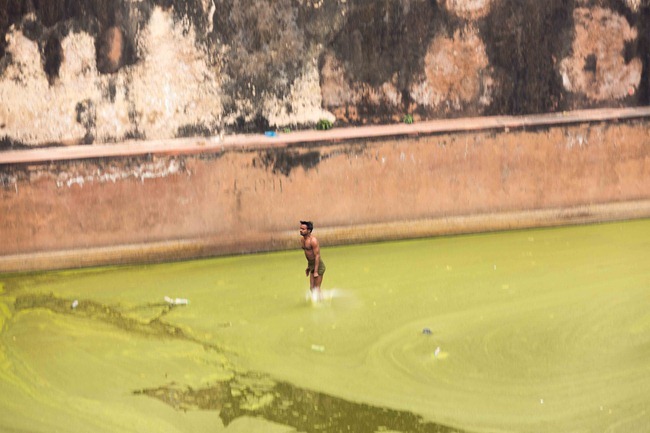

Awesome jump (smile).
Outside of Agra is Fatehpur Sikri, a small city that would often serve as the summer capital:
The city was founded in 1569 by the Mughal emperor Akbar, and served as the capital of the Mughal Empire from 1571 to 1585.[1] After his military victories over Chittor and Ranthambore, Akbar decided to shift his capital from Agra to a new location 23 miles (37 km) W.S.W on the Sikri ridge, to honor the Sufi saint Salim Chishti. Here he commenced the construction of a planned walled city which took the next fifteen years in planning and construction of a series of royal palaces, harem, courts, a mosque, private quarters and other utility buildings.[2] He named the city, Fatehabad, with Fateh, a word of Arabic origin in Persian, meaning "victorious." it was later called Fatehpur Sikri.[3] It is at Fatehpur Sikri that the legends of Akbar and his famed courtiers, the nine jewels or Navaratnas, were born.[citation needed] Fatehpur Sikri is one of the best preserved collections of Mughal architecture in India.[4]

Ornately built with incredible detail everywhere. It is an architectural wonder, and quite the “summer home”.
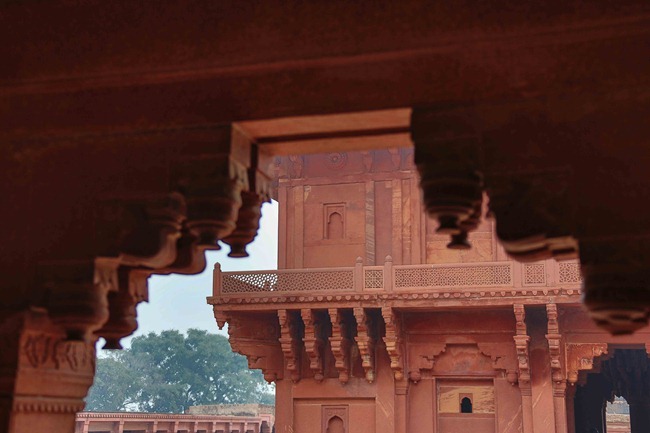

While we were there it was quite cloudy and foggy. We are just fortunate that the entire trip was not that way.
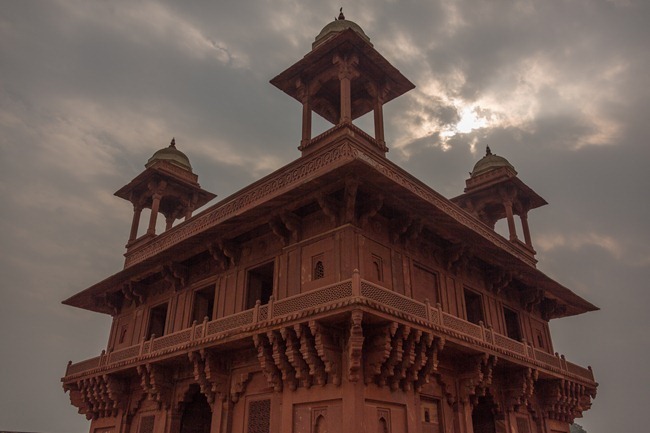
The most interesting part of the fort was the insight into the male/female lifestyle. At different spots through the fort Anu (our guide) would point out where they celebrated – with dancers and musicians – always pointing to where the women would be located/segregated, often behind some type of screen or up on one of the balconies.

Interesting insight into a Moghul’s summer life. As an aside – a point on literacy embedded in the Wikipedia entry:
Fatehpur Sikri has a population of 28,754. Males constitute 53% of the population and females 47%. Fatehpur Sikri has an average literacy rate of 46%, lower than the national average of 59.5%: male literacy is 57%, and female literacy is 34%. In Fatehpur Sikri, 19% of the population is under 6 years of age
We had many conversations with our guide on literacy, education and the class system in India. It became apparent that there is a lot of local skepticism around the claimed national literacy average of 72%.
This fellow was very proud of his camel and the grooming. A majestic animal. He was offering rides outside of Fatehpur Sikri.


Love the intricate designs. He loves his camel.

It seems that regardless of country, students always get stuck doing manual labor to “build character”. In this case it is weeding and cutting the grass (with their hands) at the Tokyo police academy.

There must have been 200 of them. The only difference between them and their brethren everywhere ? Most of them were wearing a face mask.
In most countries when you think of a construction worker you think of a hardhat, steel boots and safety equipment.


In the land of paradox, where rules abound and business culture is all about adhering to the norms and coloring within the lines, the attire of the Japanese construction worker continues to confuse me.

Construction pants? Well yes, but they are these huge, flowing baggy things that look perfect for getting caught in an auger and ripping off a limb. Called a Tobi trouser.
Tobi trousers or tobi pants are a type of baggy pants used as a common uniform of tobi shokunin, construction workers in Japan who work on high places (such as scaffolding and skyscrapers).[1] The pants are baggy to a point below the knees, abruptly narrowing at the calves so as to be put into the footwear: high boots or jikatabi (tabi-style boots), often brightly colored.[2]
According to a spokesperson for Toraichi, a major manufacturer of worker’s clothes of this style, the style was developed from knickerbockers. The regular knickerbocker-style pants are called nikka zubon ("zubon" means "trousers," and "nikka" or "nikka-bokka" is a gairaigo–transformation of the word "knickerbockers"). The excessively widened ones are calledchocho zubon.[1] This style has also entered popular fashion,[3] as evidenced by the emergence of toramani ("Toraichi maniacs"), die-hard fans of Toraichi trousers.[1]
Construction boots? No. Usually soft boots with the big toe separate to allow for slip on footwear (i.e. flip flops). Definitely not steel toe. He happens to be wearing running shoes. Called the Jikatabi. I personally like this commentary on the boot “Though slowly being replaced by steel-toed, rigid-sole shoes in some industries, many workers prefer them for the softness of their soles”.
Hard hat? Infrequently. The bandana seems to be a team favorite.
One could say that construction mirrors culture – where tradition is tantamount, despite the changing world around them. Or perhaps, the right term is “to spite the changing world around them”. The paradox that is Japan.
The only way that we found out about this wildlife sanctuary is through TripAdvisor, and my unwillingness to accept a pre-canned trip. I am glad we did.
The sanctuary is a little bit out of the way and I wish we would have scheduled more time as they also have a elephant sanctuary in the park – 30 minutes away. If you read through the TripAdvisor reviews, there will be people complaining about some fees such as the “take picture” fee at the entrance to the park. For me, it was worth every penny. These people are doing amazing work and we made a donation on the spot.
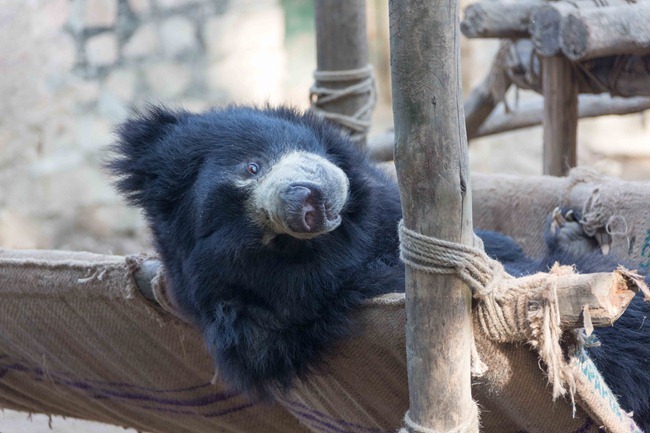
It is a rather heartbreaking story. Wildlife SOS started in 1995 with a movement to save the “dancing bears” of India. Ripped from their mothers at an early age their noses are pierced, teeth are broken and they are trained to “dance”. Their owners move from town to town, entertaining the villagers. Through a program of buying back the bears and helping the previous owners find a new livelihood (i.e. become a rickshaw driver), they have slowly eliminated the practice. Very few remain and it is now illegal.
It is truly amazing work they are doing and these bears appear so content in their huge, open sanctuary. The sloth toed bears are beautiful and incredibly serene.


You can see the mark where the ring was initially in place. Now, long gone.

Relaxing.

They also rescue other animals – which we did not have the time to see (regrettably). Although we did have a ton of fun playing with their dogs – rescued from the streets of the city, and beyond happy. This fellow was a vixen (smile).

I would highly recommend watching this video to understand the plight of these bears. You can donate here.
There are a lot in India. Nature and people collide all over the country and like the raccoons of Canada, monkeys clamber amongst the sprawling population.
I love shooting monkeys, they are so interesting to watch. Config: Canon 5D Mark III, Canon 28-300mm f/2.8 USM.
This group of families was at the entrance to a park as we travelled to a wildlife sanctuary.


They are such an intimate species. Clustered together, jumping, playing, taking care of each other.
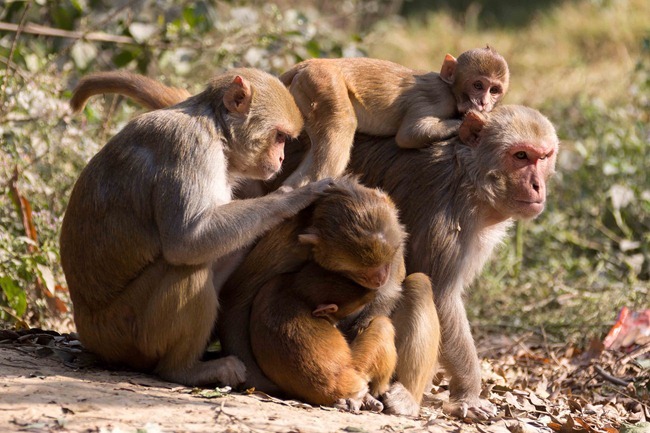
As I watched this young man came out of the back of a building. It caused quite the racket as they obviously knew what he was about to do.

He smiled the entire time, feeding the group.
I am a Starwoods guy. Whenever I can, our family stays in their hotels because that is where I stay on business. A friend coached me when I first came out of university – pick a hotel chain and stick with it – that is how he gets a free week in Maui every year.
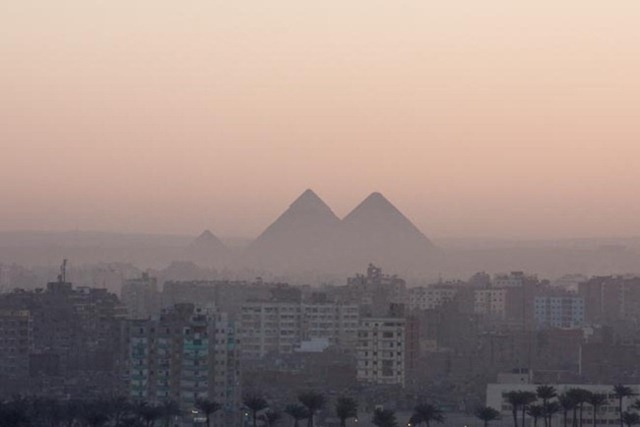
That qualifying statement complete, the Four Seasons is impressive. We stayed at the Four Seasons in Cairo years ago and it is one of the best hotel we have ever stayed at. The view helped.

Recently we were speaking with someone who had managed the restaurant at the Four Seasons in Tokyo. We were discussing the Japanese culture, creativity and education. He provided the following insight (paraphrased from memory):
It was a real challenge at the restaurant because our staff struggled with the westerners. At a Four Seasons it is very common for the guest to not order off the menu. They expect to order what they want and have us prepare it.
This is very different than the Japanese clients. I cannot remember any Japanese client every asking to order outside the menu. It just isn’t how they think and our servers really struggled with dealing with the custom ordering.
It just isn’t how the Japanese were taught to think and as the world continues to change, I wonder as to what will be required out of the Japanese education system, is it being altered to deal with change? (I believe the answer is no). We all need a good dose of Finnish education.
Everyone knows about the pollution problems in China, especially people in Asia. The cities function in a perpetual haze with varying levels of visibility.
While walking down a street in Shanghai the other week I saw a gaggle of scooters coming my way. Not an uncommon appearance in Asian cities.
As they sped towards me I was expecting to be assaulted by the smell of gasoline and the high pitch hum of single stroke engines. To my surprise, they zinged by quietly. It turns out that most scooters in China cities are electric. They are cheap to power and cheap to buy ($100-300).

A bear I would never buy. The warning is very clear about language.

I believe this golf visor was in the men’s section.

The below translates into roughly $60USD per melon.

And Tokyo is the 6th most expensive city currently!
Study after study suggest that memories are heavily linked to the senses; sight, smell and sound. According to this study it is because of where memories are stored:
Sights, sounds and smells can all evoke emotionally charged memories. A new study in rats suggests why: The same part of the brain that’s in charge of processing our senses is also responsible, at least in part, for storing emotional memories.
Spring has sprung in Tokyo and as in so many other four season cities around the world, that means construction. As I walked to the subway the other day I passed a construction site with a large safety wall blocking my view. It was early so the crews were just starting up … and in this case one of the crew was starting up a Stihl saw. I could not see it, but I instantly recognized the sound.
The ‘almost flooded’ coughing as the single stroke engine caught, followed by the high pitch whine as the operator revved the engine. It has been more than two decades since I put myself through university on summer construction sites – driving heavy equipment, lugging blocks and spending hour and hours bent over a Stihl saw with a diamond blade. At that moment, the memories felt like they were from yesterday.

It is a question I asked many people before we traveled there for 10 days with a wide range of answers; what is the right amount of time?
Reflecting on our time in the country, I would pass on the following opinions (feel free to disagree):
The tourist sites become repetitive: The pink city, the blue city, Delhi. The architecture of India is surprisingly consistent. Once you see a couple temples, forts and Tajs, they begin to look the same. Therefore if you are planning, remember that. We went to Agra, Jaipur and Delhi. I do not feel that we missed much by not hitting the other northern cities and am very glad that we didn’t make the very long trips.
That isn’t to say that the south isn’t different. It is and we will make another trip to hit the south of India.
It isn’t about the tourist sites: Had we followed the itineraries that were presented to us by travel companies we would have missed out. I spent a lot of time searching different locations on Tripadvisor and opportunities to take us off the beaten path. Into villages, on to locations that others don’t usually go to. The Taj Mahal was interesting, but I wouldn’t call it the highlight of the trip. The highlights for us were often down side streets.
I began to form this opinion at Sikandra tomb, the tomb of Akbar the great. Magnificent building? Yes. Did it have anything different than the other tombs we had seen? Not really. It was at this point in the tour that we started to actively push away from the top, commonly visited sites in the cities.


It is tiring. India is a full on assault on the senses. A 100km drive can take 5 hours. Everything is caked in dust. You will see flaunted wealth and the saddest of poverty. We booked in breaks at our hotel to just relax or it would have been to much.
As I said in a previous post, our private guide gave us this flexibility and truly explained India to us. The culture, the rich history and he was very flexible as we evolved our itinerary as we went.
And to answer the question again on safety – just be smart. We had a few run ins, but we were never in danger. We stood out in the crowd (My wife and boys are blonde), so expect lots of stairs, people asking for money and a few other things. As a group, it was safe. It is just about being smart.
India is an incredible place, but it is not for the first time traveler.


I was told they they are filled with rapeseed, a popular crop used to yield rapeseed oil which can be used for cooking and biofuel. 13% of India’s farmland grows the crop.
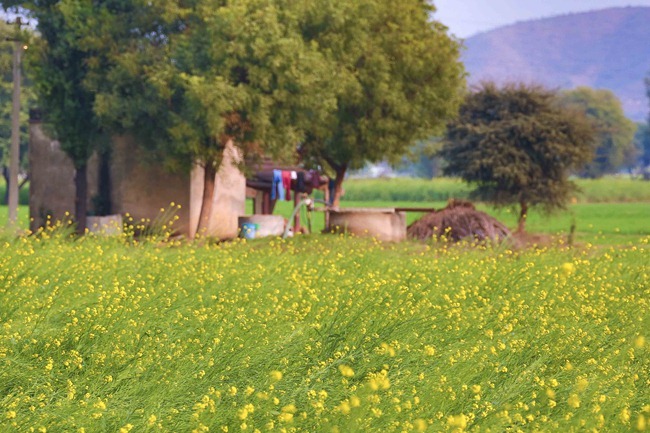

It makes for a beautiful field.
Our trip to India involved 3 cities (Delhi, Agra, Jaipur) with driving in between. What would be considered a fast and simple drive in Europe or Canada was arduous in India. The country is filled with half completed roads, which (I was told) stands as a testament to the bureaucracy and corruption that plagues the country.
For a tourist that means long – bumpy drives. Each city would be 5-7 hours apart. We booked a van.
The benefit of that distance is that you can open the window and watch the people go by. As we drove I truly enjoyed watching the trucks.

In Canada, truck drivers pride themselves on how shiny their truck is. In India, it is all about the colors and the bling.

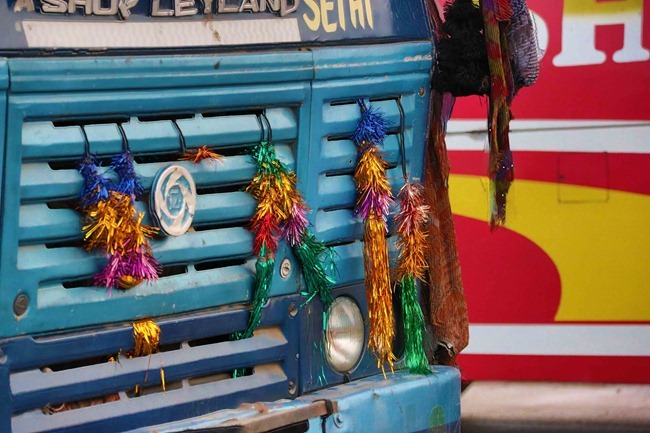
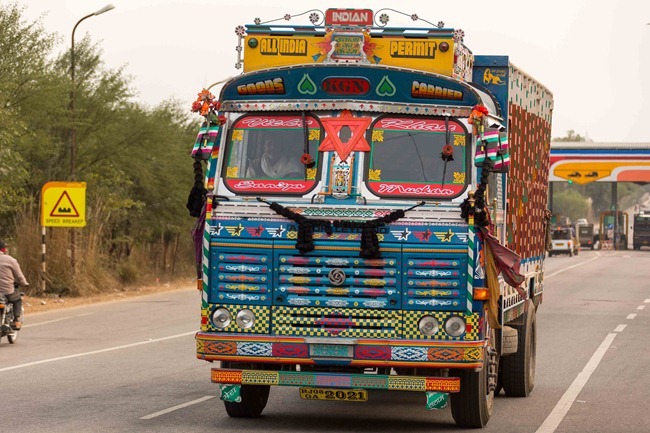
Another big cultural difference. In Canada blowing the horn is an act of anger – done infrequently.
In India, everyone does it, all the time. I mean, all .. of .. the .. time. It is one of the things that makes traveling in India such a full on, sensory overload. On almost every truck, they actively encourage it.
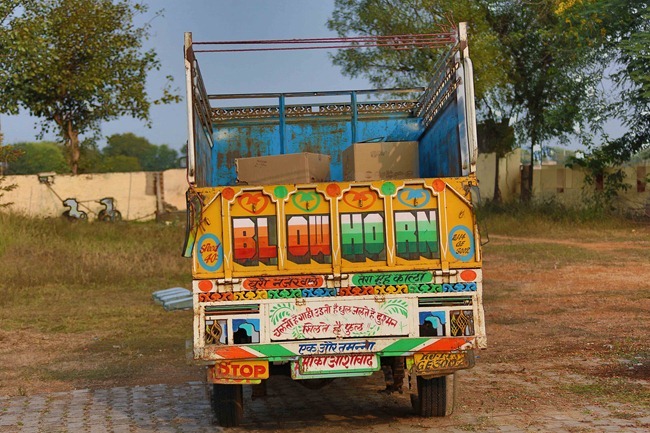

I also learned that inflammable is not the opposite of flammable. English can also be a mysterious language. I particularly enjoyed the “specialist advice” to stay upwind.

Incredible India.
As seen on the road from Delhi to Agra, India. The farmers take this to the extreme.
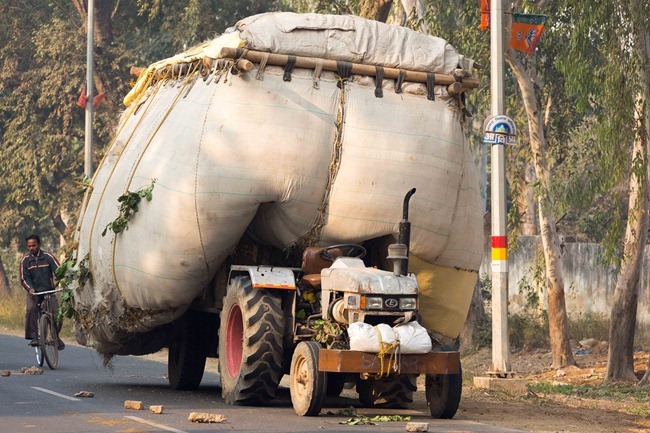
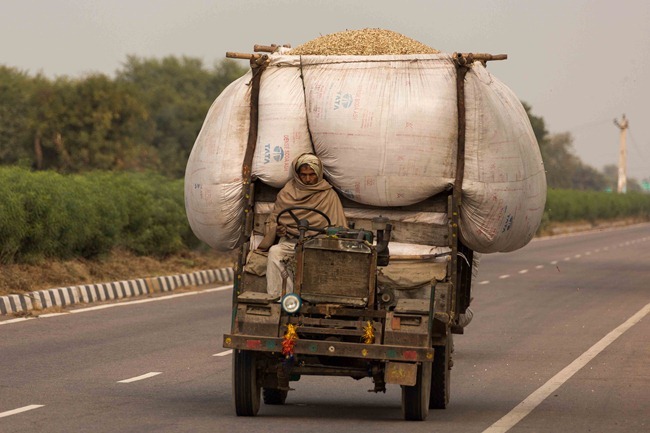
All along the route, there was much to see. People still collect wood to cook and heat their homes. Agra at this time of year is coolish (6C).

This vehicle was doing around 80 km/h and that last fellow was barely on.

In India you see everything and the contrasts are significant. As you drive you will see a $250K Mercedes driving beside a camel. There were a lot of camels.

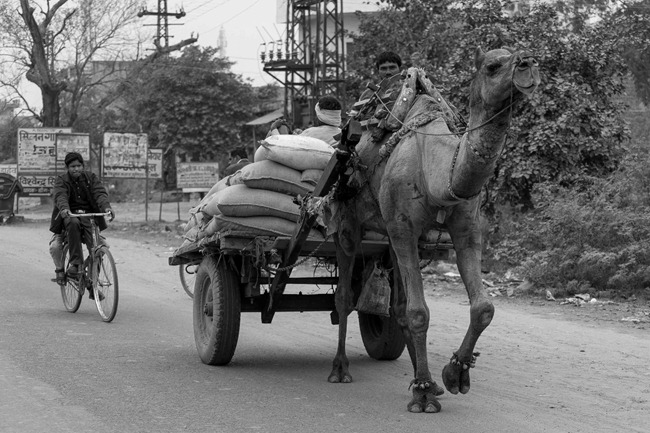
They fit in well with the water buffalo.
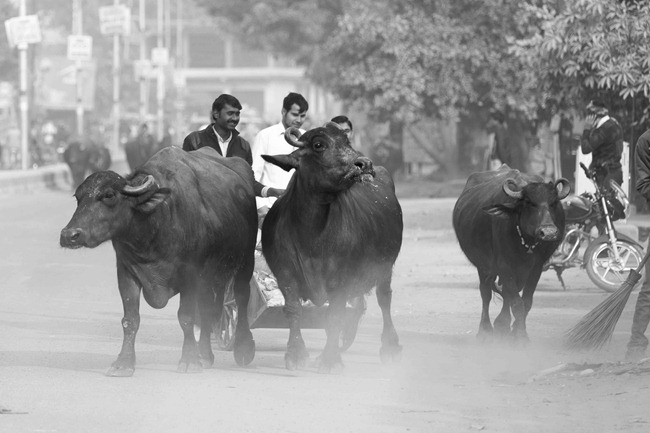
These water buffalo also provide insight into the speed of traffic in India. They roam free along with the cows.
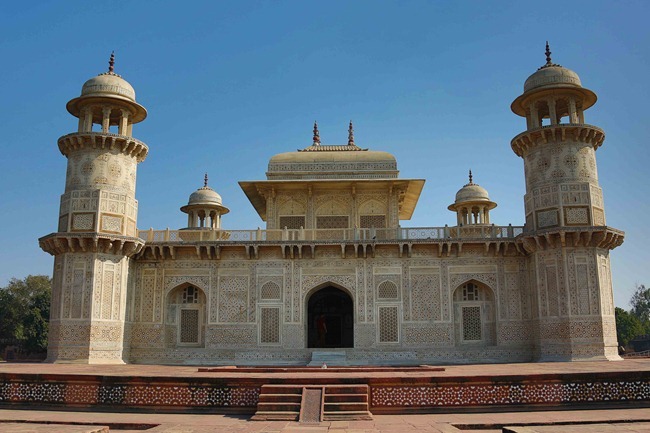
We visited this tomb on the same day we visited the Taj Mahal. I have to say, I found this landmark more interesting. Beautiful grounds, a spectacular and visually stunning building, smaller crowds and a beautiful view of the river.


Via:
Tomb of I’timād-ud-Daulah (Urdu: اعتماد الدولہ کا مقبرہ, I’timād-ud-Daulah kā Maqbara) is a Mughal mausoleum in the city of Agra in the Indianstate of Uttar Pradesh. Often described as a “jewel box”, sometimes called the “Baby Tāj”, the tomb of I’timād-ud-Daulah is often regarded as a draft of the Tāj Mahal.
The mausoleum was commissioned by Nūr Jahān, the wife of Jahangir, for her father Mirzā Ghiyās Beg, originally a Persian Amir in exile.[1] who had been given the title of I’timād-ud-Daulah (pillar of the state). Mirzā Ghiyās Beg was also the grandfather of Mumtāz Mahāl (originally named Arjūmand Bāno, daughter of Asaf Khān), the wife of the emperor Shāh Jahān, responsible for the construction of the Tāj Mahal.

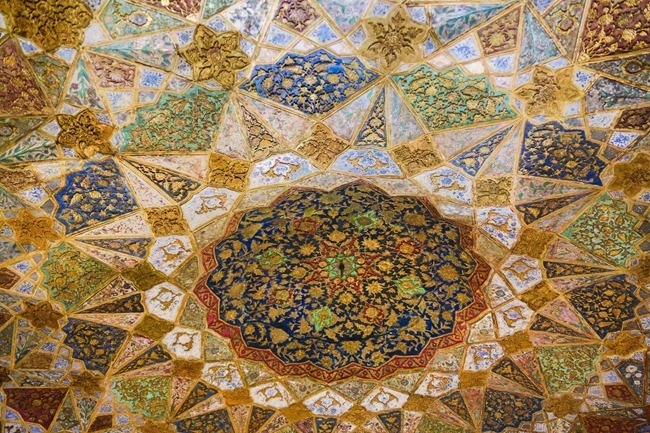
The walls outside are incredibly colorful and ornate.

And even more colorful inside.

As always, look up.
At the back of the grounds it opens up to a magnificent view of the river. People washing their clothes, water buffalo drinking and a few magnificent viewing spots.


A brief note on the entrance … it is adorned with carvings of wine. Supposedly the Mughal loved his wine.

I am not sure this is a big stop on the Agra tour. We did not see any tour buses. If in Agra, make the stop.
A small temple, tucked off the road in Chofu, Tokyo, Japan. As seen by one of the many mirrors on the road. The mirrors are in place as the buildings are so close to the roads that it is almost impossible to see around corners.

No one was around .. just a pair of boots.

The temple was across from the tracks. Everything in Japan (and Tokyo) is so tightly packed in and usually close to some type of train track.
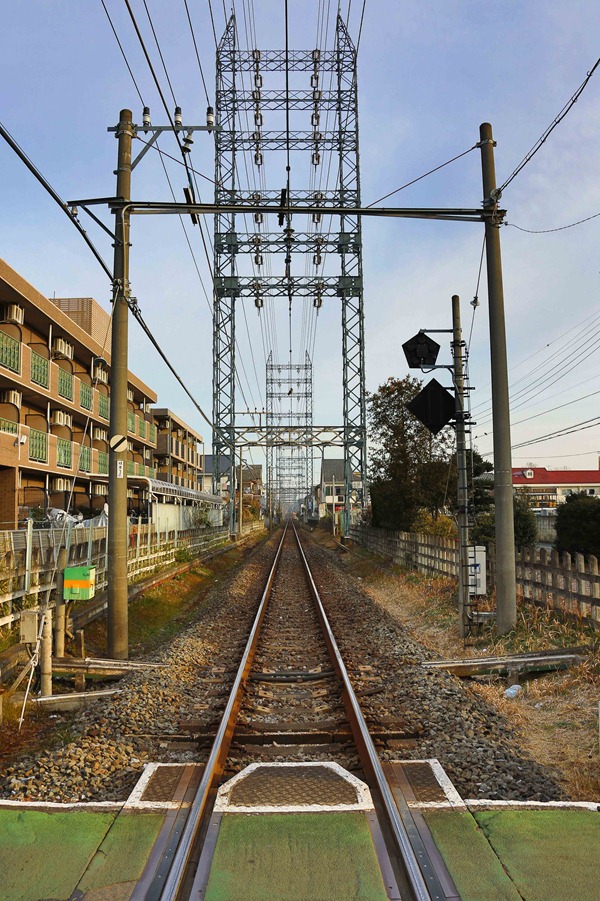
Being Canadian, seeing lemon trees like this in January when it is 6C is a bit baffling.

Near the temple was a workshop of some type. Odd seeing what appears to be a machine shop in the middle of what feels like a residential area.
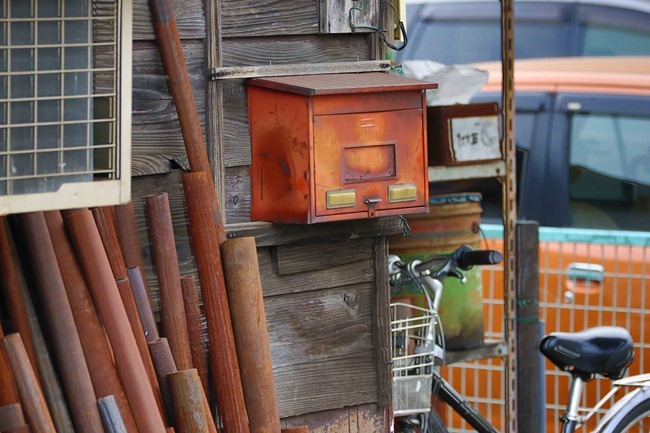


As always, Tokyo is filled with random English.

People often refer to India as “Incredible India”. Seems like Tokyo needs a adjective inserted.
The Taj Mahal, wonder of the world, ode to love. Well an ode to his 3rd wife. Not sure how first 2 felt when he embarked on this 25 year building spree to remember her.
None the less, one of the “must sees” when in India.
Our first glimpse was from down the river. It was a little bit hazy, but luckily not foggy and the sun was coming out. (Config: Canon 5D Mark III, Canon 28-300mm f/3.5 USM).
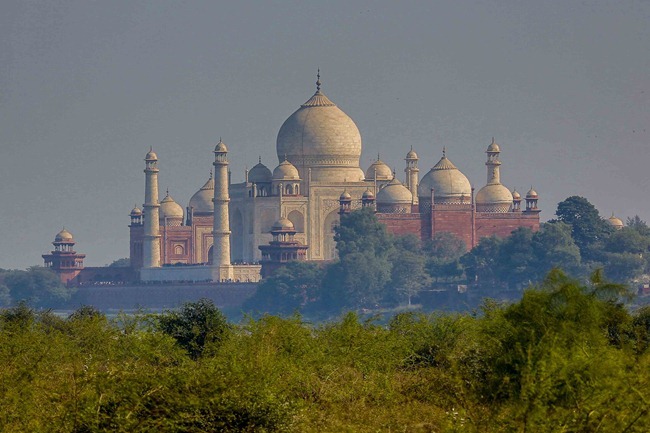
Once past the gates you come to the large entrance – effectively called “The great gate”

Our first peek at the Taj Mahal.

As we walked through the gate it came into full view. It was quite a unique experience.
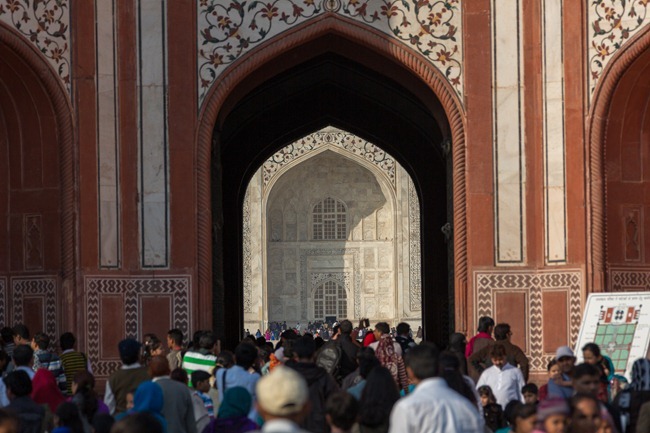
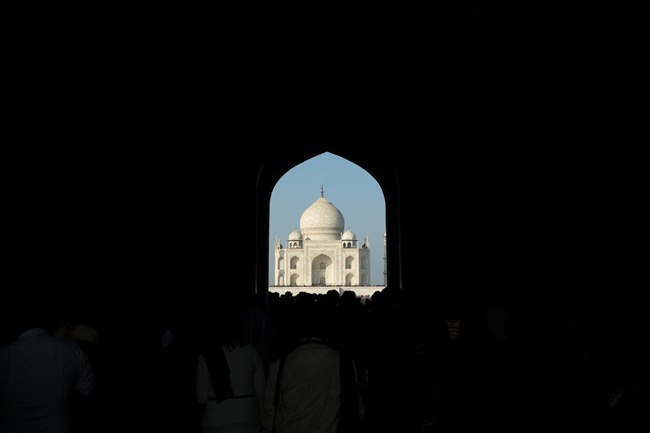


Even thought it was an official holiday, it was not as busy as I had expected. But there were a lot of Indians. With the recent collapse of the rupee there has been a sharp decline in travel abroad as Indians looked to more affordable travel within the country.
Unfortunately, this means that if you are a local, you can expect a very, very long line. Fortunately, as foreigners we were able to skip the lines. The lines wrapped around the Taj Mahal multiple times.


And on that note, what else is there to say? It is the Taj Mahal. A spectacular monument that you simply stand back and soak in.

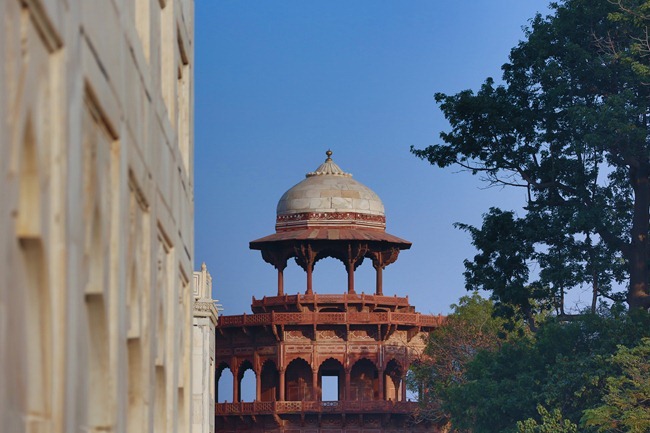


A unique Christmas day.
When we went to India over the Christmas break we did not realize that we were taking such a risk. When I say risk I am not talking about safety. I am talking about weather.
Little did we know – it was a terrible time to go to India. In the evenings it gets cold and that causes fog. Lots of fog. According to our guide he went to places like the Taj Mahal many times and all they saw was fog. How terrible would that be?
With this new insight we made a plan as we traveled from Delhi to Agra; the weather would dictate where we would go when and Anu would pick when we went to the Taj Mahal.
It turns out, we were very lucky. According to our guide .. very, very lucky.

Before I get into the Taj Mahal, I need to backtrack. The experience is an interesting one. You stop off at the tourist arrival area where you board electric buses to head to the Taj. This is in an apparent effort to reduce pollution.
They also provide you with some clear guidelines on what you should not do. I am very glad I left behind my nife, colors and helmate.
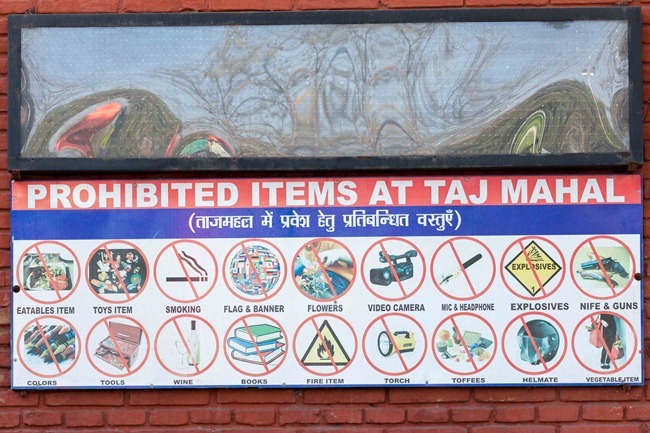
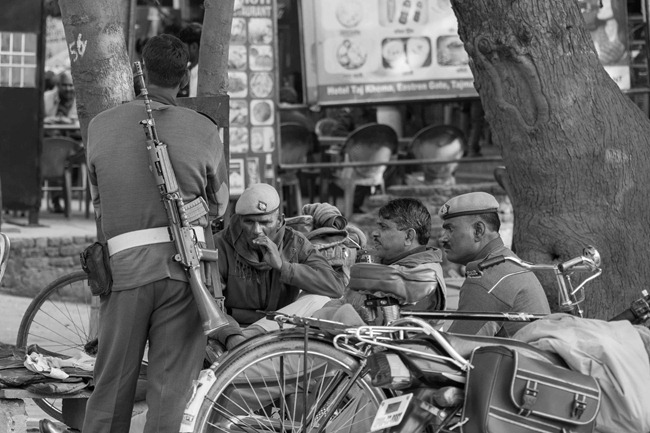
Very glad because the Ministry of Defense was ready to jump into action in their very intimidating car.

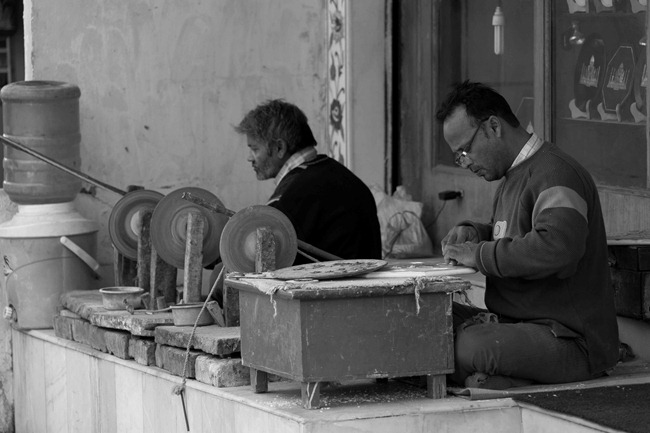
You get dropped off and have to walk to the entrance – through stalls, craftsmen and tourist hawkers. Oh yes, we also had to stop for water buffalo. They were crossing .. near the Taj Mahal.
They came up from the river bank onto the road and back down .. a normal day in the life of a water buffalo, passing through thousands of tourists.


It has to make you smile. On your way to the Taj Mahal, and you get stopped by a herd of buffalo. Incredible India. I expected the sights below, not the water buffalo.

In moments we arrived. This ticket got us past the long local lines and in to see one of the wonders of the world.
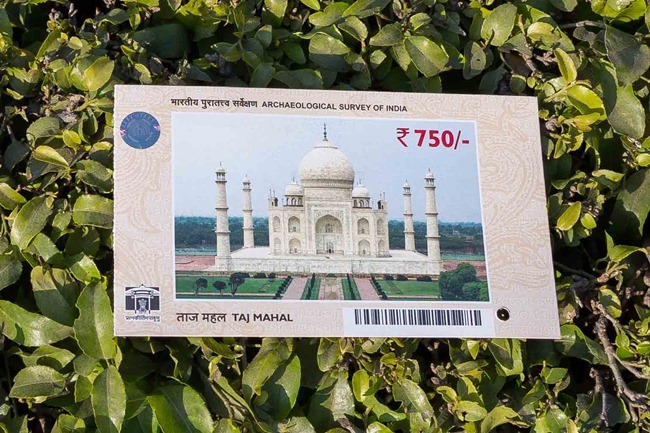
The Taj Mahal.
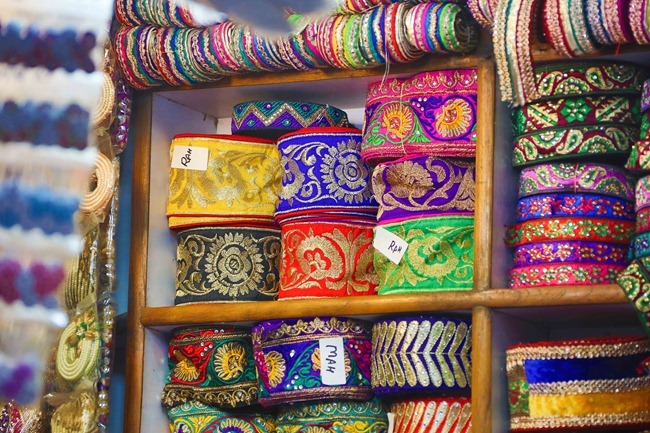
The Old Delhi markets are a real mix. Inside a city block you can find everything; spices, food, textiles, with a little bit of everything in between.
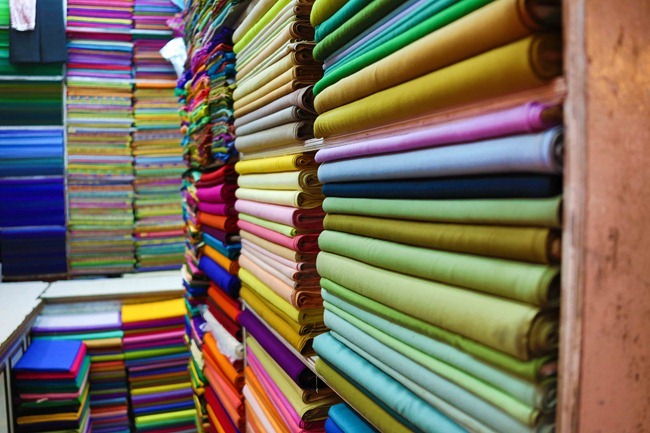
When it comes to colors and textiles, the Indian culture is all about color.

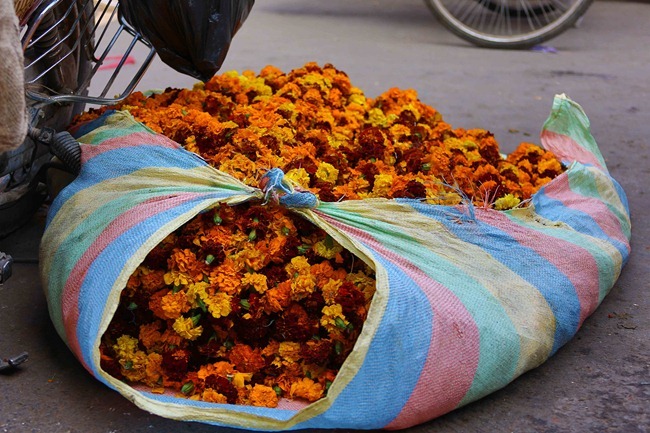
The Indian culture also loves their marigolds. Street vendors were selling them everywhere – especially near temples.
Did I mention that watching the street vendors and not being able to try any of the foods was torture?

This fellow was making these amazing deep fried, cinnamon, crispy sweet cakes. How do I know? They had them in the hotel at breakfast – a place where we could eat the food.

The Indian spice markets are like the textiles – filled with colors. I had one vendor try to sell me a huge bag of cardamom for a couple dollars – definitely not Tokyo prices.
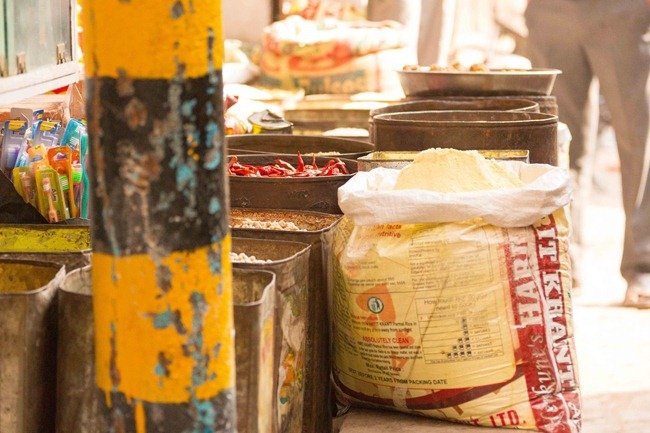
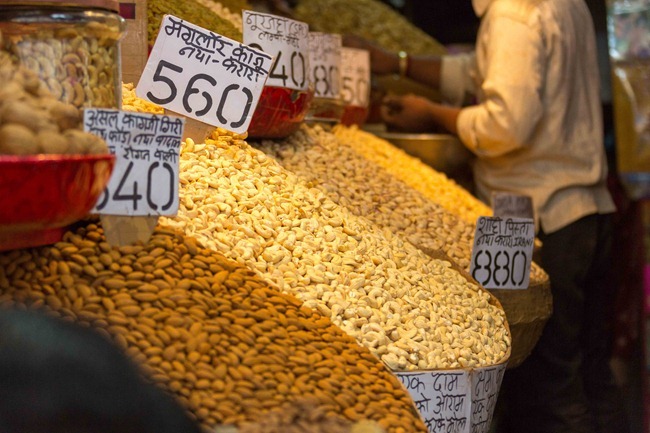
A wonderful “wander”.
Throughout India you see these on doors, walls and hanging in the air – to ward off evil spirits. In this case they are warding the spirits and locking them out.

Remember, always look up. They were hanging all around the markets.

I think it is a lime – with chilies.
How do you describe the Delhi markets? Many words come to mind. Rich, alive, colorful, crammed, dusty, packed, rambling, chaotic. All apply including “interesting”. On Christmas eve day, we wandered the textile and spice markets of Old Delhi. Every alley filled with sights.
These are two of my favorite shots – capturing the essence of the alleys of Old Delhi (Config: Canon 5D Mark III, Canon 28-300mm f/3.5 USM)


This sign was hanging outside a string of fireworks shops.

A few fireworks with very interesting names.


The fireworks were right beside the “Dental Depot”.

And this empty office, which our guide said was the sanitation office – they must have been out and hard at work.
 More tomorrow.
I was recently having a discussion with a friend about the merits of black and white versus colour photos.
I have not been a big black and white shooter (mostly because black and white is a process for me with Lightroom). However, I have become a fan of black and white for people. In a black and white photo the focus become the characters in the shot, you are not distracted by colors.
Take this shot for example, a street vendor around the spice market in Old Delhi (Config: Canon 5D Mark III, Canon 28-300 f/3.5 USM)
We happened to be stuck in traffic and these guys were having an animated conversation. Perhaps about the weather or the latest cricket scores? I post both shots, with the black and white being my favorite.

To me color of his head scarf and the mangos is a distraction while the muted wardrobe of the street vendor means that he is not a focal point. The street vendor almost fades into the background.

I am going to start producing a lot more black and white. That being said, I remain a handheld HDR fan – a great feature of the Canon 5D Mark III – for other photos.
Interested in the experiences and opinions of others.
Through the gate .. down the street .. as shot from a shrine’s parking lot.

Config: Canon 5D Mark III, Canon 28-300mm f/3.5 USM.
If there is one photo that I took while in India which “describes” Delhi, this would be my choice.
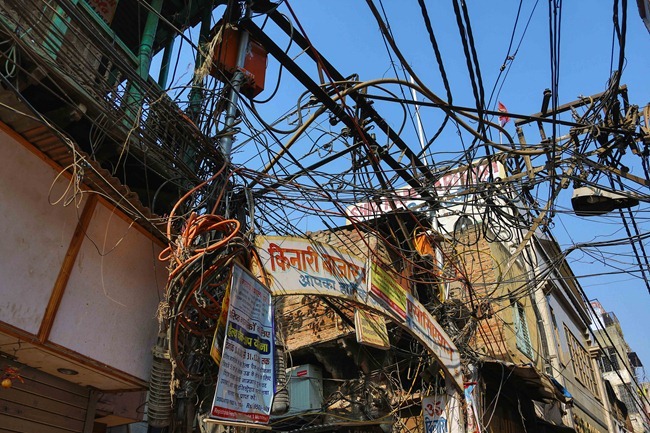
Modern capabilities (electricity, communications, internet and everything else in between) strewn across the street in chaos. The word I would use is “chaotic”.
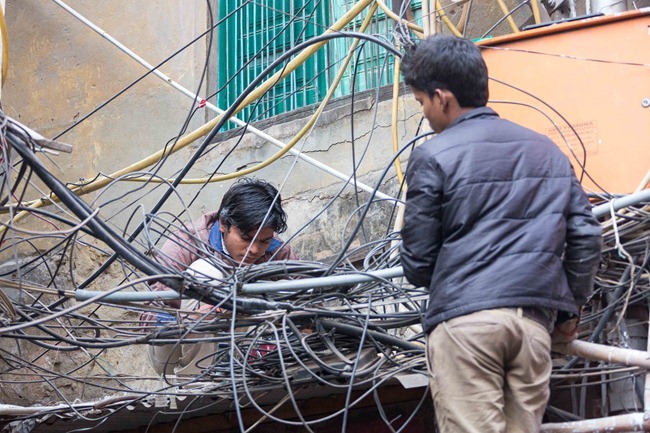
How these two guys make heads or tails of the wiring is beyond me?
Tokyo is a busy city. Everywhere is always busy. Despite being busy, it always feels orderly and most of the time – the crowds are not overwhelming.
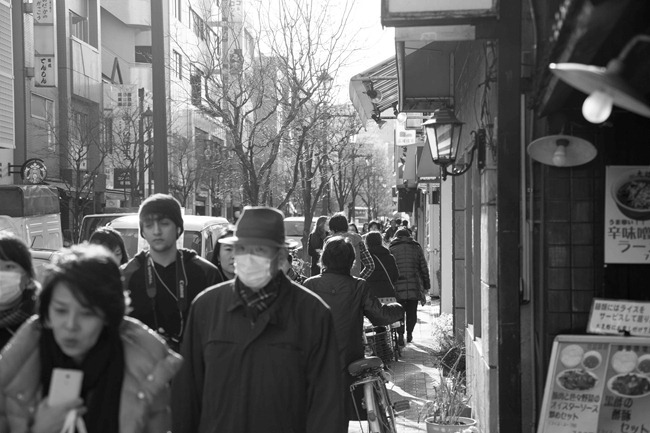
But one thing is for sure. The crowds are always there – it goes hand in hand with a population of 40 million. At times, those crowds are inexplicable to a foreigner. The popcorn stand being one of those ‘scratch my head’ examples.
I have found another in Hiroo. This line was a couple hundred meters long – which I estimate as a two hour wait (minimum – it was not moving fast).

Why? Three guesses.
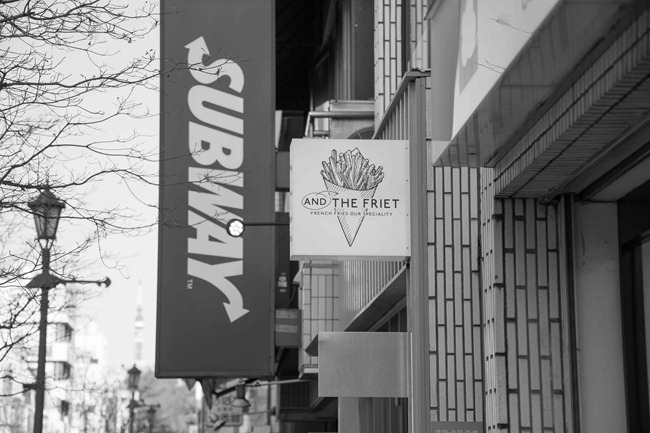
“AND THE FRIET”
Yes. A tiny little French fry shop. Seriously.
We spent Christmas Eve afternoon in Old Delhi around the markets. I could have taken 1,000 more photos like these as everywhere you turned a man or woman was performing a feat of strength to get their goods moved from A to B. Config: Canon 5D Mark III, Canon 28-300mm f/3.5 USM.
A few of my favorites. The first is the only in color – flowers presented for sale, draped across a parked motorbike.

In the Old Delhi markets there were lots of people carry their wares. Those markets are truly “human powered”. As we walked and observed, one of the most common modes of good transportation was via the head – with some carry more than others.


There were more than a few executing a tricky head balance.


Many worked as teams – balancing the load.


Look closely at the load in the back (how did they decide who gets to sit and who has to work?)

Some had long loads.

Some had big loads. What is all of that paper for? To feed the infamous India bureaucracy?


A lucky few had something other than their own hands and legs to power their cart.

These shots are from a couple hours in the markets, are a small subset of the shots available and represent the essence of what a trip to India entails. Everywhere you look you see a unique scene.
That is what this shot cost me. Outside Bangla Sahib temple. These guys have a good gig going 🙂 Love the colors (and so did the other tourists)

Behind them this man was sharpening knives by pedaling a converted bicycle. Interesting to watch, on the back streets of Old Delhi.


I could have spent weeks shooting the streets of Delhi and never lost interest.
A trip to India in December is tricky. The weather is perfect (14-20C) for touring but it can be very, very foggy. Anu (our guide) mentioned a number of times how lucky we were as he has taken groups to sites like the Taj Mahal and been disappointed as the fog can be unpredictable.
We did not stop for parliament, except to take a few shots .. a light fog and all.


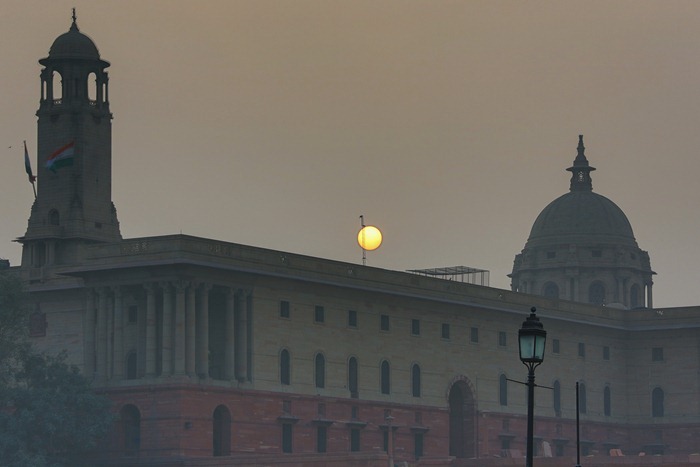
I am not sure about this shot. Love the sun over parliament, but perhaps the buildings are too dark. It was quite foggy.

If I had more time, I would spend more time on this shot in Lightroom.
We reaffirmed the value of a private guide while in India. For us, with our sons, a private guide provides two important benefits – the ability to dialogue with the family, explaining what we are seeing and flexibility.
Flexibility would be key as we constantly changed our itinerary as we travelled. It also meant that we could ask to get off the beaten path. We did not want a tour filled with all of the monster sites, we wanted to get into the side streets – to see the real India.
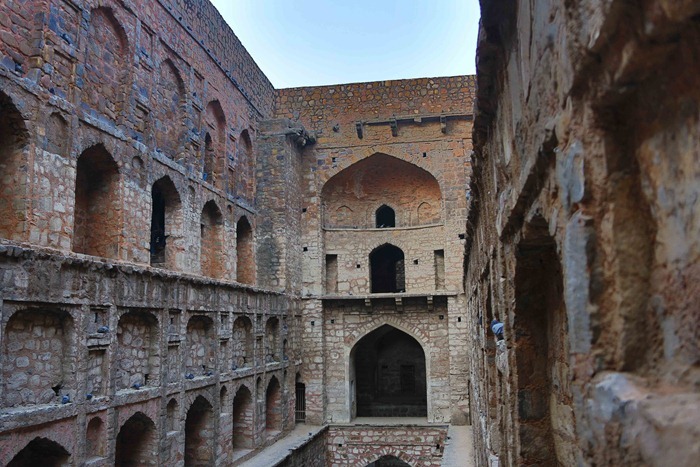
A great example of this was our first ‘side trip’ to Agrasen Ki Baoli (Or Ugrasen Ki Bali according to the plaque at the entrance), a step well in the city. Hidden down a side street and easily accessible as it was the dry season. It is a marvel to see.

From Wikipedia:
Agrasen ki Baoli (also known as Agar Sain ki Baoli or Ugrasen ki Baoli), designated a protected monument by theArcheological Survey of India (ASI) under the Ancient Monuments and Archeological Sites and Remains Act of 1958, is a 60-meter long and 15-meter wide historical step well on Hailey Road near Connaught Place, a short walk from Jantar Mantar inNew Delhi, India.[1] Although there are no known historical records to prove who built Agrasen ki Baoli, it is believed that it was originally built by the legendary king Agrasen[2] during the Mahabharat epic era[3][4][5] and rebuilt in the 14th century by the Agrawal community which traces its origin to Maharaja Agrasen.
Our guide was unbelievable and if you are in India – I cannot recommend him highly enough. A lifelong learner with great pride in his craft, Anu had 3 degrees and is studying to become a judge, with this work funding his studies. His insight into each place, attentiveness to our family, never ending knowledge and willingness to engage on every aspect of Indian history, politics and culture made it an extra special experience. To say that his the best tour guide we have ever had would be an understatement. I offer up his email to fellow travellers – anuragmisra@rediffmail.com – if you are lucky enough to get him.
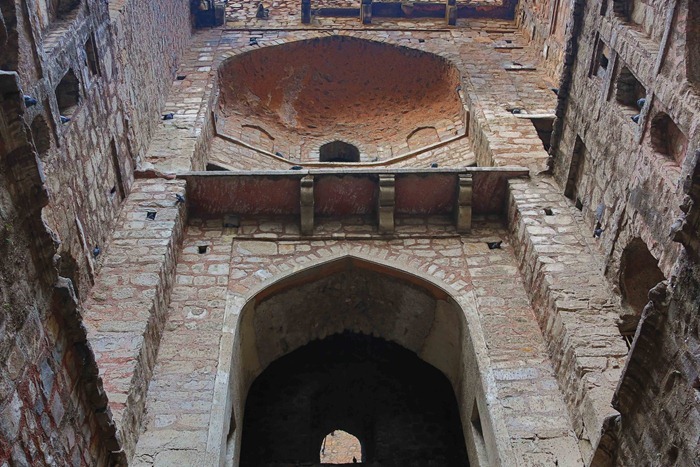
Inside the well.

At the bottom you climb through a small hole and can look up a huge cylinder .. dry for now.
Remarkable to see how well their architecture has stood the test of time.
We would see one more step well on our tour. One much larger.
Right up until the day we left for India, there was a lot of debate around going. With all of the negative press (and shocking tourist attack right after we left), we had our reservations. We spoke about cancelling many times. Was it dangerous? Was our time there too long? Would the driving from city to city be too much? I would say that of all of the places that we have travelled, this trip was the one that was most debated. We almost cancelled several times and last minute I completely changed the itinerary – shortening it by a few days.
As our guide said “India is not for the first time traveller. Most of the people who come here have been to many places before they venture to our country”.
Well said and good advice because it is not for the unadventurous or first time traveler. While I am sure there are bus tours which put you in a cocoon, India is what I would describe as “full on”. We spent 9 days there and after the trip we left enlightened, amazed and exhausted.

To be clear, we were also cautious and had a few uncomfortable moments. I happened across this post and could not help but shudder at how this woman is tempting fate (I hope her parents read it and talk some sense into her). Would you walk down a dark alley in Toronto in the middle of the night alone as a woman? Of course not. Same goes for India. We recognized that we stood out in the crowd and with the help of our amazing guide, were smart about it.
It also turned out to be the perfect opportunity to shoot my new lens. The 28-300mm proved it’s value by being able to shoot while in the van or while walking, with huge range.


And lets just say, we spent a lot of time in the van as we moved from city to city. India’s lack of infrastructure coupled with a huge population does not make for speedy movement.


Our trip took us from Delhi to Agra to Jaipur and then back to Delhi over 9 days – the Golden Triangle. Over those days we would see many things; beautiful monuments, spectacular architecture, wealth, shocking poverty, back streets, main streets, road side markets and everything in between.

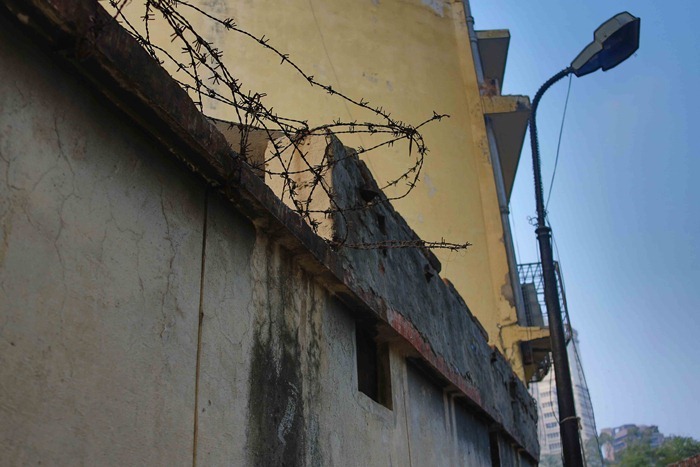
Trip of a lifetime.
If you are in Ho Chi Minh, highly suggest calling up Saigon Street Eats and taking a tour. We took a night tour down the crowded side streets (sorry, didn’t do the scooter tour). Amazing to sit and eat fresh seafood in the midst of the chaos. (Config: Canon 5D Mark III with a Canon 28-70mm – should have brought my 50mm!)
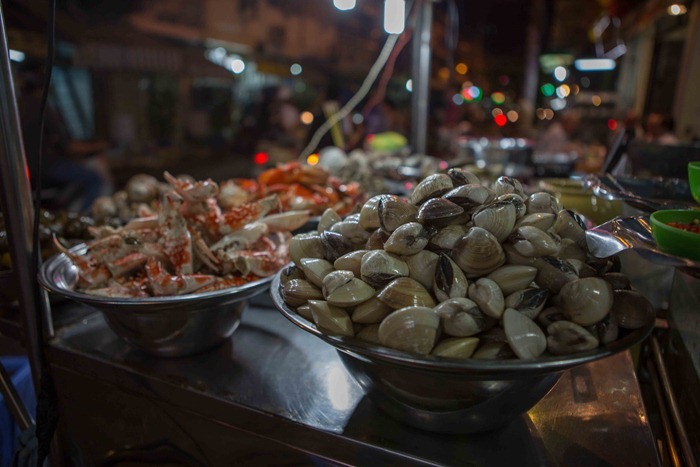

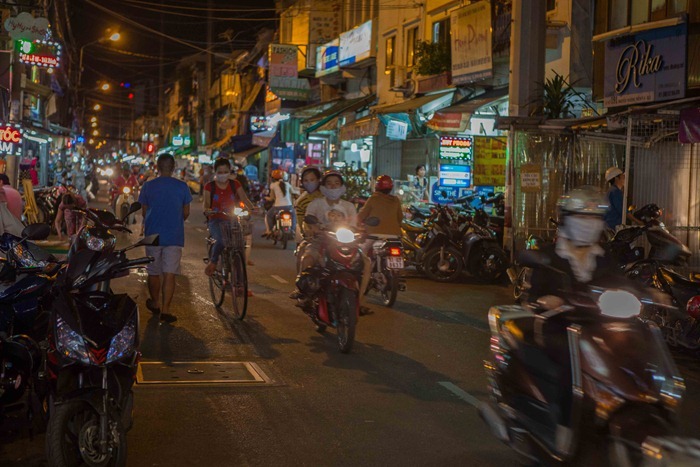

The seafood was amazing. Crab, mussels, shrimp. Awesome.


Also enjoyed that it was a rather chaotic eating experience. Plates, piled on plates.

Wasn’t a big fan of the frog.

The conch on the other hand … amazing.

A five star outing and a must do if in the city – in fact, I would say the highlight of the city.
A few more shots from around the Mekong Delta, Vietnam (Config: Canon 5D Mark III, Canon 28-70mm).
We spent time wandering around an island market … where the fresh fruit is abundant.


Even the durian (smile). Seriously, every traveler must try it at least once.

A flower along the river.

This woman was making taffy. Coconut taffy. It was amazing when eaten fresh.

To get back to our boat, we took a taxi through a back canal.


Vietnam is a beautiful country.
According to the latest indexes, the drop in the Yen means that Tokyo has gone from most expensive place in the world (when we first moved here) to number 13 .. not even in the top 10!
It sure does not feel that way (100 yen is roughly $1).
An expensive pancake (Y280)

2 pieces of fruit (individually wrapped for your pleasure).
12 slices of bread.
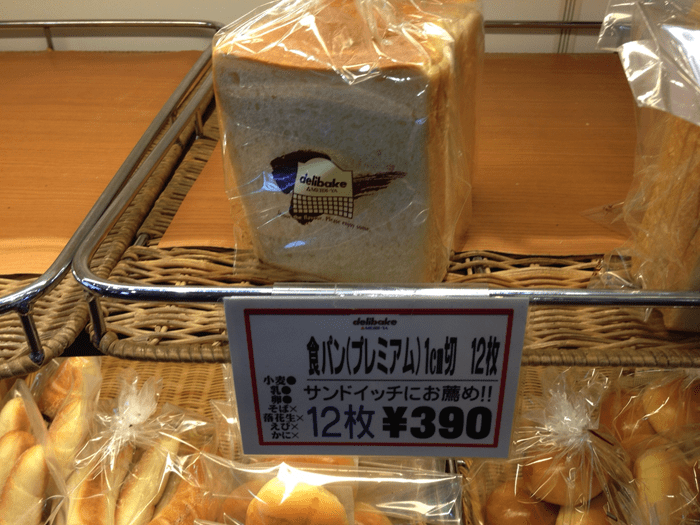
I think these prices are the reason why Japanese stay so thin.
On a dusty road, on a small mountain in Cambodia, a family tends their market. The children looking on.

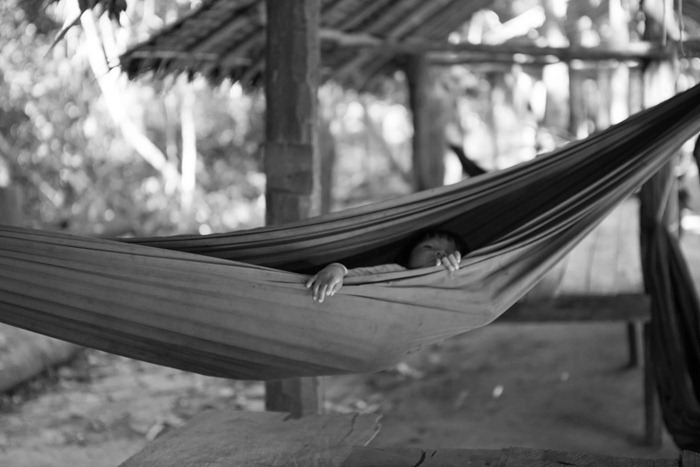

When we drove back a few hours later they were gone. Their village was a few hundred meters into the jungle. Perhaps off to enjoy the afternoon like these children.

A simpler life.
Now that I have gotten my political commentary out of the system, on to the city itself. As I mentioned in the previous post – Ho Chi Minh city is mad with scooters. Millions of people scooting around, honking, ducking, weaving and generally jamming up as a group.
Our first stop in Ho Chi Minh was the markets, our opportunity to see the hustle and bustle of the city.

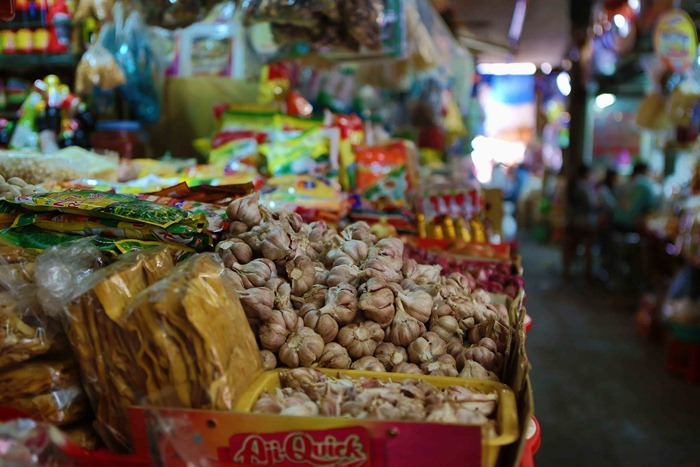
In this long hall were long butcher tables. We had missed the morning rush where the butchers line up to carve and hand out cuts to the morning shoppers.


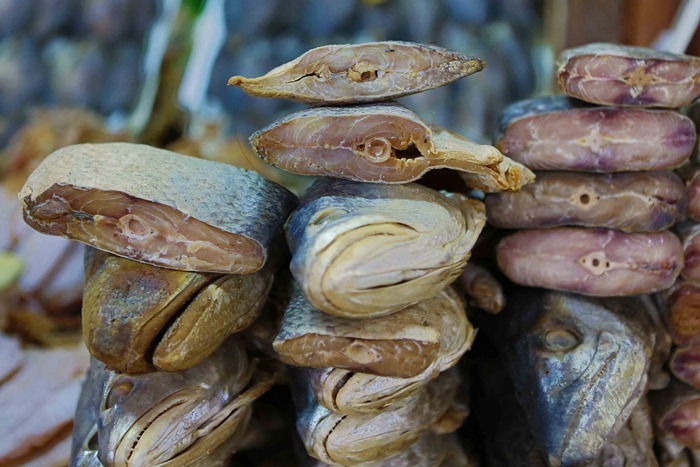
I turned and was face to face with a lot of dried fish.
One day I would love to live in one of these countries. To walk a market and be able to get the freshest of fresh, to experience the different vegetables and eat local would be amazing. We walked the market tasting with our guide explaining what we were eating.


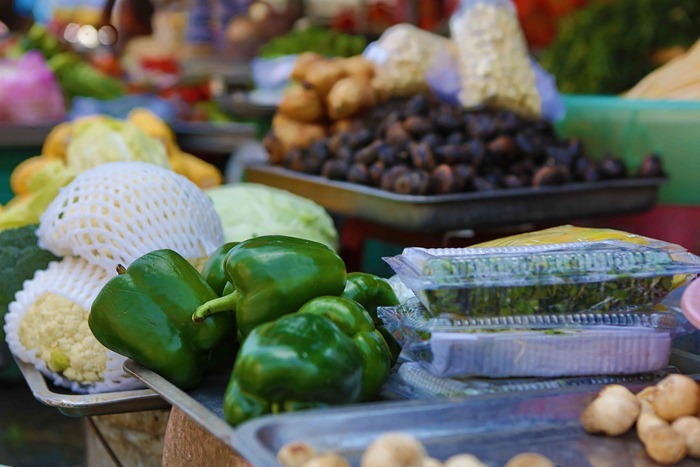
The colors are so vibrant and the textures so different. The benefit of straight from the field (or jungle)
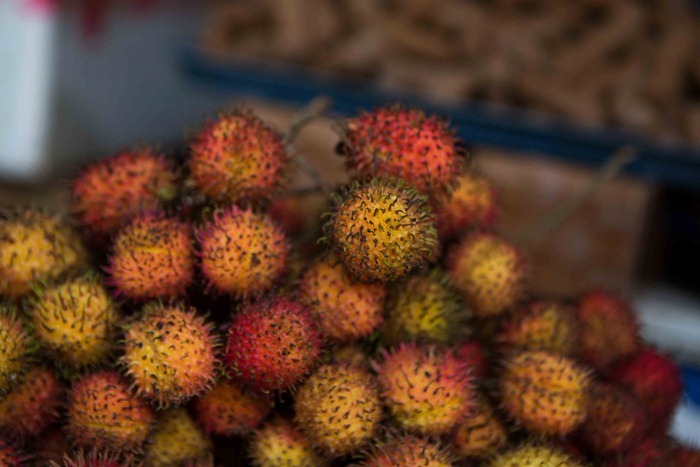
This fruit (cannot remember the name) wins my exotic fruit of the day award. Looks like a grape, sweet with a furry outside.
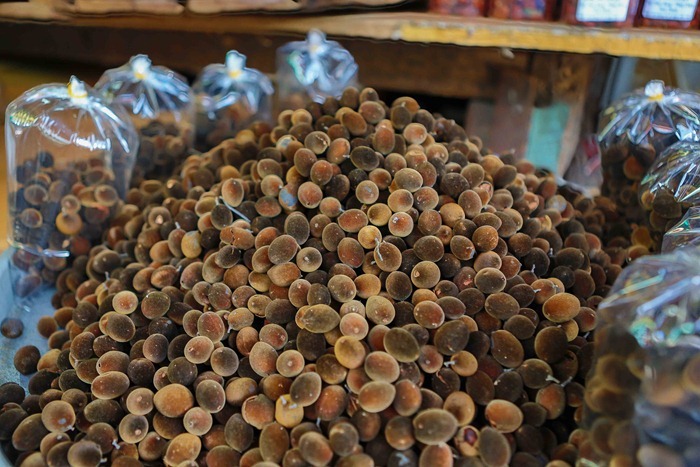
All through the markets were vendors sitting on the walk, selling their wares. We were careful to not linger in front of customers who were actually buying.
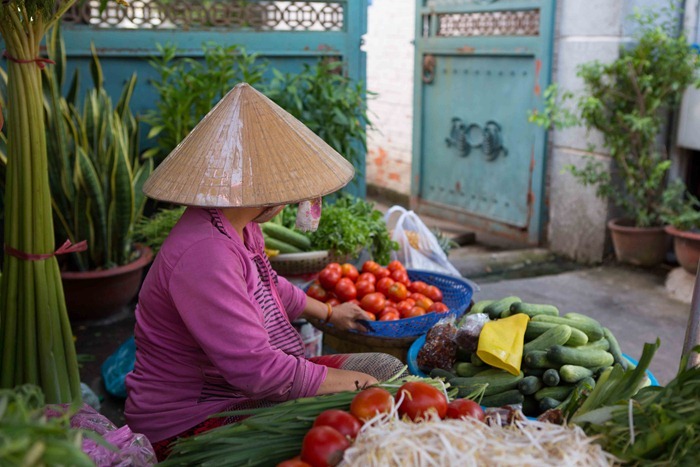
The spices of the market. You can buy a lot of spices for very little money.

The markets were very busy.

The markets were also filled with fish. Lots of fish.
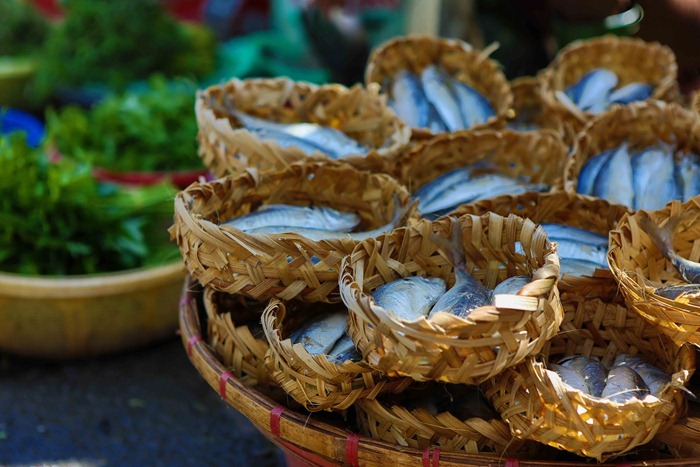
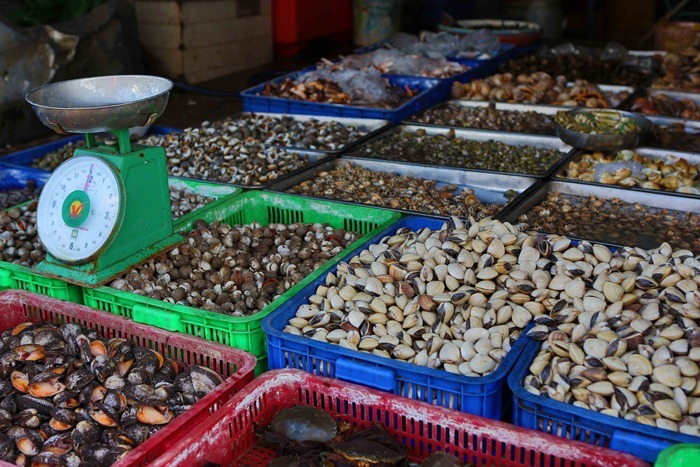
And lots of squid.

And always remember, when walking take the time to look up.
 \
\
If in the city, it is great to wander the markets.
One last temple in Cambodia to finish out the “big 3” of Siem Reap – Bayon, or the temple with 4 faces.


The Bayon’s most distinctive feature is the multitude of serene and massive stone faces on the many towers which jut out from the upper terrace and cluster around its central peak.[2] The temple is known also for two impressive sets ofbas-reliefs, which present an unusual combination of mythological, historical, and mundane scenes. The current main conservatory body, the Japanese Government Team for the Safeguarding of Angkor (the JSA) has described the temple as "the most striking expression of the baroque style" of Khmer architecture, as contrasted with the classical style ofAngkor Wat.[3]
A few shots from around the temple. The faces of Buddha faced each direction on every tower.


As with the other temples the walls were adorned with depictions of battles, gods and life.

An offering at the end of the hall.

So ends out time in Siem Reap. In retrospect I think the guide had it right, if you hit the 3 temples (Angkor, Bayon and Tah Prohm) you get a diverse view of the Cambodian culture.
Great experience.
Every time that I buy something (no matter how large or small) and use a credit card in Japan I get asked “1 or 2 payments”. I know this because of the hand signals that accompany the clerk speaking rapidly to me in Japanese.

I always thought this was some form of affordability thing – do I want to split my payment across two credit cards? After all, my cards might struggle with $30 of cat litter and random bits from the D2.
Turns out I was halfway right. An oddity of the Japanese credit card market is that you can take two payments at the till. The second half of the payment will be processed at a later date (15 or 30 days I was told) and you pay the credit card interest for the period (As obnoxious as in Canada – 19.99%).
Mystery explained.
As a random aside, I just ordered the Amazon Visa. Why? Unlike my AMEX, no currency transaction fees – which is a surprising 2.9%. While researching this I also found some interesting information on bank transaction fees::
An analysis by Cardhub showed that using credit cards with no currency conversion fees save consumers an average of 7.9 percent when compared to exchange rates offered at banks and 14.7 percent when compared to airport exchange services. Even if you are stuck with a card that charges the fee, you’ll still come out ahead using plastic, the survey found: You’ll save 4.9 percent on average and 11.7 percent, compared to banks and airport currency exchange services, respectively.
Those fees add up.
Our destination was a women’s collective that dries water hyacinths and weaves them into mats and other products. You can read more about the Saray collective here and how their efforts are employing 30 local women.
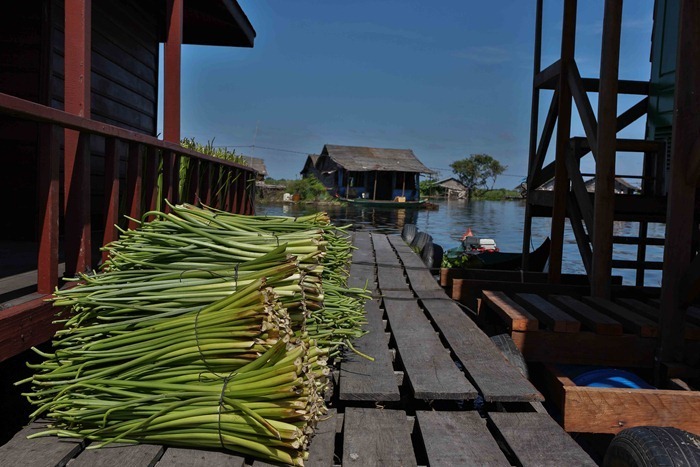
We had lunch at their local restaurant and spent time with the women, learning to weave. They are very fast.
 \
\
What I did not know is that the water hyacinth is highly invasive and quite a problem … once I learned that I started to look around and notice, it was everywhere.
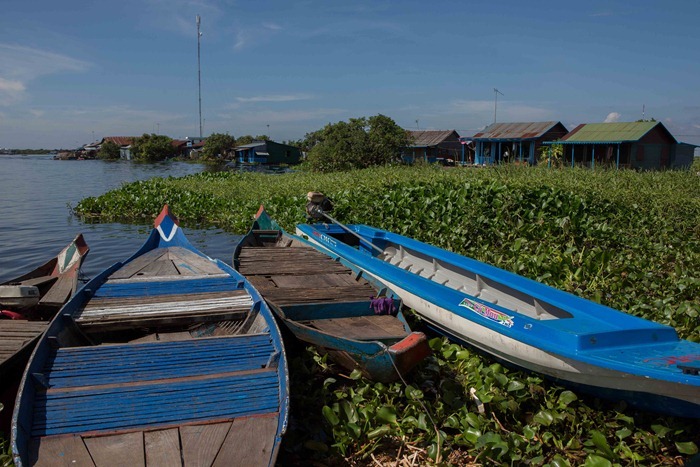
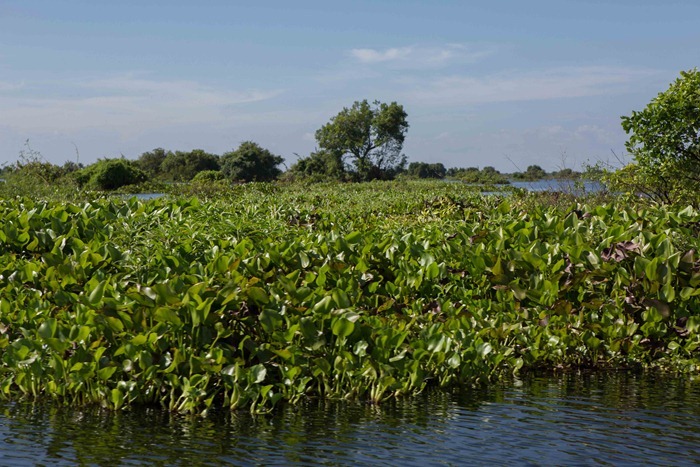
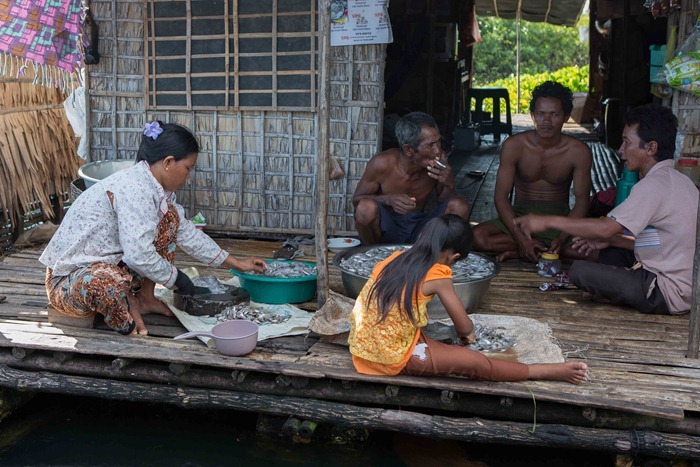
After lunch and the weaving we headed out on canoes to visit around the village. Our first stop was where they process the fish. It was amazing to see – they all worked in a cadence, the pounding of knives as they cut the fish.

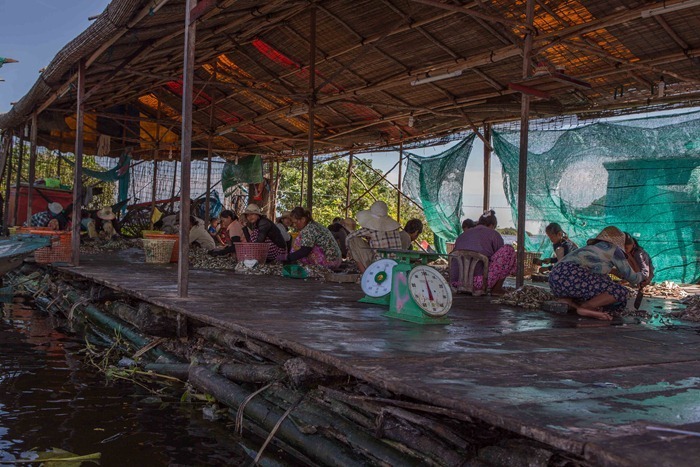

The fish on the way for processing.

As we pulled into the next stop this little fellow was happy. As soon as he saw the nurses waiting to give him his vaccine (an ambush), his demeanor changed considerably. It took a few of the women to get him to the nurses.
After a few more stops around the village we jumped back in the boat and headed home, with one last visit. Our boat captain stopped off at a home (family, friends or a business partner) to pick up a few 5 gallon drums of processed fish. We were greeted by the family dog (what is it like to be a dog who lives in a floating house?)

They processed the fish so fast. 3 knife strokes per fish.
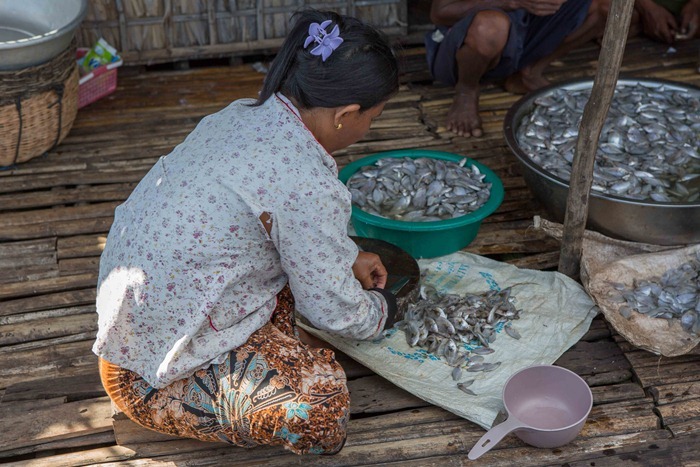
Fish loaded, we pulled away – the day complete.
A very different, insightful and educational experience. If you are in Siem Reap, highly recommended. Thanks for dropping by.
As mentioned in the previous post, the boat picked up speed and we headed to the next village. One of the first boats we saw as we entered the main village was this floating restaurant, looking for customers.
![2013 11 26 Osmose_-84[3]](https://michaelweening.com/wp-content/uploads/2014/01/2013-11-26-osmose_-843.jpg "2013 11 26 Osmose_-84[3]")
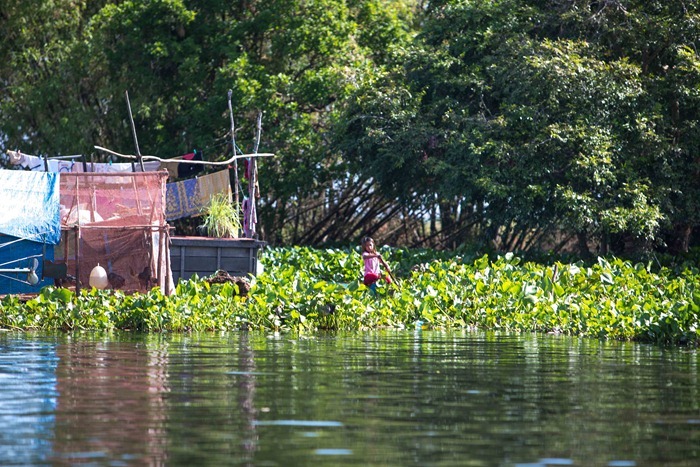
The lake will rise and fall 9-10M in a year and the people will float from location to location, following the water. It is a bit unfathomable to live your entire life .. floating.
![2013 11 26 Osmose_-87[3]](https://michaelweening.com/wp-content/uploads/2014/01/2013-11-26-osmose_-873.jpg "2013 11 26 Osmose_-87[3]")
Moored into the trees or to each other, the homes at mid/high-tide. At low tide, those trees will be 20m high.
![2013 11 26 Osmose_-89[3]](https://michaelweening.com/wp-content/uploads/2014/01/2013-11-26-osmose_-893.jpg "2013 11 26 Osmose_-89[3]")
![2013 11 26 Village tour_-4[3]](https://michaelweening.com/wp-content/uploads/2014/01/2013-11-26-village-tour_-43.jpg "2013 11 26 Village tour_-4[3]")
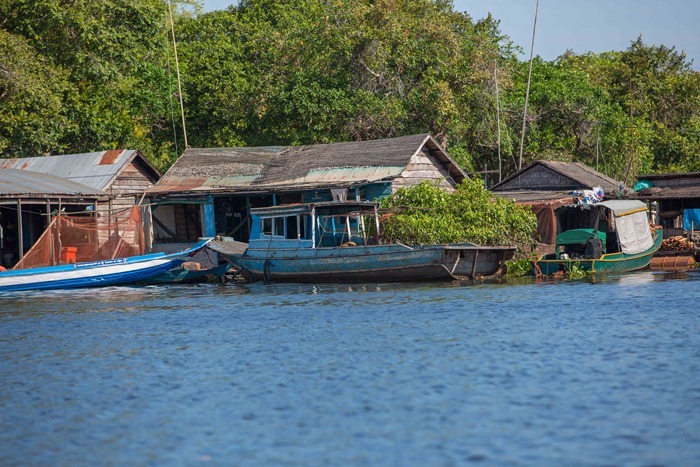
The village delivery system … gas, fruit, you name it.
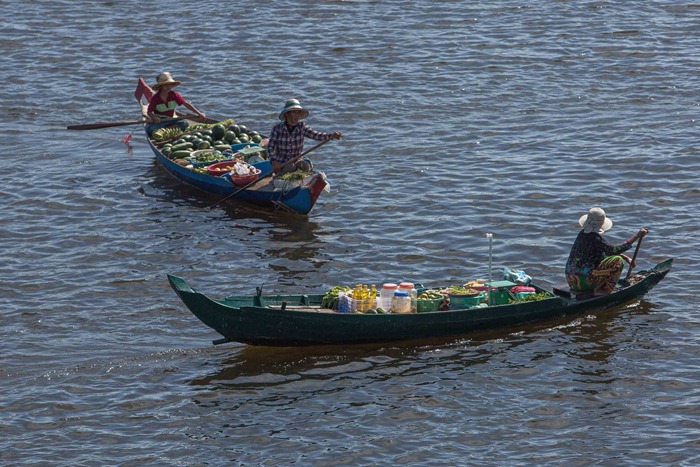
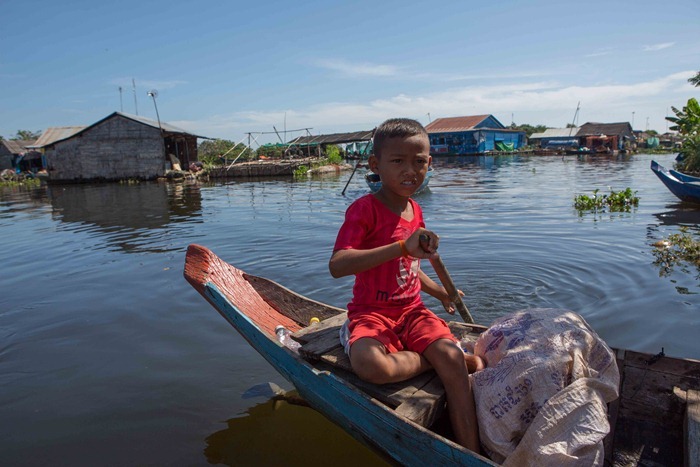
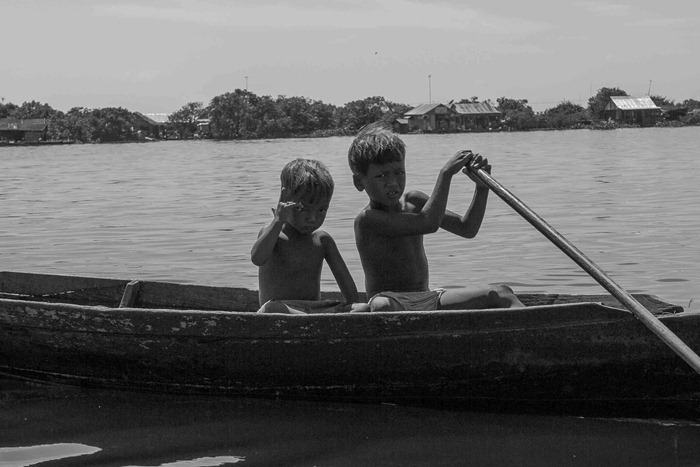
Everyone drives a boat. No matter how old.
Some boats with motors.
![2013 11 26 Osmose_-98[3]](https://michaelweening.com/wp-content/uploads/2014/01/2013-11-26-osmose_-983.jpg "2013 11 26 Osmose_-98[3]")
Many boats with only a paddle.

Of course, there is a phone store.

A completely different way of life. Thanks for dropping by.
(Updated as I accidentally merged two posts)
I am so glad we visited this site. It would have been a huge miss had we not.

I am a big fan of TripAdvisor as it helps you understand what is really available in a city or country – especially if you want to get a little bit off the beaten path. Reading the reviews there were more than a few people who said this is a must see, filled with old Russian and a few American remnants from a terrible period in Cambodia’s history.

Everything is open to explore. Feel free to climb on, in and around them to see these decades old remnants.
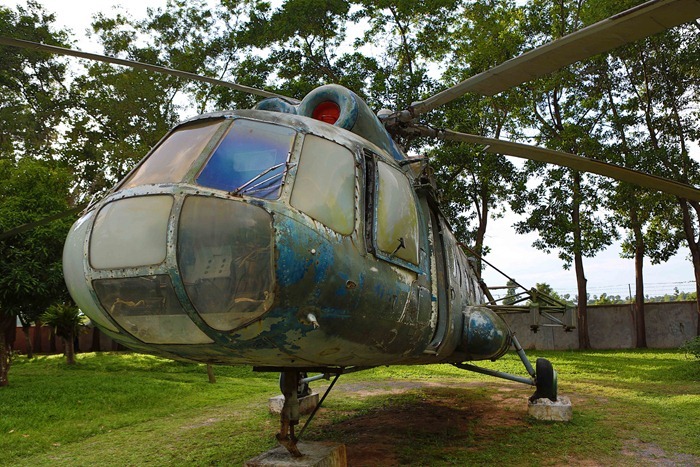

Our guide was a war veteran and his tale is heartbreaking – and worth telling here for others to read.
If you have read about Pol Pot and the Khmer reign of terror you will know that millions died. Pol Pot killed anyone with an education and engaged in a mad scheme to return Cambodia to an agrarian lifestyle with the goal of eliminating Cambodia’s dependence on foreign powers who had occupied, pillaged and generally mistreated the country. Entire cities like Siem Reap were emptied and the men were rounded up to serve in the army.
He was such a target. At 14 he was supposed to be taken away to join. His family hid him to keep him from the Khmer army. At a check point he was asked if he was a boy or a girl and he accidentally answered boy. His father, knowing he was caught, began yelling at him for blurting out the wrong thing as the Khmer commander was notified.
His father begged to let his son stay as he was too young which infuriated the ruthless commander. In moments, they shot his father and then shot his mother and two sisters as they tried to collect the fathers body. A few others from their village were also killed when they engaged in the dispute.
At 14 he was taken by the Khmer, just not fathomable. He spent years on the front, escaped into Vietnam and then returned to Cambodia only to step on a land mine and lose his leg.
Abandoned to fend for himself, he was an outcast until an Australian came along and rescued him. They flew him out of the country, got him prosthetics and helped him mentally recover. But as he said, how do you ever recover? Listening to his story, it was just so unfathomable and during the Pol Pot, Khmer reign of terror a sadly common story. No one was left unaffected.
Hearing it first hand is shocking.
 e,
e,
Just hearing that story made the trip to this museum a must see.
Along the wall there are several buildings that house hundreds of weapons, that you can handle. Fascinating to pick up an RPG.
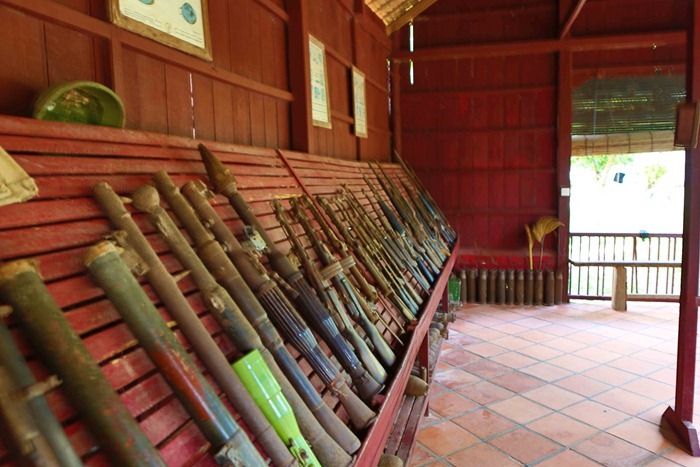

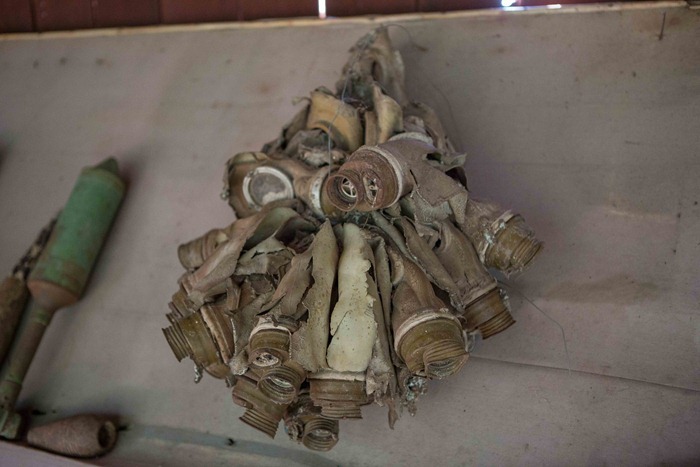


I cannot recommend it enough – a must see.
 Michael Weening: a few pictures