The fellow seems quite content.

Config: Canon 5D Mark III, Canon 28-70mm

The fellow seems quite content.
Config: Canon 5D Mark III, Canon 28-70mm
Near my office in Tokyo. Confusing.
I will take the Acmerican ones please.

I arrived early on a Sunday a few months back and went for a walk. Ended up in a little café where I had a sandwich and listened to some Jazz. I think I would enjoy living in San Francisco.


Out the window, a game of Jenga was being played.

Jenga and a few beers.


A few HDRs of the café .. could not resist (Config: Canon 5D Mark III, Canon 28-70mm)


It wasn’t the best sandwich, but the ambiance made up for it.
Now that I have gotten my political commentary out of the system, on to the city itself. As I mentioned in the previous post – Ho Chi Minh city is mad with scooters. Millions of people scooting around, honking, ducking, weaving and generally jamming up as a group.
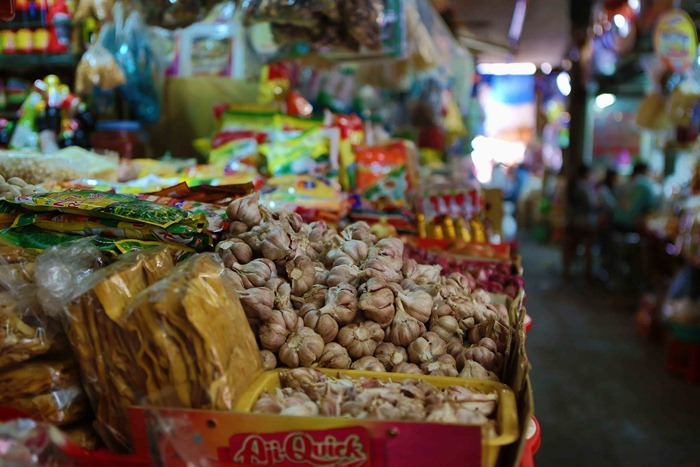
Our first stop in Ho Chi Minh was the markets, our opportunity to see the hustle and bustle of the city.

In this long hall were long butcher tables. We had missed the morning rush where the butchers line up to carve and hand out cuts to the morning shoppers.


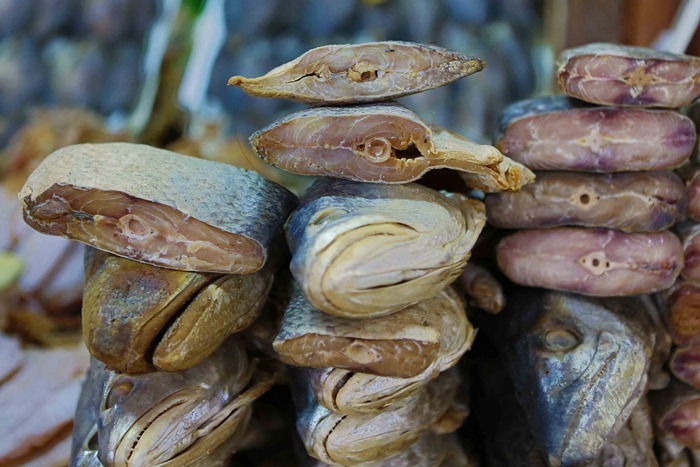
I turned and was face to face with a lot of dried fish.
One day I would love to live in one of these countries. To walk a market and be able to get the freshest of fresh, to experience the different vegetables and eat local would be amazing. We walked the market tasting with our guide explaining what we were eating.


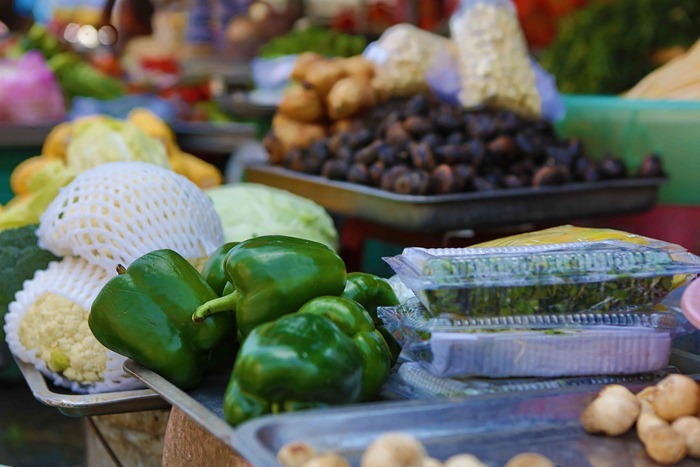
The colors are so vibrant and the textures so different. The benefit of straight from the field (or jungle)
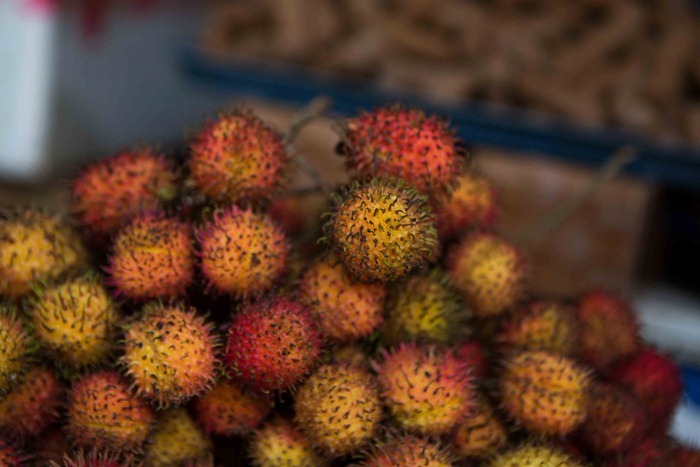
This fruit (cannot remember the name) wins my exotic fruit of the day award. Looks like a grape, sweet with a furry outside.
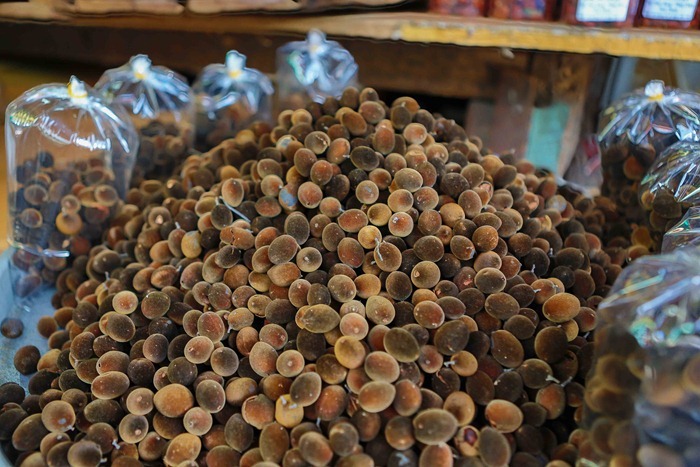
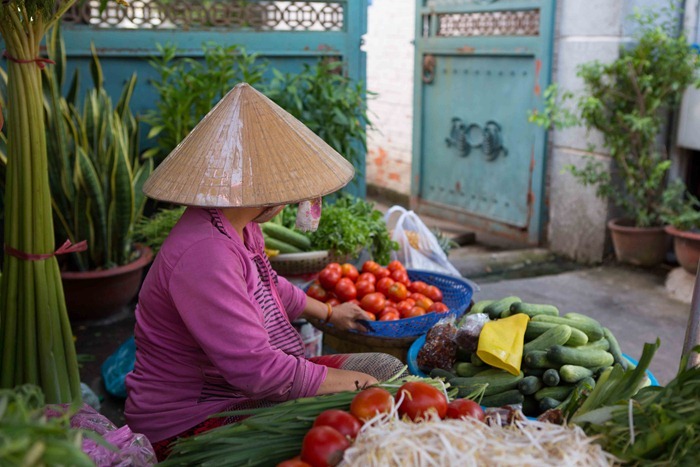
All through the markets were vendors sitting on the walk, selling their wares. We were careful to not linger in front of customers who were actually buying.
The spices of the market. You can buy a lot of spices for very little money.

The markets were very busy.

The markets were also filled with fish. Lots of fish.
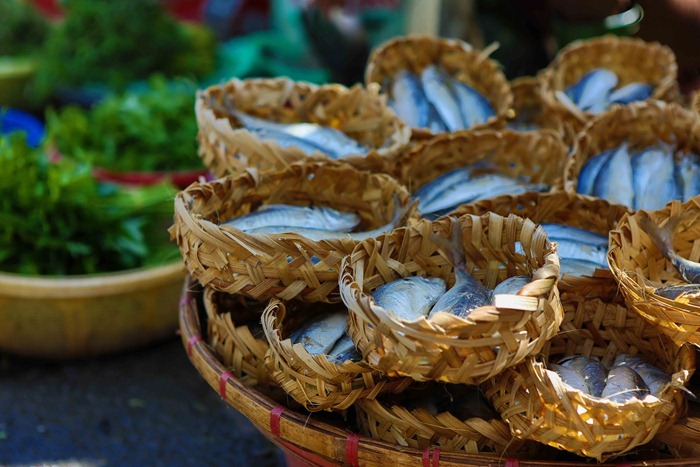
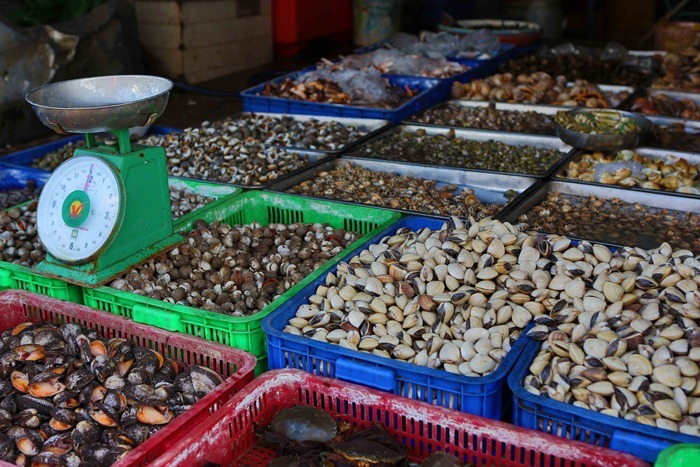
And lots of squid.

And always remember, when walking take the time to look up.
 \
\
If in the city, it is great to wander the markets.
After our tour of Siem Reap, Cambodia we headed to Ho Chi Minh city. I have always wanted to visit Vietnam and this was our first time.
I think this shot best describes the city. A large city with roughly 9M people and according to different sources, 5-6M scooters. I was warned, keep your camera on your neck because thieves on scooters love to whip by tourists and take their cameras.

Crazy. Scooters were everywhere. According to one of our guides, they put heavy taxes on cars (doubling the cost) where the price of a scooter is much more affordable for the people.
The country suffers the same ills as Cambodia – lots of corruption, no real social net to catch people and a low average income. According to this article, the average wage has “risen” to $185 per month. Ironically, it seems like Canada and many European countries are closer to the ideals of Marxism than most communist countries with regard to social balance and fairness. In these counties, it seems like it is survival of the fittest - far from the ideals of communism.
All of this starts with leadership and unfortunately, many of these country’s leaders only know the survival to grab power mentality. One guide told me that his family was forced to relocate from their multi-generational home to make way for a canal. His family was given $1200 for their home – their neighbor, the police chief, was given $10,000. Interesting observation from the BBC:
But the disparity in wealth between urban and rural Vietnam is wide and some Communist Party leaders worry that too much economic liberalization will weaken their power base.
Despite pursuing economic reform, the ruling Communist Party shows little willingness to give up its monopoly on political power.
In the end, these countries are only held back by one thing: their leaders.

To make the point, look at the Vietnam war museum in Ho Chi Minh. It is a tribute to the terrible and well known war torn history of the country. The contents of the museum were very familiar to me as I have read a lot about the Vietnamese wars. What struck me most about the museum is that it stands in stark contrast to the current political system in Vietnam – the museum is a voice of freedom in a not-so-free country.
How so? Inside the museum is a section dedicated to American photographers who stood against the war and is sponsored by a US organization from Kentucky, USA. It was also published by Random House, USA.
It is the ultimate testimony to the strength of a democracy to see such a public display of criticism not only tolerated but existing as a key part of the political system.

Now compare and contrast the political situation in Vietnam (again from the BBC):
The human rights advocacy group Amnesty International says in a 2011 report that ”more than a dozen activists were convicted in faulty trials simply because they had peacefully voiced criticism of government policies”. A new wave of subversion trials began in 2013.
Do any sites exist to criticize the Vietnam government? Apparently not. Criticize too loudly and you go to jail. I am sure that in this type of political system Jon Stewart would be behind bars.
The War Museum in Ho Chi Minh city stands as an ironic testimony to the greatness of democracy. In the US (or other solid democracy) a leader’s quest for monopolistic power is thwarted by process and the strength of a political system that empowers the people to constantly rebalance the system.
Ironic.
Make no mistake that the photos are a stark reminder of the terrible impact of war on a country that should never have happened. But in the end I left thinking that it also stands as a testimony to true democracy, strength of political process and openness; flaws and all. I say “flaws and all” because no one in the US is tearing this museum down and the political system saw those who supported the war removed, and the US pulled out – but after it happened, not before it happened.
Interesting experience.

A few final shots of the War Remnants museum.


Love when a place leaves me pondering.
One last temple in Cambodia to finish out the “big 3” of Siem Reap – Bayon, or the temple with 4 faces.


The Bayon’s most distinctive feature is the multitude of serene and massive stone faces on the many towers which jut out from the upper terrace and cluster around its central peak.[2] The temple is known also for two impressive sets ofbas-reliefs, which present an unusual combination of mythological, historical, and mundane scenes. The current main conservatory body, the Japanese Government Team for the Safeguarding of Angkor (the JSA) has described the temple as "the most striking expression of the baroque style" of Khmer architecture, as contrasted with the classical style ofAngkor Wat.[3]
A few shots from around the temple. The faces of Buddha faced each direction on every tower.


As with the other temples the walls were adorned with depictions of battles, gods and life.

An offering at the end of the hall.

So ends out time in Siem Reap. In retrospect I think the guide had it right, if you hit the 3 temples (Angkor, Bayon and Tah Prohm) you get a diverse view of the Cambodian culture.
Great experience.
Every time that I buy something (no matter how large or small) and use a credit card in Japan I get asked “1 or 2 payments”. I know this because of the hand signals that accompany the clerk speaking rapidly to me in Japanese.

I always thought this was some form of affordability thing – do I want to split my payment across two credit cards? After all, my cards might struggle with $30 of cat litter and random bits from the D2.
Turns out I was halfway right. An oddity of the Japanese credit card market is that you can take two payments at the till. The second half of the payment will be processed at a later date (15 or 30 days I was told) and you pay the credit card interest for the period (As obnoxious as in Canada – 19.99%).
Mystery explained.
As a random aside, I just ordered the Amazon Visa. Why? Unlike my AMEX, no currency transaction fees – which is a surprising 2.9%. While researching this I also found some interesting information on bank transaction fees::
An analysis by Cardhub showed that using credit cards with no currency conversion fees save consumers an average of 7.9 percent when compared to exchange rates offered at banks and 14.7 percent when compared to airport exchange services. Even if you are stuck with a card that charges the fee, you’ll still come out ahead using plastic, the survey found: You’ll save 4.9 percent on average and 11.7 percent, compared to banks and airport currency exchange services, respectively.
Those fees add up.
I have pontificated on how safe, clean and orderly Japan is many times. It is unlike anywhere in the world.
Over the holiday we lost an iPhone on Thai Airways. We were in Bangkok and as we went to fly out we stopped at lost and found to find out if it was turned in. The answer was a no. Therefore one of the cleaning staff or attendants found it (as a fellow passenger would not have seen it) and decided to keep it .. in other words, steal it.
Unfortunately, this is no different than many airlines around the world. It still bugs me 8 years later when I walked off a plane and was not allowed to go back on the Air Canada flight, leaving behind a bottle of Scotch that I had picked up for my father-in-law in England. It “disappeared”.
I would wager with 95% confidence that had we lost that iPhone on a ANA flight the staff would have turned it in and we would be using it right now.
Like nowhere else in the world.
I am sure that if you are reading this and have lived in Japan, that you could share a similar experience.
The New Yorker article Goodbye, Camera is a thought provoking article suggesting that the era of the networked device will displace the need for a camera:
One of the great joys of that walk was the ability to immediately share with family and friends the images as they were captured in the mountains: the golden, early-morning light as it filtered through the cedar forest; a sudden valley vista after a long, upward climb. Each time, I pulled out my iPhone, not the GX1, then shot, edited, and broadcasted the photo within minutes. As I’ve become a more network-focused photographer, I’ve come to love using the smartphone as an editing surface; touch is perfect for photo manipulation. There’s a tactility that is lost when you edit with a mouse on a desktop computer. Perhaps touch feels natural because it’s a return to the chemical-filled days of manually poking and massaging liquid and paper to form an image I had seen in my head. Yet if the advent of digital photography compressed the core processes of the medium, smartphones further squish the full spectrum of photographic storytelling: capture, edit, collate, share, and respond. I saw more and shot more, and returned from the forest with a record of both the small details—light and texture and snippets of life—and the conversations that floated around them on my social networks.
Reading through this quote I was left with a question – is the networked device destroying the camera .. or is it destroying the moment? He spent his time slogging through the mountains, shooting his photos, editing, instagramming and texting instead of .. enjoying the mountain path and the moment. I can just see him doing what I see so often in beautiful travel destinations .. this fellow tripping along, distracted, glancing up from his phone while he types and Facebooks … Seen it 100 times.
Does it enhance the moment? Personally, I don’t think so.
When I am shooting with a camera I am in the moment, observing, enjoying – not thinking about who I am going to share the picture with. That doesn’t mean there isn’t a time for the camera phone, but for me there will always be a time for a camera.
It would be interesting to hear what others think.
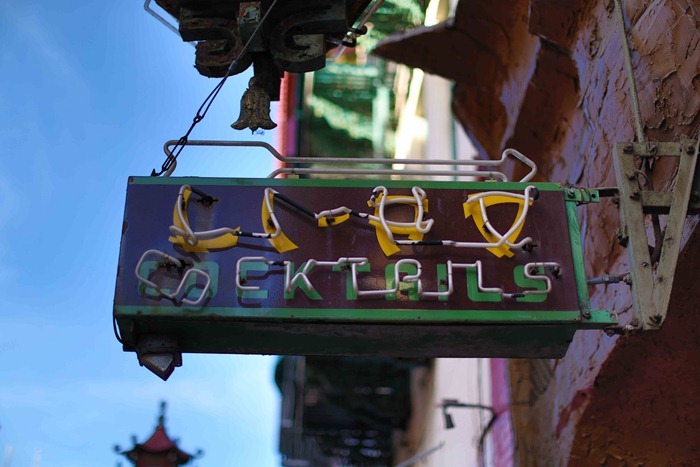
(San Francisco, China Town)
I spent months trying to decide if I was going to buy this lens.
When I first learned about the lens it struck me as perfect for travel; 28mm for that wide shot to 300mm for the close-up. Not having to switch between my 28-70mm and my 70-200mm was very appealing.
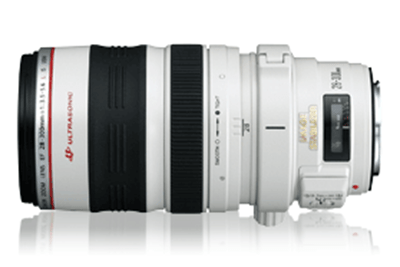
The problem is that the reviews of the Canon 28-300mm f/3.5-5.6 IS USM left me confused. I read every other review I could get my eyes on; you can read a few of my favorite reviews here, here, here and here by professionals who are much more qualified than myself.
In the end, it seemed to come down to 2 things:
Pro: Versatile lengths
Con: Super heavy.
I emailed one expert and he said “versatile lens but you don’t need it, too heavy, try the Tamron”. The problem with the Tamron? I have been disappointed with non-Canon lens before (50mm).
After months of thinking about it .. I decided to make the purchase. I picked it up prior to our trip to India and after a few weeks of heavy use, I present this amateur’s review (Spoiler alert: best lens I have ever bought):
Cons:
Pros:
I love this lens.
I will never travel without this lens in the future and probably leave all of the other lenses behind; selling off my Canon 28-70mm f/2.8 USM. The quality is superb.
All of the aforementioned cons are massively outweighed by the convenience. I will keep the 28-70mm for around the house, but other than that – it will be this lens.
A convenience example: Below is a wide 28mm shot …. (note the black specks above the arch at the Taj Mahal entrance – those are parrots)
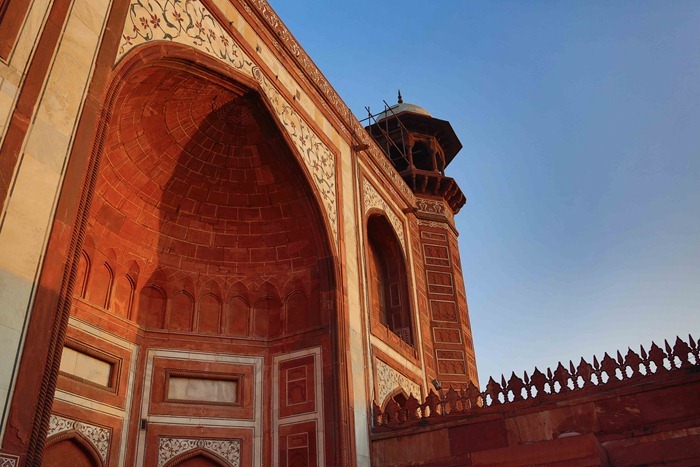
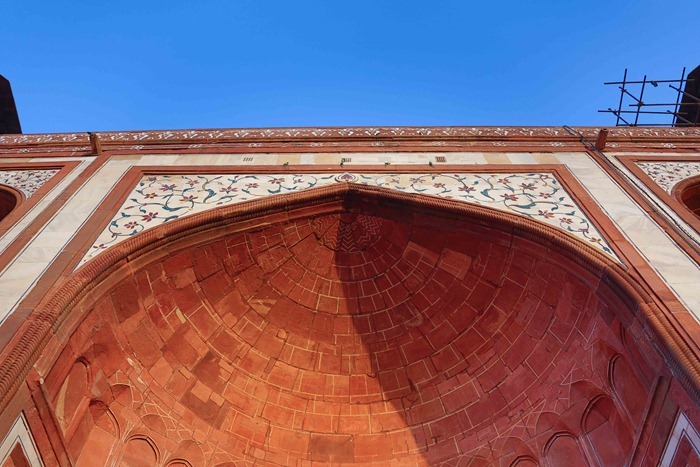
My next shot was a zoom in to snap the parrots in flight. Amazing.

In the end, best lens purchase I have ever made and worth every penny.
Just make sure you change your strap (The under-the-arm 2nd strap for the BlackRapid Sport makes all the difference). I also stopped carrying my camera backpack. Instead I ended up putting a filter, extra battery, a few cards and a lens wipe in a small Tumi bag with my wallet.

Without my backpack, this is actually lighter.
Our destination was a women’s collective that dries water hyacinths and weaves them into mats and other products. You can read more about the Saray collective here and how their efforts are employing 30 local women.
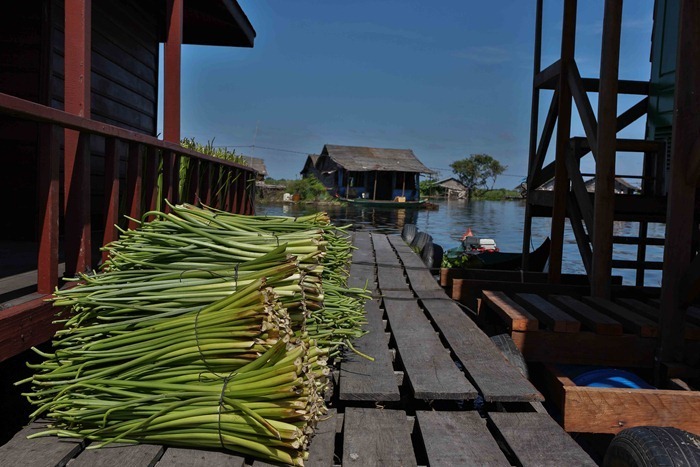
We had lunch at their local restaurant and spent time with the women, learning to weave. They are very fast.
 \
\
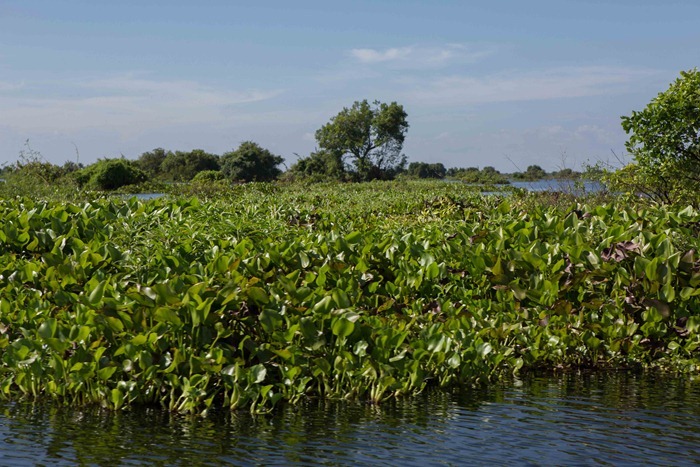
What I did not know is that the water hyacinth is highly invasive and quite a problem … once I learned that I started to look around and notice, it was everywhere.
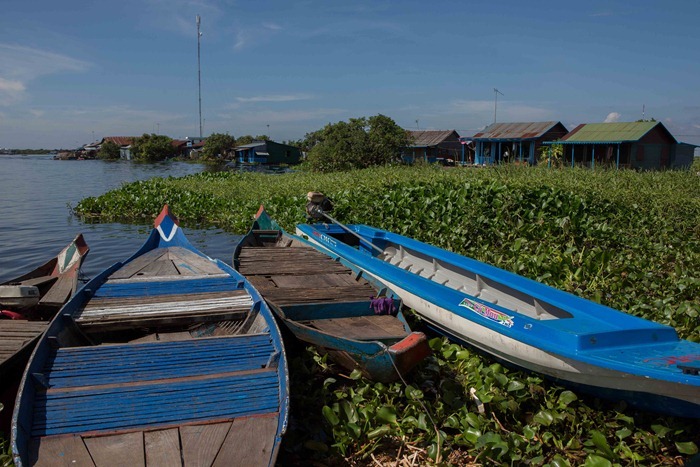
After lunch and the weaving we headed out on canoes to visit around the village. Our first stop was where they process the fish. It was amazing to see – they all worked in a cadence, the pounding of knives as they cut the fish.

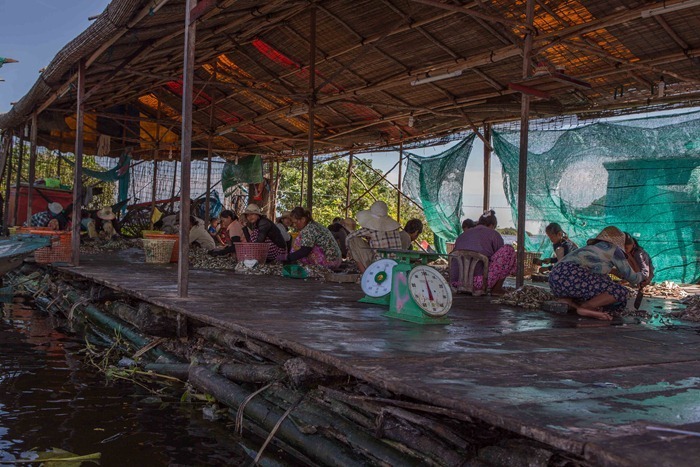

The fish on the way for processing.

As we pulled into the next stop this little fellow was happy. As soon as he saw the nurses waiting to give him his vaccine (an ambush), his demeanor changed considerably. It took a few of the women to get him to the nurses.
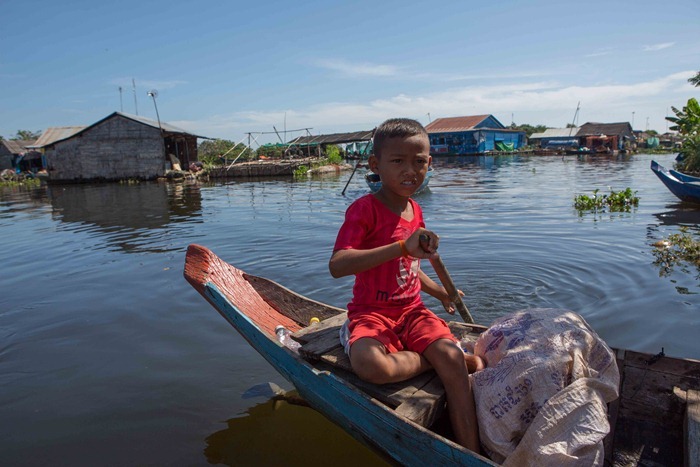
After a few more stops around the village we jumped back in the boat and headed home, with one last visit. Our boat captain stopped off at a home (family, friends or a business partner) to pick up a few 5 gallon drums of processed fish. We were greeted by the family dog (what is it like to be a dog who lives in a floating house?)

They processed the fish so fast. 3 knife strokes per fish.
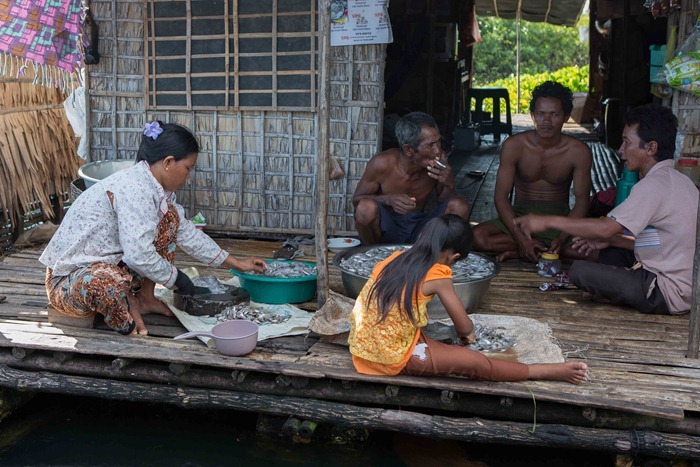
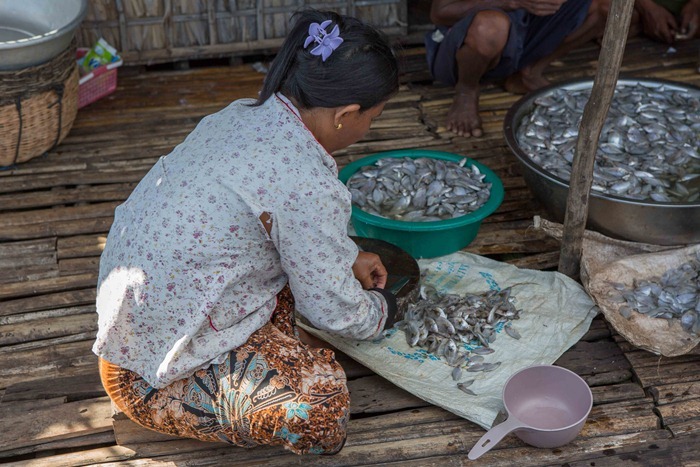
Fish loaded, we pulled away – the day complete.
A very different, insightful and educational experience. If you are in Siem Reap, highly recommended. Thanks for dropping by.
As mentioned in the previous post, the boat picked up speed and we headed to the next village. One of the first boats we saw as we entered the main village was this floating restaurant, looking for customers.
![2013 11 26 Osmose_-84[3]](https://michaelweening.com/wp-content/uploads/2014/01/2013-11-26-osmose_-843.jpg "2013 11 26 Osmose_-84[3]")
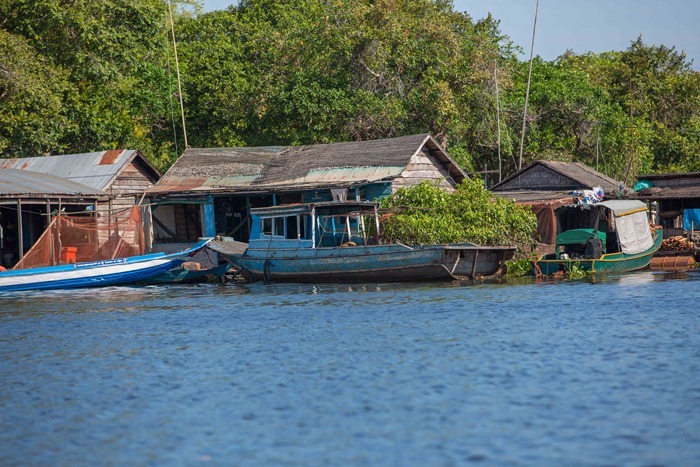
The lake will rise and fall 9-10M in a year and the people will float from location to location, following the water. It is a bit unfathomable to live your entire life .. floating.
![2013 11 26 Osmose_-87[3]](https://michaelweening.com/wp-content/uploads/2014/01/2013-11-26-osmose_-873.jpg "2013 11 26 Osmose_-87[3]")
Moored into the trees or to each other, the homes at mid/high-tide. At low tide, those trees will be 20m high.
![2013 11 26 Osmose_-89[3]](https://michaelweening.com/wp-content/uploads/2014/01/2013-11-26-osmose_-893.jpg "2013 11 26 Osmose_-89[3]")
![2013 11 26 Village tour_-4[3]](https://michaelweening.com/wp-content/uploads/2014/01/2013-11-26-village-tour_-43.jpg "2013 11 26 Village tour_-4[3]")
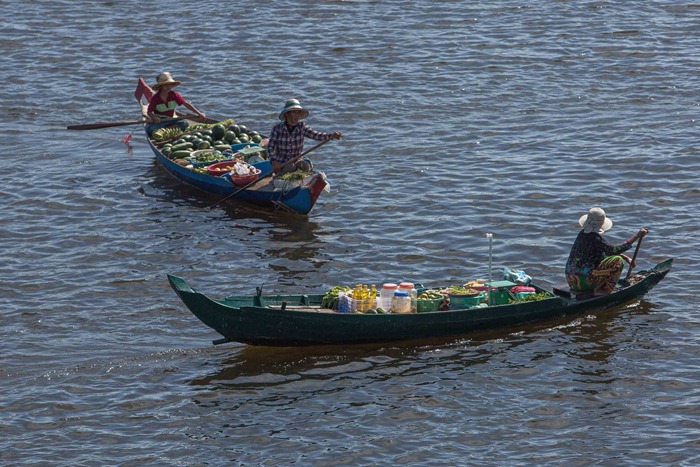
The village delivery system … gas, fruit, you name it.
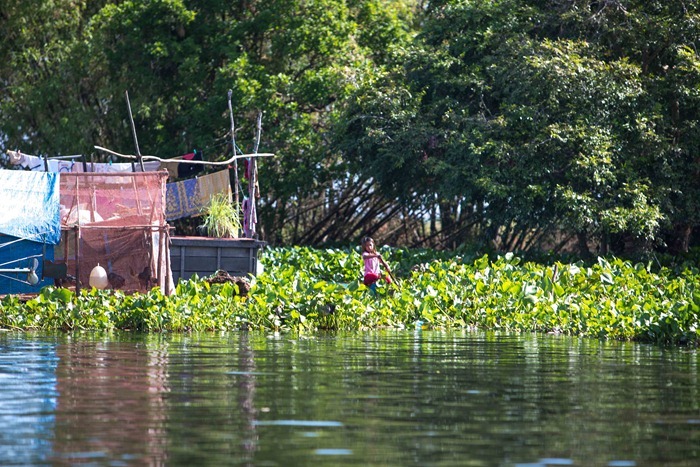
Everyone drives a boat. No matter how old.

Some boats with motors.
![2013 11 26 Osmose_-98[3]](https://michaelweening.com/wp-content/uploads/2014/01/2013-11-26-osmose_-983.jpg "2013 11 26 Osmose_-98[3]")
Many boats with only a paddle.

Of course, there is a phone store.

A completely different way of life. Thanks for dropping by.
So this weekend I thought to take the family to catch the new Hobbit flick in Tokyo. To my surprise, it is not here.
A quick look on the interweb found the opening dates of the Hobbit across the world. It is EVERYWHERE in December except for ….. Japan. Latvia .. Columbia … Estonia … United Arab Emirates .. Egypt .. no problem.
Japan? No. It opens here a few weeks before the DVD comes out. Why? No idea.

Our second day in Siem Reap involved a tour with Osmose eco-tours to a floating village. I love doing eco-tours, and this one is about seeing how the lake feeds an ecosystem of plants, animals and people.
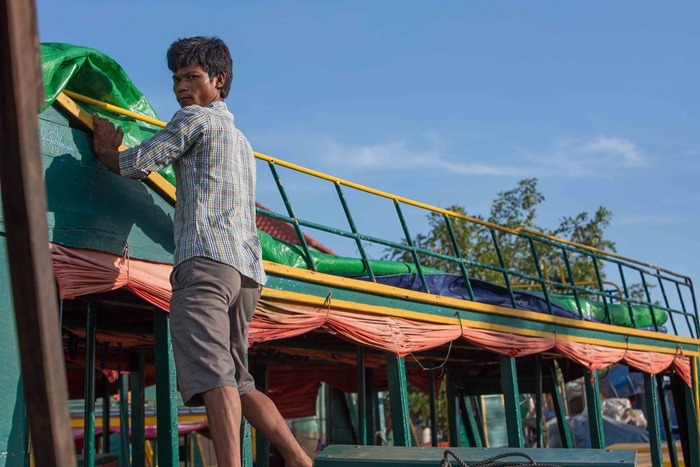
The trip began on a boat like this.
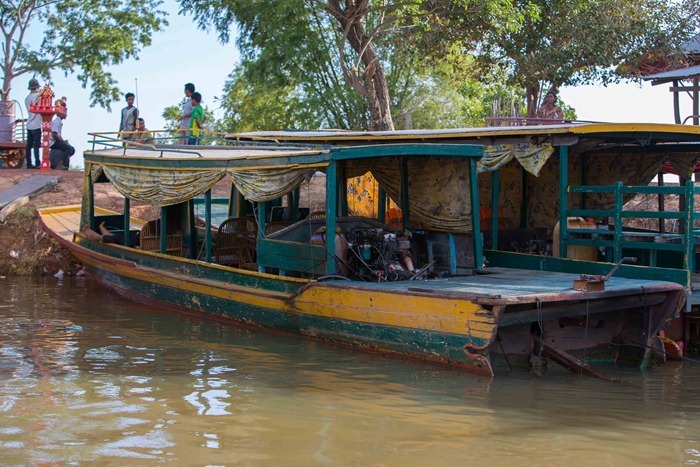
Our captain.
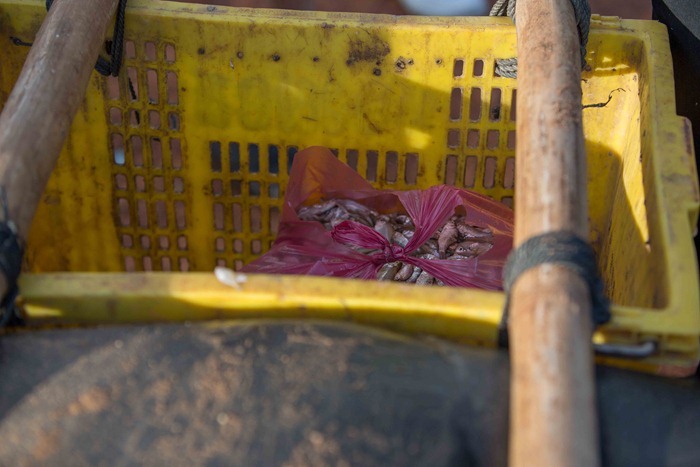
The village where we launched was filled with motorbikes, loaded with fish from the mornings catch.

Bagged for transportation. The fish were so small – not sure how they skin them or are they eaten whole?
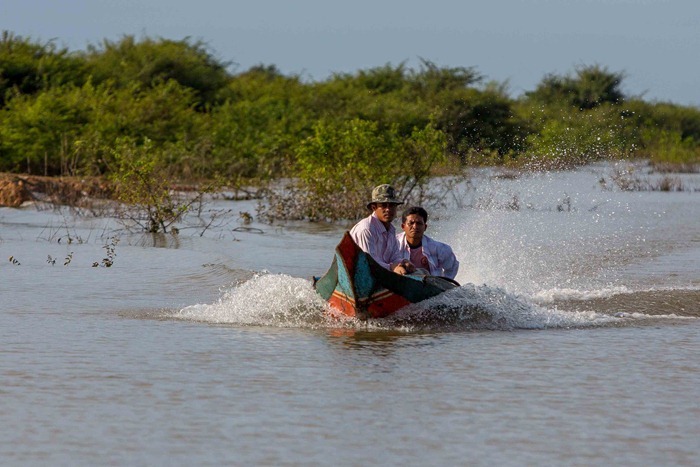
The boat had a very loud engine .. that made big waves.

As we took the 90 minute ride to the village, we saw many other boaters traveling the lake-ways.

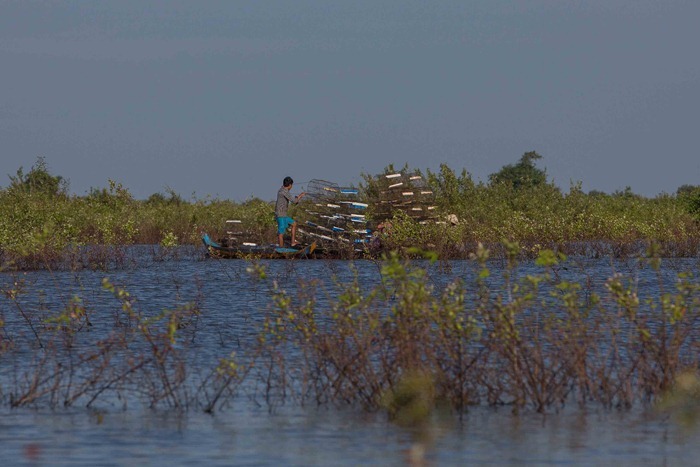
Off in the distance, a fisherman setting his nets (the pictures are darker as I had the wrong filter with me – it was that bright out)
And a few eco-companions on the way.

We stopped near a large tree where the guide explained that the tree was 15-17m high with almost 10m of the tree currently under water. The water levels on the lake go up and down by 10m during the seasons. In the tree, we noticed a brightly colored snake having a sleep .. red means poisonous.
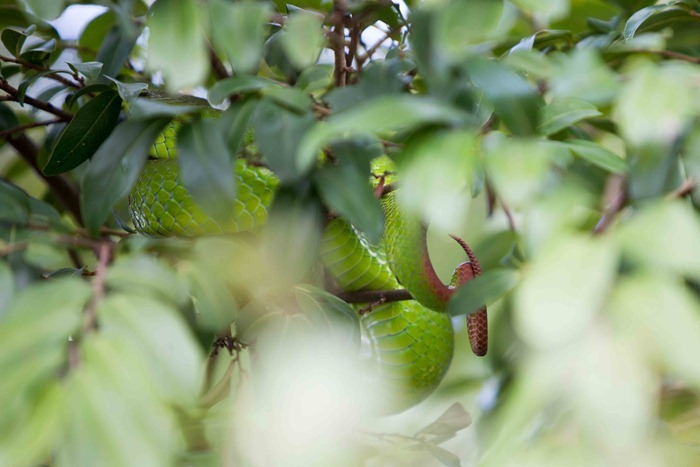
He never did peak his head out.

Traveling along the water the boat slowed as we entered the first of many floating villages.
Amazing to think that these homes move around with the water level .. and that they all have cell phone reception.

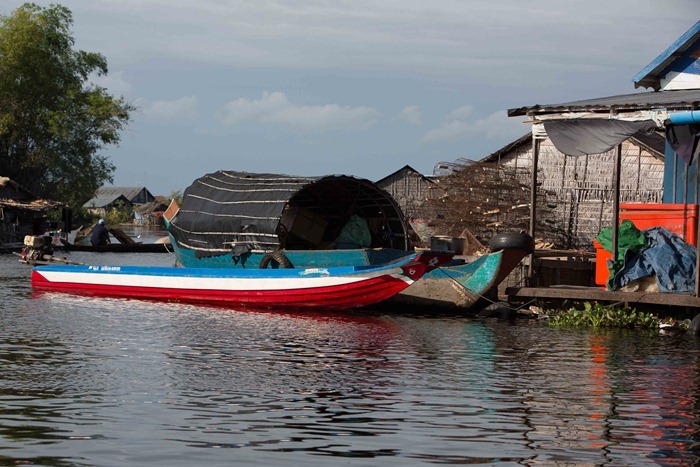
The village’s floating school.

Beside a few floating homes.


With the fishermen/women working on the day’s catch.

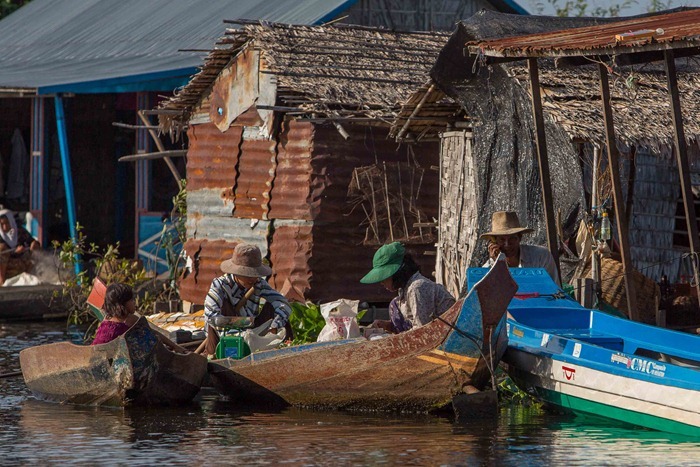

The boat picked up speed as we headed to the next village.
For many years I have wanted the tablet to deliver on one promise – paperless.
Starting with Microsoft’s digital ink (2002) which was rumored to cost hundreds of millions, but due to battery life and screen issues – never took off. Then the iPad came along and whilst it is a good multi-purpose device, the note taking element remains substandard. I have written on this topic a few times.
When I am in a meeting and someone is typing notes into their tablet or laptop, it is distracting – creates a barrier and ultimately, inefficient. Type the note on your phone and you run the risk of looking like you are checking email creating irritation or suspicion.
So, I keep using my Moleskine with the Evernote function (I never sync to Evernote) hoping that one day, someone will invent the capability to properly take notes electronically. Why notes? I like to write notes – it helps me remember, comprehend, think – digest – or something along those lines. Plus, when I am taking notes I am focused, and if I am with a client – that sends a message.
Yes, I have tried different pens on different devices .. Android, iPad with a Wacom pen, but everything is middling and I end up back to pen and paper.
Perhaps the day has finally come and this company has figured out the trick. The solution is like the Kindle, a single purpose, low cost device .. the BoogieBoard 9.7. Bluetooth sync and transfer, $100 price tag, Evernote integration, the right size – light and big enough to write on. Looks like it will go “live” at CES 2014.

Signed up for the notice of when it finally goes GA. Hopefully it will come in a color other than orange trim.
(Updated as I accidentally merged two posts)
I am so glad we visited this site. It would have been a huge miss had we not.

I am a big fan of TripAdvisor as it helps you understand what is really available in a city or country – especially if you want to get a little bit off the beaten path. Reading the reviews there were more than a few people who said this is a must see, filled with old Russian and a few American remnants from a terrible period in Cambodia’s history.

Everything is open to explore. Feel free to climb on, in and around them to see these decades old remnants.
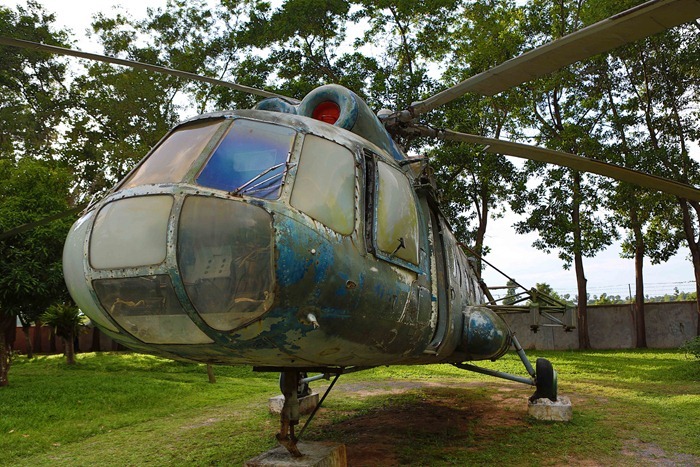

Our guide was a war veteran and his tale is heartbreaking – and worth telling here for others to read.
If you have read about Pol Pot and the Khmer reign of terror you will know that millions died. Pol Pot killed anyone with an education and engaged in a mad scheme to return Cambodia to an agrarian lifestyle with the goal of eliminating Cambodia’s dependence on foreign powers who had occupied, pillaged and generally mistreated the country. Entire cities like Siem Reap were emptied and the men were rounded up to serve in the army.
He was such a target. At 14 he was supposed to be taken away to join. His family hid him to keep him from the Khmer army. At a check point he was asked if he was a boy or a girl and he accidentally answered boy. His father, knowing he was caught, began yelling at him for blurting out the wrong thing as the Khmer commander was notified.
His father begged to let his son stay as he was too young which infuriated the ruthless commander. In moments, they shot his father and then shot his mother and two sisters as they tried to collect the fathers body. A few others from their village were also killed when they engaged in the dispute.
At 14 he was taken by the Khmer, just not fathomable. He spent years on the front, escaped into Vietnam and then returned to Cambodia only to step on a land mine and lose his leg.
Abandoned to fend for himself, he was an outcast until an Australian came along and rescued him. They flew him out of the country, got him prosthetics and helped him mentally recover. But as he said, how do you ever recover? Listening to his story, it was just so unfathomable and during the Pol Pot, Khmer reign of terror a sadly common story. No one was left unaffected.
Hearing it first hand is shocking.
 e,
e,
Just hearing that story made the trip to this museum a must see.
Along the wall there are several buildings that house hundreds of weapons, that you can handle. Fascinating to pick up an RPG.
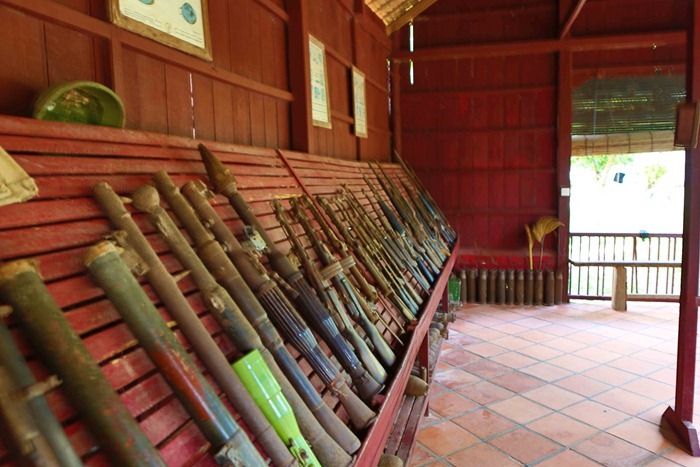

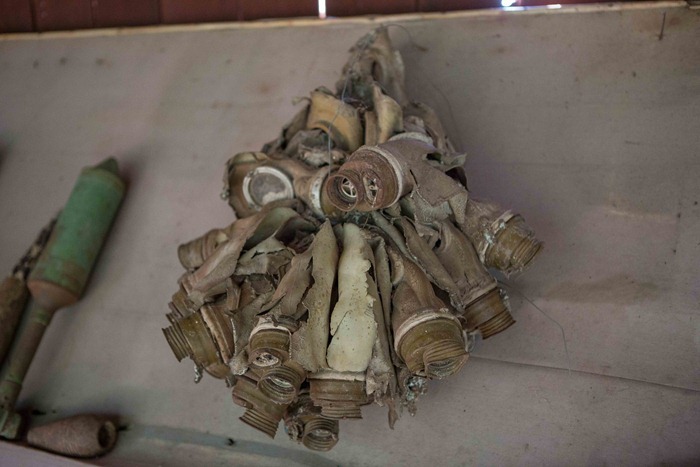


I cannot recommend it enough – a must see.
Every temple we travelled to in Siem Reap had some form of foreign sponsored restoration going on. Scaffolds, trucks and signs. Not insignificant undertakings.
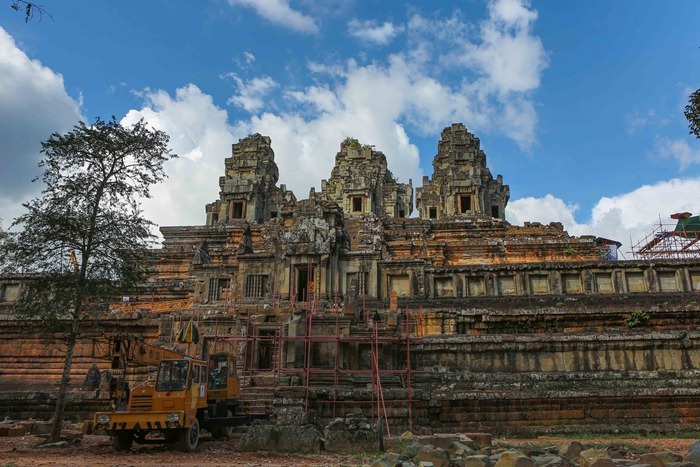
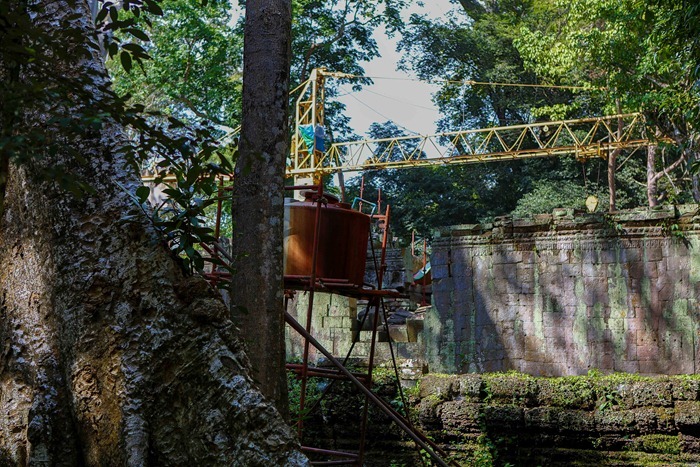
To understand just how dramatic the change is, I took this shot from the Indian restoration of Tah Prohm, Amazing to see the work that they can do.
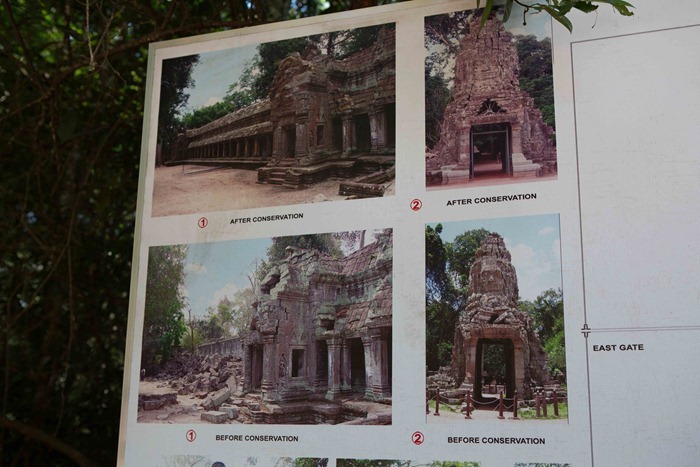
Great to see the international community helping maintain this important part of our collective history.
The center of Angkor Wat houses the holiest of places, up a steep set of stairs.
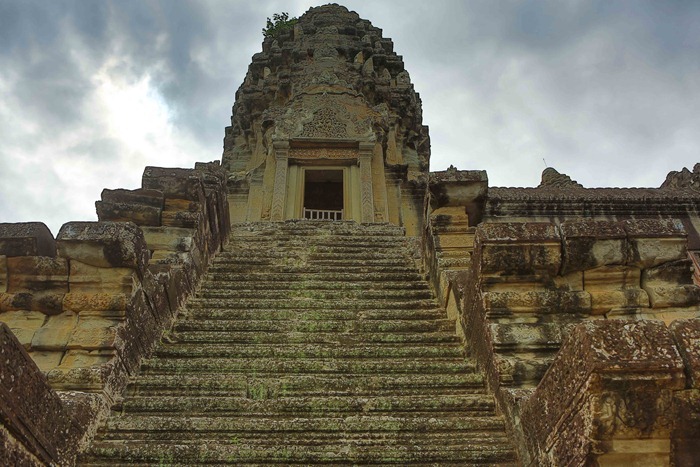
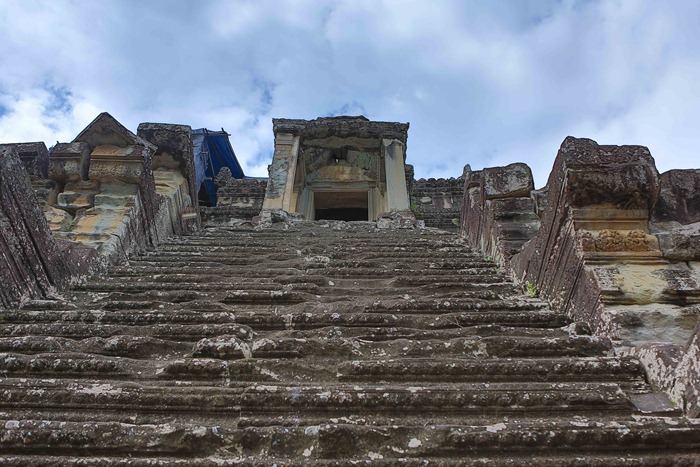

We were fortunate, the line was not that bad (quite short actually). From the top you have a spectacular view of the countryside.
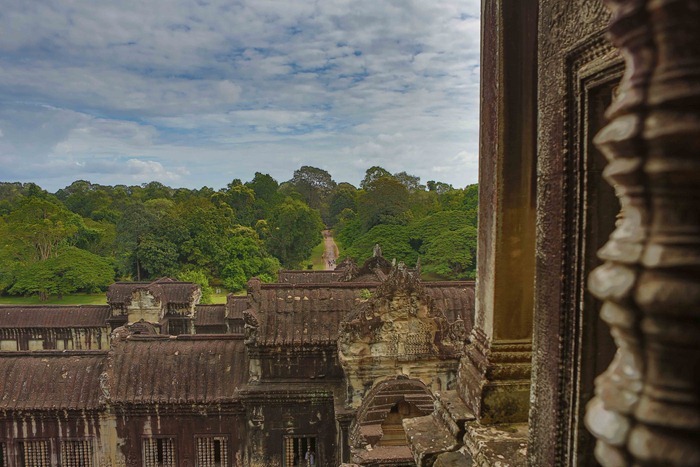
Throughout the day our guide pointed out the restoration work that was being done. What is remarkable is that very little of this work is being paid for locally, international donors (India, Japan, France to name a few) are very active in helping the Cambodian people restore and maintain their history.

The detail on the buildings is remarkable. One can only guess at the quantity of workers and time it took.
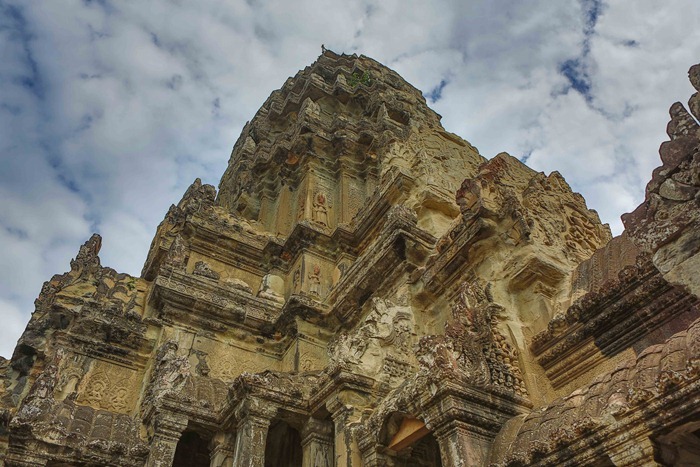

A spectacular site that lived up to the reputation.
Many of Cambodia’s temples are overgrown, they say there are an unknown number hidden away – engulfed by nature. Ta Prohm is marked as one of the 3 temples you need to see because of the way that nature sprouts from the temple – that tree must have been 30 meters high (or higher) – a new roof for an ancient temple.
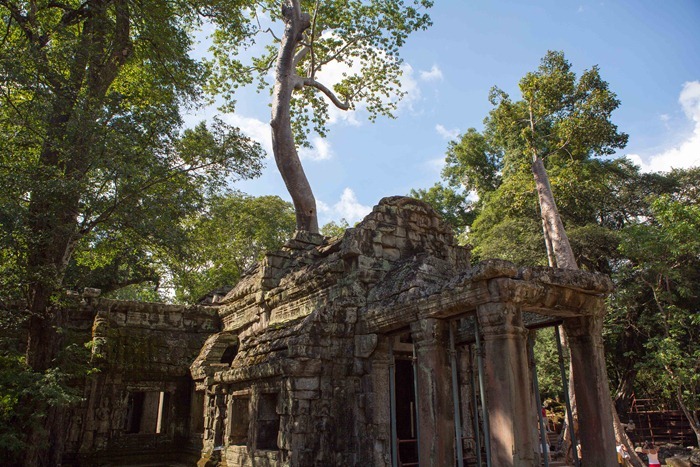

The trees have taken root everywhere over hundreds of years.

Made famous by the movie Tomb Raider (have not seen it), Ta Prohm is in the middle of restoration, in this case thanks to India.

This picture shows an example of the before (the jumble of rocks) and the after (on the right above the scaffold). Like a giant jigsaw puzzle.

A few more shots of a very beautiful and exotic temple.

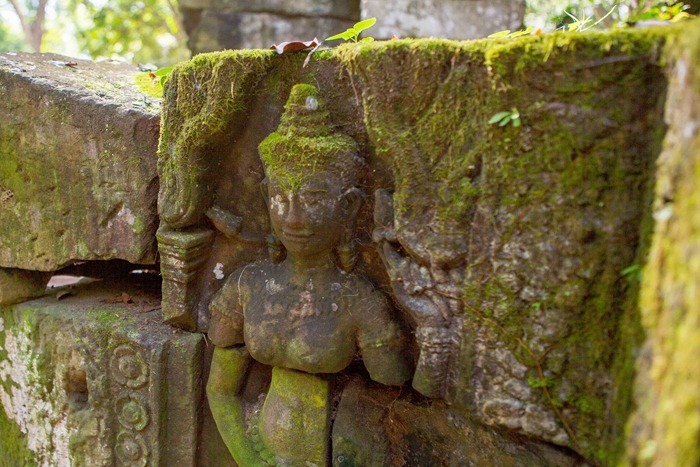

A beautiful place. Of the 3 must see temples in Siem Reap, this was our favorite (yes, more than Angkor Wat). There is something mystical about the jungle intertwined through the temple.
On our first full day of touring in Siem Reap our guide said Angkor Wat in the morning – I said really? He said all of the tour companies do it the same way, off to the other temples and balloon views first (Bayon, Ta Prohm) and Angkor in the afternoon.
We took his advice and did Angkor Wat first and he was right. Sure it was busy (as it was getting into the dry season and high tourism time) but far from “busy”.
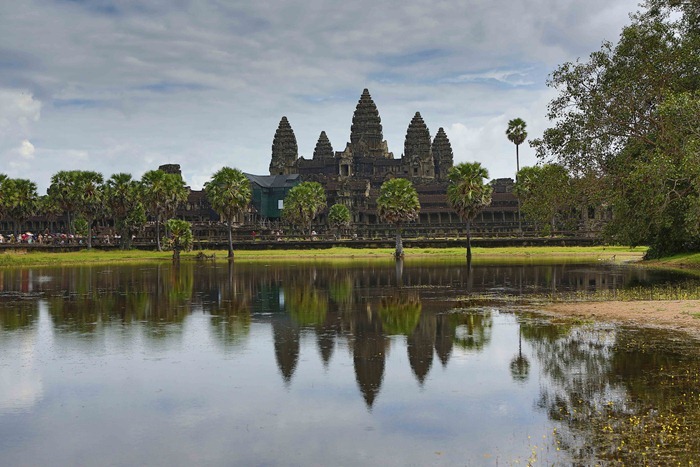


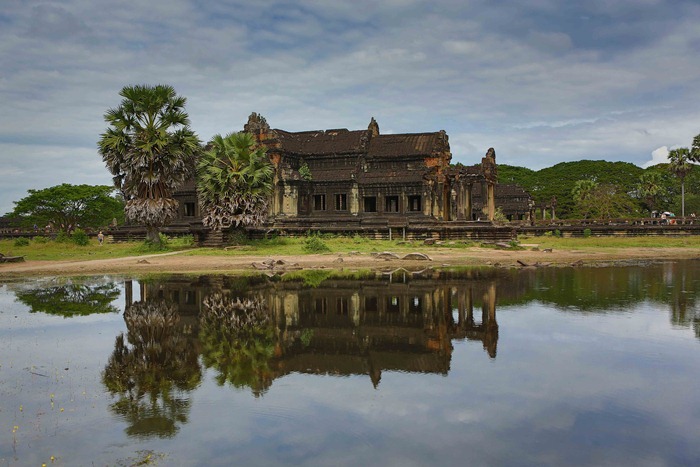
The library.
The back of the entrance.


Taking the long walk with the other tourists.

The interior is adorned with murals, often depicting fierce battles between the gods, humans and other creatures.

You can still see the remnants of paint. Areas shine on the murals where people rubbed them.

The steps to the top of the temple are quite steep. There was a woman at the entrance to the top looking at people’s clothing. If your shorts were too short, they would not let you pass.

I would agree with the first westerner who saw Angkor Wat when he said “is of such extraordinary construction that it is not possible to describe it with a pen, particularly since it is like no other building in the world. It has towers and decoration and all the refinements which the human genius can conceive of” (1586 – Portuguese monk)
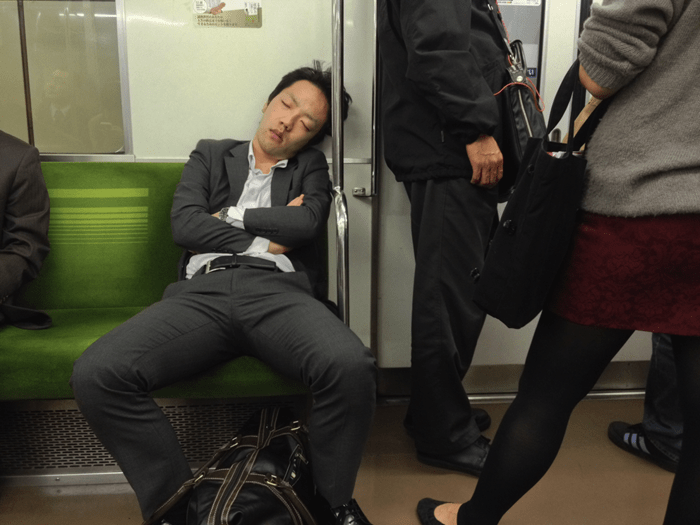
It seems the Japanese can sleep anywhere, anytime. I cannot fathom how you do not miss your stop.
When touring a place for a quick stop. We passed by, stopping for 10 minutes to walk the terrace. (Config: Canon 5D Mark III, Canon 70-200mm f/2.8)

It was a place where the old Khmer held events.
The 350m-long Terrace of Elephants was used as a giant reviewing stand for public ceremonies and served as a base for the king’s grand audience hall. It has five outworks extending towards the Central Square-three in the centre and one at each end. The middle section of the retaining wall is decorated with life size garuda and lions; towards either end are the two parts of the famous parade of elephants complete with their Khmer mahouts.
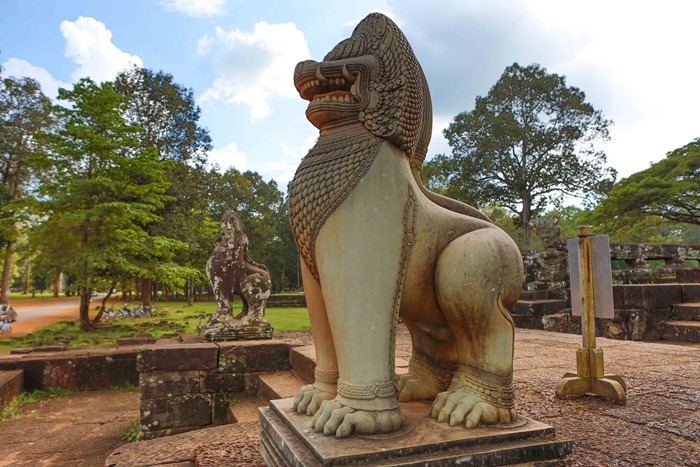
The entire terrace is covered in elephant carvings.

A view along the length of the terrace.


I would have liked to get to some of the older outlying buildings, but there was no time.
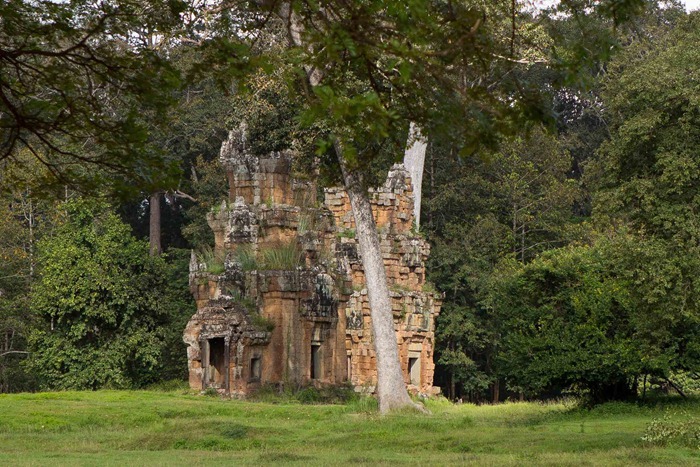 I am sure that the Siem Reap area is covered with unexplored buildings.
Outside Angkor Wat.
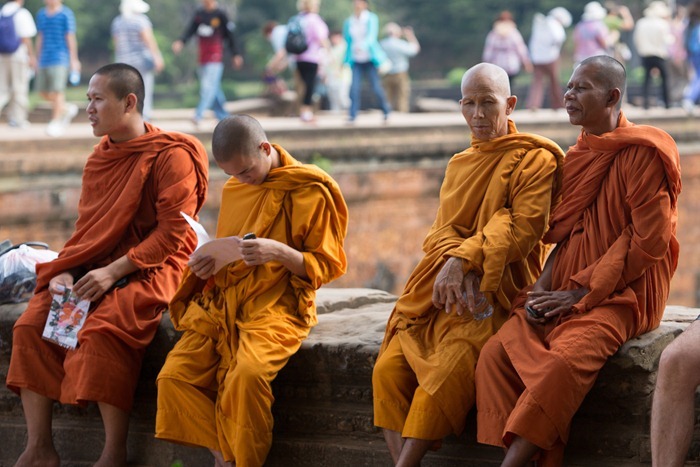
Outside our hotel, entering the park.

While traveling through Vietnam and Cambodia we drank fresh coconut whenever we could.
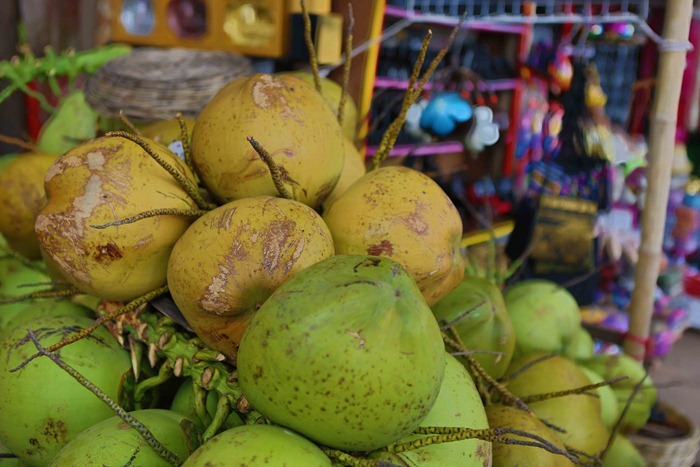
Those are very, very sharp knives and they swing them fast.

Cambodia, China and other Asian nations – each with their unique way of getting around dependent on factors such as tourism, distance and cost. A few from Cambodia. Config Canon 5D Mark III, Canon 28-70mm f/2.8 and Canon 70-200mm f/2.8.
Waiting for a tourist (outside Angkor Wat)

Down the road.

The family business. Yes, those are durian.

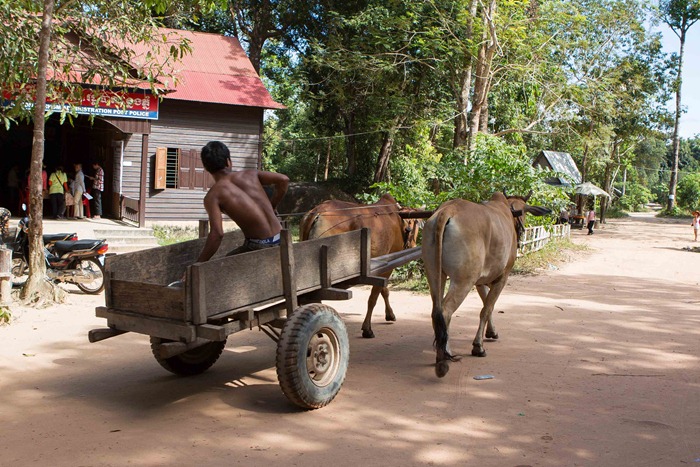
And still quite common, the cart and oxen.
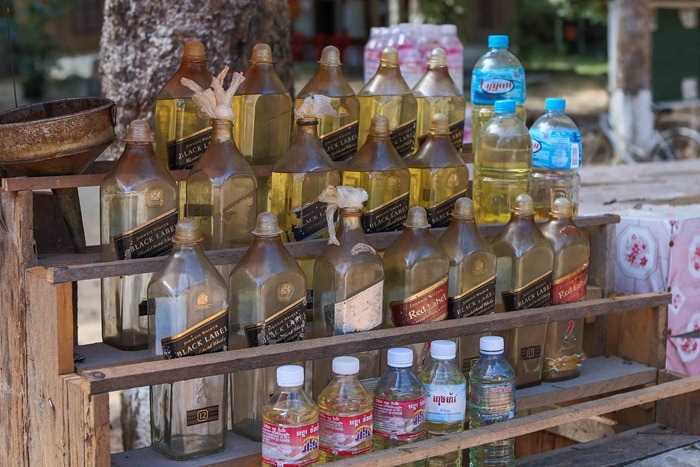
One thing that remains consistent .. petrol distribution is a little different in these countries.
And a few black and whites.

Love the kid making faces. One thing is for sure, the Cambodian people are super nice (and happy).

Scooters were everywhere.

And of course, human powered.

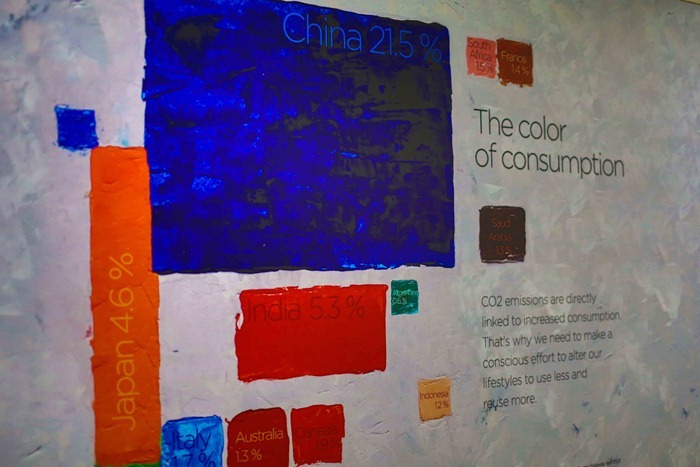
A very interesting chart on the wall of a client’s lobby. Look squarely at the two big blocks who make up 43% of the world’s emissions (surprised at how small Russia and India are).


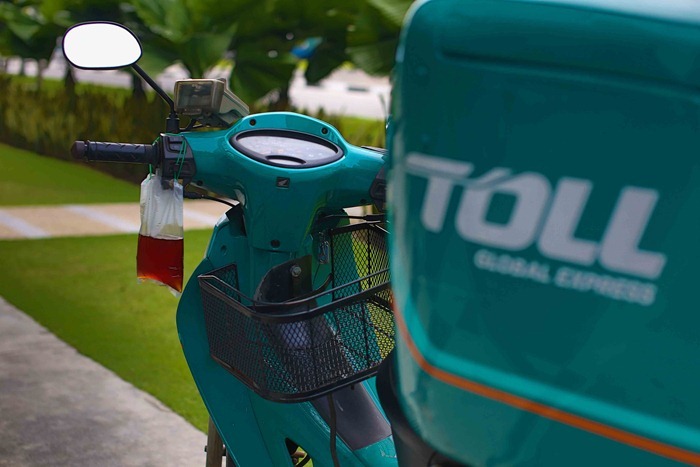
Insert straw and drink. Much cheaper than a cup and conveniently straps to the handlebars.
From country to country the vehicle choice changes. In Vietnam it was the scooter. In China it is the 3 wheeler. Config: Canon 5D Mark III, 50mm f/1.2.
Here is a pic of the average family’s vehicle (note the his foot placement – there must be an engine in there somewhere). It was amazing to see just how much they could pile on one of these vehicles.
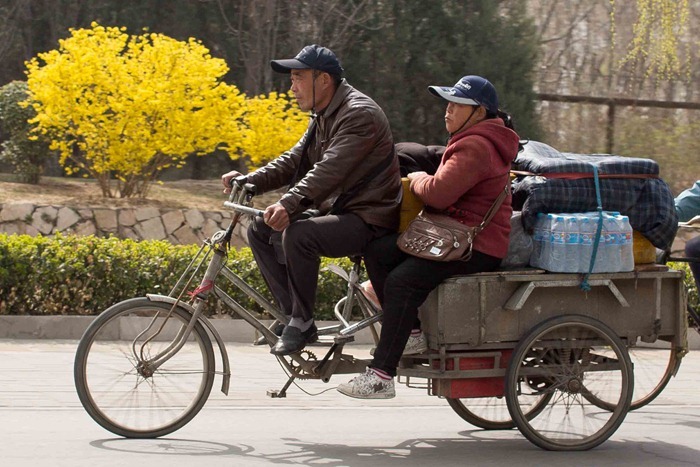
The upscale family’s vehicle.

The compact.

Kicking it old style, human powered.

Industrial. This guy was smiling awkwardly because he cut everyone off. (NOTE – no helmets!)

A very different world.
We have been traveling over the last week and it is amazing to watch foreigners enter a country and simply shed the logic that they apply in their home country. I am not sure if it is the “do as they do here” mindset or simply a belief that entering a country with less rules is a refreshing change from our safe, structured 1st world way of life.
Or perhaps it is naivety.
This is no more apparent than in helmet usage. Rent a scooter; why use a helmet in a foreign country where they don’t enforce it? After all, travelers logic dictates that your chance of an accident is lower while tearing down dirt, pothole ridden streets with scooters and cars everywhere right?
Taking a tour with scooter drivers. They have helmets on but you don’t. Why would you?
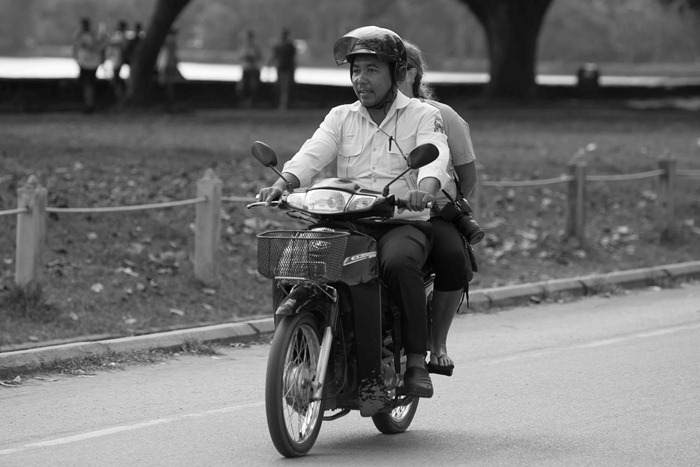
As one tour guide said, he found many travelers ‘obstinate’. In his words, we warn them “please don’t go there’ or ‘please don’t climb that’ but they do anyway.
I don’t understand it. We had a tour in Ho Chi Minh city and the options were scooters with drivers or the ‘scaredie cat’ option of a taxi to flit us around. We took a cab option.
Via my iPhone.
A very fast train (In China)

Excuse me .. I was looking for the Vitamin C aisle?

A friend told me it was –26C and snowing like mad in Calgary. I do not miss snow. I never need to see snow again. We had one day of snow in Tokyo last year, I did not like it. Shut the city down.

Just say “NO” to snow.
I forgot to post this photo. This fellow was out front at Sensoji temple entertaining the locals and tourists. Love the earrings.
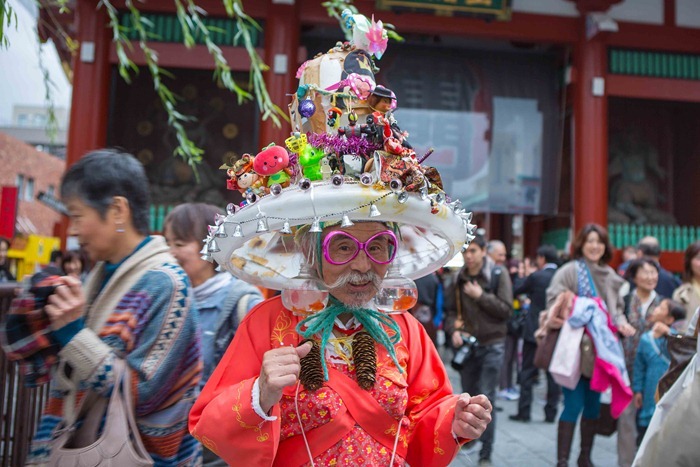
From a distance; Canon 5D Mark III using Canon 70-200mm f/2.8.

I am often perplexed by the way that English is used in Japan. A couple cases in point.
Why is the title of the car wash in English and the content in Japanese?

Why is this Crunky bar advertised in English? (Yes .. Crunky bar)

Why does is this sign in Japanese have only a few English words? (Most people will not understand that this means that the entire city is smoke free – it is illegal to smoke in public (awesome)).

This is just funny (At the entrance to the big Buddha)
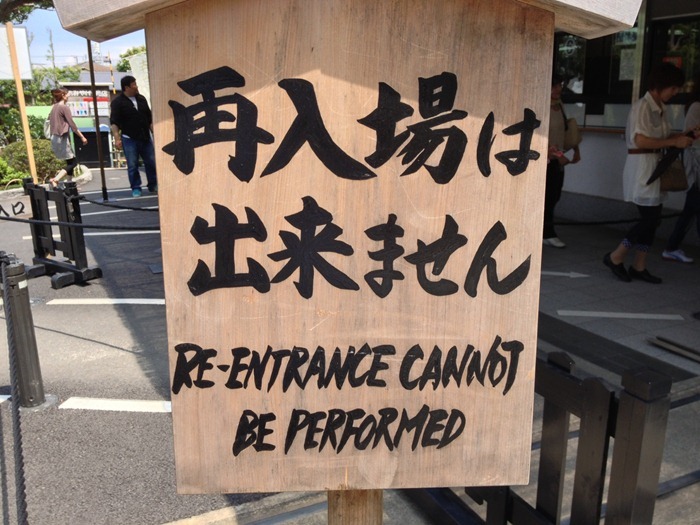
This just makes me wonder, what were they thinking? (although this is not Japan – this is in Singapore)

And last but not least, I point the finger squarely at the Canadian consulate in Japan. Really? English and French hand-washing instructions .. but nothing in Japanese. Figures.
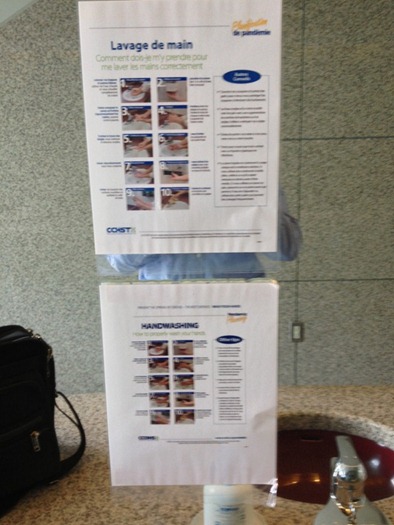
From around town.
“The quality sleep”. Japan has a different definition of what constitutes a quality mattress than North America.

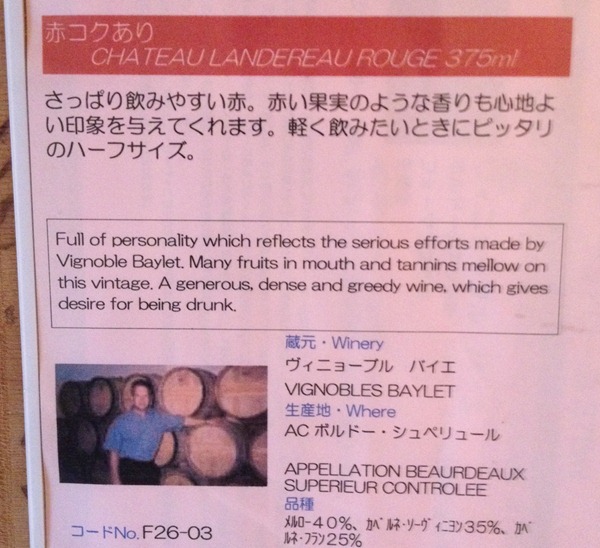
I was grabbing a bottle of Sake at a local shop and this wine advertisement (among others) caught my eye for the unique use of English in the marketing – specifically the “desire for being drunk” phrase. Quite the sales pitch.
I am glad this guy caught up with my taxi. Look closely … (from my iPhone). He is in the rain, holding an umbrella, in a suit, riding a bike, with no helmet while talking on the phone. I don’t understand why no one wears a helmet …

Another interesting use of English in the ANA line at Narita. I laughed at the sign giving us an update on when we will board.

Living in Japan is a little like a Monty Python movie. There are some obvious things that make you laugh, but the best laughs require that you pay close attention or you will miss them.
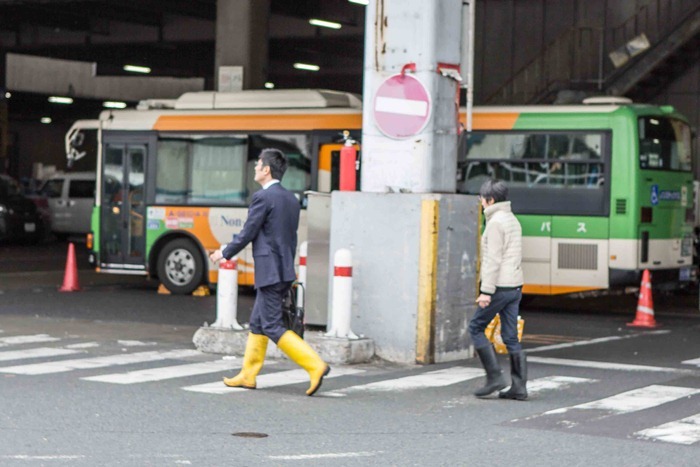
How the business man conducts business at Tsukiji market.
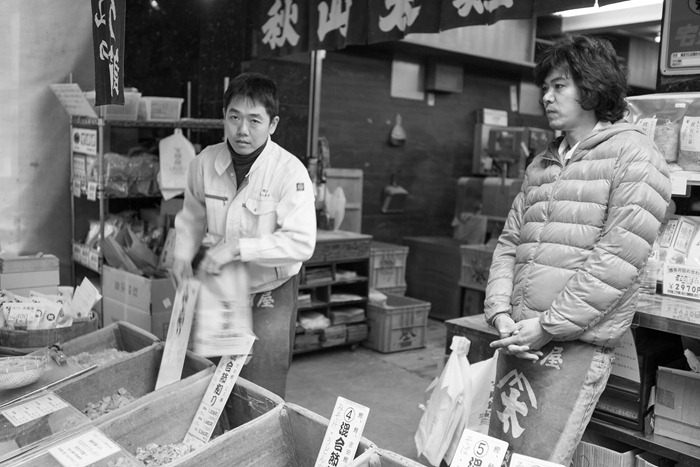
How the tourist conducts themselves at the market, wandering in the crowds. A couple black and whites (Config: Canon 5D Mark III, Canon 28-70mm f/2.8)

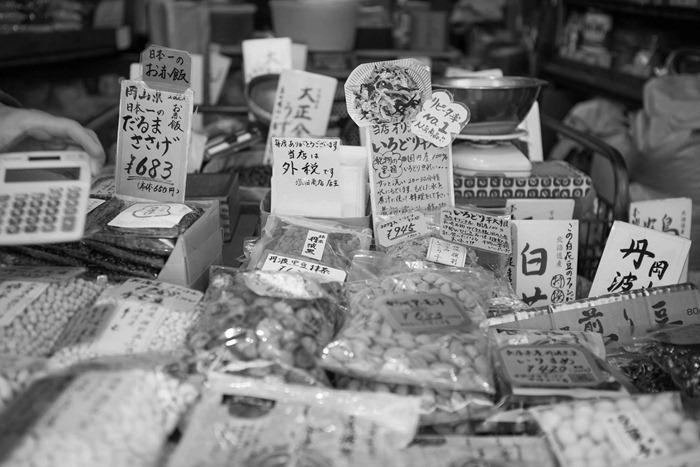
Welcome to the “Relax lounge”. Feel free to smoke away – because you are not allowed to smoke anywhere in public (nowhere – when the Japanese get it right, they really get it right!)

A couple handheld HDRs. That is a great color for tuna.
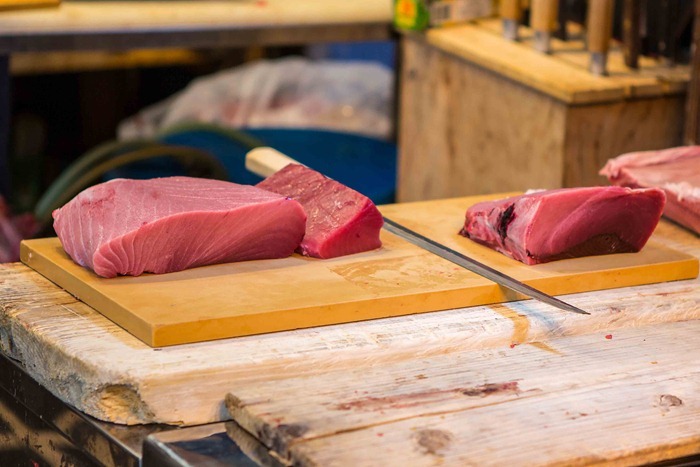
Japan is known for their knives .. amazing.

Head anyone?
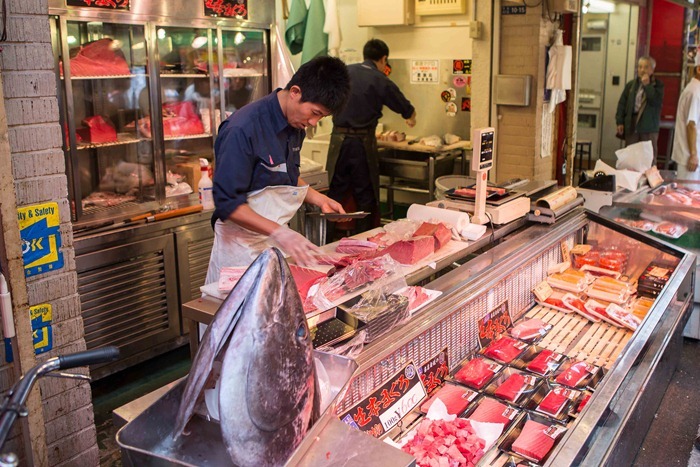
I have yet to try it, but I hear it is quite the delicacy.
With a friend from Canada, on a very busy weekend. Config: Canon 5D Mark III with my Canon 28-70mm f/2.8.


Many were saying their prayers.
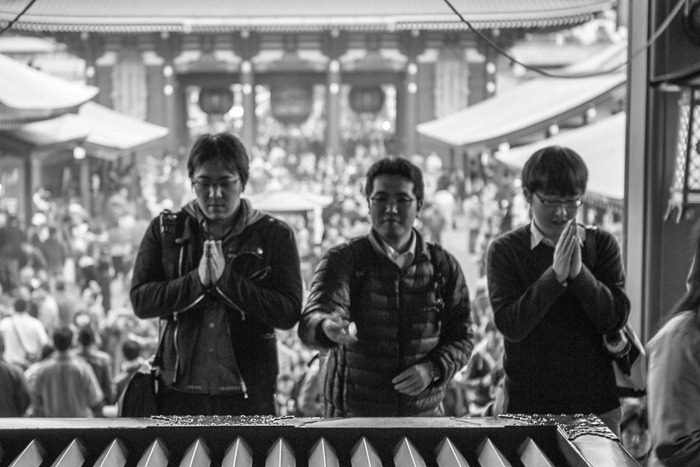

A few HDRs.


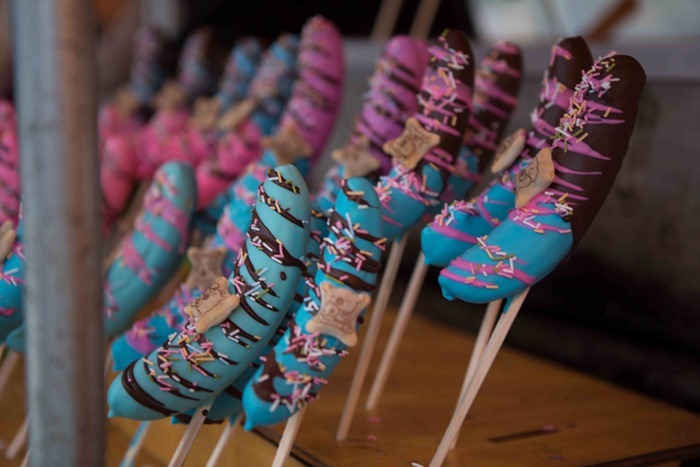
Many were selling their wares. If you ever see this chocolate coated banana – don’t stop. Opinion based on experience … more pleasing to the eye than the palate (by about 50 miles)
I still find the swastikas as a temple symbol disconcerting.

But the temples are spectacular.
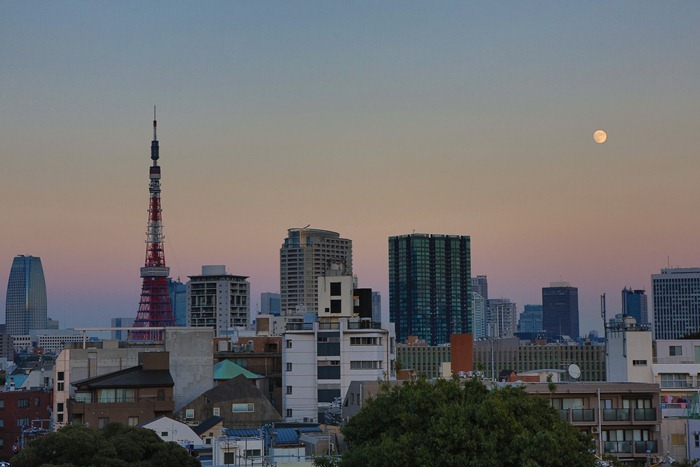
The Tokyo Tower, changing colors for the upcoming Christmas season.
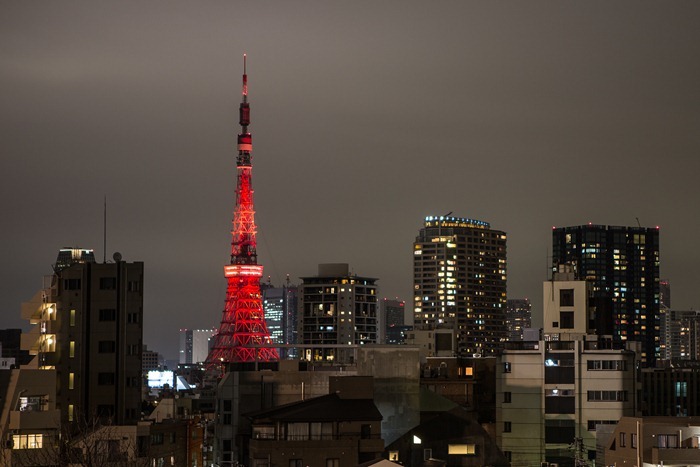

And a few moments before the lights come on.
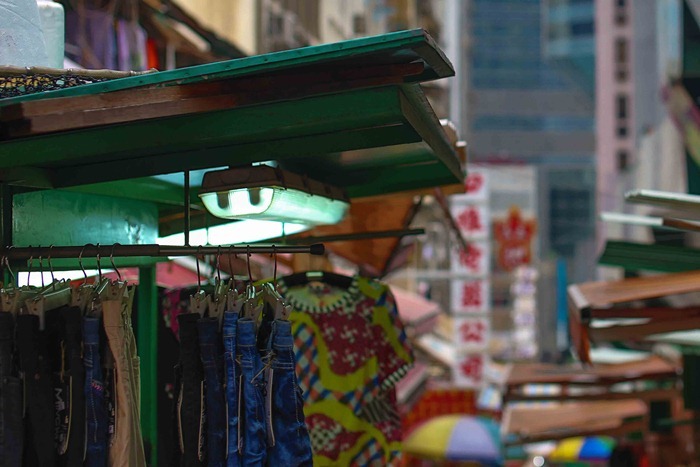
A few more shots of the side streets of Hong Kong. A delicacy from one of the street markets.


Flowers are everywhere and inexpensive. That is $17 Canadian ….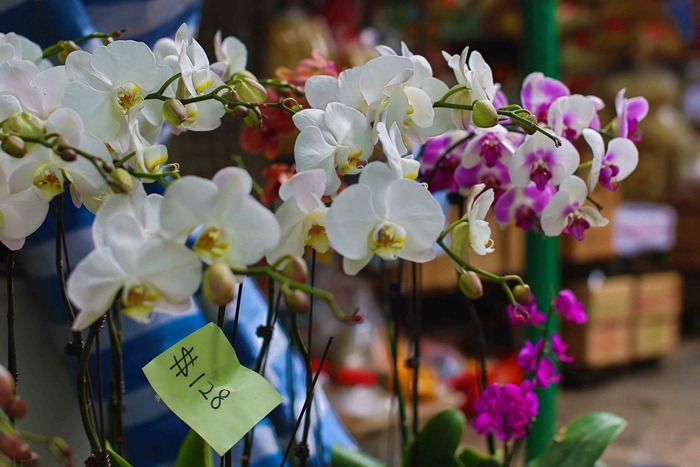
This sign made me laugh. Was it a rough Grand Opening or a sign that is long overdue to come down?

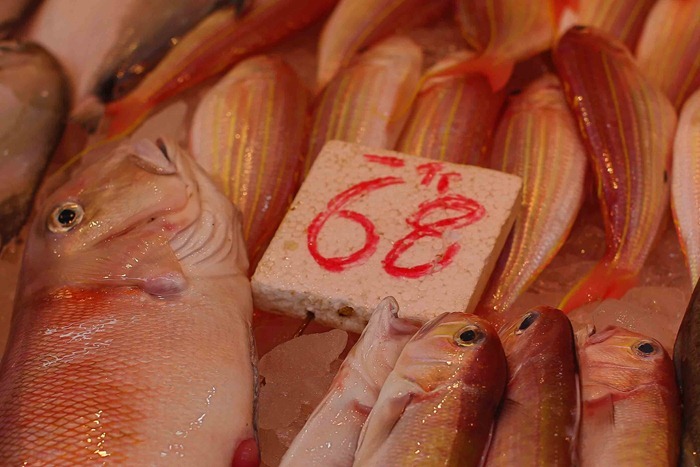
The fishmonger.

An important feature at this boarding house.
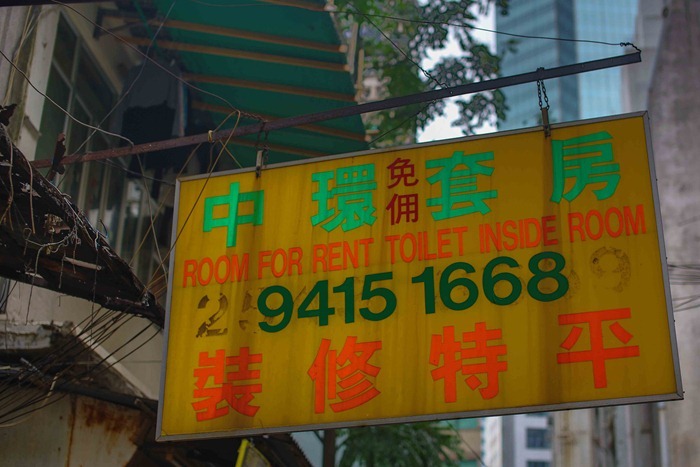
Need to get there for a “tourist” weekend.
I was asked what HK is like the other day. I am far from an expert on the city as my travel there involves the usual; airport > hotel > office > meetings > hotel > airport. I did, however, take my camera and wander around one lunch time that I had free.
My opinion, Hong Kong is a city of poles. Multi-billion dollar, ultra modern buildings with extremely old buildings and farmers markets squeezed in-between. It is interesting to see.

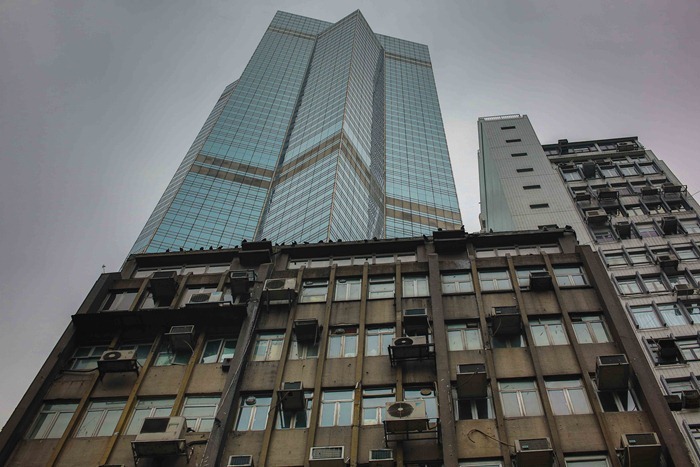
Fascinating side streets.

Magazine stands are quite popular.


Durian anyone? I can always smell it in a market.

A Hong Kong scaffolding truck. They will build a 50 story building with bamboo scaffolding.

Interesting place.
I do not know Garret Popcorn. I do not know if it is good, I do not know if it is bad.

All I do know is that the store in Shibuya must be the highest sales per square foot in their chain. It is ALWAYS lined up around the block. I tried to capture the size of the line, but is hard.
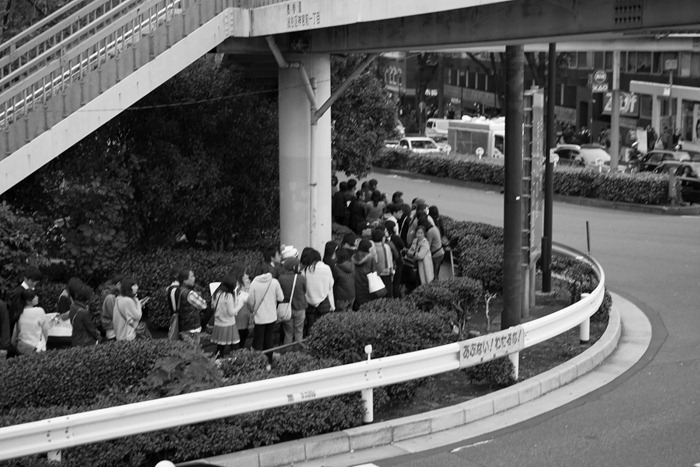
Do you see the end to the line? Hard.

Crazy. I will be unable to form an opinion on Garrett popcorn as the chances of me standing in a line for 2 hours for popcorn are somewhere between 0 and none.
A side note, the advanced encoded security with digits that moved around on the pad for this bathroom gave me a chuckle.
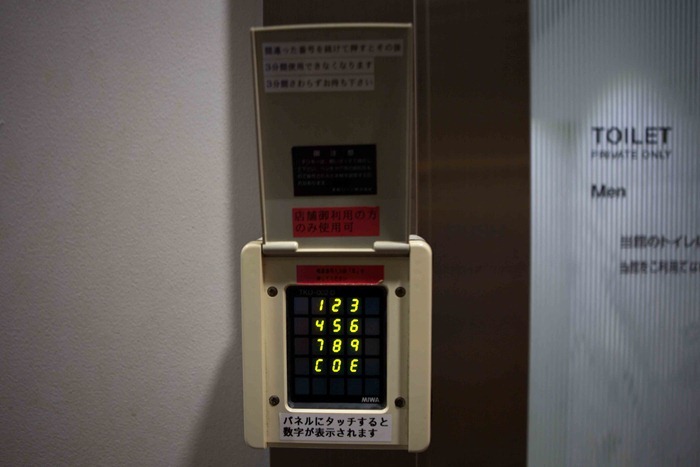
It wasn’t even that fancy of a bathroom (smile).
We were with a friend at Meiji Shrine on the weekend and there were a few things going on – weddings and children coming of age celebrations.
I enjoyed watching the posing of this wedding party, the photographer and his staff must have adjusted an arm here – a leg there, for 10 minutes.
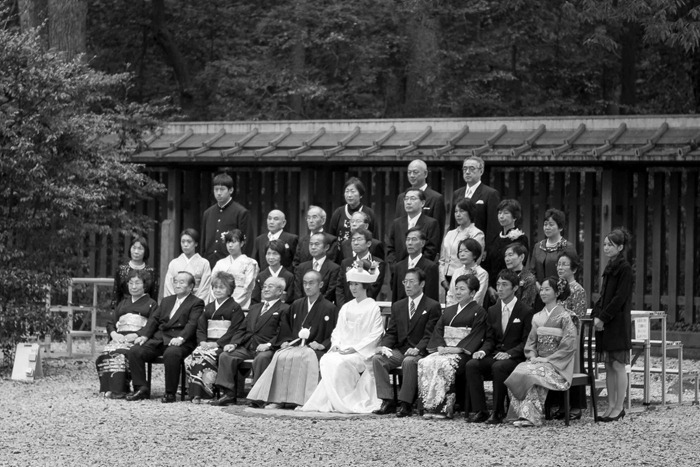
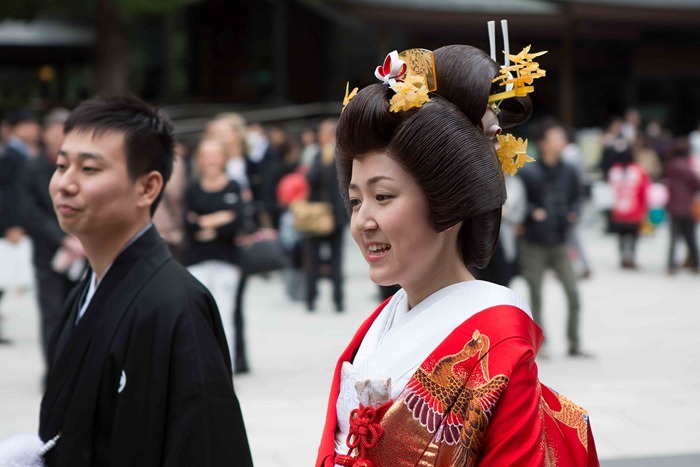
The bride is wearing the head covering that is traditionally worn to cover her “horns”.

Perhaps this bride is happy because she does not have anything to hide (smile).
Everywhere you looked were children in colorful traditional dress, to celebrate their coming of age. Of course, parents were being parents, primping and preening – that is the same in every culture.


The path to the shrine was lined with ornate flower arrangements. No idea what they were for, but I have not seen daisies arranged like Japanese trees before. Very pretty.

As always, lots to see at Meiji shrine.
Well, 1/3rd of a rainbow. Brilliant colors though.

Danger lurks above.

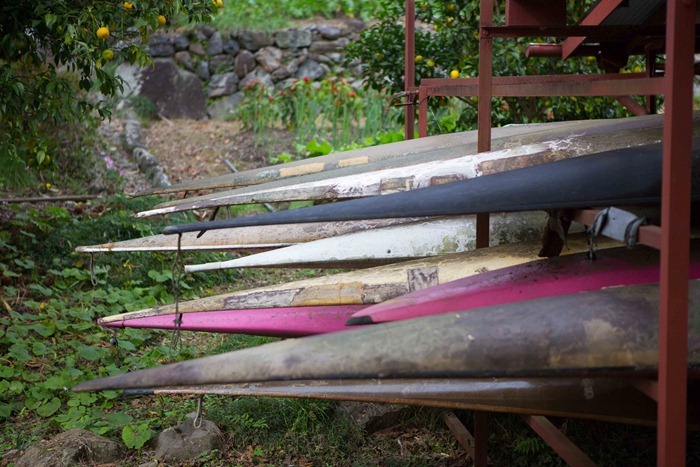
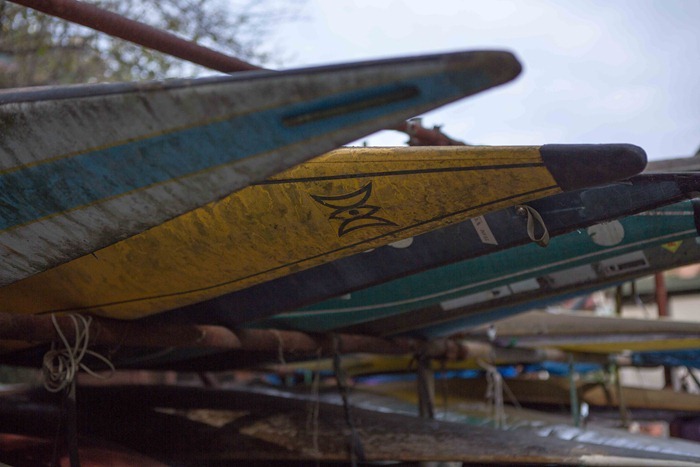
As we walked along the river running through Mitake gorge we passed racks and racks of old kayaks, waiting for their owners to realize … they are obsolete.

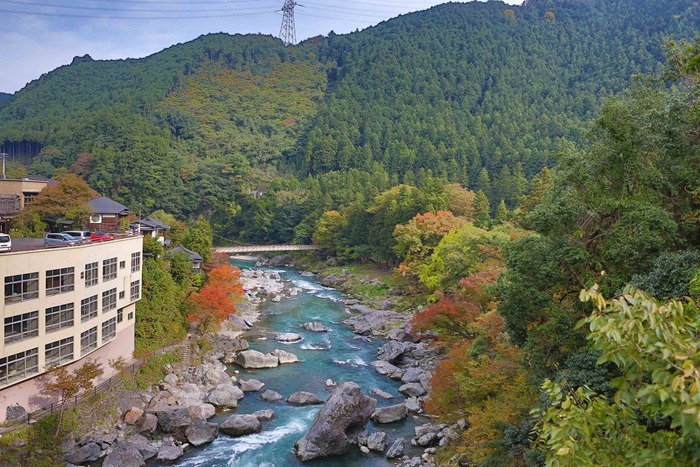
The fall is arriving in Japan, the trees are turning. A good day for a wander around the town that sits at the base of Mt. Mitake, Tama-Gawa.
A few mixed shot of the hike. Config Canon 5D Mark III, Canon 28-70mm f/2.8.
The view of the “rapids”. You can take a whitewater ride down the river, although they didn’t seem all that “rapid”. Config: Canon 5D Mark III with 28-70mm f/2.8.
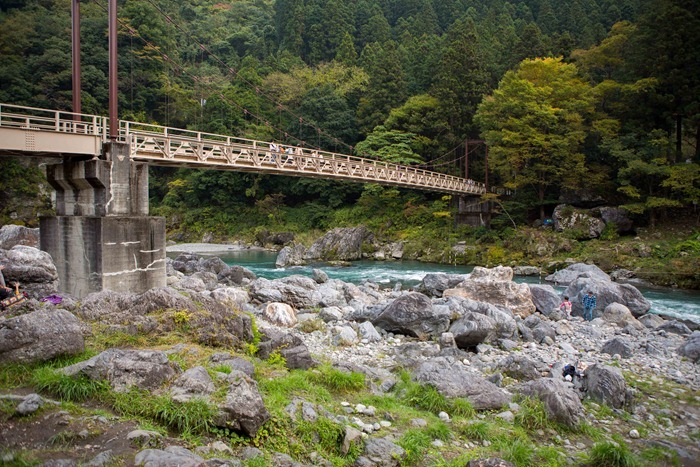
The region is also known for kayaking. There were a lot of groups along the banks of the river.

Gnomes along the trail.

Local farmers (or what I would call gardeners) were selling their wares along the trail.

Beautiful time of year.

I got off of a red-eye from LAX in Haneda, Japan this week and the total time from plane to taxi was 12 minutes. I love Japanese efficiency and Haneda is my favorite airport in the world. Close to downtown Tokyo and so efficient.
The "special re-entry" line also helps as it is often empty (smile).
We have a friend coming over from Canada this weekend and he is very tall – 6’ 4ish. He will probably have a tough time with the doors in Japan … This is a not-uncommon door frame height in older buildings.

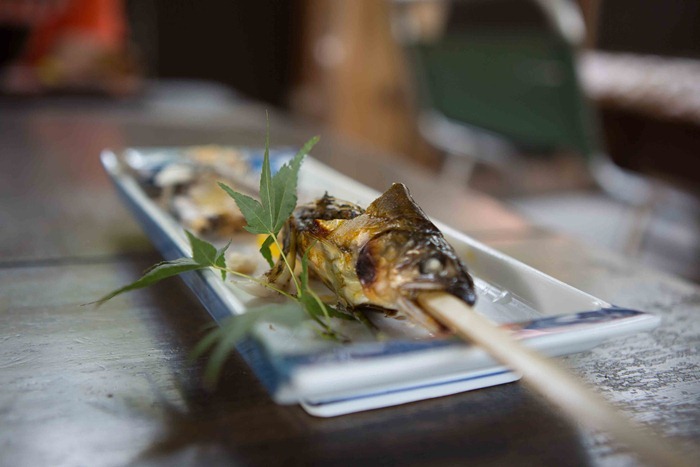
Grilled. Shot with a Canon 5D Mark III and a Canon 28-70mm f/2.8.

I have been playing around with black and white lately. Not sure if I like sake in green or B&W?

 Michael Weening: a few pictures