GOODBYE TO GLIB GURUS AND THEIR GOBBLEDEGOOK


A colleague forwarded me a great article from the The Times Online this week.  So good, that I cut and pasted the whole thing for future reference. I have highlighted a few points that really stuck out for me.

While I do not agree with all of the points, the article makes a strong case for balance. Like in all things, text book learning does not translate into aptitude and knowing a lot of management theory does not create great managers, leaders or businesses.

Reading it, I was left with a couple thoughts:

  • Where have the billions of dollars of investment into Sarbanes Oxley gone and what was it for? The points made on compliance in the below article support Lois Frankel’s paradox of control (from the book Overcoming Your Strengths):

It was the first year that I decided to invite a large group of relatives and friends for Thanksgiving dinner. Being the independent woman that I am, I wanted to prepare and serve the meal by myself. As more people came into the kitchen to help, I became increasingly frustrated with my inability to maintain control of the situation. My mother was telling me to do one thing to the turkey, a friend was telling me to do another to the stuffing, and still someone else was telling me how to cook the vegetables. Finally, heeding my own guidance to others that the paradox of control is the more control you have the more you give away, I decided to let everyone do what they wanted. I was just positive, however, that this meal would wind up a disaster.

No one was more surprised than I was when it turned out to be one of the best Thanksgiving dinners ever to come out of my kitchen.

  • Management theory is not about a pretty box, with a bow that can be textbook implemented to ensure success. If it causes you to step back from your business and apply a percentage of the learning to make your business better – that is success. And if 0% is applicable but it made you step back, assess and think, that is a benefit too.

Good article. Enjoy.


Goodbye to glib gurus and their gobbledegook

The credit crunch is showing management theory for the hollow, jargon-filled sham it always was. But at last the tide is turning

Andrew Billen

It was John Humphrys on the Today programme who last autumn summed up the tragedy of Baby P. Exasperated by an apologist for Haringey Council, who smugly claimed that it had followed procedures, he thundered: “And the end of this perfect paper trail is a dead baby.”

Such is Humphrys’ range that a few weeks later he was interrogating Sir Michael Lyons, the chairman of the BBC Trust, about Russell Brand’s naughty phone call to Andrew Sachs. Was the answer, he asked satirically, more “compliance procedures”? It surely must have been, for the corporation is currently echoing to the clang of stable doors being belatedly bolted (that and the Teletubbies theme tune, for a senior BBC staffer has been told to watch every episode to ensure that it meets “current compliance” procedures).

“What they don’t understand,” one of the BBC’s most respected producers explained to me, “is that the more compliance you put in, the more likely [controversy] is to happen because it takes away the innate sense of personal responsibility that everybody in the BBC once had.”

Of course, it is not only social services and the BBC who today wade so deep in management theory that they can barely do their jobs. Schools last year received 6,000 pages of theory and guidelines from Whitehall. The result? Primary school teachers, busy reading and filling in forms, no longer have time to read books to their charges. In hospitals, doctors long ago took the hint that the State will value them more for meeting targets than for treating patients, so they order ambulances into “holding patterns” in car parks for fear that, if patients are admitted to A&E too early, the target that all must be treated within four hours may be missed. Cynical? They are acting no more venally than the Kent policeman who arrested a child for throwing a slice of cucumber from his sandwich at another youngster. The PC, lamented the Police Federation of England and Wales in 2007, needed to meet his mop-up target.

We know, of course, that bureaucracy works first in duplicate, then in triplicate and thus unto infinity, but what is happening now is no accidental proliferation of red tape. In the past two decades, management theory, once rejected in Britain by both management and unions, has been deliberately imposed on almost every aspect of commercial and public life. Resistance, from the policeman’s beat to the chalk face, has been widespread but futile.

The Wall Street Journal columnist Thomas Frank, who has studied the cult of management in books such as One Market Under God, savours the paradox on our behalf. Millionaire management theorists such as Tom Peters, author of The Pursuit of Wow!, may believe that they are cool “but the public has always regarded these guys as a joke. You think of that book Who Moved My Cheese? There are parodies of it all over the web. People don’t trust this stuff. They think it’s silly.”

Management theory was born, naturally, in America. Its father was Frederick Winslow Taylor, the time-and motion man who died in 1915 with, legend has it, a stopwatch in his hand. A mechanical engineer, he believed that workers should be made to do small, specialised, repetitive tasks. Their work rate could be ratcheted up by pouring extra dollars into their wage packets. In 1914, 16,000 people flocked to New York to hear him relay such insights.

The realism of Taylor was quickly countered by the “human relations” school of management theory, led by touchy-feelier theorists such as Elton Mayer, who believed that if you treated the workers like family, they might treat you like family back.

But it was James Oscar McKinsey, a Chicago accountancy professor, who turned management theory into money by founding a company of consultants who claimed not merely to heal unhealthy companies but to make healthy ones great. McKinsey died in 1937, but his “fellow visionary” Marvin Bower continued to advise McKinsey and Company until his death five years ago – by which time it was serving seven out of ten of Fortune magazine’s most admired companies. By the Fifties it was almost mandatory in the US, if you wished to run a company, to get a masters degree in business administration – an MBA. Preferably it would be bestowed by Harvard Business School, where, currently, 1,800 students are beavering away, trying not to think too hard about the economic triumphs achieved by such notable alumni as George W. Bush and Rick Wagoner, the chairman of General Motors.

“What you get from Harvard Business School,” says Radio 4’s In Business presenter Peter Day, “is a wonderful network of people who were there with you and a set of tools that you can then use and bamboozle people with for the rest of your life. It is a habit of thought – conventional responses to conventional situations. Harvard teaches very much on a case-study basis, so it is always telling people how to respond to things that happened in the past. No wonder that when something like the credit crunch comes along, huge numbers of highly skilled people in compartmentalised worlds are unable to respond to it.”

But what do they teach? Come the Sixties, all schools united in their loathing for the comfortable, profitable Fifties business culture as described by William H. Whyte in his 1956 book The Organization Man. This was a world in which white-collared workers were beholden to their employers. “They are wry about it, to be sure; they talk of the ‘treadmill’, the ‘rat race’, of the inability to control one’s direction,” Whyte wrote. “But they have no great sense of plight; between themselves and organization they believe they see an ultimate harmony…”

Harmony! This life of job stability, quality health insurance and pension plans looked like commercial death to the theorists. “Tom Peters would say that you have to turn loose market forces at every level of the firm,” says Frank, who, when not writing for The Wall Street Journal, edits a journal of dissent called The Baffler. “There is this cult of destruction that you see in American management theory – creative destruction, with the emphasis on destruction.” The cult’s credo is reduced ad absurdum in the title of one book of popular management theory ubiquitous in American airport bookstores: If it Ain’t Broke…Break it!

At its bleakest, this social Darwinian philosophy, as advocated by the McKinsey consultants who dreamt up the phrase “the war for talent”, requires managers to rank their employees each year. Some 20 per cent are “A players” who must be handsomely rewarded. The next 70 per cent, the Bs, will be less well paid. The bottom 10 per cent, the Cs, will be fired.

Hard? Certainly. Fair? Only possibly. But does it work? On the contrary. In 2004, a survey of 200 human resource professionals reported that “forced ranking” resulted in lower production, scepticism, damaged morale and reduced collaboration. As the authors of the new book Hard Facts: Dangerous Half-Truths and Total Nonsense point out, there is no reason why 10 per cent of your workforce should every year become incompetent.

“Forced ranking” is a fad that is fading – but it is hard to keep up, there are so many. Amazon.co.uk is selling 11 books with a combination of the words “management” and “fad” in their title, the snappiest of which is Fad Surfing in the Boardroom. These volumes promise to separate the wheat from the chaff for the bemused manager. The trouble is, there is so much corn in the field that even the high priests become confused. For a while McDonald’s taught its managers the American psychologist Abraham Maslow’s hierarchy of needs, a pyramid building upwards from “breathing, food and water” to an apex of “self-actualization” (as a burger house manager?). Yet by the time of his death in 1970, Maslow himself had admitted that some employees simply did not choose to “self-actualise” in the workplace and might resent being expected to do so. Peter Drucker, perhaps the most respected of all the gurus, who died in 2005, eventually concluded that, contrary to what he had once believed, the volunteering sphere offered more personal fulfilment that the workplace.

Performance reviews, in which staff are yearly taken into a room by their manager and told how they are doing, are increasingly regarded as the least effective way of communicating between boss and worker. If you learn anything new at your review, the latest thinking goes, your boss has not been managing you correctly. In the City, bonuses – long since elevated into a culture – are finally being recognised as one of the very motors of investment banks’ disastrous recklessness. Sitting next to them in the dock are “targets”, which, as the former chairman of the Audit Commission, James Strachan, was telling anyone who would listen as long ago as 2003, were a “sure-fire way” of failing to improve services in schools and hospitals (he resigned three years later).

The comical ingenuity of doctors in cheating over targets was dramatised ruthlessly by one of their former colleagues, Jed Mercurio, in his BBC drama series Bodies. One obstetrician on the show, frightened of his morbidity score rising above target, simply began refusing to treat very sick patients. “Doctors end up becoming more and more cynical about the way the NHS is governed,” he says. “It’s a very dangerous mindset for a workforce to get into.”

Yet Mercurio acknowledges the need for someone to watch over the medical professionals. Margaret Thatcher, when she threw millions of pounds in extra funding towards the police, was determined that the quid pro quo would be accountability: from that moment, Gene Hunt started to become an historical figure. Equally, there are few greater critics of management theory than David Craig, a former management consultant turned apostate who has written Plundering the Public Sector, a book castigating the Government for squandering billions on consultancies. He, too, acknowledges that efficiency needs to be measured: “KPI [key performance indicators] are absolutely fabulous if used by effective management. But if you have incompetent, ineffective management and policies that only want to give the illusion of progress, they are a disaster and demotivate everyone in the organisation.”

It was in 1995, while working with Gemini, then a struggling consultancy, that Craig helped to come up with the concept of organisational transformation. “We published a book called Transforming the Organization,” he says. “But it was a con, something we dreamt up to try to sell bigger money-making projects to companies. It took three or four years, then everyone started picking up on it. And Tony Blair bought it when McKinsey sold it to him. Suddenly all he would talk about was “transformation of the public service”.

Those, such as Day, Frank and Craig, who have watched management theory transform itself into a religion wonder whether its false gods should take responsibility for the current economic downturn. Target-related bonuses generated greed, which generated irresponsibility. Compartmentalisation – that old Taylorist panacea – left bosses with no overall view of what was going on. Older hands predicted that no good would come of it.

In The Puritan Gift, published last year, the septuagenarian Scottish brothers William and Kenneth Hopper, respectively a banker and an engineer-turned-industrial consultant, argued that for 200 years the puritan foundations of America kept its businesses emphasising craft, financial responsibility and the sublimation of private interest to the group. Young men would rise through a company to the top, gaining deep personal knowledge of the business. In the 1970s, however, a new breed of “professional managers” arrived, armed with MBAs. They were trained to manage anything – a charity or a chemical company – but they lacked “domain knowledge”. The founding fathers’ gift was squandered. Managers who knew all about management but nothing else left the incomprehensible science of sub-prime mortgages to the boffins in their labs.

The economy is now exercising its traditional revenge. At McKinsey & Company in London, bonuses have been cut by a third. Consultants once hired out to companies for £8,000 a week now write on websites of having been “benched” for months. Like the unluckier employees of the companies they advised, they now uneasily await a call from the HR department – this time their own.

If there is hope, it may lie not in the private sector, which will sooner or later seek new potions from the witch doctors, but with the state toilers who were never in it for bonuses in the first place. Last year, four English police forces decided to abandon government targets in favour of common sense. In Surrey, Mark Rowley, the acting chief constable, spoke the revolutionary words: “I want officers to apply their professional judgment and discretion to do the right thing.” As the experiment is slowly taken up by forces across the nation, older coppers remark in wistful gratitude that this is what they came into the job to do. Younger recruits accustomed, like most of their generation, to PowerPoint lectures on targets, best practice and accountability initiatives, are understandably anxious.

It would be a brave new world without such gobbledegook in it but – to use a management theorist’s phrase – an empowered one, too. Managers would be chosen not for their ability to bandy jargon with their superiors but for their empathy, pragmatism, experience and decisiveness with their staff – who would no longer, like the former social worker on the Radio 4 Today progamme this week, spend 80 per cent of their working day filling in forms. They would not be drawn from a pool of professional managers but from among the people who do the work. And, once chosen, they would be allowed to do the job or replaced. This brave new world would cease to be managed. It would begin to be led.

Management by numbers

The gurus know how to count…

Michael Porter’s Five Forces

Kenichi Ohmae’s 3 Cs – Commitment, Creativity, Competition

Peter Senge’s Five Disciplines

W. Edwards Deming’s Fourteen Points

David Kolb’s Four Factors

Rensis Likert’s System 4

Management by acronym

They also like to spell things out…

AVA = Activity Value Analysis

BPR = Business Process Re-engineering

CBA = Cost-Benefit Analysis

TQM = Total Quality Management

Management by cliché

But best of all they like a snappy phrase

Management by Walking About

(Tom Peters)

Who Moved My Cheese?

(Spencer Johnson)

Theory X and Theory Y

(Douglas McGregor)

The Managerial Grid

(Robert Blake and Jane Mouton)

In Search of Excellence

(Peters again)

If it ain’t broke… break it!

(Robert J. Kriegel)

The Pursuit of Wow!

(Is there no end to Peters’s phrase-making?)

GETTING A DRIVERS LICENSE


We all have those fond (or not so fond) memories of getting our first drivers licence. Sitting in the car with our white knuckled parent beside us as we moved down the road, inches away from a crash. In today’s society, I would imagine that most of that is gone thanks to the abundance of driving schools.

One of the fringe benefits of being Canadian is that when you come to the UK you simply hand in your old license and they swap it for a UK license. No drivers test. No need to prove that you know how to get around a round-about and that you are not that person who was in the wrong lane for exiting, but tried to exit anyway cutting off 15 people. No need to prove that you have not come out of a driveway and run headlong into traffic the wrong way until you overcame the instinct to drive on the right. No need to prove that you are not the person who completely scraped up the rims on their rental car learning the hard way that UK roads were built for horses, not cars and are therefore rather tight.

Nope. Nothing to prove, they just hand it over. Please note, none of these things happened to me (smile).

But if you are American, different story. Drivers courses. Written tests and the worst penalty: a £400 fee. I guess this is Britain’s way of slowly recouping some of the war debt (The last payment being made in 2007).

But it could be worse. I now say to my American friends ‘at least we are not in China’:

If someone’s intestines are protruding from an open abdominal wound, should you: A. Put them back in place; B. Do nothing; or, C. Cover them with some kind of container and fasten it around the body?

The above is not from a first-year medical school exam, but is one of the 100 questions that both locals and foreigners could find on China’s written driver’s licence exam. (The answer, by the way, is C.)
Test candidates are given a booklet of 800 test questions, 100 of which appear on the actual exam. While the questions dealing with traffic signs are universally understood, others have singularly Chinese characteristics

Take the following example…

"What should a driver do when he needs to spit while driving? A. Spit through the window. B. Spit into a piece of waste paper, then put it into a garbage can. C. Spit on the floor of the vehicle." Answer? B.

Read the full article here.

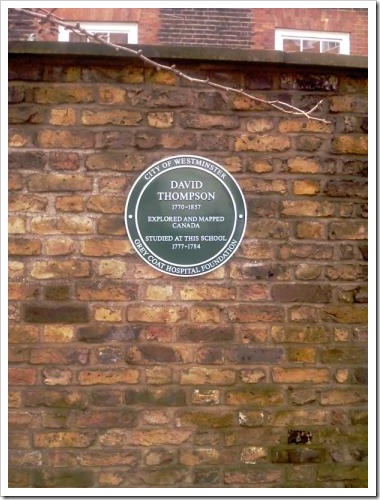
DAVID THOMPSON: EXPLORED & MAPPED CANADA


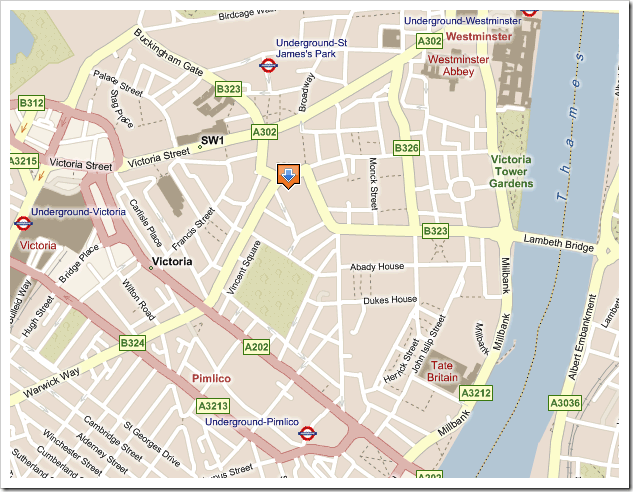
The picture below was sent to me by a colleague as he walked down the street (thanks!). It is Grey Coat Hospital which is now a specialist language school for women.

canada

image

I do not remember David Thompson from history class, so I looked him up:

David Thompson (April 30, 1770February 10, 1857) born Dafydd ap Thomas,[1] was an English-Canadian fur trader, surveyor, and map-maker, known to some native peoples as "Koo-Koo-Sint" or "the Stargazer". Over his career he mapped over 3.9 million square kilometres of North America and for this has been described as the "greatest land geographer who ever lived."[2]

Thompson was born in Westminster to recent Welsh migrants , David and Ann Thompson. When Thompson was two, his father died and the financial hardship of this occurrence resulted in his and his brother’s placement in the Grey Coat Hospital, a school for the disadvantaged of Westminster. He eventually graduated to the Grey Coat mathematical school and was introduced to basic navigation skills which would form the basis of his future career. In 1784, at the age of fourteen, he entered a seven-year apprenticeship with the Hudson’s Bay Company. He set sail on May 28th of that year, and left England forever.[3]

I cannot even imagine sending my 14 year old son away. Different times.

PARIS CONTINUTED: THE LOUVRE

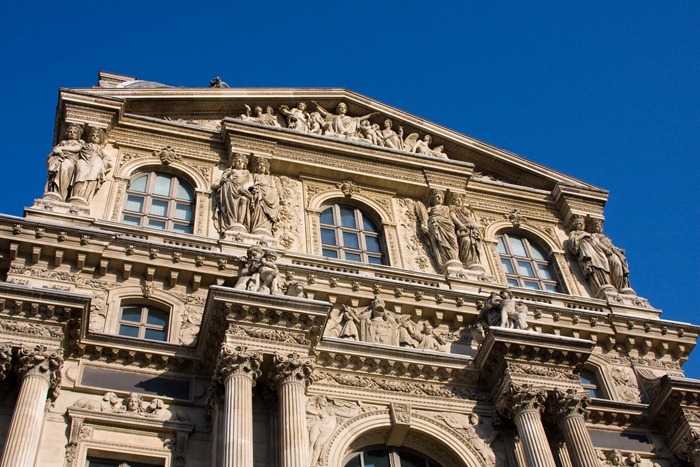
Our third day in Paris was one of those days that we usually say we will never do, completely full from start to finish. The first stop was The Louvre and as one would expect, it was packed. We decided on a whirlwind tour where we agreed to hit the big three.

2008 December 29 The Louvre  _MG_2617

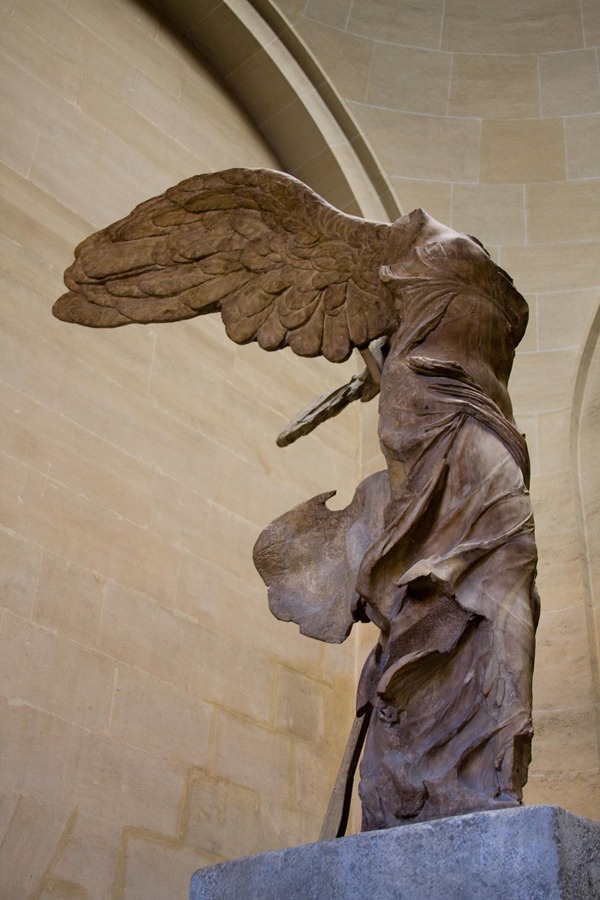
The Winged Victory of Samothrace:

The product of an unknown sculptor, presumably of Rhodian origin, the Victory is believed to date to between 220 and 190 BC. When first discovered on the island of Samothrace (in Greek, Σαμοθρακη — Samothraki) and published in 1863 it was suggested that the Victory was erected by the Macedonian general Demetrius I Poliorcetes after his naval victory at Cyprus between 295 and 289 BC. The Samothrace Archaeological Museum continues to follow these originally established provenance and dates.[7] Ceramic evidence discovered in recent excavations has revealed that the pedestal was set up about 200 BC, though some scholars still date it as early as 250 BC or as late as 180.[8] Certainly, the parallels with figures and drapery from the Pergamon Altar (dated about 170 BC) seem strong.

In April 1863, the Victory was discovered by the French consul and amateur archaeologist Charles Champoiseau, who sent it to Paris in the same year. The statue has been reassembled in stages since its discovery. The prow was reconstructed from marble debris at the site by Champoiseau in 1879 and assembled in situ before being shipped to Paris. Since 1884 it has dominated the Daru staircase.[9] displayed in the Louvre, while a plaster replica stands in the museum at the original location of the Sanctuary of the Great Gods on Samothrace. The discovery in 1948 of the hand raised in salute, which matched a fragment in Vienna, established the modern reconstruction — without trumpet — of the hand raised in epiphanic greeting.

2008 December 29 The Louvre  _MG_2554

Venus de Milo. A fascinating history:

The Venus de Milo was discovered by a peasant named Yorgos Kentrotas in 1820, inside a buried niche within the ancient city ruins of Milos, on the Aegean island of Milos, (also Melos or Milo). The statue was found in two main pieces (the upper torso and the lower draped legs) along with several herms (pillars topped with heads), fragments of the upper left arm and left hand holding an apple, and an inscribed plinth. Olivier Voutier, a French naval officer, was exploring the island. With the help of the young farmer, Voutier began to dig around what were clearly ancient ruins. Within a few hours Voutier had uncovered a piece of art that would become renowned throughout the world. About ten days later, another French naval officer, Jules Dumont d’Urville, recognized its significance and arranged for a purchase by the French ambassador to Turkey, Charles-François de Riffardeau, marquis, later duc de Rivière.

Twelve days out of Touloun the ship was anchored off the island of Melos. Ashore, d’Urville and [fellow officer] Matterer met a Greek peasant, who a few days earlier while ploughing had uncovered blocks of marble and a statue in two pieces, which he offered cheaply to the two young men. It was of a naked woman with an apple in her raised left hand, the right hand holding a draped sash falling from hips to feet, both hands damaged and separated from the body. Even with a broken nose, the face was beautiful. D’Urville the classicist recognized the Venus of the Judgement of Paris. It was, of course, the Venus de Milo. He was eager to acquire it, but his practical captain, apparently uninterested in antiquities, said there was nowhere to store it on the ship, so the transaction lapsed. The tenacious d’Urville on arrival at Constantinople showed the sketches he had made to the French ambassador, the Marquis de Riviére, who sent his secretary in a French Navy vessel to buy it for France. Before he could take delivery, French sailors had to fight Greek brigands for possession. In the mêlée the statue was roughly dragged across rocks to the ship, breaking off both arms, and the sailors refused to go back to search for them.[2]

News of the discovery took longer than normal to get to the French ambassador. The peasant grew tired of waiting for payment and was pressured into selling to a local priest, who planned to present the statue as a gift to a translator working for the Sultan in Constantinople (present day Istanbul, Turkey).

The French ambassador’s representative arrived just as the statue was being loaded aboard a ship bound for Constantinople and persuaded the island’s chief citizens to annul the sale and honor the first offer.

Upon learning of the reversal of the sale, the translator had the chiefs whipped and fined but was eventually reprimanded by the Sultan after the French ambassador complained to him about the mistreatment of the island citizenry. The citizens were reimbursed and ceded all future claims to the statue in gratitude.

2008 December 29 The Louvre  _MG_2591

And last but not least, the Mona Lisa: which was protected by glass as it has been vandalized twice (acid thrown on it once, a rock another time).

2008 December 29 The Louvre  _MG_2564

We did not have a lot of time (and it was just too busy), and we passed by a thousand great pieces (which means we definitely need to go back). One noteworthy part for me was when we passed the Greek and Egyptian displays (having been there, we skipped past). It left me reflecting upon the comments of our guides in those countries and how their history no longer belonged to them. Each went on to explain how large parts of their history is in the museums of the world (Britain and England in particular). Consider the following ….

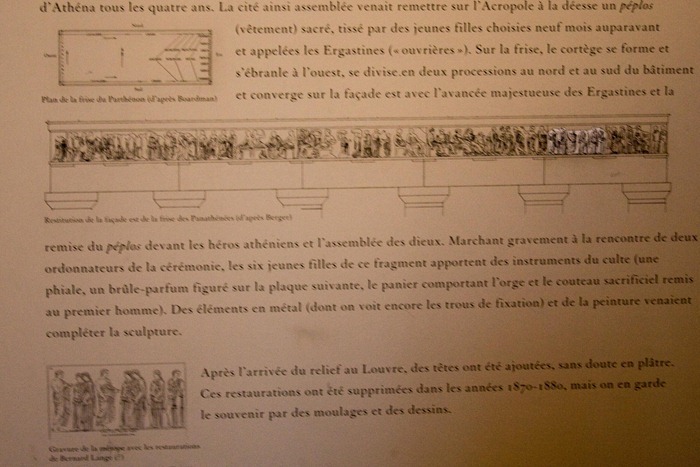
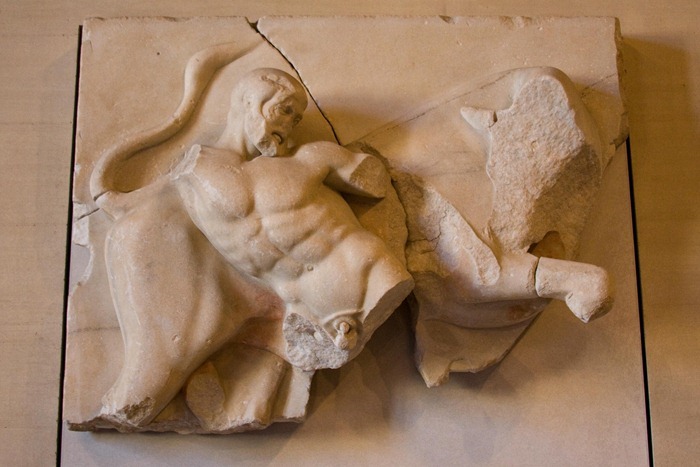
From the Parthenon in Athens, hundreds of statues were taken (the second picture being where this would reside had it been left behind):

2008 December 29 The Louvre  _MG_2589

2008 December 29 The Louvre  _MG_2588

2008 December 29 The Louvre  _MG_2580

A sphinx …. (well over 6 feet high):

2008 December 29 The Louvre  _MG_2600

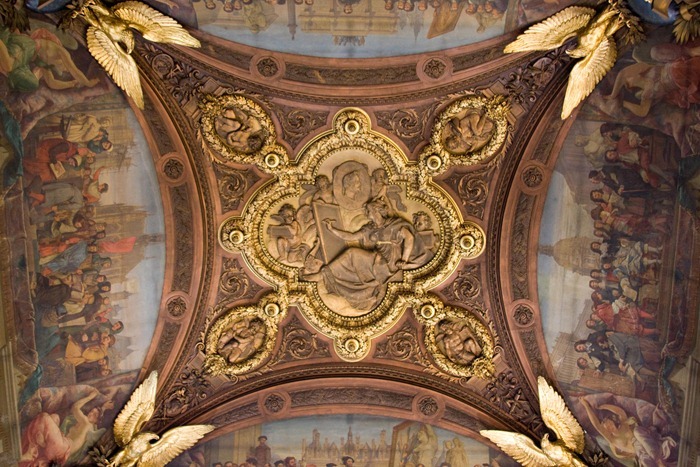
Of course. You need to look up. This is just the roof …

2008 December 29 The Louvre  _MG_2569

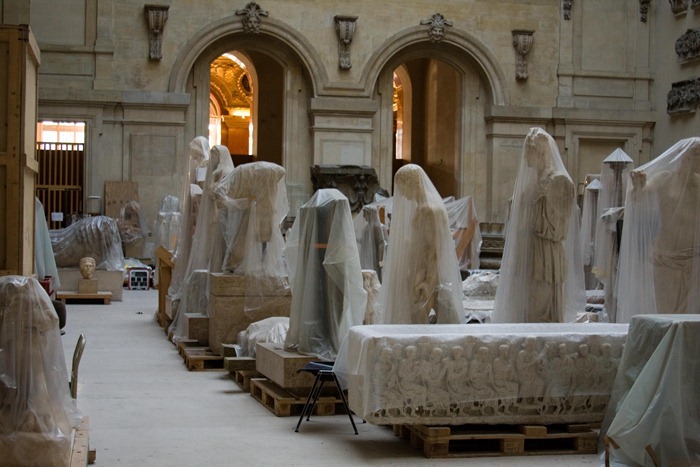
How it looks before they go on display:

2008 December 29 The Louvre  _MG_2577

And that was just the morning.

RHS WISLEY: LET THE BUTTERFLIES GO!


I have been remiss on finishing out a number of our recent UK adventure logs. One that came to mind today is our trip on the 18th of January to the Royal Horticultural Society Wisley garden.

I remembered the visit thanks to a friend sharing that Canada is getting pounded by another –15 degree spat of weather. This weekend was 10 and sunny, we played tennis. Which brings me to RHS Wisley which is a lovely garden a short drive away. On a beautiful January day we walked the gardens, drawn to the event of the day – the release of 1,000 butterflies.

In the office, when I shared my weekend, I had several people reply in shock ‘WON’T THE DIE?’. To provide clarity, it was the releasing of the butterflies within the greenhouses.

 2009 01 18 Royal Wisley  _MG_2934

2009 01 18 Royal Wisley  _MG_2944

2009 01 18 Royal Wisley  _MG_2963

2009 01 18 Royal Wisley  _MG_2968


2009 01 18 Royal Wisley  _MG_2954

In the end I counted about 20 butterflies. I am sure they were hiding.

I don’t miss the snow and –15. I do miss my garden. A wonderful day. To my Canadian friends, if you can, get down to the Niagara Falls Butterfly Conservatory, it is amazing.

A POSITIVE WORD: MARCH 2009 HARVARD BUSINESS REVIEW


It seems like everywhere we go and everything we read is focused on one thing – the negative state of the economy. Unfortunately, negativity sells. It goes back to what one of my favourite mentors would often said:

‘Make 1 person happy and they will tell 5 people, make one person unhappy and they will tell 250’.

We all face different times with new challenges. As leaders, one of the best leadership articles that I have read over the past months is only a couple paragraphs in March issue of HBR titled Performance Incentives for Tough Times. In the end, it is all about managers recognizing great performance:

Abundant evidence indicates that employee behaviour is a function of its consequences. People do what brings praise and avoid what doesn’t. And good performance will probably decline unless it’s acknowledged.

Leaders need to remember, people leave managers, not companies.

I also enjoyed the article Learning from Heroes:

Like Hercules, Luke Skywalker, and Jack Welch, we all struggle with five recurring challenges as we journey through work and life: We wander without knowing where we’re going. Data and circumstances confuse us. Fear blocks us from acting. Change paralyzes us. And despite our best intentions, we talk more than we listen.

An examination of business writing from the past 30 years shows that these challenges emerge again and again—and the best books offer simple yet profound lessons for overcoming them: Find a clear purpose. Be aware that past experience and a mass of information can interfere with wise decisions. Maintain a bias toward action. Be open to change. Seek feedback.

Feel the force Luke. It is quite simple …..

THE INTERVIEW QUESTION THAT NEVER GETS ASKED

I had 3 conversations about interviewing over the last couple weeks with friends. What do you hire for? How do you sort reality from padding? Personally, I am a big fan of the book Never Hire a Bad Salesperson Again, which focuses on how to bring out someone’s drive and the Predictive Index as both a hiring and development tool.

I had not thought about the importance of the personal angle, as put forth by The Interview Question You Should Always Ask:

What do you do in your spare time?

The premise is that if you are passionate about your trade outside the workplace, it will translate into the workplace. His example being the airline pilot who took his gliding license as a kid, built model airplanes and in his spare time volunteered to improve airline safety.

Interesting thought. Worth pondering what great salespeople or leaders do in their spare time. What does Steve Jobs do in his spare time?

I have started to ask this question, attempting to correlate personal life to business success while also watching for the red flag, the person without an answer.

NHS: NATIONAL HEALTH SERVICE


I have commented on the British Health Care system before. Quite enlightened. While it is as slow as the Canadian system, it does not have some of the silly rigour that yields no value. For instance, if you go into a hospital here you don’t have to show ID, they just take care of you.

In what I can actually call a genuine surprise, we received a survey on the weekend asking us to comment on our Doctor. Amazing. Our doctor here (who caters to ex-pats) is great, but we do find that the it is not as ‘modern’ and the hierarchical element (i.e. I am the Doctor, don’t question) seems to be alive and well.

Of course, I have yet to meet a truly bad Doctor (smile).

A FEW FACTS ON BRITAIN


Over our vacation I did find the time to finish off a book that I had been plugging through vacation to vacation … An Utterly Impartial History of Britain or 2000 Years Of Upper Class Idiots In Charge.

A few enlightening facts:

pg. 412 On the Boer War

Bart Simpson said that there were only three ‘good wars’: the American Revolution, World War Two and the Star Wars trilogy. It is not surprising that the Boer War didn’t quite make it on to the list; it is not a conflict that provides moral certainties to those who are searching for a simple struggle between good and evil. One side was led by Britain’s General Kitchener, who used the opportunity to invent the concentration camp; on the other side were the Boers who later came up with apartheid. You feel that Nelson Mandela would have found it hard to take sides.

pg.422  On being bald

Male pattern baldness was no bar to the very top in the way it is in the current age of TV politics, or else we might have had to fight the Second World War without Winston Churchill.

Since the age of television no bald man has been elected Prime Minister, although John Smith would probably have broken the rule had he lived. Defeated contenders include Sir Alex Douglas-Home, Neil Kinnock, William Hague and Michael Howard – Ian Duncan Smith was dumped before he even had a chance to lose.

pg. 426  On women’s rights

Queen Victoria had written of this mad, wicked folly of ‘Women’s rights’ with all its attendant horrors and around 2,000 prominent women signed a women’s ‘Appeal against Women’s Suffrage’ published 1889. It is generally advocated that by focusing her mind on traditionally male pursuits, a woman’s biological ability to bear children might be adversely affected.

Britain was relatively early among Western democracies in granting votes to women: ahead of the United States (1920), France (1944) and Italy (1945). Swiss women didn’t get the vote until the 1970s and as for Saudi Arabia, well, don’t even ask.

pg. 444   On the odd pub hours

Convinced that alcohol consumption was affecting the production of munitions, the government introduced stricter licensing hours. Pubs would only open for a couple of hours at lunchtime and then close earlier at night in the hope that all factor workers handling high explosives might sleep in their beds rather than a gutter. This drastic step was brought in as an emergency measure just for the duration of the First World War. So when peace returned and you came out of the cinema at 11:01pm and fancied a drink and a chat about the film, you were permitted to do so after November 2005.

pg. 466 More women’s rights

Women’s suffrage has also been overwhelmingly accepted almost without debate in a free vote in the House of Commons. … However, just to annoy them, the men decided that women would not get the vote until they were thirty. Otherwise the men would have had to endure the terrible prospect of there being more women voters than men (due to war losses – more than 750K in Britain), and all the laws would have been about remembering to take things up the stairs instead of just walking straight past them.

pg. 464   A nice way to end WWI

In the latter months of 1918 more people around the world would die of an influenza epidemic than had been killed in the entire war. In Britain, 150,000 people died from so-called ‘Spanish Flu’.

pg. 503   What is a Reich?

Just in case you are wondering, the First Reich was the Holy Roman Empire from around 800 to 1806; the Second Reich was the Kaiser’s Empire declared after the Franc-Prussian war in 1871. They decided not to have another Reich after the Third one, the whole ‘Reich’ brand was a bit tainted by then.

pg. 507   I should have had this quote in the French War museum when the boys asked about the Maginot Line

The French had placed an enormous amount of confidence in the impenetrability of the ‘Maginot Line’ … The only tiny criticism that might be raised against it, and maybe this is just being picky, is that it stopped two hundred miles short of the coast. But surely no German army would be so cunning as to go round it; for when did Germany ever invade France via Belgium? Apart from the last time?

An amazing country.

MOBILE WORLD CONGRESS


I had the good fortune to attend Mobile World Congress again this year and was not disappointed. A few of the highlights that I was able to catch between meetings:

  • The Toshiba booth was filled with innovation. They unleashed the TG01 – their new big screen phone. Hands on, it is an amazing device with video quality off the planet. They also displayed a phone form factor with a Bluetooth keyboard (basically held together by the leather case for travelling). Interesting concept devices.
  • As always, one of my favourite booths was NTT Docomo. They showed the below children’s phone solution with GPS tracking and problem notification and mapping.

NTT Docomo Kids Phone NTT Docomo Kids Phone (2)

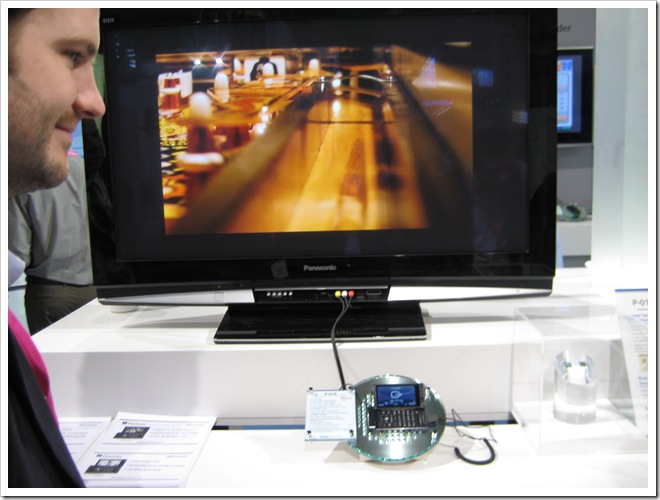
  • Panasonic was running a large screen TV off of one of their phones. Not sure of the application, but very cool. Maybe while in a hotel room? The guy to the left looks impressed.

Panasonic

  • Last, O2 had a really cool demo of Surface going. Video below.

GOING TO THE AIRPORT – BRING PACKING TAPE


I was early for my flight and the flight before was not closed so I had to wait 10 minutes so that ‘I would not lose my bags’ (according the check in lady in Barcelona).

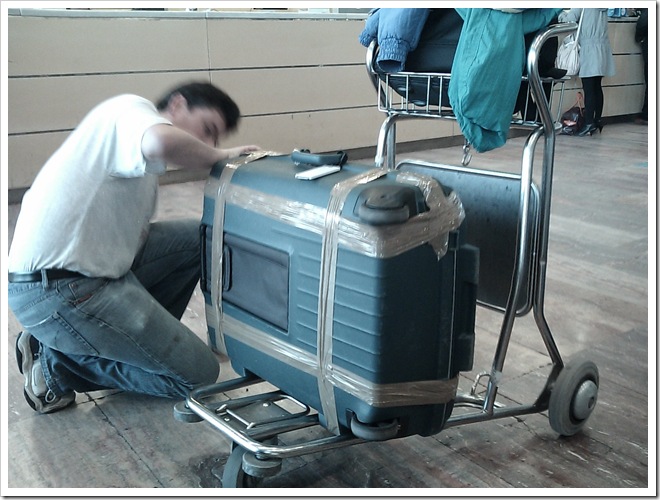
What did I do for those 10 minutes? Well, I tried to read but could not because of this guy and his 10 minute packing tape work right in front of me.

IMAG0040

Why you ask? I know I was wondering that. The luggage looked fine. Buckles were all in shape because he tested them in front of me. He double checked the lock. I observed no cracks. Yet, he used the better part of a roll of packing tape to make that case air tight.

Maybe he has something super valuable in it? Or maybe the answer is buried in this question:

Why do people wear suspenders with a belt?

I will never know.

TURNING YOUR IDEA INTO A PRODUCT


In days not long past, building a product required a lot of capital. The story of James Dyson and his quest to make the best vacuum cleaner at great cost, personal risk and debt being one of many.

Wired had an interesting article in their January edition that goes through sites that allow you to leverage their facilities and designers to mock-up a product:

Whipping up production-ready furniture and laser-cut tchotchkes has always been a cinch on custom-fab site Ponoko.com—for those who know their way around apps like Adobe Illustrator or CorelDRAW. But what if you’re like us — heavy on the ideas, light on the CAD skills? Our DIY dreams die on the napkins we draw them on. Luckily Ponoko recently launched a service just for us. It lets creative types submit concepts to be mocked up by actual designers (if your brain wave is deemed worthy). You can then sell your built-to-order product on the site, CafePress-style. We decided to give it a try, requesting a few items we wish were on the market.

Sites like Ponoko and CafePress-style allow you to quickly mock up a working product at a low cost. One of the 4Ps just got a lot more accessible.

MAN MUCKING AROUND WITH NATURE: Macquarie Island


Australian friends have told me about the problems with non-native animals on their continent, the rabbit problem being the largest and most famous of stories. In Ontario, it is the Zebra Mussel (which has killed out a lot of lake life but really cleared up the water) and the imminent threat of the Asian Carp, spotted miles from Lake Michigan and making their way north – slowly but surely.

The International Herald Tribune had an article on the Macquarie Islands today titled ‘The unintended consequences of changing nature’s balance’. A fascinating read on man introducing new animals and then attempting to unravel the mistake with unintended consequences:

In 1985, Australian scientists kicked off an ambitious plan: to kill off non-native cats that had been prowling the island’s slopes since the early 19th century. The program began out of apparent necessity — the cats were preying on native burrowing birds. Twenty-four years later, a team of scientists from the Australian Antarctic Division and the University of Tasmania reports that the cat removal unexpectedly wreaked havoc on the island ecosystem.

With the cats gone, the island’s rabbits (also non-native) began to breed out of control, ravaging native plants and sending ripple effects throughout the ecosystem. The findings were published in the Journal of Applied Ecology online in January.

"Our findings show that it’s important for scientists to study the whole ecosystem before doing eradication programs," said Arko Lucieer, a University of Tasmania remote-sensing expert and a co-author of the paper. "There haven’t been a lot of programs that take the entire system into account. You need to go into scenario mode: ‘If we kill this animal, what other consequences are there going to be?’ "

With our World Is Flat reality, one has to wonder if this really is just the beginning?

DUBAI


Another great holiday adventure completed, our family is just back from Dubai. I will describe it with one phrase ‘A place like no other’. Will post my thoughts later this week, but here is a start. We stayed on The Palm, one of 3 artificial islands. It is unbelievable – they moved more than 100 million cubic meters of sand and rock to build 2 of the 3 islands. The 3rd island will contain more than 1 billion cubic meters of sand and rock.

As my son and I walked along the beach we watched this ship (below) blow sand into a construction site and had a ‘crane counting contest’ on all the buildings. We got to around 60 cranes, with the visibility low (It is estimated that 25% of the worlds cranes are in Dubai). Unbelievable.

Of interest, it was not as hot as we would have liked at around 25C. Although, one of the locals told me he loved this weather, especially when contrasted to 50C in August with 95 percent humidity.

Amazing place. More to come.

IT STARTS WITH A COMMON REALITY


In four or five conversations over the last week I have come back to the article ‘How Management Teams Can Have a Good Fight’ which provides great insight into conflict resolution inside a management team or with customers and partners.

In my conversations, the focus was on how we build stronger go to market partnerships with our partners and one of the key starting points is this:

  • Focus on the facts. Arm yourselves with a wealth of data about your business and your competitors. This encourages you to debate critical issues, not argue out of ignorance.

Example: Star Electronics’* top team “measured everything”: bookings, backlogs, margins, engineering milestones, cash, scrap, work-in-process. They also tracked competitors’ moves, including product introductions, price changes, and ad campaigns.

How many times do customer or partner relationships go sideways when people do not agree on the facts? When a joint  scorecard or some common form of measuring reality (e.g. a service level agreement with key performance metrics) are not in place, the conversations do not focus on moving the business forward, they often start with data debates.

One of my first mentors always said ‘Perception is reality’, and I have always found that to be true. If I believe one thing – deeply – it is my reality and the basis upon which I make decisions. Which means that to be successful with a customer or a partner, you must start with an agreed upon ‘reality’, and that means investing in a joint scorecard. It will pay off.

THE INTERNET ISN’T ACCURATE?


After blogging the Karl Marx quote without checking the source, I had a buddy forward me the article ‘Americans to Undergo Preschool Reeducation in Advance of Country’s Conversion to Communism’:

In the wake of the cataclysmic failure of free market capitalism and the nationalization of the country’s banks, Americans over the age of seven will be forced to complete a reeducation program designed to re-instill lessons learned in preschool that have been deemed essential to functioning in a communist society by the federal government.

“Kids learn a lot about things like sharing and playing fair during their pre-school and kindergarten years that are gradually forgotten as such values simply aren’t congruous with the everyday world of a capitalist society, but will become of paramount importance once again as the United States transitions to communism,” remarked Pat Caufield of the Department of Education.

Caufield proceeded to describe what the reeducation would seek to achieve.

“In today’s America, for example, a person who’s somehow acquired a number of eggs will assume personal ownership of those eggs. They will say, ‘These are MY eggs, and I will do with them as I please. Perhaps I will eat them in an omelet, or maybe I’ll throw them at a house. Regardless, it doesn’t matter, because they are MY eggs,” Caufield explained, “But such will not be the case in the America of tomorrow. In tomorrow’s America, those eggs will be the people’s eggs. Meaning if a neighbor suddenly gets the wild idea to bake some chocolate whoopee pies and he’s minus one egg, he can come over and help himself – hence the importance of sharing.”

Citing Karl Marx, who presaged: "The owners of capital will stimulate the need of the working class to take expensive, collateral loans to buy their condos, houses and technological products; and, at the end, these unpaid debts will result in the nationalization of the banks upon their bankrupcy, and so the state will be on the pathway to communism," Caufield emphasized the exigency of reestablishing preschool values in all post-adolescent Americans.

"Being too young to understand the concepts of capitalism or exchange their labor for money, preschool children are merely taught not to destroy or deface the material objects that comprise their classroom because doing so isn’t nice," said Caufield, "The same will be true of the communes most Americans will soon inhabit. Though they may get away with breaking things that are collectively owned, breaking things isn’t nice."

It would appear the Karl Marx entry is a parody (smile).

We do not own a set of Britannica Encyclopaedias like my parents did (at a cost of more than one mortgage payment, proudly displayed in a wooden cabinet). Instead, our children turn to the web to seek content for their school projects. I will always remember a friend telling me that a TA in his MBA class made him redo his paper because he referenced Encarta, which the TA said is ‘not to be referenced’.

A cautionary reminder. Maybe it is time to subscribe to Britannica online? After all, $70 per year is a lot cheaper than $2,000 in 1982.

THEIR DARKEST HOUR

Their Darkest Hour: People Tested to the Extreme in WWII by Laurence Rees


While travelling to a lovely airport hotel on the outskirts of Paris for a business review a few weeks ago I stopped in a book shop and felt compelled to buy Their Darkest Hour by Laurence Rees. The book jacket describes the contents as follows:

How could Nazi killers shoot Jewish women and children at close range? Why did Japanese soldiers rape and murder on such a horrendous scale? How was it possible to endure the torment of a Nazi death camp?

Award-winning documentary maker and historian Laurence Rees has spent nearly 20 years wrestling with these questions in the course of filming hundreds of interviews with people tested to the extreme during World War II. He has come face-to-face with rapists, mass murderers, even cannibals, but he has also met courageous individuals who are an inspiration to us all.

It is an engrossing read, with the 35 interviews containing portraits of monsters who are now ordinary grandfathers and grandmothers, living their lives. Time and time again, the atrocities and sins of the past are explained away as a different time, with many looking back at the events as if it happened to a different person. At least, that was my first reaction.

The stories that shocked me the most were not the Japanese slaughter of the Chinese, Stalin’s atrocities or the German actions towards Jews and others. They are disturbing, but believable because they are well publicized and what we have come to expect. The most shocking were the Allied stories:

  • pg. 54:  (US Marines)

‘We did not ever take a Japanese prisoner,’ said Eagleton simply. ‘In the two years that I was overseas I saw no prisoner every taken …. Once thirty or forty of them came out with their hands up. There were killed on the spot because we didn’t take prisoners’

  • pr. 112-113: referencing the BBC2 documentary ‘A British Betrayal’ that Rees wrote.

World War II is looked on by many readers as a uniquely moral war – a conflict in which the good guys behaved well and the bad guys behaved badly. Indeed, in Britain it is almost the period by which we define ourselves: our values, our beliefs and our sense of self can all be traced in large measure back to those years. All of which makes it more inconvenient that there exist moments in this history when the good guys did not behave well – moments, in fact, when the good guys behaved very badly indeed. And the circumstances surrounding the handover by the British to the Soviets in 1945 of around 42,000 Cossacks make for particularly disturbing reading.

…. a reminder of a reality that we sometimes forget. Just because a decision has a catastrophic impact on thousands of people, it doesn’t necessarily need to have had any real effect on the handful of people who made it.

The final page sums up where I finally ended up, reflecting on the experiences of the 35 (pg. 278):

If most people’s character and beliefs are more susceptible to change with circumstances than we might think, it also follows that we have to consider the testimony in this book with humility. ‘That’s the trouble with life today,’ one former Nazi once said to me, ‘people who have never been tested go around making judgements about people who have been tested’ And whilst this sentiment did not stop me condemning this man’s wartime actions, his words did make me think more carefully before confronting the question: ‘What would I have done?’

In the end each of us has to decide for ourselves how we might change were circumstances to alter. Maybe terrible adversity would bring out the best in us, or, just maybe, it would reveal the worst. What do you think? What would you have done?

Reminds me of the story I learned in Sunday School where Peter denies knowing Jesus. And as one person said in the book, ‘I wasn’t brave enough to be a martyr.’

What would I have done? Humility, for sure.

A GOOD CREW


From Their Darkest Hour, Laurence Rees:

Recently I interviewed one of the most famous German U-boat captains of World War II and asked him what qualities were required of a submarine commander in action. He replied: ‘The most important quality a U-boat commander needed during the war was simple – a good crew.’

So true.

PLEASE: NO MORE SARCASTIC CANADIAN EMAILS


To all of my Canadian and American friends who have thought it necessary to send me a sarcastic note about the ‘Great Blizzard of Britain’, you can now stop. I have not forgotten what a Canadian winter is like and I agree, 5 inches of fluffy white snow that gracefully falls to the ground in fluffy looking white bunny bunches is not the driving sleet of Highway 400 risking a 100 car pile-up.

I get it.

That being said, my favourite email was to Narda and is a study in subtlety, enjoy:

Subject: ‘Blizzard’

So sorry to hear about your 10 centimetres of snow.


To each of you who emailed me, I have only one response: ‘So sorry to hear about your next 6 weeks. Our snow is almost gone’ (wink)

SNOW IN ENGLAND


A major snow storm hit the UK yesterday shutting down the greater London area.   A Canadian would have looked at it as a normal winter day, although their lack of snowploughs makes a big difference. It was a beautiful day, the boys actually got 2 days off. I wish I would have had time to play in the snow with them.


PS: One interesting side note. In the UK, customer service is a bit of a bi-polar experience. Often really bad, but here and there beyond what I would expect. Online grocers and the milkman are examples. Yes, we have a milkman. Rain or shine, this guys shows up at 5:00 a.m. 3 times a week. On Monday, I opened the door at 6 a.m. and the snow was falling, 7 inches covered the roads and the only tracks were those of the milkman who had driven his open air, rickety milk wagon to deliver our products. Amazing.

PARIS DAY 2 CONTINUED


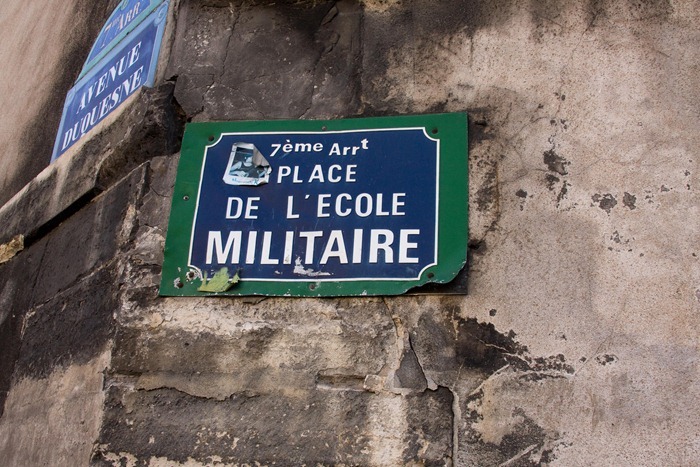
After enjoying the Catacombs, we headed toward the Eiffel Tower and the Military Museum. Our first stop was lunch at a little French deli near École Militaire. The food  was fantastic and we did everything that we could to get the French lady who was serving us to smile (she certainly was not going to speak English).

The École Militaire is a vast military training facility near the Eiffel Tower and had I read the map correctly, I would have realized that it was not the Musée de l’Armée that we were looking for. It is very vast and in the biting wind, the troops were getting a bit frustrated that I could not find the entrance.

2008 Dec 28 Paris Armoury-4

2008 Dec 28 Paris Armoury-5

As we circled, we came across this memorial and to the best of my knowledge this refers to the round-ups of Jews and other political targets in Paris:

December 12, 1941:
Arrests in homes. Roundups carried out in Paris, regardless of nationality but aimed particularly at French Jews (dignified Jews) – sent to the camp of Compiegne.

2008 Dec 28 Paris Armoury-6

Coming around another corner, I finally realized we were circling around the wrong building (DOH). Guess I should have looked up earlier.

2008 Dec 28 Paris Armoury-7

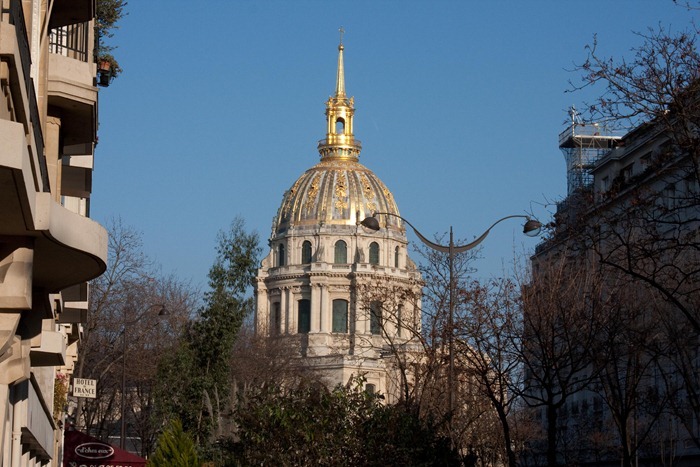
I should have realized that it was the building with the gold roof.

2008 Dec 28 Military Museum Paris_-2

The Musée de l’Armée is a museum at Les Invalides in Paris, France. Originally built as a hospital and home for disabled soldiers by Louis XIV, it now houses the Tomb of Napoleon and the museum of the Army of France. The museum’s collections cover the time period from antiquity until the 20th century.

The start of our tour was the tomb of Napoleon (among others). This is a magnificent building dedicated to one of the world’s greatest generals:

Within Les Invalides is the final resting place of Napoleon Bonaparte.

The former emperor’s body was returned to France from St Helenain 1840 and, after a state funeral, was laid to rest in St Jerome’s Chapel while his tomb was completed in 1861.

There was no expense spared for the tomb and Napoleon Bonaparte’s body lies within six separate coffins. They are made of iron, mahogany, two of lead, ebony, and the outer one is red porphyry.

The tomb sits on a green-granite pedestal surrounded by 12 pillars of victory.

2008 Dec 28 Military Museum Paris_-8

I found this book very interesting, it is Napoleon’s notes about Adam Smith’s The Wealth of Nations, which influenced his thinking. The Scots would be proud.

2008 Dec 28 Military Museum Paris_-18

What is also interesting (and not publicized) is the fact that the tomb also hosted hundreds of President  Mitterrand’s spies who kept tabs on his enemies.

A FORMER French spy chief has revealed how a bunker beneath Napoleon’s tomb was used by hundreds of secret policemen to monitor the conversations of politicians, writers and celebrities.

Pierre Charroy, 69, a retired general, lifted the veil last week on one of the most sensitive secrets of French intelligence when he told a court about the so-called inter-ministerial control group, or GIC, that he ran for 16 years.

He is one of 12 accused in the “Elysée-gate” scandal, a case that has made history by showing the extraordinary lengths to which the late President François Mitterrand went to keep tabs on his enemies.

Abusing the near absolute powers of the French presidency, the Socialist leader set up a cell of security officials in the Elysée Palace to protect secrets such as the existence of his illegitimate daughter and his work as an official in the collaborationist wartime Vichy government.

We then headed into the museum. Put a male in a war museum, you can never go wrong. The museum covers all major wars and France’s colonial days. A few highlights for me ….

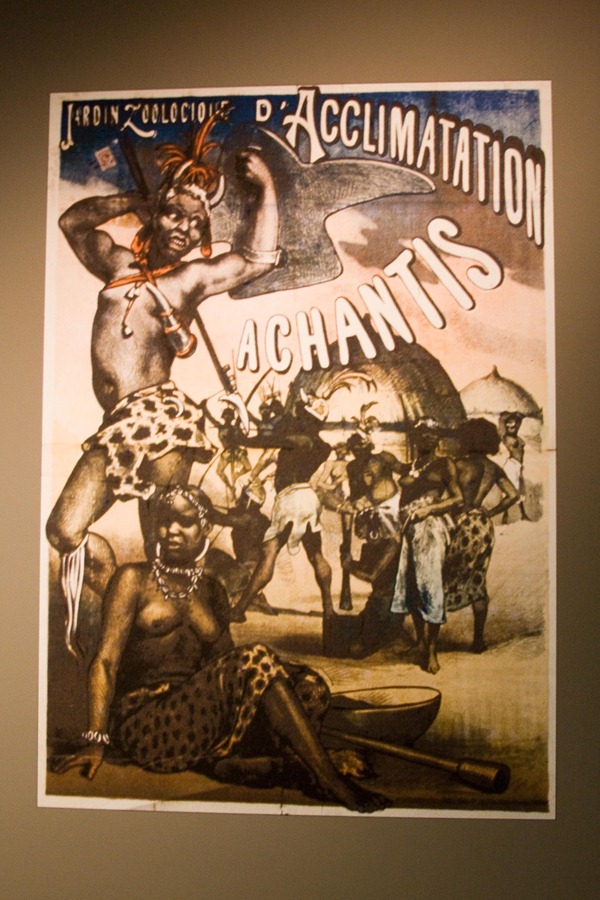
It is scary to think that exploitation of Africans was so common place in an era not that long past. These posters are from 1905, The paper on the right was denouncing the exploitation of black Africans (November, 1905).

2008 Dec 28 Military Museum Paris_-26

2008 Dec 28 Military Museum Paris_-27

During the Battle of the Marne (WWI), the German’s tried to encircle Paris. At one point, the legend of the Taxis of the Marne was created, where 670 taxis took 6,000 troops to the front as the rail system was too congested. You can read about it here. It should be noted that the fares were paid, at 27% of the metered rate.

2008 Dec 28 Military Museum Paris_-30

This weapon stopped me in my tracks. In the middle of machine guns and artillery from WWI was a French made cross bow. It was used to hurl grenades and made from wood. Someone must not have seen the memo about the move to Gatling guns and mortars.

2008 Dec 28 Military Museum Paris_-36

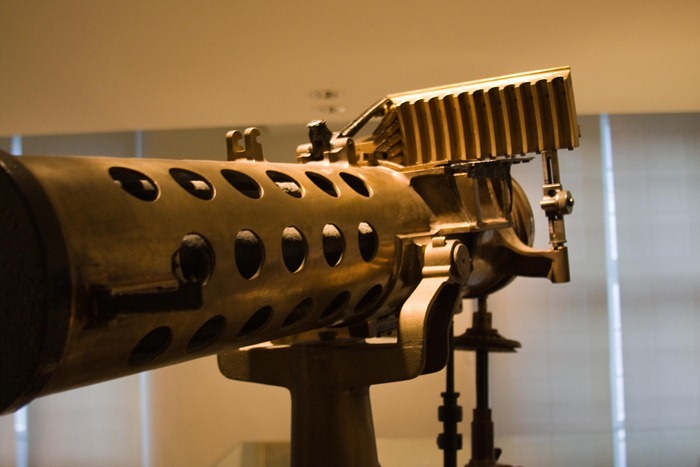
The tank changed the cavalry but it was the Gatling gun that changed man’s approach to infantry. This 1939 Gatling gun looked menacing.

2008 Dec 28 Military Museum Paris_-24

This map reaffirmed my admiration for the British in World War II. A small island of blue holding out against the Axis regime. Thank God for the British and Churchill.

2008 Dec 28 Military Museum Paris_-41

The benefits of video games? My boys could name an astonishing number of weapons in that museum including the German Goliath, the tracked mine (thanks to Company of Heroes). It was bigger than I imagined.

2008 Dec 28 Military Museum Paris_-52

So ended day 2, strolling past a beautiful flower shop on our way back to the hotel.

2008 Dec 28 Paris_-3

RAMBLINGS FROM THE INTERWEB ….


  • Supposedly Richard Branson’s favourite customer complaint.
  • A very cool website. PipeBytes let you transfer any size file.
  • Robin Williams on Obama’s election.
  • The tunnel of death:  The 3,150 meter long Lefortovo tunnel, in Russia , (near POLAND ) is the longest in-city tunnel in all of Europe. It is nicknamed ‘The Tunnel of Death’. There is a river running over the tunnel and water leaks onto the roadway at some points. When the temperature reaches nearly -60ºF like it does in Russia’s winter, the road freezes and becomes as slippery as…well…ice. The result is the video below, which was taken during a single day with the tunnel surveillance camera.


KARL MARX ON CREDIT


This quote was just forwarded to me and it warrants posting:

"Owners of capital will stimulate working class to buy more and more of expensive goods, houses and technology, pushing them to take more and more expensive credits, until their debt becomes unbearable. The unpaid debt will lead to bankruptcy of banks, which will have to be nationalized, and State will have to take the road which will eventually lead to communism."

Karl Marx, 1867

I SEE DEAD PEOPLE – PARIS DAY 2

We decided to stay in the heart of the city, at the Hyatt which made it easy to get to the subway and move around Paris (public transit is fantastic).

Walking out of the hotel we received our first big Paris experience – the cold. It was hovering around –2 but there was wind chill. As a family of Canadians who have not seen a Canadian winter in 2 years, we found –7ish crisp VERY cold (how quick we forget).

2008 Dec 28 Our first walk in Paris_

2008 Dec 28 Our Starting Point in Paris_

Paris is littered with great food shops. As we walked to the subway stop we noticed these truffles in the window. Note the price for the white truffles. These are not Cadbury truffles (smile).

2008 Dec 28 Paris Truffles_-2

2008 Dec 28 Paris Truffles_

Our first stop was the Paris Catacombs. We had to wait in line for a half hour and noticed these protestors in the park next to us. The boys went up and asked what they were protesting. Turns out they were protesting smoking, although I wonder if they were protesting people who smoked or the Paris smoking ban?

 2008 Dec 28 Antismoking Sleep In_

The line slowly moved forward and after a short wait, we entered the catacombs:

The Catacombs of Paris or Catacombes de Paris are a famous underground ossuary in Paris, France. Organized in a renovated section of the city’s vast network of subterranean tunnels and caverns towards the end of the 18th century, it became a tourist attraction on a small scale from the early 19th century and has been open to the public on a regular basis from 1867. The official name for the catacombs is l’Ossuaire Municipal.

This cemetery covers a portion of Paris’ former mines near the Left Bank‘s Place Denfert-Rochereau, in a location that was just outside the city gates before Paris expanded in 1860. Although this cemetery covers only a small section of underground tunnels comprising "les carrières de Paris" ("the quarries of Paris"), Parisians today popularly refer to the entire network as "the catacombs".

The catacombs are massive. We exited at least 6 blocks from where we entered.

2008 Dec 28 Paris Catacombs_-3

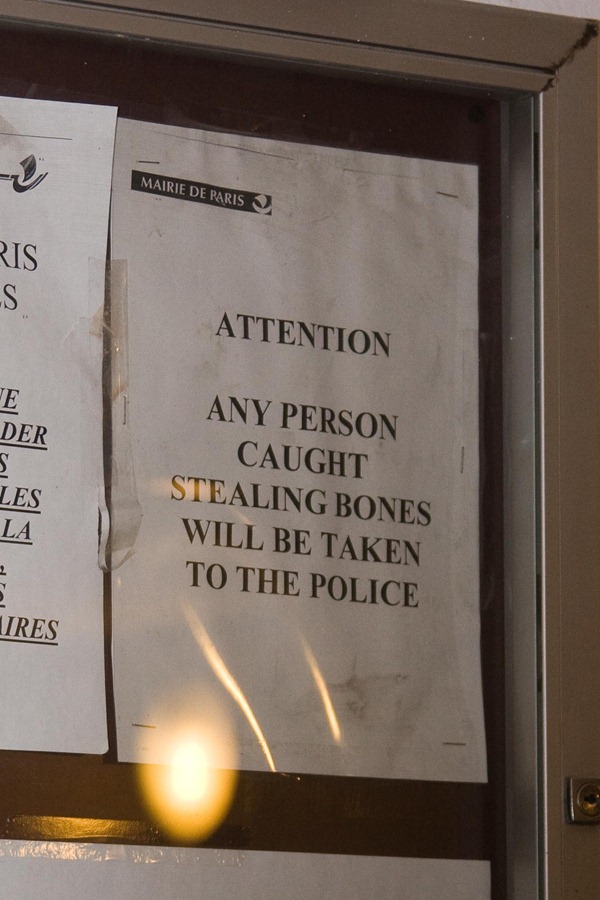
I found this sign at the entrance quite interesting. Who would steal bones? Turns out lots of people. At the exit the security guard had a stack of bones and skulls that he had confiscated from people. But he doesn’t bother calling the police.

2008 Dec 28 Paris Catacombs_-4

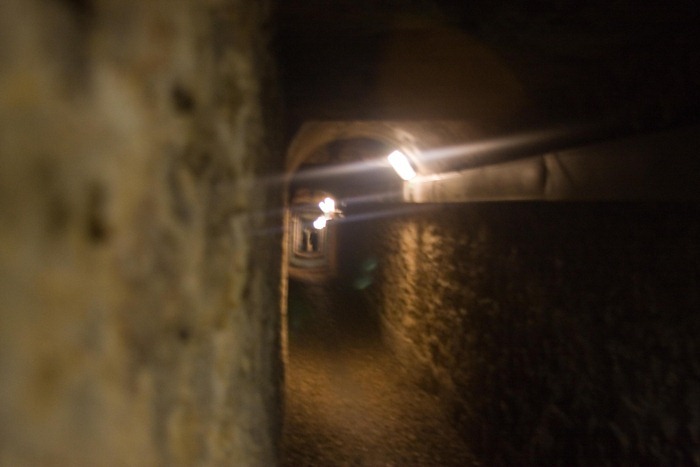
It is roughly 135 steps down to the catacombs, and then it is through a series of tunnels. My camera instantly fogged up (and kept fogging) because the humidity was very high, with water dripping from the ceilings. The ambiance was quite effective and unsettling.

2008 Dec 28 Paris Catacombs_-6

2008 Dec 28 Paris Catacombs_-7

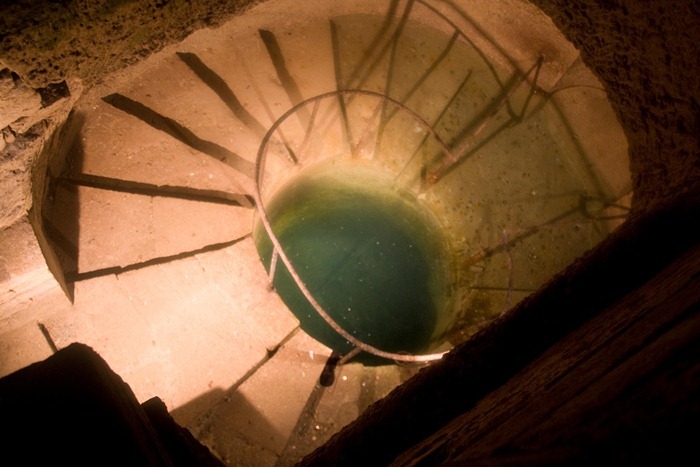
After a myriad of tunnels, you finally arrive at the catacombs. The Quarrymen’s foot bath is where the workers would draw water for personal use. The water was a rather eerie green.

2008 Dec 28 Paris Catacombs_-13

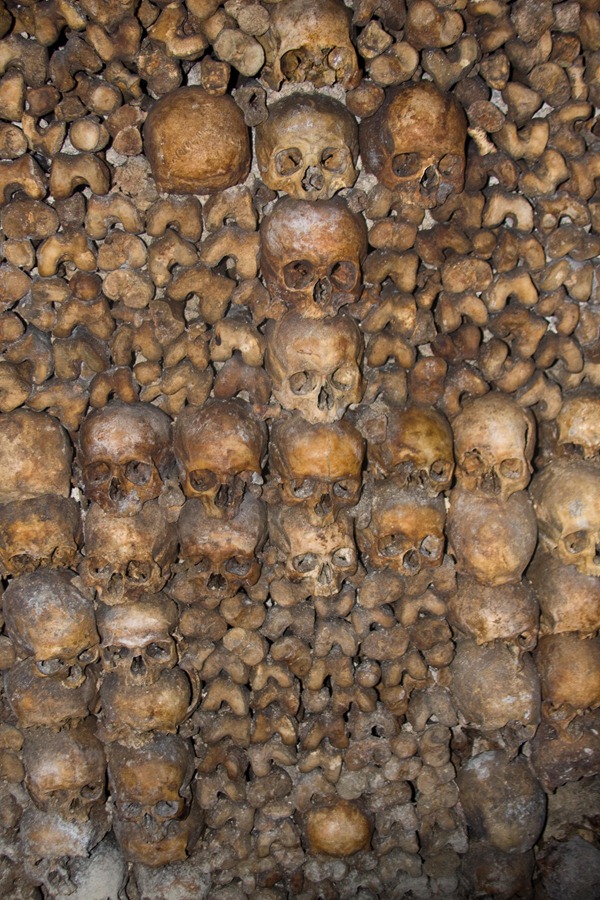
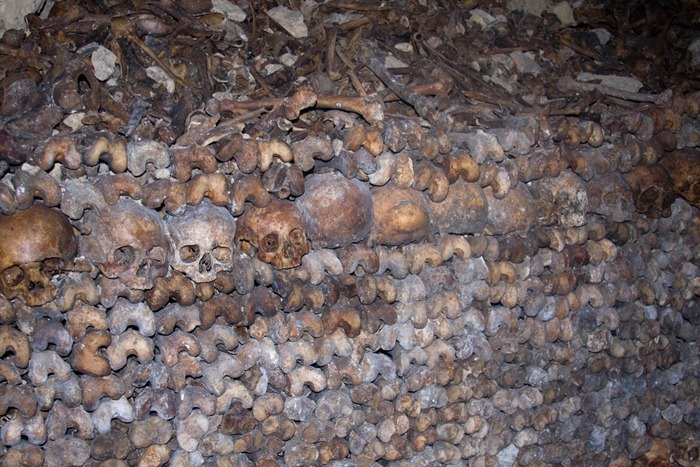
And then there it is. The bones of 6 million (estimated) Parisians. Initially, the bones were simply thrown into the tunnels but during Napoleon’s time it was ordered that they be arranged. The front bones are in neat piles, with the rest jumbled in behind. It is genuinely creepy (but a must see).

2008 Dec 28 Paris Catacombs_-14

Various designs adorn the bone ‘walls’.

2008 Dec 28 Paris Catacombs_-21

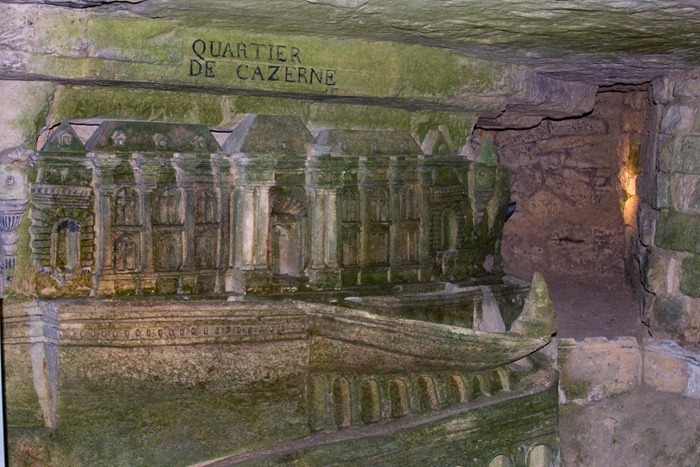
Part way through the catacombs you come upon a sculpture carved into the wall, Port Mahon gallery, carved by Decure, a veteran of the armies of Louis XV. The town of Port Mahon is in Minorca, where Decure was kept prisoner by the English.

2008 Dec 28 Paris Catacombs_-9

There are few bodies that were actually buried in the Catacombs. Those killed during the massacres of September 1792 were:

The September Massacres[1] were a wave of mob violence which overtook Paris in late summer 1792, during the French Revolution. By the time it had subsided, half the prison population of Paris had been executed: some 1,200 trapped prisoners, including many women and young boys. Sporadic violence, in particular against the Roman Catholic Church, would continue throughout France for nearly a decade to come.[2]

2008 Dec 28 Paris Catacombs_-18

An amazing start to day 2 … and a final bone design to close …. creepy.

2008 Dec 28 Paris Catacombs_-20

THIS IS NOT A RECESSION


Via Tom Peters:

Don’t think of our current economic crisis as a recession. Instead, think of it as a recalibration.

Everything is different now.

If you think of it as a recession, you may be tempted to "hunker down" and wait for the economy to cycle back.

If you think of it as a recalibration, you will be motivated to focus on what you have to do differently, since everything is different now.

The way your business generates results is different, now.

Your customers think differently, now.

Your customers care about different things, now.

Your customers act differently, now.

Your customers may actually be different people, now.

Customers aren’t disposable anymore; more than ever, you have to create sustainable customer relationships.

Everything is different now.

So true…

CONSTANT CHANGE & OBAMA


We live in a new world. As the article ‘The New Reality: Constant Disruption’ points out:

The world is moving so fast that even the short term seems long. Writing his Financial Times column The Long View on a recent Friday morning, John Authors observed that, "as far as many traders across the world are concerned, a ‘long view’… is anything that goes much past Sunday evening."

These are interesting financial and political times. But one thing is for sure, the new US leader is working to act decisively, already ordering the dismantling of CIA prisons and Gitmo. A Harvard article provides insight into Obama in the article ‘How to Communicate like Barak Obama’;

  • Challenge: Yes we can was his campaign slogan.
  • Question: Hear all sides of the issue.
  • Be real: Most evidenced by his letter to his daughters.
  • Decide: Be decisive.
  • Inspire: Absolutely.

Press on.

PERSPECTIVE


There are a lot things going on in the world right now. Obama’s inauguration (a great speech), the crazy financial situation around the world and people experiencing highs and lows. I found this article from John Maxwell’s leadership newsletter particularly interesting. It puts into perspective that old adage that ‘money does not buy happiness’, something many people will need to remember over the coming period.

Distraught over massive financial losses incurred during the past year, Adolf Merckle scrawled a suicide note to his family and wandered out the door into a dark, wintry night. He made his way for the railway where he stood by the tracks and waited in the cold. Spotting the headlight of an oncoming railcar, he threw himself under the train and took leave of this world.

As tragic as the suicide was, it would not have received worldwide press apart from one shocking fact: Adolf Merckle was valued at 9.2 billion dollars, ranking 94th on Forbes 2008 list of the world’s richest persons.

It can be hard to fathom the extent of Mr. Merckle’s wealth, a billion dollars being such a staggering sum. Think of it this way, 9,000 people could each win a million dollars in the lottery, pool their money together, and still have less money than Mr. Merckle was worth. Or, the entire nation of Haiti (8.5 million people) could work for two and a half years without accumulating income equal to Mr. Merckle’s portfolio.

The author provides two pieces of advice; remember to thank people for their great work (because it can just get so busy that we forget) and avoid selective hearing – continue to appraise the situation and adjust. He closes with one last line:

Like a mountaineer, you may be enduring a rocky, uphill stretch. If so, keep fighting to gain perspective. Hard work and persistence seldom go unrewarded, and they often carry you to a glorious destination.

So true, PRESS ON.

GUITAR HERO MYSTIFIES


I found it interesting to read the two viewpoints on the game Guitar Hero (and others like it) in this article (Via):

Real musicians:

"I’ve been puzzled by the popularity of the game Guitar Hero," writes Rob Horning at PopMatters. "If you want a more interactive way to enjoy music, why not dance, or play air guitar? Or better yet, if holding a guitar appeals to you, why not try actually learning how to play? For the cost of an Xbox and the Guitar Hero game, you can get yourself a pretty good guitar."

There seems to be a consensus that real musicians look down on games like this. I can understand their point of view. After all, to become a musician is a lot of hard work.

While the comments about the article provide a different viewpoint:

Sean has it right. All the silly crying about guitar hero is about as absurd as it gets.

All sorts of people who would have never thought they would be able to play guitar are trying it out because guitar hero was fun, and showed them that ‘hey, maybe I could play guitar a little bit.’

And further, it’s exposing people to a lot of music they never would have otherwise sought out. You’d think people who really loved music would think these to be good things. But instead the reaction has been largely one of snobbery, like this blog post.

I found this statement particularly interesting:

The moment you will find me grinning: When ten years from now, one or more newly famous rockers credit their music career to Guitar Hero getting them interested in music. Only then will all this ridiculous hand wringing be put in its proper context.

Interesting to see a debate rage. Personally, I find the game a ton of fun to play with the family. But I hold no illusion that I am a musician (I was a good Sax player at one point, but that was long ago) nor do I want to become one. We will see if it impacts my boys, there is talk of guitar lessons.

In the meantime, EA’s sales of Guitar Hero III becomes the first game to cross $1 billion. Amazing.

TRAVELLING TO PARIS – DAY 1

Over the Christmas break our family elected to spend it in Paris. Our first decision was an easy one, spend time in the airport during the holidays or drive to Paris. We quickly settled on the drive (with a few reservations as it is much longer than our Brugee journey) via the Eurotunnel.

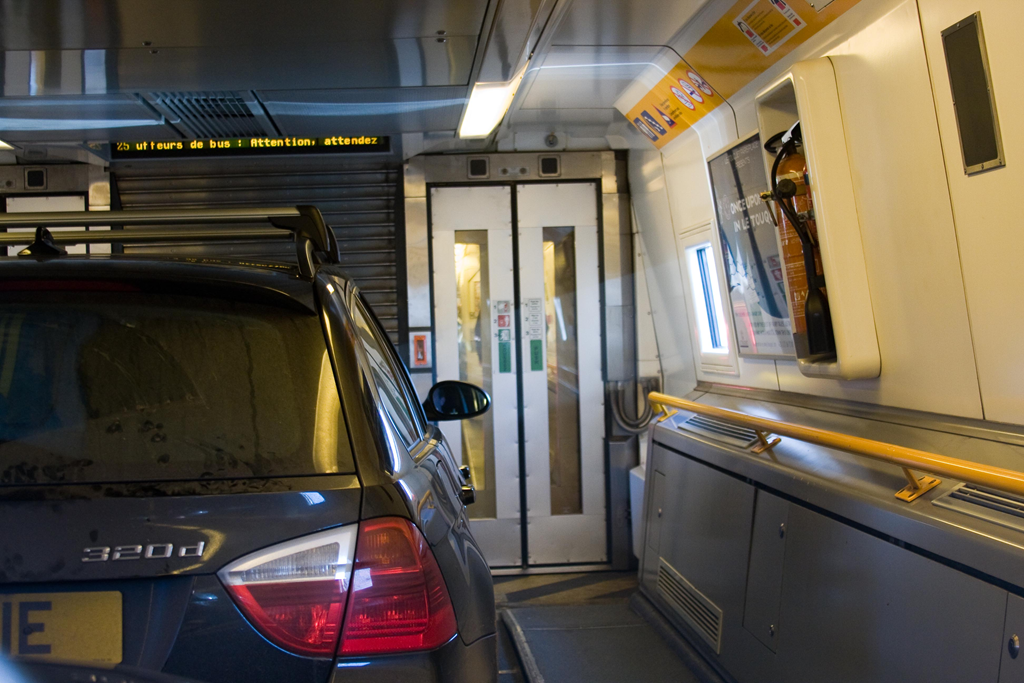
Again, it was surprisingly easy. Approximately 6 hours door to door with roughly 1 hour waiting on the train (to board). The tunnel itself is an engineering wonder and sitting inside the train with a couple hundred other cars is surprisingly relaxing. Correction, relaxing once I had asked the people in front of us to roll up their windows as I was growing weary of listening to High School Musical 3 blaring from their DVD player.

image

Driving into Paris around 4 p.m. (We are not into the whole ‘get on the road early’ thing), we headed directly to our first tourist destination: The Pompidou Center:

Centre Georges Pompidou (constructed 1971–1977 and known as the Pompidou Centre in English) is a complex in the Beaubourg area of the 4th arrondissement of Paris, near Les Halles and the Marais. It was designed in the style of high-tech architecture.

It houses the Bibliothèque publique d’information, a vast public library, the Musée National d’Art Moderne, and IRCAM, a centre for music and acoustic research. Because of its location, the Centre is known locally as Beaubourg. It is named after Georges Pompidou, who was President of France from 1969 to 1974, and was officially opened on 31 January 1977 by the then-French President Valéry Giscard d’Estaing.

An interesting building, designed with the ‘guts’ of the building on the outside.

image

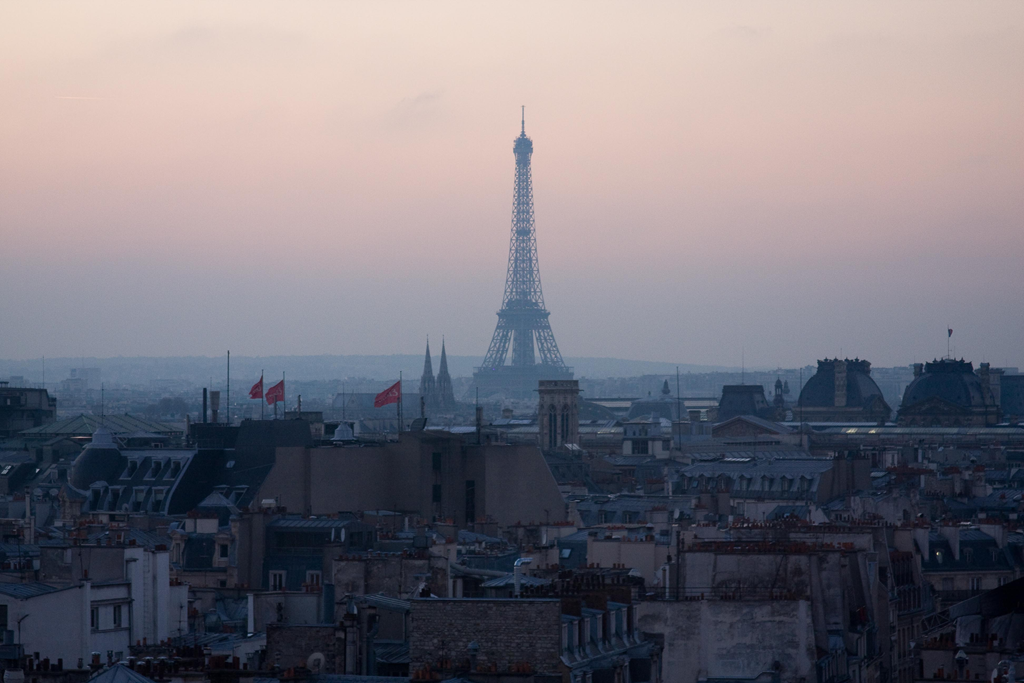
The center is dedicated to a French President who loved the arts, with a library and a few museums. We went straight to the top to catch the sunset from the restaurant Georges. It was a spectacular view of the city which you enjoy from here via their live webcams or here for a 360 degree view..

The view needed to be great, because the food was average, expensive and the service was VERY poor. It was very clear to me that they picked their staff based on their looks and whether or not they would complement the ‘modern art, trendy location’ ambiance versus aptitude (they would rival the British for bad service). But like I said, we were there for the view:

image

image

Frustrated, but still enthusiastic, we headed down to the very cool Junior Pompidou interactive gallery, filled with interactive light and music displays. The boys particularly enjoyed posing for the light wall.

image

It was then off for a quick tour of the modern art museum, which has digitized much of the collection here. Of course, this is where the pragmatic small town boy in me comes out. I see art in many of the pieces, but am really challenged by others.

For example, I get this piece of art: This is a protest piece. This is an artist who has something to say and is expressing his point of view. Of course, this is why it is not surprise to me that during the same year that he made this piece, he was also busy signing manifestos with his fellow art buddies:

October 27
Signs a manifesto with Klein, Raysse, Hains, Tinguely Spoerri and Villeglé, thus founding the “Nouveau Realisme” with the Critic/Art Historian Pierre Restany. New Realism= new perceptive approaches of reality.

This fellow is deep. Apologies for the picture, no filters on hand. Click the link above for one without reflections.

image

Now, here is where I struggle. To me, this piece, in British terms, is ‘taking the piss’. I know, the art elite are in shock. How can I not see it? Have I no vision?

To me, this artist is laughing all the way to the bank. Seriously, am I the only one? And to make it even funnier, it is a prominent location near the entrance.

image

The title of this magnificent piece? Dark Blue Panel by Ellsworth Kelly. When commenting on his style:

William Rubin noted that “Kelly’s development had been resolutely inner-directed: neither a reaction to Abstract Expressionism nor the outcome of a dialogue with his contemporaries.”[7] Many of his paintings consist of a single (usually bright) color, with some canvases being of irregular shape, sometimes called “shaped canvases.” The quality of line seen in his paintings and in the form of his shaped canvases is very subtle, and implies perfection. This is demonstrated in his piece Block Island Study 1959.

I love reading art reviews. Said one art critic to the other over a glass of white wine ‘Magnificent. Look at the way he has taken this 12’ by 12’ canvas and only covered it in the darkest black, and only black. Minimalist mastery. It is like I am looking into the tortured soul of the artist. I must have this, it is a bargain at $6,000’.

To add to the humour of the situation, Ellsworth is an American artist. I wonder when the French will finally realize that this is simply an American getting the last laugh? And not just an American … A New Yorker …

So ends day one, with a laugh. Thanks Ellsworth.

ON THE LIGHTER SIDE: WHAT IF THE WORLD WAS WIPED OUT BY AN ASTEROID?


Funny how one thing leads to another. This blog entry and video lead me to the Discovery Channel video of an Asteroid hitting the earth:

A hundred years ago a large meteor exploded ten kilometres above the Earth’s surface in Tunguska, obliterating 830 square miles of woods. It was the largest impact in recent history, but nothing compared to this.

The meteor—or comet fragment—was only a few tens of meters in diameter, according to modern estimates based on its 15 megatons energy blast. This 3D simulation, however, shows what something like Apophis will do if it hit Earth. I saw a while ago on the web, but now it is available in glorious HD, so you can see all the gritty-nitty detail of good old planet Earth getting completely obliterated.

A small meteor hitting and obliterating 830 square miles is alarming. Edmonton just had a meteor hit in full view. I wonder how big it was?

Of course, if you are a Darwin fan (sorry, I am a Creation guy), then you will think this is par for the course. After all, Darwin fans think things will continue to evolve (Super cool video, but can anyone know what these people are selling?)

CES BRINGS THE NEW TECH


If you are technically inclined, you know that CES is on, the big Vegas show where the manufacturers roll out their new technology and Engadget has been doing a stunning job of covering it. A few that I have found interesting:

  • Toshiba embedding Windows Media Extender technology into their new AV products.. This is a very interesting move. Imagine buying a DVD player and being able to stream the pictures, video and music from the PC through the DVD player to the TV or stereo. Now if a company like Denon would do that, it would be even cooler. The Yahoo news is also interesting with their gadgets on a TV. The routes to the TV continue to proliferate … XBOX 360, HDMI out on the laptop. Many choices. I came across this video, which is the history of Media Centre for the TV – past, present and future – interesting watch.
  • It may be time to upgrade to the latest Harmony remote. I still remember being in the office onCarl Zeiss pushes 3D in updated Cinemizer e day and a guy on our team had been over to their office and seen this new product, the Harmony remote control. A year later, Logitech bought them. Best remote I have ever used.
  • Of course, Windows 7. Beta is out. Interesting overview here. You will be able to download it Friday here.
  • Our boys love building things and I can see how Kodu, the new XBOX LIVE game creation program, will be a huge hit in the house.
  • This is not a CES link, but I really need to get to a demo spot to try these ‘Video eye-wear’ devices.
  • I played with the new line of HP TouchSmart PCs at the Costco the other day. These are very slick devices, with the touch interface and a huge 22 inch screen. Great for a kitchen or dorm room. I remember my first 22 inch monitor, it weighed 150 lbs and cost $2300.
  • They are also posting about MacWorld or something?
  • MSN has a few other neat gadgets from CES including the WowWee Spyball (A little odd) and the Powermat (which I can totally see in my house).
  • DIVX announced full HD and H.264 support.

Over the holidays I acquired some new tech. First and foremost was the Canon Speedlight 430 EXII. I made sure it was the first present opened so that I could capture all of the pictures with perfect lighting (although the comments of ‘Wait a minute guys, don’t open anything else until Dad figures out how to turn it on’ did not go over well. And then of course, disaster struck. A Duracell Plus AA blew up in the flash while we were in Paris. That battery is now on it’s way to Germany courtesy of P&G for testing and a report (which better result in their replacing my brand new flash as I can hear it corroding in the battery department as the second pass).

The second was a wireless router upgrade. This is an interesting one. In the UK, the walls are very thick in the homes. Plaster is alive and well. Which means that getting a connection from floor to floor or even from room to room is almost impossible. At one point I tried to hook up the XBOX 360 with wireless but could never get a good enough signal for video streaming. In the end I resorted to Ethernet over power. But I still was not getting the speed that I truly desired (The broadband provider has a ADSL2 router that I was using, but it always seemed flaky and using XBOX Live lead to challenges (i.e. NAT issues)).

What is amazing to me is the choice. 54mbps, 300mbps, N, N+1, 2.5GHZ, 5.0GHZ, dual band. Plus the reviews are all over the map. CNET says one thing and while Trusted Reviews says another. In the end, I ordered the Belkin N1 Vision after much humming and hawwing for four reasons:

1. Reasonably consistent good reviews.

2. N+1 for coverage for long life (I hope).

3. The LED was reviewed by many as handy. I agree, nice to see download and upload activity at the push of a button.

4. Gigabit Ethernet ports.

And in the true spirit of technology, the day that I buy it they announce the next version at CES with one more feature – dual band. I am not returning it ….

THE POWER OF SLEEP


You can read many things about the power of sleep with most concluding the same thing – you need a minimum amount of sleep to be healthy.

In the article ‘3 Smart Things About Sleeping Late’ (Wired, December), they make some very interesting points:

1 // You may need more sleep than you think.
Research by Henry Ford Hospital Sleep Disorders Center found that people who slept eight hours and then claimed they were "well rested" actually performed better and were more alert if they slept another two hours. That figures. Until the invention of the lightbulb (damn you, Edison!), the average person slumbered 10 hours a night.

2 // Night owls are more creative.
Artists, writers, and coders typically fire on all cylinders by crashing near dawn and awakening at the crack of noon. In one study, "evening people" almost universally slam-dunked a standardized creativity test. Their early-bird brethren struggled for passing scores.

3 // Rising early is stressful.
The stress hormone cortisol peaks in your blood around 7 am. So if you get up then, you may experience tension. Grab some extra Zs! You’ll wake up feeling less like Bert, more like Ernie.

As a night owl myself, I could not agree more. I loved spending sleeping in during the holidays. I can still remember sitting up until 2AM studying in first year University, then coming out of my room and joining a few buddies in the common room to catch a late night re-run of Magnum P.I. 

That being said, I can guarantee you, if we would have had an XBOX 360 we would not have been watching Magnum PI.


Technorati Tags: ,

XBOX DRIVE


I have always been left wondering, what do you do with the 120GB drive on my Elite? I stream music and video from my central server, so not for that. Saving the boys’ games will take KBs. Renting movies will take some space (but those are temporary downloads) and map packs and or music for games like Lips are small. So what?

Yesterday, I was enlightened. Simply press the ‘Y’ button on the launch screen in the new XBOX menu and you get game options which include installing the game to the hard drive. Sure, you still need to put the disk in each time (copyright), but it does not spin and that means less chance to damage the disk and DEFINITELY less noise.

Great new feature of the new skin.

Technorati Tags:

SPEAKING OF EXPECTATIONS


I had the good fortune to read the book Great Expectations by Charles Dickens over the break. Thoroughly enjoyed it. What I did not realize is that it was a week by week serial (the Young & Restless or Eastenders of the time):

Great Expectations is a novel by Charles Dickens first serialised in All the Year Round[1] from 1 December 1860 to August 1861. It is regarded as one of his greatest and most sophisticated novels, and is one of his most enduringly popular, having been adapted for stage and screen over 250 times.

A few quotes stuck with me, make of them what you will:

‘Mrs. Joe was a very clean housekeeper but had an exquisite art of making her cleanliness more uncomfortable and unacceptable than dirt itself. Cleanliness is next to Godliness and some people do the same by their religion.’ page 23

‘That was a memorable day for me, for it made great changes in me. But, it is the same with any life. Imagine one selected day struck out of it, and think how different its course would have been. Pause you who read this, and think for a moment of the long chaining of iron or golf, of thorns or flowers, that would never have bound you, but for the formation of the first link of one memorable day.’ page 72

‘throughout life, our worst weaknesses and meannesses are usually committed for the sake of the people whom we most despise’  page 218

‘In the little world in which children have their existence whosever bring them up, there is nothing so finely perceived and so finely felt as injustice. It may be only small injustice that the child can be exposed to; but the child is small, and it rocking horse stands many hand high, according to scale, as a big-boned Irish Hunter’  page 6

MY 2009 EUROPEAN ECONOMIC STIMULUS PROPOSAL


As I walked around Paris and reflected on the ‘consumer’ experience in the UK, I came upon an economic stimulus idea for the European Union. I like to call it ‘The 21st Century European Retailing Stimulus Package’.

In what many would consider a radical move for Europe, my program calls for:

  • Shops opening in the evening during the week. That means no more closing the shops down at 5 pm. (or 4 pm. depending on your location). That means that on a Friday night, you would actually be able to go to the book store or buy a coffee in the evening. I remember this summer walking in Edinburgh on a Thursday night at 7:30p.m. with the streets packed and not a single store open (not even a pharmacy – which is what I needed).
  • Shops open on the weekends (many don’t).

This will lead to:

  • More jobs (more retail hours = more jobs).
  • Increased customer satisfaction (With the radical idea of retail hours being tailored to the customer’s availability). Although, this depends on whether or not the 16 year old sitting on their butt behind the till at the Waitrose watching me pack my own groceries is also taught to get off his/her butt and help me.
  • My ability to enter a retailer during the week and avoid the weekend rush.

Now, I know that many will be offended by this idea. What about the worker? Why do we need to be more materialistic? We don’t want to be like North America? Hold on a minute, they will say, you must remember that bad customer service is part of the European culture –

Or as a Brit said to me at a New Years eve party ‘I quite like the shops in Windsor’ (Note: I agree – it is just that they are open for such a short period every day!).

I built a diagram to describe it for Parliament ….

                 Let the debate begin.

HAPPY NEW YEAR


Another interesting, unique and exciting year has passed. I cannot believe that it is almost 2 years since our family headed out of Canada. Scary how fast time flies by (something every parent is painfully aware of).

All the best in 2009! And if you need inspiration, well here it is ……

BUELLER!

HAPPINESS & CHRISTMAS


A word of wisdom which seems particularly appropriate considering the current economic climate AND the fact that the holidays are upon us, from one of my favourite business authors, Richard Abraham:

According to James Fowler, Ph.D. and Nicholas Christakis, MD, Ph.D., not only is happiness absolutely contagious, it spreads beyond direct contact between two people to "infect" each person’s social network to several degrees beyond first contact.  Put another way:

  • "The happiness of an immediate social contact increased an individual’s chances of becoming happy by 15%."
  • "The happiness of a second-degree contact, such as the (immediate contact’s) spouse or friend, increased that person’s likelihood of becoming happy by 10%."
  • "The happiness of a third-degree contact . . . or the friend of a friend of a friend, increased the likelihood of becoming happy by 6%."

In the article ‘Peace’ by Justin Pinkerman (As highlighted in John Maxwell’s Leadership Wired eLetter), he makes a similar point under the greater lesson of what we can do as leaders to help people through this tough time:

Let in ……

The loved ones in your life. Laugh together, cry together, share stories from the year. Take joy in being with the friends and family who care about you most. Now is not the time to barricade yourself in the office to plan for 2009. Pause, reflect, and be reminded of what matters most on this earth – relationships.

So true. Optimism, happiness, a positive outlook, remembering what is important, family and a ‘CAN DO’ attitude (both personally and professionally), they all have an impact on those around you both at work and at home. A great piece of advice to carry us into the holidays.

Merry Christmas (or as the Brits say ‘Happy Christmas!’).

BOB & DOUG – CANADIAN FAVORITES


It is around this time of year that the holiday favourites come out and of course Bob & Doug are central to that. I have very fond memories of getting their first album for Christmas (I would be it was around 1981 or 1982) and listening to it over and over and over.

It would appear that FOX and Global have resurrected Bob and Doug for a cartoon. These things usually don’t last, but their 12 days of Christmas animation is fantastic. We will see.

Of interest, turns out that Bob & Doug made their way over to the UK in the 80’s. You can listen to the BBC ‘cast’ here. You have to love the internet and fanatics who take the time to find these things.

image

LEAVING CRETE, MY LAST GREEK POST


After a great week in Greece we packed and headed for the airport. For the first time in a while, our flight was late that evening (10pm) so we were left with a free afternoon. The trip to the airport from the east coast of Crete can be as straight forward as driving 100KM down the highway on the E75. We decided to go another way – through the mountains via the Lassithi Plateau.

image

As we winded our way through the mountains, you really begin to feel like you are heading back in time. The ‘old’ ways still exist. Small villages which rely on local agriculture, the tourist and history that goes back hundreds of years. We stopped at a small town (name unknown) for lunch and above the door was a black and white photo of a man holding his gun (proudly). I asked the woman who that was using the most effective tourist English that I have (speaking … slowly … pointing), it was her father (Who looked like the sort of guy that really ticked the Germans off during WWII).

Narda took the boys to this woman’s stall (we could not resist), where she bought baked chestnuts and an assortment of fruits. After leaving she commented again on the sales prowess of the elderly women, dressed in black and looking harmless and sweet. Make no mistake, if she had a car on hand, we probably would have been compelled to buy. Imagine trying to get a 1952 Datsun back to the UK?

2008 Oct 24 The road to the Lassithi Plateau_

2008 Oct 24 Driving back from the Lassithi Plateau_

2008 Oct 24 The road to the Lassithi Plateau  (11)

The higher into the mountains we went, the more goats we saw. They were everywhere. In places which make sense (like open fields) and in not-so-likely places like sheer cliff faces. Amazing.

2008 Oct 24 The road to the Lassithi Plateau  (15)

Another common countryside fixture were the windmills. Everywhere. Obviously, not functioning at this point, but in previous decades they were key to the local agriculture based culture.

2008 Oct 24 The road to the Lassithi Plateau  (12)

As we reached the top of the mountain road we stopped at a convenience store and I snapped off this shot. The white building in the middle of the valley with no apparent road leading to it is a cemetery and a small chapel.

2008 Oct 24 The road to the Lassithi Plateau  (10)

As you come to the top it opens up into the plateau:

Oropedio Lasithiou (also Lasithi Plateau) (Greek: Οροπέδιο Λασιθίου) is a large (11 km in the E-W direction and 6 km in the N-S, approx. 25 km²), scenic plain located in the Lasithi prefecture in eastern Crete, Greece. It is approximately 70 km from Heraklion and lies at an average altitude of 840 m, which makes it one of the few permanently inhabited areas of such altitude around the Mediterranean.Winters can be very harsh and snow on the plain and surrounding mountains often persists until mid spring.

The fertile soil of the plateau, due to alluvial run-off from melting snow, has attracted inhabitants since Neolithic times (6000 BC). Minoans and Dorians followed and the plateau has been continuously inhabited since then, except a period that started in 1293 and lasted for over two centuries during the Venetian occupation of Crete. During that time and due to frequent rebellions and strong resistance, villages were demolished, cultivation prohibited and natives were forced to leave and forbidden to return under a penalty of death. Later, in the early 15th century, Venetian rulers allowed refugees from the Greek mainland (eastern Peloponnese) to settle in the plain and cultivate the land again. To ensure good crops, Venetians ordered the construction of a large system of drain ditches (linies, Greek: λίνιες) that are still in use. The ditches transfer the water to Honos (Greek: Χώνος), a sinkhole in the West edge of the plateau. Lasithi plateau is famous for its white-sailed windmills that have been used for decades to irrigate the land. Despite their vast number (some 10,000) in the past, most of them have been abandoned nowadays in favour of modern diesel and electrical pumps.

Of course, being Canadian, I would question what a ‘harsh’ winter is like in Crete. I hear they got 14 inches of snow north of Toronto on Saturday and it was –22C. All relative.

2008 Oct 24 Diktian Cave Crete (birthplace of Zeus)  (11)

Of course, the whole history, windmill and agricutural history of Lassithi is intersting and everything, but we were there for a more important reason – the birthplace of Zeus!

The Dictaean cave is famous in Greek mythology as the place where Amalthea, perhaps known in Crete as Dikte, nurtured the infant Zeus with her goat’s milk, the mythic connection to the long use as a site of cult attested here by archaeology. The nurse of Zeus, who was charged by Rhea to raise the infant Zeus in secret here, to protect him from his father Cronus (Krónos) is also called the nymphAdrasteiain some contexts

2008 Oct 24 Diktian Cave Crete (birthplace of Zeus)  (2)

You arrive at the base of the site, surrounded by a few shops and a family churning out freshly squeezed orange juice at their cafe. You need it. It is a long hike to the top.

2008 Oct 24 Diktian Cave Crete (birthplace of Zeus)  (5)

For a few €, you can hire a donkey for the ride up. We walked. We did pass a few people who should have spent the money.

2008 Oct 24 Diktian Cave Crete (birthplace of Zeus)  (4)

When you get to the top you are peering down a 200’ drop to the bottom of the cave. Steep stairs take you to the bottom where it is a bit eerie. Yellow light plays off the walls, the sound of water dripping. Huge stalagmites worn smooth by thousands of years of dripping water. Creepy but cool.

2008 Oct 24 Diktian Cave Crete (birthplace of Zeus)  (34)

2008 Oct 24 Diktian Cave Crete (birthplace of Zeus)  (26)

As we emerged from the caves, the rain started to drop down. We hiked to the car, grabbed a fresh Orange juice and hit the road travelling through the mountains to the main road and the airport.

Another adventure completed.

THE eCARD


I am not a fan of eCards. For some reason, when I receive one, I am instantly left with a feeling that it is ‘too easy’. To send an eCard with a generic greeting lacks personalization and the fact that it can be done so easily (i.e. mass email) means I put low value on the card. Maybe it is because I get so much email – it just gets lost in the noise.

That all changed recently, when my wife came across the cool web application Smilebox. The service allows you to choose from hundreds of card templates, upload pictures and videos and custom music (choose from their 2,000 songs or upload your own – like Barenaked Ladies Jingle Bells (smile)) to build a truly customized card. You then send the card out and people enjoy a fully animated, custom experience. Pretty cool.

The service has a robust reporting function (LOL). It took me about 4 hours to do our first every eChristmas card due to fiddling, changing templates, choosing photos, playing with it. I am sure the next will be more efficient.

Very cool. I even paid them $30 to subscribe.

GREEN TECH


The website goodcleantech follows everything environmental including the bad (like the hotel in Dubai that plans on refrigerating the beach) and the good like the Energy Ball, a small wind turbine for the home:

The Energy Ball might not look like a wind turbine at first glance, but in truth, it’s a highly-efficient turbine that’s perfect for residential homes. The circular turbine makes use of the Venturi effect that’s the fluid pressure when a liquid that can’t be compressed passes through a constricted part of a pipe. Using the Venturi principle, Energy Ball channels air "through its six blades and around its generator," according to Inhabitat.

What’s great about how the Energy Ball works is that it can be used and can generate energy even in low wind speeds. As such, the wind turbine is perfect as an energy solution for houses, public facilities, schools, and other venues. In addition, Energy Ball operates in relative silence so no one would be complaining about turbine noise near installations.

At some point when we land we are planning to build a new home and energy management will play a big part of the design (right behind the No.1 item which is the media room). The biggest energy pet peeve of mine is heating a pool. At our last house it drove me crazy that the air conditioner blew heat out of the top and the heat pump on the pool blew out cold air. After building the pool I found out that converting the discarded heat from the air conditioner into heat for the pool is very doable and a logical option. Why everyone in climates like Canada does not do this is beyond me – maybe it is because no one advertises it? Next time!

                         Energy Ball1.jpg

CHRISTMAS MUSIC


I cannot understand anyone who does not love Christmas music (a debate I found myself in the middle of yesterday). I am a big fan of Christmas music. How can you not get in the mood?

Of course the season leads to the inevitable list of ‘favourites’ or ‘must have’ Christmas CDs. MSN had this list which made me scratch my head? Where is the Barenaked Holiday? Where are Bob and Doug? Was this list created by a Canadian because if it is a Canadian portal, a true Canadian would never put a Mariah Carey ‘anything’ on a top 10 list. And for goodness sake Harry, it is your 3rd Christmas album. Enough already – go make another Jazz album or star in a sitcom or something. Anything.

Personally, I am sticking to my top 6 that you can find here:

  1. Barenaked for the Holidays: It takes 1 or 2 listens before you get into it but it is still a family favourite. The Elf’s Lament is worth the purchase by itself (Who else would sing about the elf’s plight as forced labour? I can just here the elf calling out ‘But I wanted to be a dentist!
  2. When My Heart Finds Christmas, Harry Connick:  His first and best album. Ignore the next 2.
  3. A Very Special Christmas 3:  I bought this for one reason, Sting singing I Saw 3 Ships. Could listen to it 100 times.
  4. Bruce Cockburn Christmas: Bruce, sitting somewhere in Northern BC, strumming along. Borderline country (which leads to vigorous internal debate on whether it deserves to be in our home), but skates to the border and comes back. It is NOT country. Nice to see that he is not slinging a rocket launcher at Christmas.
  5. Great White North, Bob and Doug Mackenzie:  This reminds me of my youth. My brother and I wore this album out when we got it for Christmas and who doesn’t want 2 French toasts and a beer for Christmas?
  6. White Christmas:  Bing. Love yah big guy.

Of course, after listening to these, it is off to watch the best Christmas movie every made: A Christmas Story. Let the debate begin.
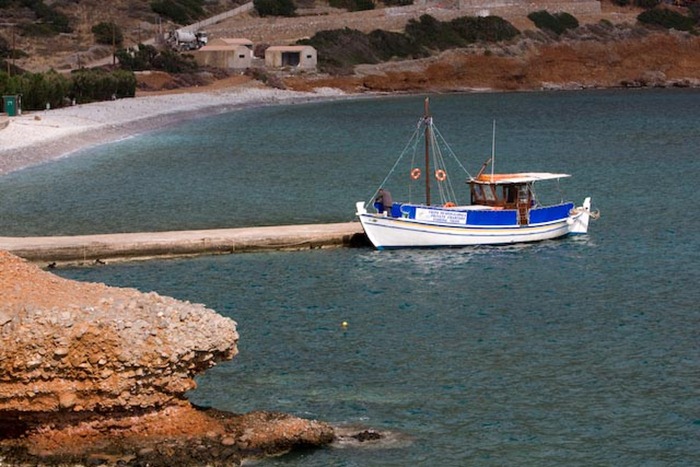
Update: Looks like Bob & Doug are being made into a cartoon. Fantastic. Enjoy this 12 days of Christmas video. A Canadian classic.


THE INVASION OF CRETE AND A LEADERSHIP LESSON

When we travelled to Crete I did not pick the right books to bring. I always get in trouble for filling the suitcase with 5 or 6 books with the excuse of ‘I don’t know what I will feel like reading’. This was the case in Crete and found myself browsing through various Crete centric books and landed on the book ‘Crete, The Battle and the Resistance’ by Anthony Beevor.

I found the author long winded and a little too detail orientated, but the anecdotes and stories of the British characters who participated in the events in Crete were fascinating. For those who do not know the Battle of Crete:

The Battle of Crete was unprecedented in three respects: it was the first-ever mainly airborne invasion; it was the first time the Allies made significant use of intelligence from the deciphered German Enigma code; and it was the first time invading German troops encountered mass resistance from a civilian population. In light of the heavy casualties suffered by the parachutists, Adolf Hitler forbade further large scale airborne operations. However, the Allies were impressed by the potential of paratroopers, and started to build their own airborne divisions.

The lesson comes in the form of a quote. As the German’s invaded via air, the commanders were convinced that a seaborne invasion was imminent at another point and held back 6,000 troops to deal with it. Had those reserve troops been committed to the fight, the German paratroopers would have been quickly eliminated (the drop did not go smooth) and the airfield, which was vital to landing more troops, would have remained in Allied hands. But the commanders did not see it for a simple reason:

Colonel Stewart also pointed out after the war that ‘A striking feature of the battle was the tendency for senior officers to stay in the headquarters. In subsequent campaigns it was the accepted practice in the Division for commanders to be well forward …. In Crete where communications were always bad and often non-existent, it was more important than ever that commanders should have gone more forward.’

The lesson of ‘Lead from the front’ is never clearer than in this story.

One last note, the resistance that the Cretan people put up was monumental but not without a price. The German’s were ruthless, burning villages to the ground and mounting mass executions:

A large number of civilians were killed in the crossfire or died fighting as partisans. Many Cretans were shot by the Germans in reprisals, both during the battle and in the occupation that followed. The Germans claimed widespread mutilation of corpses by Cretan partisans but MacDonald (1995) suggests this was down to the breakdown of dead bodies in the very high temperatures as well as carrion birds. One Cretan source puts the number of Cretans killed by German action during the war at 6,593 men, 1,113 women and 869 children.[citation needed]. German records put the number of Cretans executed by firing squad as 3,474, and at least a further 1,000 civilians were killed in massacres late in 1944.[32]

Glad I read the book. Great people with a rich history.

2008 Oct 22 Abandonded city of Lato Crete  (36)

WHAT IS $25B BETWEEN FRIENDS?


The stock market was buoyed today by news that the US government appears to be set for another mammoth bailout. What the heck? The deficit is already running near a trillion, what is another $15B or $25B between friends?

We have all heard about the fiasco of AIG getting $80B and still blowing $500K on a weekend event. But that is topped by the story of the big 3 automaker CEOs flying into Washington to ask for $25B on their corporate jets.

"There is a delicious irony in seeing private luxury jets flying into Washington, D.C., and people coming off of them with tin cups in their hand, saying that they’re going to be trimming down and streamlining their businesses," Rep. Gary Ackerman, D-New York, told the chief executive officers of Ford, Chrysler and General Motors at a hearing of the House Financial Services Committee.

"It’s almost like seeing a guy show up at the soup kitchen in high hat and tuxedo. It kind of makes you a little bit suspicious."

He added, "couldn’t you all have downgraded to first class or jet-pooled or something to get here? It would have at least sent a message that you do get it."

You can watch it here. How much does it cost?

Wagoner’s private jet trip to Washington cost his ailing company an estimated $20,000 roundtrip. In comparison, seats on Northwest Airlines flight 2364 from Detroit to Washington were going online for $288 coach and $837 first class.

Ford CEO Mulally’s corporate jet is a perk included for both he and his wife as part of his employment contract along with a $28 million salary last year. Mulally’s family lives in Seattle, not Detroit. The company jet takes him there and back on weekends.

Only 1 CEO (Chrysler) has put forward that he would take a $1 salary to stay on. The good thing? These guys have learned their lesson! After being beaten, GM has agreed to sell ‘most’ of their corporate jets and then decided to join Ford and sell them all.

What is even more interesting to me is the fact that there seemed to be less pushback on the $800B financial services buyout than on the $25B automaker buyout. Congress is really making a stink about the auto buyout. Maybe they are all invested in Citi?

I wonder if China is planning on bailing out any of the 67,000 factories that have closed across China over the year? The workers of one factory were asking for 2 months back wages … about $440 each.

THE LEAPER COLONY – MORE CRETE

The Crete adventure continued on with a day trip north to the Island of Spinalonga. Our first stop was the quaint town of Elounda across from the island.

As is the case with most of Greece, dogs and cats were abundant and this one seemed to enjoy hanging out on the fishing nets.

2008 Oct 23 Plaka Crete  (39)

Fishing boats had been repurposed to shuttle us back and forth … with a little fishing thrown in between.

2008 Oct 23 Plaka Crete  (3)

2008 Oct 23 Plaka Crete  (11)

Across from the town is the island which was a fort during the Turkish times and later a leper colony until 1957.

Following the Turkish occupation of Crete in 1669, only the fortresses of Gramvousa , Souda and Spinalonga remained in Venetian hands; they would remain so for almost half a century. Many Christians found refuge in these fortresses to escape persecution. In 1715, the Turks came to terms with the Venetians and occupied the island. At the end of the Turkish occupation the island was the refuge of many Ottoman families that feared the Christian reprisals. After the revolution of 1866 other Ottoman families came to the island from all the region of Mirabello. In 1881 the 1112 Ottomans formed their own community and Later, in 1903, the last Turks left the island.

The island was subsequently used as a leper colony, from 1903 to 1957. It is notable for being one of the last active leper colonies in Europe. The last inhabitant, a priest, left the island in 1962. This was to maintain the religious tradition of the Greek Orthodox church, in which a buried person has to be commemorated 40 days, 6 months, 1, 3 and 5 years after their death. Other leper colonies that have survived Spinalonga include Tichilesti in Eastern Romania, Fontilles in Spain and Talsi in Latvia. As of 2002, few lazarettos remain in Europe.[1])

It must have been heartbreaking for the people to be bound to the rock, even if the government did take care of them.

The island itself is magnificent. Huge walls jutting out of the sea. A commanding point to control the sea around it and another great family hiking opportunity ….

2008 Oct 23 Spinalonga Island Crete  (30)

2008 Oct 23 Spinalonga Island Crete  (36)

2008 Oct 23 Spinalonga Island Crete  (33)

2008 Oct 23 Spinalonga Island Crete  (31)

It never ceases to amazing me how life will pop out in the oddest of places. This is a picture straight up a wall that must be 15m high. What are the odds?

2008 Oct 23 Spinalonga Island Crete  (39)

Inside the walls is a well preserved town with a small museum dedicated to the previous inhabitants.

2008 Oct 23 Spinalonga Island Crete  (49)

2008 Oct 23 Spinalonga Island Crete  (109)

2008 Oct 23 Spinalonga Island Crete  (125)

Unfortunately, the leper grave is without a single marker to identify those who have passed on.

2008 Oct 23 Spinalonga Island Crete  (136)

The below gives you an idea of how steep the island is. Fantastic adventure hiking to the top, but very steep. Of course, the view from the top is amazing.

2008 Oct 23 Spinalonga Island Crete  (144)

I can see the soldiers standing on the parapet, bored out of their minds….

2008 Oct 23 Spinalonga Island Crete  (161)

2008 Oct 23 Spinalonga Island Crete  (162)

2008 Oct 23 Spinalonga Island Crete  (171)

All in all .. a great adventure for the day. We topped it off with dinner on the shore at a local sea food restaurant who served great lobster and scallops.

I miss Crete already.