I enjoy great marketing. This is a great ad (and made me laugh, I like to apply ‘Daddy Tax’ to Halloween candy)
And guess who Ally is? I didn’t know but felt compelled to look. GMAC.

I enjoy great marketing. This is a great ad (and made me laugh, I like to apply ‘Daddy Tax’ to Halloween candy)
And guess who Ally is? I didn’t know but felt compelled to look. GMAC.
Yesterday I watched a Canadian Forces ship leave the Halifax harbour in the morning. I thought of two things:
1. It was very cold on the pier. It would be much colder on the ocean. I deeply appreciate what they do and with Remembrance Day around the corner – appreciate everything that has been done before them.
2. That the ocean is a nasty place. I read a review of the book ‘The Wave’ that references the fact that 2 large ships go missing on the ocean every week, many attributed to rogue waves as high as 120 feet.
When you watch a video like this, you understand why. I knew I didn’t like cruises for a reason.
Updated November 9th: Today is the anniversary of the sinking of the Edmund Fitzgerald. The new hypothesis is that it was sunk by a 10 story freak wave!
I had the opportunity to learn about Aquaculture and the vibrant entrepreneurs at Cooke Aquaculture in New Brunswick yesterday. One of the world’s leading pioneers in the industry, I found the story of how they started inspiring;
The Cooke family’s roots stretch back 200 years in the Charlotte County area around Blacks Harbour. According to Cooke, for a large part of that time, his family was employed by the other corporate juggernaut in the village, Connors Bros. Ltd., the parent company of Clover Leaf Seafoods, LP, the largest seafood brand in North America.
"My father worked for Conners Bros., he was a marine mechanic – but my grandparents also worked for Conners Bros., and my parents worked for Conners Bros., and my great grandparents fished for Conners Bros.," he says.
Because the town was so small – at about 950 people today and even fewer back then – its success was tied to the Connors Bros. company. Although Cooke says the firm was integral to the town’s continued success, he also suggests its sole dominance as the only employer in the area put a blanket on entrepreneurial spirit.
That made him want to succeed with his own company even more, however.
Fresh out of high school in 1983, Cooke ventured into the world of small business and tried to put together a couple of his own start-ups. All of his attempts at success in his early years failed however.
Rather than giving up, Cooke treated his initial failures as learning opportunities.
"I thought I could take the world on. I assume I lost my shirt and probably a few other people’s shirts along with me," he says.
"It’s absolutely crazy that you graduate from high school and go start doing what I was trying to do. But I certainly did learn my most important lessons of how business works back in those days."
In 1985 Cooke put the false starts behind him and joined his brother and father to buy two fish cages and about 5,000 salmon.
The trio brainstormed a name for the new business and settled on Kelly Cove Salmon, named after the area they operated their fish farm in.
Work was steady for the next four years until the fledging company decided to buy its own supply chain and purchased Oak Bay Hatchery, which provided them with salmon eggs and smolt (juvenile fish).
And the rest is now their successful history, winning the honour of one of Canada’s 50 Best Run Companies multiple times and a growth trajectory that is far from over (Privately owned, their revenues a few years ago were over $180M). You can read about their approach to verticalization and ongoing innovation in the industry here.
From humble beginnings, an inspiring story.
I was thinking about the story (below) of the Spanish man and his housing purchase. The family income was €1700 per month or €20,400 per year. There purchase was 253,000 or 12X their annual income.
I remember buying our first home and being uncomfortable with the ‘conventional’ thinking that you could afford a house that was up to 3X your annual income.
12X? That banker should be put in jail.
I remember landing in the UK 3 years ago and sitting down with a banker to discuss UK finances. Somehow, we found ourselves on the topic of mortgages and I was quite alarmed to learn that you can get a mortgage which has interest only payments. There was no requirement to pay down the principal, essentially leaving the borrower in debt forever.
That mindset has been leaking into the Canadian economy over the last decade as household debt has sky rocketed. TD Bank raised the alarm bell recently:
Canadians are carrying far too much debt relative to what they earn, and the problem is only going to get worse if the Bank of Canada maintains a low-interest rate environment over the next few years, a report from TD Economics warned yesterday.
Craig Alexander, chief economist with TD Bank, said household debt as a share of personal disposable income has tripled since the 1980s, to 146 per cent from 50 per cent, with debt accumulation accelerating at an alarming rate especially since 2007.
That figure could rise to as much as 151 per cent by 2013 if the economy grows at a moderate pace and the Bank of Canada only raises rates to 3.5 per cent by that time.
The reasons why? Two income families provides a sense of income security (only 1 will lose a job), stable job market, low inflation and low interest rates. But as interest rates rise (they must, it is inevitable), those with a high debt rate will find it harder and harder to sustain. As TD points out:
As well, the most vulnerable households are those at the lower-end, with low-income families holding the highest debt-to-income ratio (180 per cent) and highest debt-service ratio (25 per cent).
"Low-income families are more susceptible to adverse economic shocks, more likely to lose their jobs, and they do not have a strong asset base that they can liquidate in times of financial stress," he said.
In other words, the poor will suffer. Spain is a great example of what can happen. The Globe ran a story on how Spain’s poor are suffering through the crisis as unemployment rises, housing prices collapse and the debt from homes they cannot afford crush the low income earners. Low income earners who have made some tragic mistakes:
In 2006, a Barcelona bank offered him a “free” mortgage – with no down payment – that was offered, signed and closed in one day. His salary of €1,100 a month was combined with his wife’s earnings of €600, and the bank asked them to claim they worked weekends (they didn’t) in order to make their income appear high enough to qualify them.
Before he had a chance to think about it, Mr. Cadena was given the keys to the apartment and a 2-centimetre-thick package of fine-print pages he either couldn’t or didn’t read, and was told the mortgage payments would be €900 a month, withdrawn from his account.
He had no idea how much he’d paid for the 3-bedroom basement apartment (only this year did he realize it was an extraordinary €253,000) or the interest rate (5 per cent above prime).
The monthly payments, he soon learned, were calibrated to rise over time, first to €1,100 euros and then, in 2009, to €1,600 – a mortgage structure, also popular in the United States, that only made sense under the assumption both the borrower’s income and the house’s value would rise quickly and constantly.
They didn’t. The collapse of Spain’s property bubble coincided with the rising mortgage rates faced by Mr. Cadena (and many others). In early 2009, his construction company cut his shifts to six hours per day; in November they folded completely.
This man is left losing the house and still owing €200K (they do not have a bankruptcy option). Money that he does not have, in a job class that makes it almost impossible for him to ever repay it.
Tragic.
I am a reasonably fast reader. I often find myself switching into ‘skimming’ mode if a book becomes a bit cumbersome. And many books do (Tom Clancy, are you listening?), with fictional books taking a paragraph to expand on the most mundane ….
He entered tentatively, the tears drying upon his cheek, the sound of the door slamming in the background as Esmeralda stormed off into the frosty night, and like the sun rising, the room opened before him as if he had just crested a hill and entered the valley of new beginnings, a yellow tapestry covering the back wall with a hint of deep velvety mauve around the edges that gave a rich, medieval Scotland impression, not unlike the crest that adorned Esmeralda’s family castle in North Wales, while to his left, the chrome faucet, that Esmeralda had just bought online during a Restoration Hardware Thanksgiving weekend sale, shimmered as the all natural yellow bees wax candle from a small shop in New Hampshire, where Esmeralda completed her Masters in Neuroscience and Insect Microbiology, threw light that danced and illuminated, giving a sense of inner peace to all who entered the sanctum and sought a moments respite or time with the trove of knowledge that was encased in the large earthen pot in the corner; The Economist, Cosmo, People, and a scruffy looking copy of Men’s Health, each yearning to educate George as he contemplated the porcelain before him.
At a dinner last week the conversation turned to a task ahead. One of our group had 2 books to read for a leadership meeting he was attending. A very interesting suggestion was made, learned during MBA days where the reading load was enormous and time precious (I paraphrase):
Read the first and last paragraph of every chapter. Read the first line and the last line of each paragraph in between.
Some would say brilliant, and worth trying, especially when reading certain business books with a simple premise that could be covered in a short article instead of 300 pages.
I finally got around to reading Bill Bryson’s Notes from a Small Island last weekend. It lived up to all of the reviews, and while I only spent two years there, his observations had me laughing out loud and missing the Old Blighty. Even the British like the book:
In an opinion poll organized for World Book Day in 2003, Notes from a Small Island was voted by BBC Radio 4 listeners as the book which best represented England.[1]
A few of his observations that I really enjoyed:
I just ordered his travel books on Europe and Australia. Fantastic writer and a fantastic book – it truly does describe what makes the UK one of the most amazing places in the world.
Bill Bryson wrote that you should never be unhappy for 3 reasons: You were born (a miracle of odds in itself), you are alive – it is a ‘miraculous privilege’ and you have plenty to eat at a time when there is no threat of a world war.
Reading the paper this weekend, I was reminded of just how fortunate we are in North America and the developed world. If ever you have a need to put into perspective a financial problem, or that the light turned red too fast or you have too many meetings today, just read any one of the following articles. For me, it made me reflect on just how fortunate I am:
Very thankful.
One of my favourite interview questions is ‘What do you do outside of work?’ Personally, I believe that a well balanced lifestyle (i.e. Having a life outside of work) leads to a healthier view, better productivity and a healthier team.
I was speaking with a friend a while back and he mentioned how his boss does not have kids, does not have hobbies and the only thing that he does is work. That lifestyle falls upon his reports in the form of non-stop emails, little respect for personal time, no ability to connect beyond work items (What do you talk about?) and an attitude which burns people out (and makes them hate working for him).
He wished his manager had a hobby.
I happened across the site Failblog, filled with marketing pictures that people vote as a Win or Fail. As you would guess, what makes the site so funny is that most are resounding fails.
Two that made me laugh out loud:


A colleague shared this interesting quote as we discussed just how fast our world is changing.
If ever the last 50,000 years of man’s existence were divided into lifetimes of approximately sixty-two years each, there have been about 800 lifetimes. Of those 800 at least 650 were spent in caves. Only during the last seventy lifetimes has it been possible to communicate effectively from one lifetime to another – as writing made it possible to do. Only during the last six lifetimes did masses of men ever see the printed word. Only during the last four has it been possible to measure time with any precision. Only in the last two has anyone used an electric motor. And the overwhelming majority of all material goods we use in daily life today have been developed within the present 800th lifetime.
Hans Kung, On Being a Christian
Makes you wonder, what will our children see 60 years from now?
The thing about sports stars is that there are two types, those who are good with people and those who are not. Pro Ams are the best example of this, where a group is all excited to be with a pro and he turns out to be brutally unsocial and doing it ‘because he has too’.
Larry Robinson was great with people. Through the evening he was approached time and time again for autographs, with stories of how he inspired people when they were kids and for pictures. No problem, he was nice to everyone.
Having the opportunity to talk to him through the evening, I learned a lot about him and his views. I enjoyed his views on how to motivate his team (as a coach, with players where money is not the motivator), about his being a super proud Dad and Grandfather (Just like so many other people) and on why Canada beat the Russian Army … It was the thing I was very curious about.
What was it like to play the Russians versus in a Stanley Cup? He described it as being very different. The cup is a long gruelling slog to the top. The national games like the Canada Cup were different. They ended in weeks, were very intense and felt different, because all of Canada was rooting for the team.
He described the Russians as a unique lot. They would head north into Belarus, to an encampment circled by barbed wire, to practice non stop, studying the hockey theory of Lloyd Percival and executing like machines. He stated that when you played them, it was always the same. They were just so good, always playing at one level, their best.
So I asked, then how did you win if they always played at their best? They trained as a team all year round (unlike the Canadian team which was all stars who came together for a month, then went off to the NHL), were well known to have the government assisting their development artificially, and were machines (he described hitting them like hitting a tree trunk). How do you beat that? He looked at me and said one word …
Passion.
True in hockey. True in business. I would take drive over skill any day. You can teach skill …
I had the good fortune to sit with Larry Robinson at the Bell Celebrity Gala in support of the Center for Addiction and Mental Health last week, where they raised $2M for a great cause.
Beside the fact that the event was extremely entertaining, it was very cool to talk to Larry. 9 Stanley Cups (between coaching and playing), numerous Canada Cups where he represented Canada in those famous cold war duels between the west and the east.
Now, for those of you who know me, you know I don’t watch sports on TV because it bores me to tears. But I did as a kid, simply because that is what you did on a Saturday night in Canada. If I look back on my youth, it was always about hockey. We played once a week in a league, every recess at school in the winter we went on the canal or the pond and played hockey, in the summer we played ball hockey all day long and in the evening we were either in the basement batting a tennis ball around or playing table hockey for hours .. Making up tournament, using our hockey cards to build lines, tracking which player got a goal and an assist. In fact, after a 20 year hiatus, I have started playing hockey again, super early with a bunch of great guys.
So while I would struggle to name a hockey player who played after Gretzky .. The Canadiens of the 70s are ingrained in my brain. Ken Dryden, Guy Lafleur, Larry Robinsons. Heroes from my youth. So it was both shocking and cool to be introduced to him and spend the evening enjoying his company.

Microsoft may be struggling with a few of their products and people, but one thing that isn’t struggling is the XBOX. The now departed Robbie Bach did an amazing job to ensure that the product lives on in greatness. Our Wii continues to gather dust ….
I pre-ordered our Kinect about a month ago, good thing as it is selling out already. It looks like a break out experience and the start of a whole new mode of gaming. Truly hands free control that has been envisioned in movies for decades. Personally, I am really looking forward to the many fitness programs, already have the basement set up for it. Glad I didn’t order the Wii Fit. It looks truly amazing.
Now if the could just make a P90X version ….
That is right. The aisles of the local Costco are stuffed to the rafters with junk. Signs adorn the local party store. Yes, it is almost Halloween. Out comes the kitsch. Who will have the coolest smoke machine in the neighbourhood?
Probably not us. Don’t really do the whole ‘decorating’ thing. But I did find a few quality ideas for consideration. The first is from The Onion:

(I also like their idea’s for naming a wireless network and The Moral of the Story).
I am also getting inspiration from Esquire who suggested a way to give your pumpkin a little flair. Take a roll or toilet paper, soak it in kerosene and light well away from everyone as it will shoot a 3 foot flame for 45 minutes.
I will follow that up with some good quality treats, I would wager the advice will be the big hit?

I was in a Metro and saw the below sponsor on a green tea box. I don’t know, it just didn’t compel me to buy. It did make me chuckle though. I can see it now, a marketing person with a budget who pitches Wayne “the Great One” Gretzky as the spokesperson just so that they can meet him.

But I could be wrong. Maybe Wayne is magic at selling green tea.
For the last 8 years someone has been following me around .. and a few months ago, they found me again. How? I do not know. But the person did. I received an ‘executive focus’ newsletter with a yellow post-it note attached and handwritten:
Michael, try this. It works! J
At the end of the article, the address and subscription to American Speaker is circled with a check mark.
The first couple times I received this (in 2002), I actually thought it was someone that knew me. Obviously, that is not the case. But, I admire their persistence. They keep at it after all these years.
It is a strategy I have used before, and one I will use in the future, but in a different way. I find a quick handwritten note is an effective communication tool and in today’s world of billions of daily email, mail is becoming a way to differentiate.
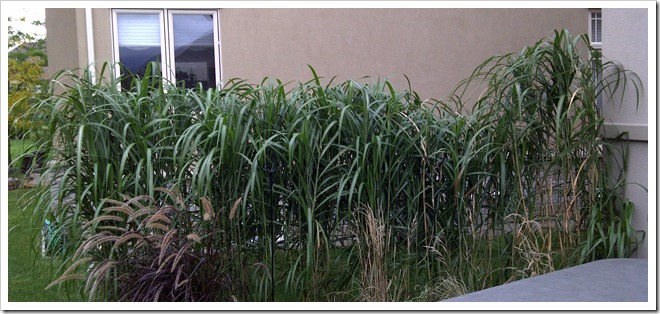
I know a few people were interested in my use of grass at the house. Note that it is NOT visible from the road (smile). This year it is only 8’ high and a bit thin. Next year will be fantastic.
Over the last couple of weeks, I have been watching with interest as old colleagues describe a leadership crisis that is going on at a company I use to work for. I asked one person, how is the leadership team communicating about the crisis?
The answer: ‘Radio silence’.
And sure enough, that is leading to uncertainty, ‘water cooler’ talk, confusion, fear and of course, an unhealthy environment.
Personally, I have always believed that in situations like this, if there is no communication broadly, then people will fill that void by making stuff up. Truth or not, the void gets filled with hypothesis, conjecture and generally negative information.
It is amazing how much has been written about this. A great case of this is comparing how Tylenol dealt with their product recall issues and how BP botched the Gulf incident. An HBR blog post on the topic really hits the mark:
To survive, humans developed a keen ability to judge other people in terms of their intentions or "warmth," and on their ability to carry out those intentions, or their "competence." Studies in 36 countries have defined the attributes of warmth and competence to include, among other traits, the trustworthiness and selflessness that Tylenol aced and BP flunked. The degree to which consumers identify warmth and competence traits with brands strongly predicts intent to purchase, likelihood to recommend, and brand loyalty.
The same logic can be applied from brand to working in teams, and to the internal crisis that my old company is facing. How do you maintain trust and an air of competence if you are unwilling to step forward and address the issues head on?
It is all about building trust, being open and ensuring that people understand the entire picture. It is all about understanding human nature, not ignoring it.
From Stuart McLean’s Stories from the Vinyl Cafe:
Dorothy knew exactly what she was doing buying the dog. It wasn’t for company – although, at the time, the notion of having something in her life that loved and, more importantly, listened to her, was a comforting thought. She bought him because she didn’t want her life getting too easy. Complications were important. Without something messing up your plans you became self-centered. Then you became selfish.
Well put.
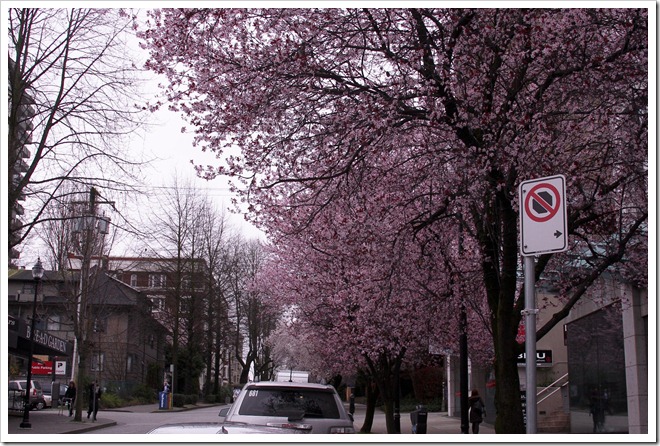
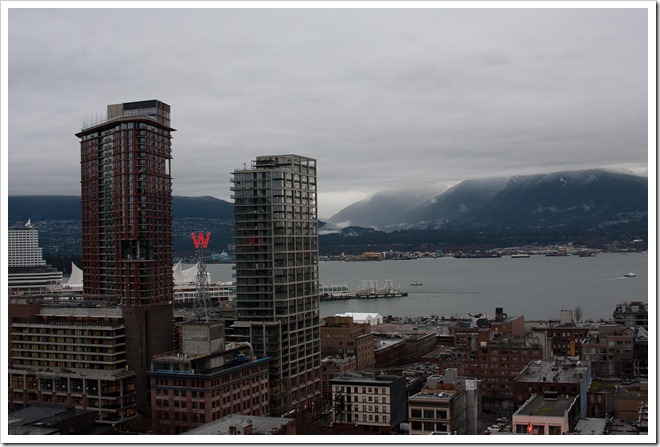
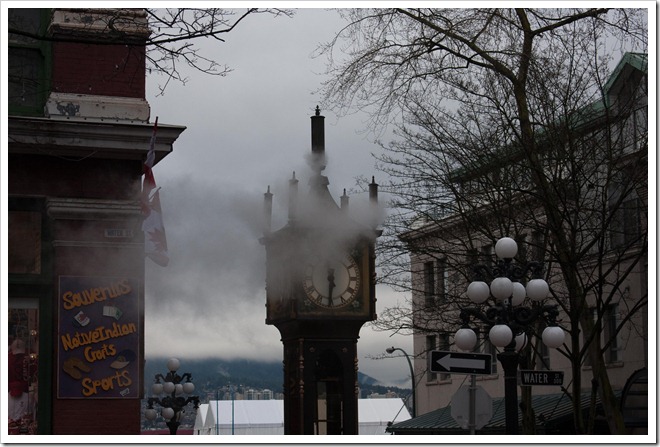
A few random shots that capture the spirit of Vancouver. Such a vibrant city.
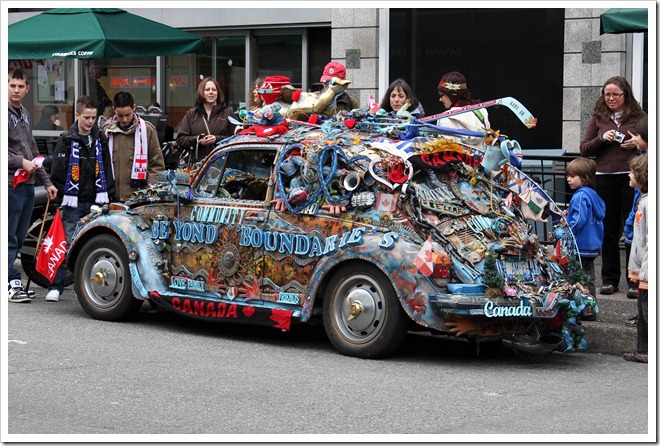
The trees were a little messed up, it was that warm. They should not have been flowering.
When the fog moves in.

The Olympic torches against a dark sky.

An actual steam clock, built as a tourist attraction in Gastown.
Across from where we stayed was a Asian market. It was just unbelievable, they made fresh everything for take-away (dim sum, sushi, you name it ..) and we frequented their store. What caught my eye was their fresh seafood area. Those are some HUGE crabs.

I did enjoy the warning.

Vancouver was a great host, and remains one of the coolest cities around. And so ends … our Olympic adventure.
What would a Canadian Olympic visit be without a hockey game? We caught the American women’s game, where they trounced their European competitors.
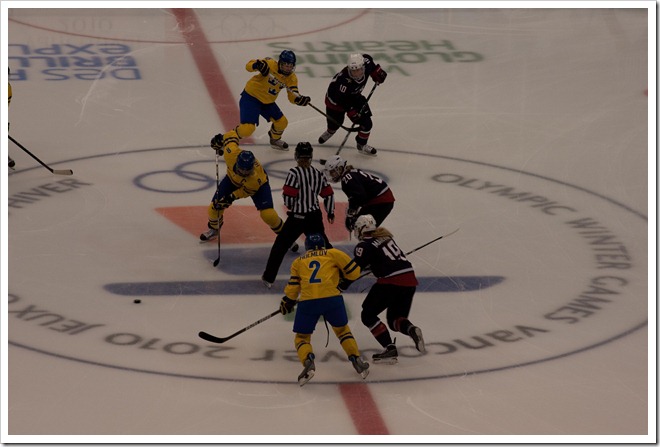
And of course, we all remember how hockey went for the Canadians in the Olympics, men’s and women’s gold.
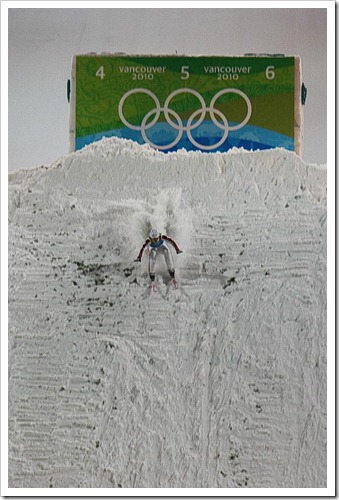
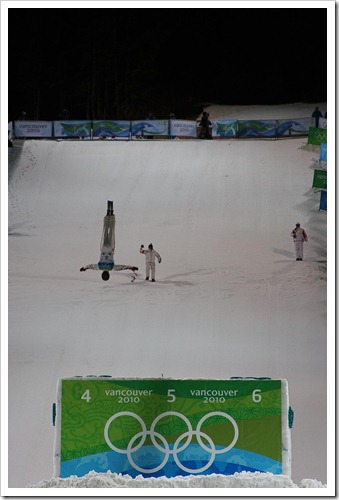
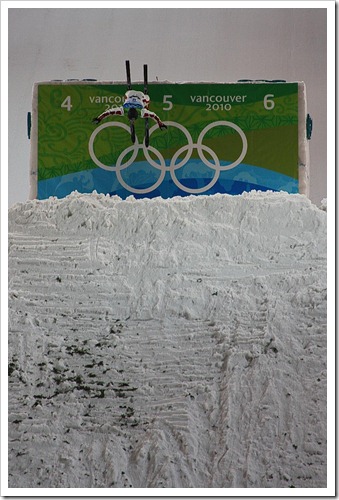
The highlight was ski jumping. Wow. Sitting right below these guys, watching them jump 100m into the air is breathtaking and they land on the steepest of slopes. We really enjoyed watching them twist and turn. Something I will never do …
These pictures give you a sense of the hill and the slopes.
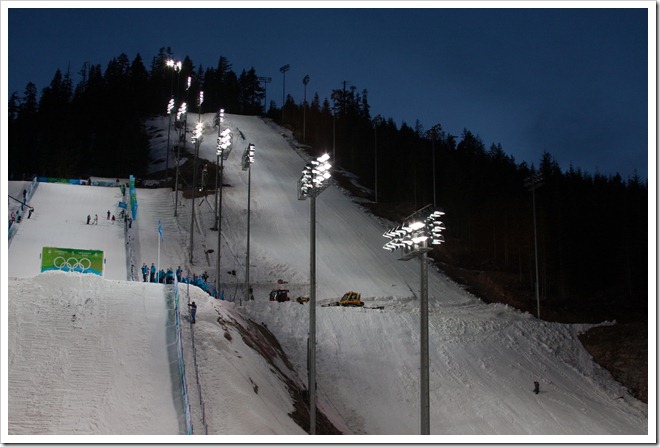

And these photos give you a sense of just how high and how tenuous the landing can be. We saw a few major wipe outs.
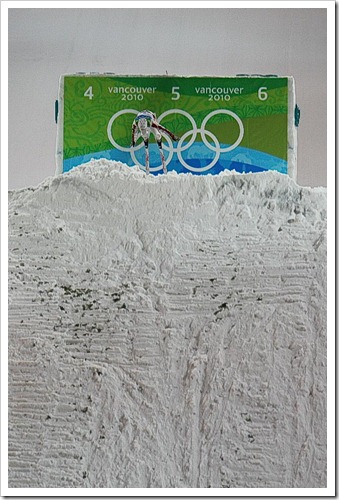

And as with every event, there was an army of people ready to help out after every big jump.
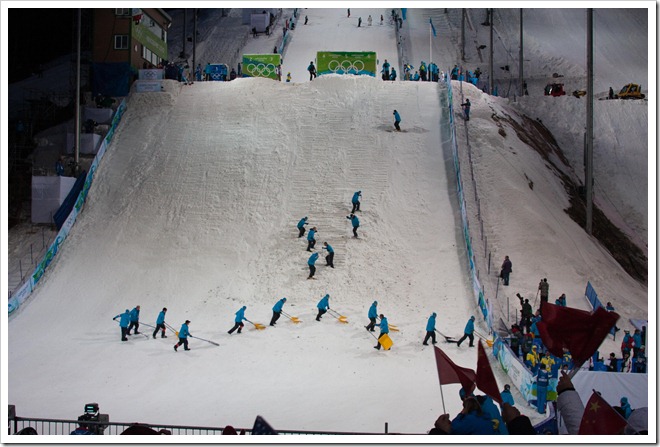
Very cool event.
As I mentioned, Vancouver was buzzing with activity. We were fortunate to stay downtown, in the sea of activity. Vancouver really is one of the more beautiful cities in the world (and it was sunny the entire time).
A few shots of the skyline from our room at different times. Beautiful city.

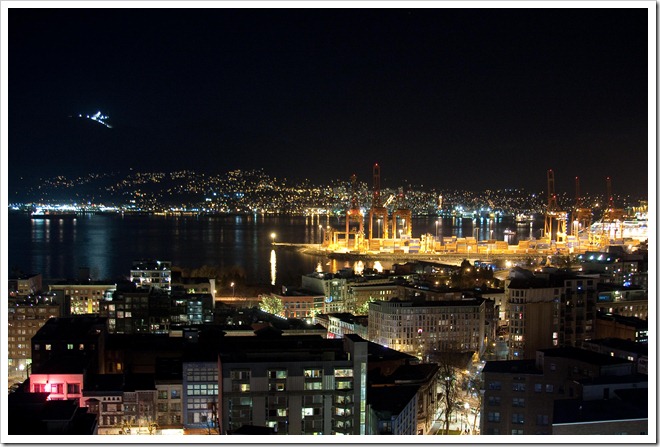

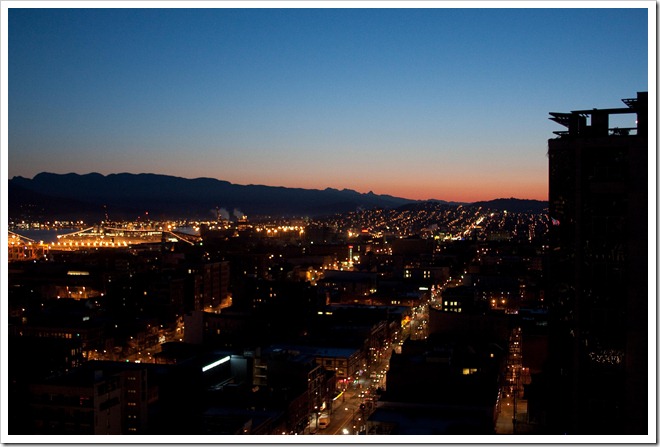
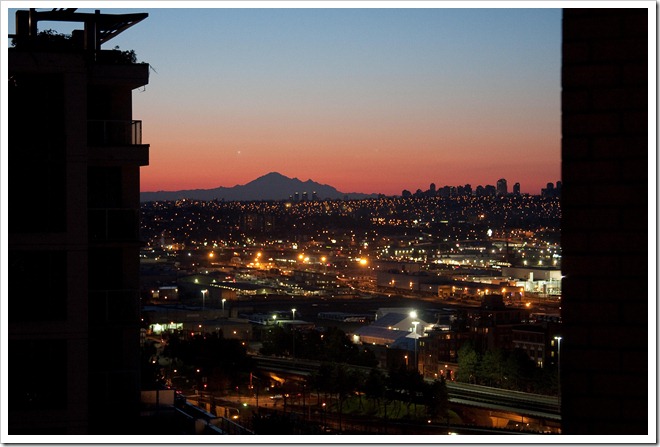
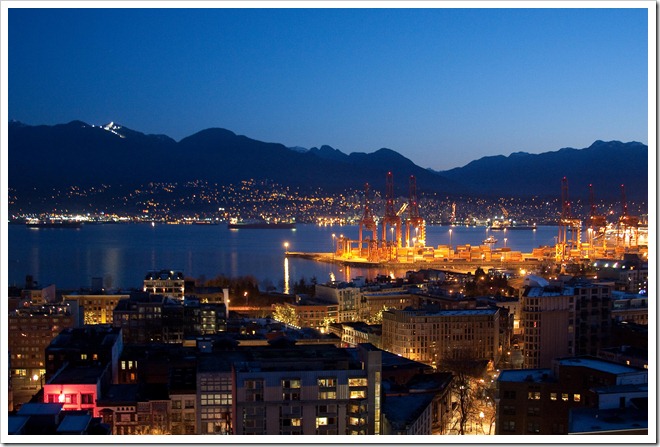
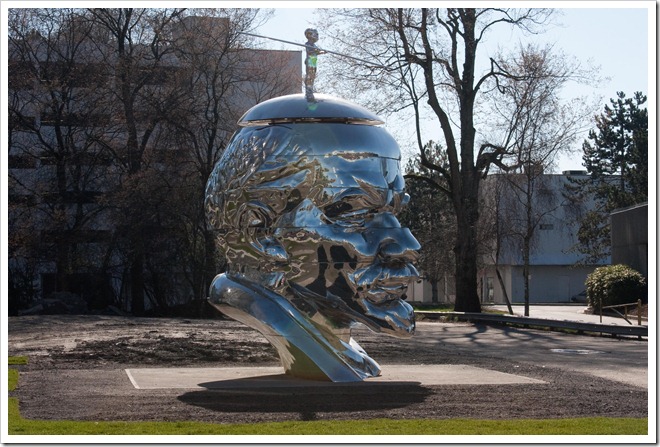
And a shot of a big chrome head. We didn’t have time to walk over and see who it is. But it sure looks like Lenin ….
New blog, old blog draft clean-ups. It has been a busy year and there are a few blog posts that I never actually posted. For example, a post on the Olympics. So, better late than never. Here it is.
A few weeks ago (or more than a few weeks ago) I had the opportunity to spend time with clients at the Olympics. Being Canadian, it was definitely a proud and unique experience. It was odd to see so much patriotism, Canadian t-shirts, jackets and jerseys everywhere. A wonderful event.
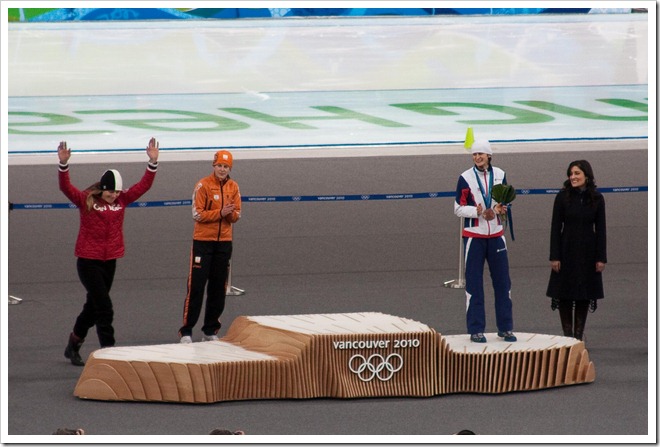
Our first event was speed skating and it seemed like it was a sea of orange, the Dutch were everywhere! I don’t know what they did, load up a big boat or a ton of planes and come over en-mass, but they love their speed skating. I have never been to one of these events, but it was great to see a Kristina Groves get 3rd (1500m).
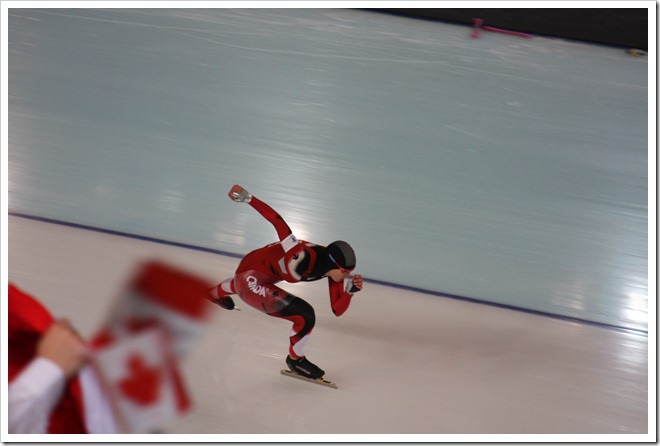
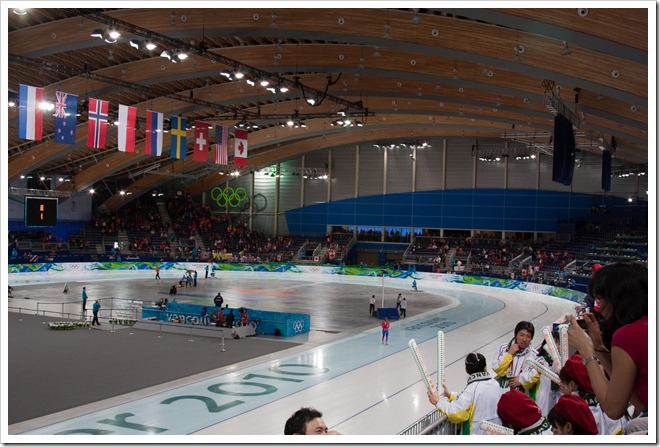
It was held in the Richmond Olympic Oval, which has a spectacular with a roof:
BC Pine-Beetle Wood Roof — The Oval’s massive ceiling is made of salvaged British Columbia wood that was damaged by a pine-beetle infestation. At a size of about 100 metres by 200 metres (2 hectares), the roof is believed to be the largest surface ever covered in the once-discarded wood. Showcasing use of this wood may encourage its application elsewhere and help mitigate the economic hardship the pine beetle epidemic has brought upon regional communities in British Columbia.
As we left, the sea of orange followed and I started to notice just how tall the Dutch are. Someone with us mentioned that it is the Dutch, to which Narda inquired ‘What happened to you?’
Guess I am really from Estonia.
Obviously, my previous work life has lead to a very Microsoft centric lifestyle. I did ask the boys if they wanted Apple’s this fall for school (laptops) but they said no, as middle and senior school are all PC. Hey, I tried. Call me enlightened.
That being said, I have been using the Blackberry Torch for the last month or so and I am blown away. I love this device and as the saying goes .. “they will have to pry it out of my cold dead hands”.
I have tried many full screen devices, but I always come back to that keyboard. I need a keyboard. And with the new OS, RIM has finally solved what I would call my ‘big beefs’. A few highlights:
Well done RIM. While I have had a few people talk about the GHZ of this device or uber-screen of another, in the end do I really care? Nope. This device is a productivity machine for a business person. Well done.
The transfer from Windows Live is now complete, with an unexpected outcome. My first blog – A Salesman’s Journey – was transferred over too. I will slowly start ‘releasing’ the old blog posts onto this blog over the coming months .. so the archive will get longer, until they are all back … right to my first post ever:
This is my first blog entry. I am not sure if blogging is for me, but I am going to try it – to encourage myself to have one different thought, every day.
Funny thing about this post, I heard Seth Godin say something similar and encourage everyone in the crowd to consider participating.
I was watching a show on the Pharaohs and it made me think back to Egypt and the Cairo museum. It is one of the most amazing museums in the world with 100K artefacts on display and another 140K in storage. The King Tut exhibit is rich beyond measure (and he was a minor Pharaoh).
In one room, they have mummies of Queens and Kings that are as old as 3,000 years and you can still see features, hair and even skin.
But you have to wonder, when they agreed to be embalmed, did they think through the fact that their mighty reign would be relegated to a tourist display, for millions to see?
I would bet not.
I have this old English saying on the wall in my office. Makes me chuckle. My family picked it up for me a few months ago.

I am thinking of replacing it with a better saying that I heard:
DO WORK THAT MATTERS
Don’t just carry on. Think. Change something. Innovate. At the sales leadership conference there were many different conversations about doing things differently. About how new technologies and business methods present opportunities to innovate.
A big theme was online assets, how to use new technologies such as social media and the internet to increase productivity and the likelihood of success. One such company, Jive Software, talked about how their social media products help people connect to others and information faster (the consumerization of enterprise IT).
What was interesting is that while the discussion continued, invariably someone asked the question that I have heard many times before:
‘Are you not worried about the internet and it distracting people from doing real work?’.
That had actually been a big debate the night before at a speakers dinner (again, centered around the Internet, and whether or not social media is of value to business (e.g. Twitter, etc)). I had the opportunity to share my perspective:
And last, one of the speakers made a great point about today’s employees. He said that it isn’t the internet that he is worried about, it is email. In today’s society, there is so much noise from email, and all of the other forms of communication that people get that feeling of instant gratification when they react. But the question must be asked, is that productive or is it just ‘busy work’?
People must avoid the sense of accomplishment from just being busy. It is so much harder, but ultimately more rewarding when you are doing WORK THAT MATTERS.
Overheard while walking down an aisle, past bedroom linens, in Elte Carpet on Saturday while preparing to pay too much for a kitchen table:
Lady on cell phone loudly: “Seriously Dear. Half of whatever he has accumulated during the time that you were together …..”
Heard over an hour later while walking out of Elte Carpets with my wallet lighter, in almost the exact same spot from the same woman who now has 2 or 3 other women standing around her:
“I know. Can you believe it? She is the nicest woman. Beautiful! Smart! And he went and …..”
It appears that Microsoft has decided to bail out on the blogging business (which is fine, they have not upgraded spaces for about 3 years) and I am now converted to WordPress.
After a few issues, the blog is up and running. I have been rooting around the site, quite the difference from the barebones Microsoft site. Expect a few changes.
I never did blog about our trip to Florence or Venice. Both remarkable cities. In Florence, we had one of our best dinners of the trip. Somehow, I am not sure how, we were given advice on a restaurant that was well out of the way and a local favourite – I Tarocchi. A small restaurant, with wooden bench seats, very minimal decor and spectacular – home cooked food. They make this pasta dish with pear that is to die for, and their tiramisu was as good as I have ever had. All for 40 Euros, a pleasant change after a few mediocre – tourist restaurants that charged you an arm and a leg.
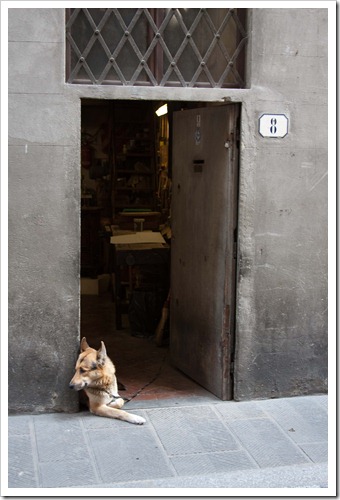
A few photos of Florence. A craftman’s shop, which looked a lot like how it would have been a hundred years ago.
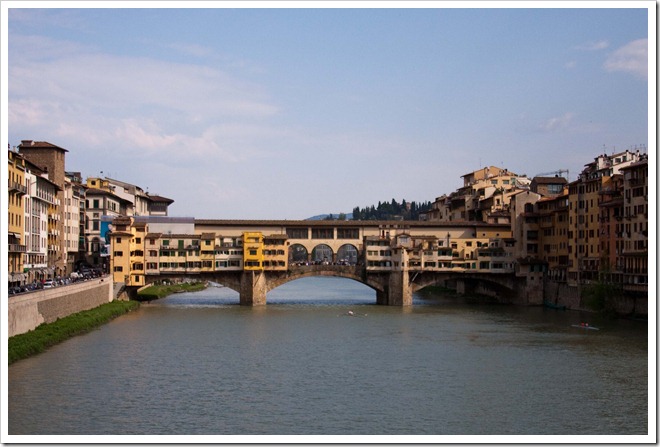
The covered bridges of Florence host homes and shops. And are very crowded …

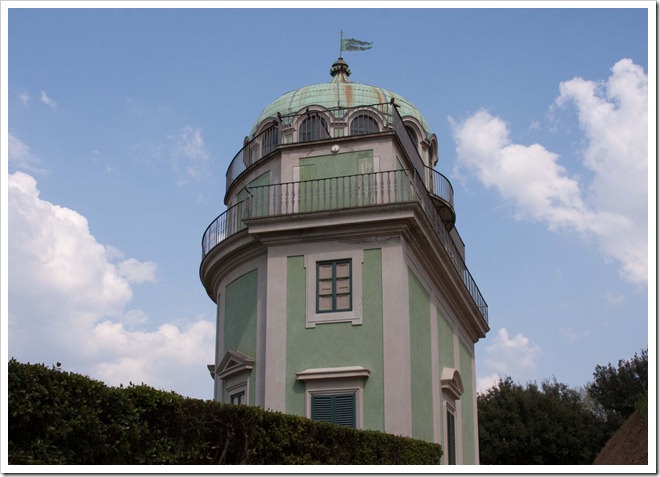
The Boboli Gardens are spectacular. Seems the Italians also have a ‘gift’ or two liberated from Egypt.

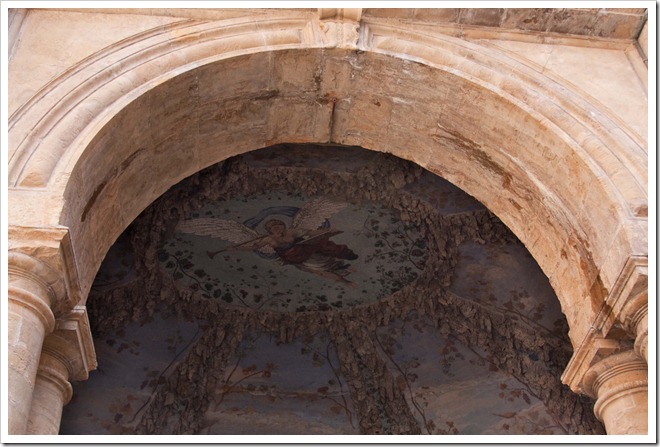
A fresco in one of the garden buildings.
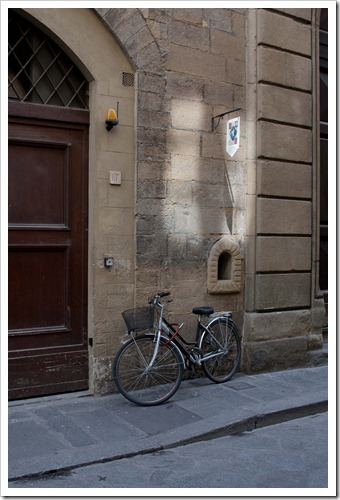
I love how Europeans ride their bikes everywhere.
And no trip in Europe is complete without a beautiful church, and in this case a door – made of gold – depicting scenes from the Bible. In this case, David and Goliath.

I would like to go back to Florence one day. It really isn’t a ‘kid’ trip. Florence is a city made for couples. One day.
A friend forwarded the article ‘Death of a Salesman’ and thought of the quote famous quote by Mark Twain:
“The rumours of my death have been greatly exaggerated”
The author points to the fact that the Sales profession has been expanding rapidly over the century, at the front line of capitalism and the ‘consumption’ mindset. He then points to a large perceived ‘killer’ of sales roles:
But the biggest culprit in killing off sales jobs is right in front of you: the Internet. There was a lot of talk in the dot-com era, mostly positive, about "disintermediation," or creating direct connections between consumers and suppliers. Think of all the purchases you make today online that once would have been accompanied by a salesperson: a sweater, a book, a "compact disc," a small appliance or piece of electronic equipment, shares of a stock or mutual fund, airline tickets, etc. Even in my own industry—media supported by advertising—some ad space can be booked online, as Slate writer Seth Stevenson demonstrated in a video earlier this year. The precise impact of Internet selling on sales jobs is hard to quantify, but it’s a big contributor and it’s irreversible.
I would argue that the author’s viewpoint is too limited. The reality today is that if a job can be automated, it should. Capitalism and market economics will eventually dictate that reality, as the company who automates and gains efficiency overcomes the ones that do not. As simply stated in this poster from despair.com:
Do I really need someone to help me select a CD or a book? No. I would rather use the web and social media to review opinions. Plus, the economics do not make sense.
What the author fails to understand is that this fundamental economic principle needs to be balanced off against human behaviour. It has been proven time and time again, that people are more likely to buy from people that they like or have a relationship with. Companies simply need to do the math: When the value of the sale is matched with an increased probability of volume, due to persuasion, and it makes financial sense, then the salesperson will remain in the equation. If the value of the sale is so low, or relationship does not play a part in the purchase, the salesperson will be cut out. Simple.
But it hardly means the death of sales. It just means the death of low value sales jobs:
The middle, however, is being "hollowed out," in the phrase David Autor used in an economic paper published in April, and sales is a major component of that shrinking middle. The strength of sales jobs is that they can be reasonably high-paying but typically don’t require technical training or other specialized skills. When those jobs disappear, the people who hold them will often be pushed down the wage ladder or even out of the workforce. Sixty years after Willy Loman, that is our tragedy.
It means an evolution, where the low value ‘sales people’ see their roles eliminated, not unlike many other jobs that are automated. Of interest, I have spoken to more than one sales leader who lamented about how hard it is to find qualified, high quality sales people, as many ‘salespeople’ enter the field by accident, do what comes ‘naturally’ and don’t take the profession of sales seriously. If people wish to remain in the ‘hollowed out’ middle class via sales, then they better take it seriously and focus on skills improvement. Most sales people I know have a University degree as a start. In the profession, sales books and training abound, but how many actually leverage it? The successful ones.
It also points back to something that I continue to harp on, when will our educational institutions get out of their glass towers and recognize that a business degree should include sales and leadership training? It is pathetic. Instead they stick to the antiquated notion that an Economic class is more relevant, when in fact I have never used a theory from that class in my daily business life. But I could have used practical sales and management training, even if I was too young and inexperienced to really leverage it, at least it would have provided a foundation.
Time for Universities to recognize that employers require sales, that they need to meet the market demand AND finally provide sales the respect that it deserves.
The door to the ‘Red Carpet Lounge’ in the Philly airport. I laughed about it with the woman at the reception desk. She said, yah, I know, a new one is coming. People keep mistaking it for the janitor’s closet. LOL.

I had a very interesting conversation today about learning and the evolution of how people learn at the Sales Leadership Conference in Philly.
There are many theories, the experiential learner, the person who learns through structure. Concepts that have been explored for centuries at all levels. As a parent it manifests as your beliefs in public, private, Montessori, fully without structure, home schooling and on an on. In the end, I believe there isn’t a one size fits all. We will all learn in different manners and it is about access, so that we can learn in the way that best suits us.
But one thing that is becoming very clear is that learning is changing in that what you know isn’t as important, it is about knowing how to sift through information and find knowledge. Sure, a base level of information is important, but knowing how to find perspective on a problem and apply it is much more important.
Seth Godin was a headline speaker and he had an interesting perspective on the evolution of learning, as it relates to his theories on tribes (I am about to watch his video’s on TED). He did a little test on a few children aged 11-14 who were A students. He put a bobbing bird in front of them and asked them to explain how it worked. They looked side to side and then the 11 year old pulled out a pen and said ‘Teach us how it works’. His point was that getting an explanation is easy. You can get that on the web, on Wikipedia in an instance. He stated if you can write it down and explain it, it probably isn’t worth anything and teaching that young person how it worked is of no value.
But what is of value is creative thinking. The ability for those children to puzzle out that idea, to be creative, to figure it out. To think and solve problems. Something that our formulaic schools system is not interested in, school is focused on compliance and having people fit in. Can you imagine trying to explain to a teacher the method to teaching creativity? He also pointed to the games that we play as kids. He said ‘remember the game Candyland? We all played it and the rules are this – pick a card, do what it says’. Become sheep.
I always worry that the rigid approach to learning kills creativity. As one HBR blogger put it in his article ‘What Leaders can Learn from Children’ :
the curiosity of a child is incomparable. Children ask questions because they want to know. Naturally curious, hungry for information, and constantly churning new facts to understand the world around.
Seth then put up a quote which I found rather ominous:
‘The reason why they want you to fit in is so that when you do, they can ignore you’
I think he is right on the mark. In a world drowning with information, it isn’t about what you can memorize. It isn’t even about what you can find (although it is good to be able to find information quickly in the sea of data) and one really has to question the value of a test that grades based on the quality of your memory (when the reality is, the internet is a big memory bank – available virtually everywhere). It is about how you use that information to be creative, to come up with ideas, how you interpret it.
I also suggest that the vast majority of tests should be open book. Find the information fast, then do something with it – and be graded on how you use it.
And of course, challenge the norm. Something that hasn’t ever been a real personal challenge (smile).
There are a lot of computers in our house. We have now been in place for a year and things are settled, but one minor computer element was missed. A few upgrades happened and I forgot to turn RAID 1 back on with my home machine. Which meant that when I experienced my first hardrive failure in a very long time, the Alberta photos and one other event’s photos were lost.
As it is mechanical, I was kind of hooped. However, I was able to recover about 80% of the photos off of the memory cards using recovery software, and everything else of value is backed up.
I also went on a quick tour of the PCs, ensured that everything is properly backed up, that the latest hardcopies are in place and ensured that my USB RAID storage is in safe shape. Amazing how for $300 you can run 2TB of RAID 1 thanks to hardrive enclosures like the Kanguru (thank-you China).
A few photo’s from a 12KM Johnston Canyon hike in Banff … that I was able to recover.




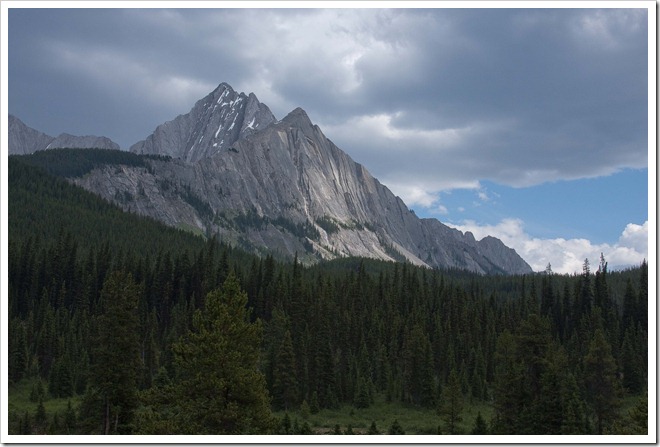

All safe and sound. Banff truly is one of the most beautiful places on earth.
Professionalism is something that does not require a special suit, or a certain ‘class’ of job. It can be anywhere and everywhere – or nonexistent. Take for example pet breeding. We have had a number of purebred animals, and in every case we went through a selection process to find the right breeder and environment. But there is no standard code of conduct, although ‘certified’ breeders will go on about uncertified breeders. In the end it is about the professionalism of the individual.
Our latest cat was acquired from a woman who breeds them as a hobby, not a ‘professional’ cattery, and it worked out great. After much reading, we decided that we really need two cats so that when we are not around, they have a playmate. The net is filled with reasons why two is better than one. So we spent a few agonizing weekends searching and finally settled on a kitten. He was to arrive on Saturday.
Then all of a sudden the breeder went silent. No return calls. But we did get an email Sunday saying that she had just lost one of her other cats, and is now considering keeping him. A clarifying email sent back (because she would not pick up the phone) with a response that actually, she had found another home that would let her breed him and would pay more money so he was off.
During our conversations with her prior to the verbal agreement, she had spent many minutes telling us about how you must select a ‘reputable breeder’ and one that you can trust. Ironic and unprofessional.
Made me reflect. In the end, we must all look at our conduct and our statements and decide if we measure up or are held wanting. And in the end, what comes around goes around ….. so treat people like you want to be treated.
I have really worked hard to avoid the whole Steig Larsson thing that is going on.
Sure, it is an interesting story. Minor writer, activist, living in Sweden, who is described as ‘a leading expert on antidemocratic right wing extremists and Nazi organizations’ turns in the Millennium trilogy, but passes away shortly after. The book makes it big in Sweden, they are translated and 40 million+ of copies are sold around the world. It was made into a movie in Sweden and an English version with Daniel Craig is out at Christmas. An international sensation in the making. In fact, he has now become a cultural icon, with a sense of ‘conspiracy’ surrounding his death and life as an activist:
To be exact, Stieg Larsson died on November 9, 2004, which I can’t help noticing was the anniversary of Kristallnacht. Is it plausible that Sweden’s most public anti-Nazi just chanced to expire from natural causes on such a date? Larsson’s magazine, Expo, which has a fairly clear fictional cousinhood with “Millennium,” was an unceasing annoyance to the extreme right. He himself was the public figure most identified with the unmasking of white-supremacist and neo-Nazi organizations, many of them with a hard-earned reputation for homicidal violence. The Swedes are not the pacific herbivores that many people imagine: in the footnotes to his second novel Larsson reminds us that Prime Minister Olof Palme was gunned down in the street in 1986 and that the foreign minister Anna Lindh was stabbed to death (in a Stockholm department store) in 2003. The first crime is still unsolved, and the verdict in the second case has by no means satisfied everybody.
A report in the mainstream newspaper Aftonbladet describes the findings of another anti-Nazi researcher, named Bosse Schön, who unraveled a plot to murder Stieg Larsson that included a Swedish SS veteran. Another scheme misfired because on the night in question, 20 years ago, he saw skinheads with bats waiting outside his office and left by the rear exit.
Having read about him online, it seems that his pre-book life was filled with noble efforts. One has to wonder, what would he have done with his vast wealth had he lived? (I am sure the extreme right wouldn’t have liked it). Which is why I pondered reading the book, even though it contained sentences like the following;
‘After discussions with her mother they had agreed to give Pernilla an Ipod, an MP3 player hardly bigger than a matchbox which could store her huge CD collection’
Perhaps iPods haven’t made it to Sweden? Or maybe Steig needed to get to a Best Buy more often. And as an aside, I doubt that she had a CD collection … And really, Pernilla?
But thanks to the brightly colored cover, I was reminded constantly of the books popularity (seems like it is everywhere) . I even held out in Costco, which was as tough as passing by the Halloween candy in August when they first put it out, right beside the Christmas decorations.
I finally caved in and this weekend I started reading it. An interesting read, with a complex plot and a list of characters as long as the queue to get a copy of Halo Reach last week. About half way through the 500 page tome, I started to realize that the book was sending me a message. And that message is that I really don’t like reading crime fiction. I find it tedious and irritating (unless it has something like a cool supernatural twist) so I stopped. Rented the movie and started reading Bill Bryson’s Notes from a Small Island.
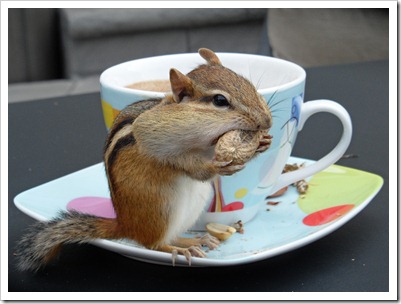
We have a few chipmunks who enjoy the family depositing peanuts for them in the backyard. The below shows how comfortable they have become, next they will be tasting the cappuccino! (They already enjoy eating the tomatoes).
On the weekend we had the opportunity to enjoy the Toronto International Film Festival launch of the movie Barney’s Version based on the novel by famous Canadian author Mordecai Richler. This is my first every TIFF event and i t was interesting to hear from the Director, Producer, to see the actors on stage prior to the movie and to hear Mordecai’s wife talk about her husband. She was definitely the most charming speaker of the evening. Interesting enough, Minnie Driver’s demeanour on the stage matched the personality of the character she plays in the movie – which I had not expected at all. Perhaps she was simply uncomfortable with being up front.
I would agree with the reviews, it was a thoroughly enjoyable movie. Funny and poignant. Paul Giamatti was great in his role playing the fatally flawed, some times charming, smooth talking and often loutish Barney. Highly recommended.

The show itself is really well done. Watch a trailer here.A fantastic show and a great interpretation of a modern day Sherlock with Martin Freeman as a brilliant Dr. Watson.

People who work with me know that I love the feature in Outlook where you put your picture in your contacts, their photo shows up at the top of their emails. It also shows up on a synchronized smart phone that draws contact cards from Exchange.
The LinkedIn application for the Blackberry takes it a step further. If someone does not have a picture, and you have linked in on the BB, it will update the picture in Outlook. I know this as a bunch of pictures started to show up in contacts with the little linked in icon in the bottom corner.
Well done Blackberry. You can get the app here.
Last week marked back to school for University and once again, business schools will fall flat with regard to teaching new business people about sales and sales management, leaving it for corporation to train ‘raw’ students who have yet to acquire the most basic of sales or sales management skills.
Many training organizations suggest that the sales training that is happening in corporations isn’t enough:
“Sales management training is the category of sales training addressed with the least frequency – less than annually, if at all.”
- American Society for Training and Development State of Sales Training – Research Study 2009
I would wager that ‘coaching’ regardless of management class or skill, is probably under trained. Thank goodness for books.
This weekend I watched a surprisingly good movie, Moon. A twisting and curving plot, much more interesting than I anticipated. But then the indie movies that sit with 2 copies wedged between entire walls dedicated to blockbuster, big budget movies usually are. Well worth a watch.

This weekend I read Esquire’s write up on Newt Gingrich, the disgraced Republican House Speaker who is making a come-back and is a clear runner for the Presidential candidacy along with other notables, such as Sarah Palin.
It is a tawdry article, about his multiple affairs, multiple divorces and Republican leadership. One particular quote really left me slack jawed:
He asked her to tolerate the affair, an offer she refused (referring to his 2nd wife).
He’d just returned from Erie, Pennsylvania, where he’d given a speech full of high sentiments about compassion and family values.
The next night, they sat talking out on their back patio in Georgia. She said, "How do you give that speech and do what you’re doing?"
"It doesn’t matter what I do," he answered. "People need to hear what I have to say. There’s no one else who can say what I can say. It doesn’t matter what I live."
Reminds me of the theory of cognitive dissonance, which is so key to human interaction, to organizational success:
Cognitive dissonance is an uncomfortable feeling caused by holding conflicting ideas simultaneously. The theory of cognitive dissonance proposes that people have a motivational drive to reduce dissonance. They do this by changing their attitudes, beliefs, and actions.[2] Dissonance is also reduced by justifying, blaming, and denying. It is one of the most influential and extensively studied theories in social psychology.
Perhaps the Republican Party will only find itself again if it can put to bed fundamental conflicts such as:
Seems like the Republicans need a leader who does what he/she says, desperately. Every organization does.
I read a great quote this morning:
‘A wise man learns from the experience of others; a fool by his own’
Life’s greatest lessons can be learned by watching others succeed or fail. If I look back on the last 4 years, these are definitely the most valuable of lessons and I have seen some very interesting ones. Always be watching and learning.
While on our way to Drumheller, Alberta to see the dinosaur remains and the badlands I had to stop at the town of Beiseker. Small towns like this are scattered all over the prairies, maybe a gas station, some form of general store and a few agricultural or oil supported businesses. To me, it just looked deserted.

Even though it is a small village with limited facilities, it is Canadian and therefore, there is a hockey rink. Of course.
Wired had a great pointer to the web site Awkward Family Photos. There are hours of cringe inducing laughter there.

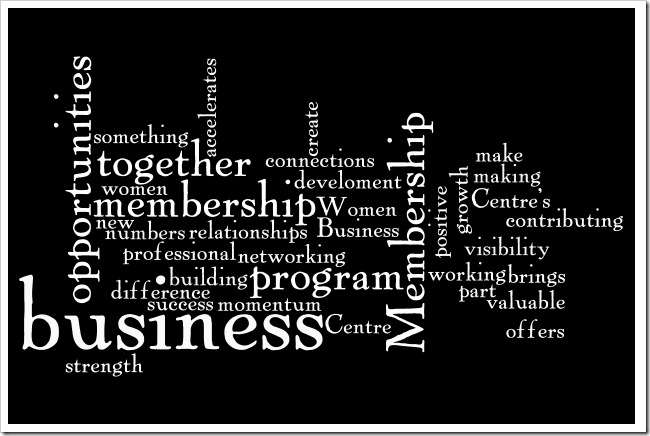
In a recent presentation someone used the tool Wordle to highlight the results of a survey. They put all of the survey comments into the tool and it puts together a word cloud with the most common words being the largest. A very cool tool.
From the Centre for Women in Business:
In July I took the family to Alberta, my home province. They have never been there before. I will blog about the Rockies soon enough. We also went to the Stampede which I remember from my youth. I marched in the Stampede parade as a kid – with the Brooks Community Band – in grade 8 and 9 … I was the youngest member ever. Check out the fancy uniform. Heavy, 3 sizes too big and thick wool (very hot and itchy).
![band[1]](https://michaelweening.com/wp-content/uploads/2010/08/band5b15d5b35d.jpg?w=470&h=336 "band[1]")
I didn’t remember the Stampede very well from my youth. It was an interesting affair this time around and I did get a few interesting pictures. My favourite below, I was rooting for the horse and the horse won.

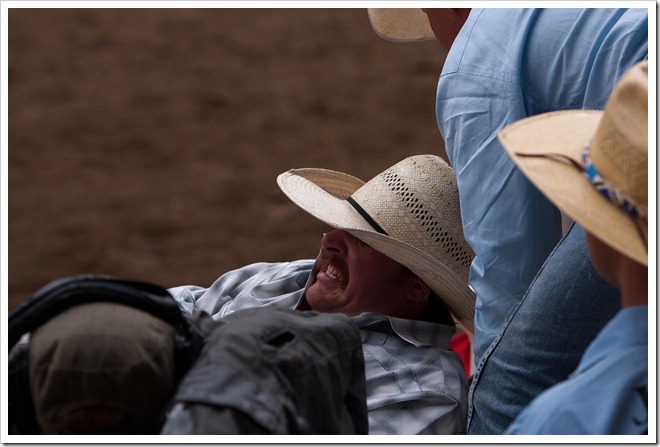
A picture of the ‘before’ the gate opens. Why they do this, I have no idea. The facial expression does not indicate enjoyment.
The horse number 409 is riding is worth $100,000.

To be honest, the highlight for us was the Superdogs. What an amazing show. The sheep dogs are beyond smart and by far the fastest.

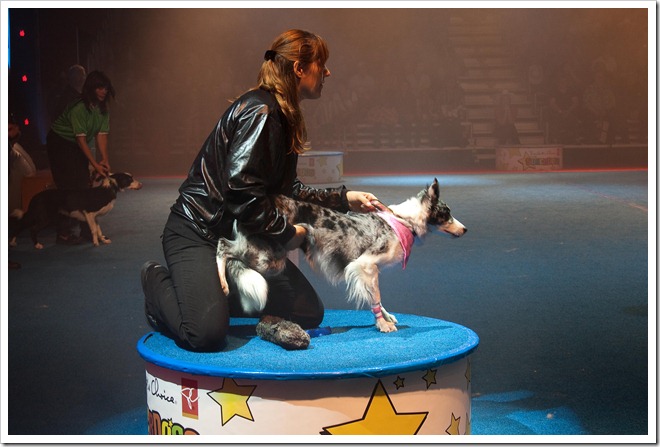
Another culture experienced.
I love a good sunset. This one in Calgary in July was breathtaking.


The Globe and Mail had an interesting article on the back page this morning titled ‘Calgary is making me nicer’.
As a native Torontonian there are two types of people you meet when you move to Calgary.
There are those who immediately tell you how wonderful Calgary is. “The mountains, the outdoors, the rivers, the Stampede!” These people have no doubt you won’t miss Toronto one bit and can’t imagine why you would have lived there in the first place.
Then they give you their cellphone number so they can meet you for lunch and show you around or invite you over and make you feel welcome. If you were expecting just an e-mail address, forget it. That’s way too impersonal for a Calgarian. They tell you they are looking forward to your call. And they mean it.
Then there is the other type, best personified by a salesgirl I met at a local drugstore when my hairdryer exploded and I went looking for another. The store didn’t have any dryers that were of the quality I wanted, so I asked the woman where I could get a salon-grade hairdryer in Calgary, explaining I was from Toronto and didn’t know my way around yet.
Before I had even finished my sentence she blurted out, “Why would you ever leave Toronto? We have nothing here! We only just got an outlet mall and it’s not even that great. I’m desperately trying to get into nursing school in Toronto so I can get out of here and live in a real city.”
To be sure, after this anti-Calgary outburst, the salesgirl spent more than 20 minutes with me figuring out what I needed and where I lived, then drawing maps and looking up phone numbers of places that might carry what I wanted. She was helpful beyond belief.
And that’s when it started to dawn on me. Calgarians, whether fiercely hometown patriotic or bigger-city wannabes, were not like most of the Torontonians I had lived among all my life before moving here in May for my partner’s work.
Calgarians were nice. Not just polite – but nice. They wanted to talk to you. They wanted to listen to you. They wanted to help you if they could.
If anything reinforced this belief, it was driving. Or walking while other people were driving. On a nice day I decided to go out for a stroll, bringing my jaywalking habits along for the ride.
I was halfway out in the road trying to cross, expecting the cars to come whizzing past me with no regard, when the strangest thing happened. The cars stopped so I could get across. Stopped dead in the middle of traffic! With seemingly no ire that I was disrupting their right of way. No honking. No fist waving. Just a smile and a nod letting me know I was safe to cross.
Read the rest of the article here. The traffic story made me laugh. I still remember moving from Ontario to Alberta and my dad commenting how people would pull over on a 2 lane highway to let you pass. Or maybe it is the sunset and the odd Chinook … but I would agree, people in Calgary are very, very nice.

 Michael Weening: a few pictures