Over the coming weeks I will get back to regular blogging. With 30C weather, every extra bit of time spent on the golf course or in the sun seems to be the right choice ….

Over the coming weeks I will get back to regular blogging. With 30C weather, every extra bit of time spent on the golf course or in the sun seems to be the right choice ….
I have to admit that as I read the story about the Hewlett Packard CEO and his resignation over expense fraud and harassment, I was perplexed. I had often heard from people at HP that he was a really good CEO, having put HP on the right track after the Fiona years of lots of flash, and little delivery. That being said, the detractors are now coming out. Consider the story ‘Actually, Mark Hurd was a Thug’;
This guy was a thug, nicknamed Mark Turd by ex-HPites who worked directly for him — stories that have circulated in the Valley for three years. He raped HP employees (figuratively, without violating the sexual conduct code at HP) by eliminating the sixty-five year concept of profit sharing, preferring to move to obscene bonuses for himself and his five top minions — a mere $113 million payout for them in a year he chopped everyone else’s pay by 5% plus profit-sharing. These were raises for some of the five people by as much as 400% — a tidy uptick.
He was profane, a bully, autocratic, threatening, demeaning, vindictive, and rude. Blogs over the weekend by current employees said "Hooray, the tyrant is gone!" I couldn’t contain my glee on the 11pm news — best news for HP in a very long time!
The Voice of the Workplace, HP’s thirty-five year historic ‘measure’ of employee feelings (done every five years) showed in April an astonishing finding — more than two-thirds of HP’s employees would quit tomorrow if they had an equivalent job offer. Not a raise, not a promotion, simply an alternative. That number never used to be in double digits. Other companies in the Valley have reported an amazing rate of HP resumes being submitted; one large company saying, "we didn’t know they had that many people working there".
A quick web search finds an entire web site dedicated to Mark Hurd loathing. One has to wonder what he was thinking. Did he figure that he was untouchable (the Tiger Woods syndrome)? If you review the facts it remains a head scratch:
A blog at HBR suggests that it could be embarrassment (he tells more lies to cover the first), arrogance or a lack of attention to detail. I am sure that over the coming months more will come out.
What an odd story. But then again, no odder than many others such as Eliott Spitzer and countless others. A far cry from the ABB CEO who famously walked onto an airplane during dramatic corporate cutbacks and went straight to coach while his VPs sat, uncomfortably, in Business Class. Leadership by example.
Such an odd story and HP will suffer through this unfortunate crisis of character like so many other companies, and their employees have before.
I have often heard a story about Bill Gates. It could be an outright lie, a falsehood, I am not sure. But it does make a point. The story goes like this; Bill Gates is famous for his abrupt manner and impatience. It was related that during people reviews or reviews of projects, he would often cut people off as they went through the ‘good’ of the project or how they had been successful in their role and say ‘Don’t tell me what you did right. Tell me what you did wrong, and how you learned from it’. His abrupt – bullying style is well known, so it does not seem like a stretch.
Personally, I have seen it time and time again. Big wins are often celebrated, but the little wins are forgotten, celebrating the journey toward success seems to never be a priority even though it is clearly correlated to success in adults and children (when done correctly). Of course, I have also been in work environments where the praise is unwarranted and the culture is one that ignores the negative, blind to the challenges ahead, which is equally as frustrating and damaging. A point that Steven DeMaio in his article ‘When being positive is positively meaningless’.
In the end, the above represent two ends of the spectrum. The Bill Gates ‘don’t praise’ mentality to the other end where praise is meaningless and dangerous. So it must be about balance. Providing critical feedback to help people learn, progress and be more successful while seeking opportunities to find people doing things right, making the effort. I like the advice in ‘The Art of Giving Praise’:
And I would add, be cautious of praising skill versus effort. The article ‘How Not to Talk to Your Kids’ is a truly scary example of the dangers of the wrong kinds of praise (I have seen this one time and time again in kids):
Dweck sent four female research assistants into New York fifth-grade classrooms. The researchers would take a single child out of the classroom for a nonverbal IQ test consisting of a series of puzzles—puzzles easy enough that all the children would do fairly well. Once the child finished the test, the researchers told each student his score, then gave him a single line of praise. Randomly divided into groups, some were praised for their intelligence. They were told, “You must be smart at this.” Other students were praised for their effort: “You must have worked really hard.”
Why just a single line of praise? “We wanted to see how sensitive children were,” Dweck explained. “We had a hunch that one line might be enough to see an effect.”
Then the students were given a choice of test for the second round. One choice was a test that would be more difficult than the first, but the researchers told the kids that they’d learn a lot from attempting the puzzles. The other choice, Dweck’s team explained, was an easy test, just like the first. Of those praised for their effort, 90 percent chose the harder set of puzzles. Of those praised for their intelligence, a majority chose the easy test. The “smart” kids took the cop-out.
Seek balance.
The Forbe’s article ‘Life after Moore’s Law’ suggests that the doubling of processor power every 18 months is over.
But in a development that’s been largely overlooked, this power scaling has ended. And as a result, the CPU scaling predicted by Moore’s Law is now dead. CPU performance no longer doubles every 18 months. And that poses a grave threat to the many industries that rely on the historic growth in computing performance.
Going forward, the critical need is to build energy-efficient parallel computers, sometimes called throughput computers, in which many processing cores, each optimized for efficiency, not serial speed, work together on the solution of a problem. A fundamental advantage of parallel computers is that they efficiently turn more transistors into more performance. Doubling the number of processors causes many programs to go twice as fast. In contrast, doubling the number of transistors in a serial CPU results in a very modest increase in performance–at a tremendous expense in energy.
![5-2-10-mooreslawwall600[1]](https://michaelweening.com/wp-content/uploads/2010/07/5210mooreslawwall60014.jpg?w=602&h=291 "5-2-10-mooreslawwall600[1]")
I have to admit that I don’t even understand the correlation between processor speed (GHZ) and performance anymore. And if it is dead, that means that coders will have to seriously review how they write their programs because I still find my PC slowing down. One also has to wonder at the impact of web services, which puts the processing power in the cloud (impacting the need for local server or desktop processor speed).
Although I hope it continues, I love to watch computer components continue to tumble down. $84 for a 1.5TB drive is pleasantly mad.
The end of an interesting phenomenon (perhaps).
I had forgotten about seeing this. A book that a few Ontario drivers should acquire.

While in the UK I blogged about our visit to Stonehenge but left out the rest of the trip, where we landed in city of Bath, Somerset..
Bath (pronounced /ˈbɑːθ/) is a city in the ceremonial county of Somerset in the south west of England. It is situated 97 miles (156 km) west of London and 13 miles (21 km) south-east of Bristol. The population of the city is 83,992.[1] It was granted city status by Royal Charter by Queen Elizabeth I in 1590,[2] and was made a county borough in 1889 which gave it administrative independence from its county, Somerset. The city became part of Avon when that county was created in 1974. Since 1996, when Avon was abolished, Bath has been the principal centre of the unitary authority of Bath and North East Somerset (B&NES).The city was first established as a spa resort with the Latin name, Aquae Sulis (“the waters of Sulis”) by the Romans in AD 43 although verbal tradition suggests that Bath was known before then.[3] They built baths and a temple on the surrounding hills of Bath in the valley of the River Avon around hot springs, which are the only ones naturally occurring in the United Kingdom.[4]. Edgar was crowned king of England at Bath Abbey in 973.[5] Much later, it became popular as a spa resort during the Georgian era, which led to a major expansion that left a heritage of exemplary Georgian architecture crafted from Bath Stone.
It was a wonderful stay with the highlight for me being the Bath Abbey, not because it is yet another magnificent church (It is), but because of what is inside.


The walls were adorned with flags of military companies that had served Britain in ancient wars, and marble slabs with inscriptions describing the past lives of those who have passed on. This may sound morbid but one of my favourite things to explore in England was the cemeteries. Seeing a monument to someone from the 1600 or 1700’s and a snippet of their life was fascinating for me.
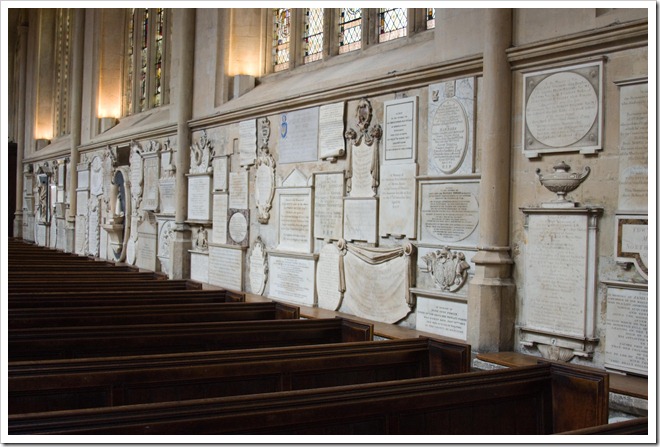

The one I remember the most, but did not photograph, was one written by a family as an ode to their loving mother. I do not remember the words, but I remember how it was an apt tribute to a great mom. Here are a few others that I found fascinating. The UK history is so rich and long.
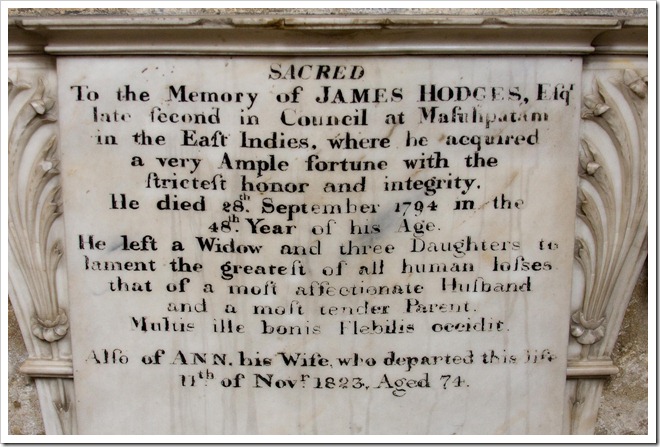
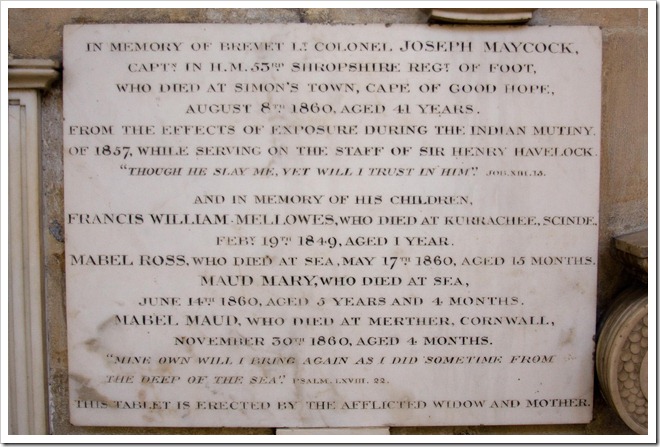

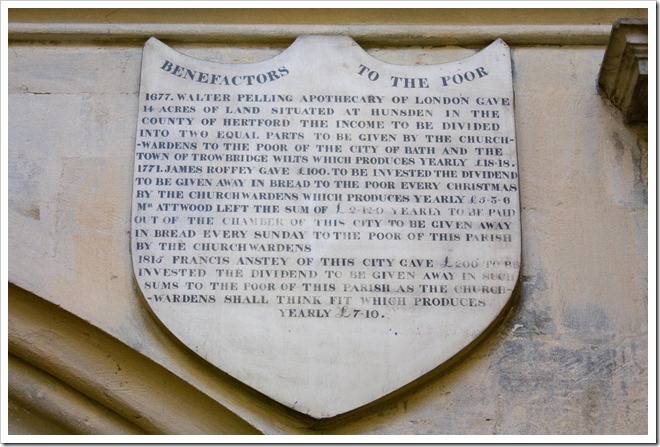
Imagine living in Bengal, serving the Empire in the 1700s.
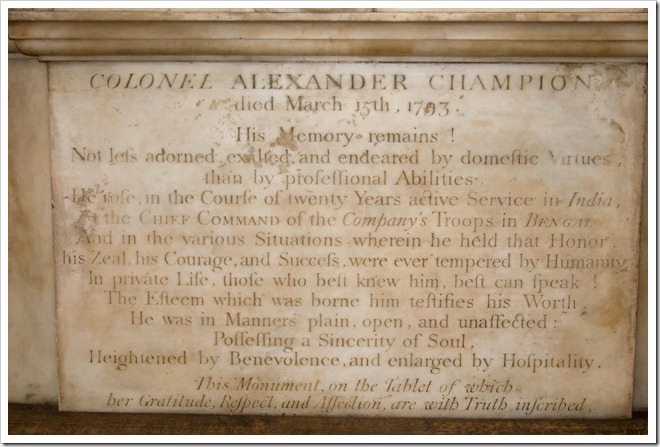
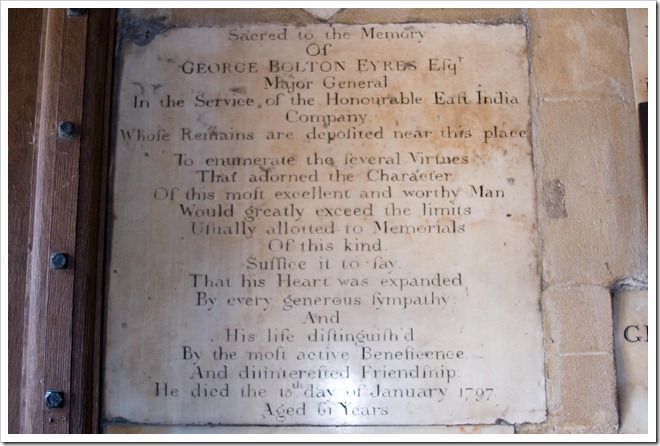
And last but not least, this slab was underfoot.
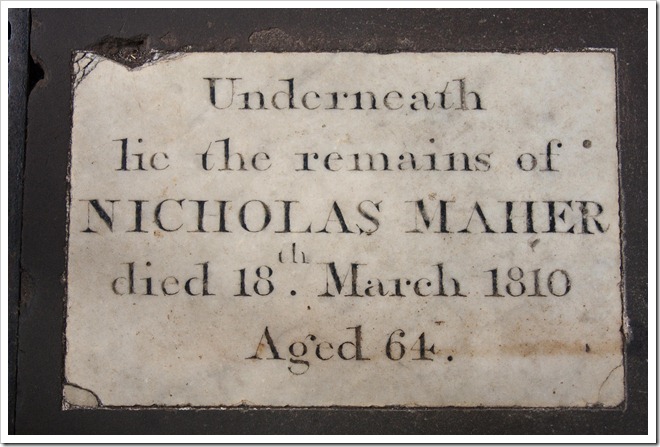
Lives lived. You can take a visual tour here.
Over the coming month (August), my blogging will be sporadic as there is so much going on this summer between work and home (which is fantastic). I also have the good fortune of the boys really starting to enjoy golf this summer (they played 9 almost every day last week), so I get the opportunity to really bring the game back after that 4 year hiatus. I do love golf …
I am just finishing pictures from Banff. It is the first time the family has been to the province of my youth, Alberta. What is there to say about Alberta and the Rockies? It is the most beautiful place I have ever been. Glad that we are finally exploring our home country.
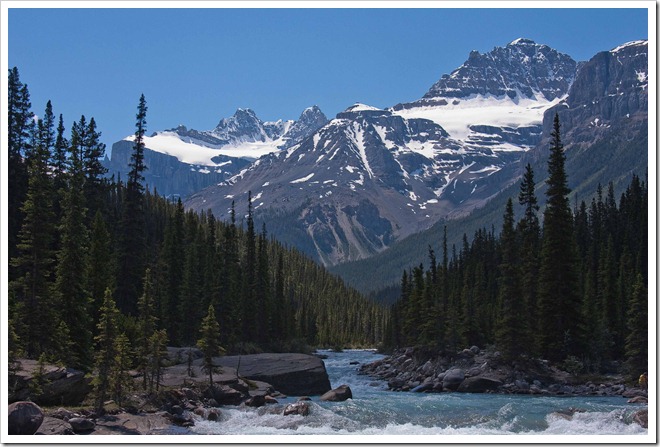
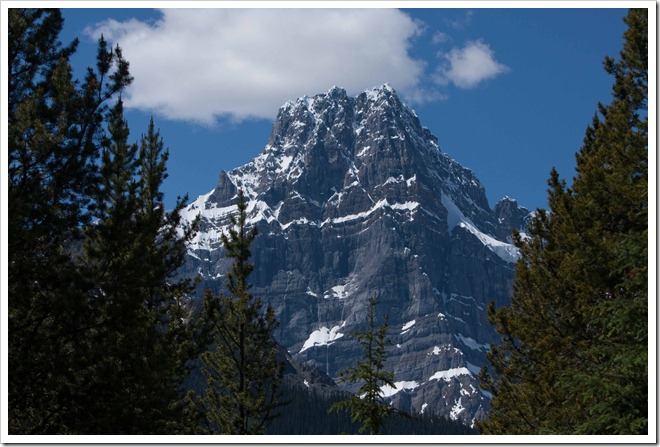
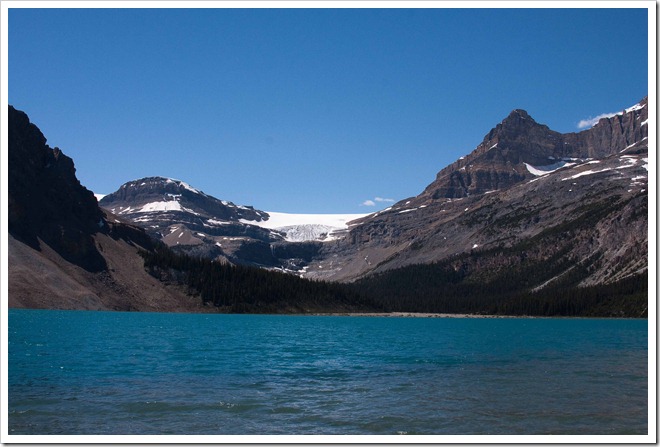
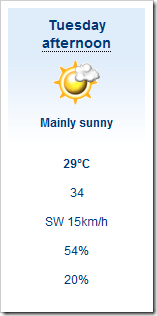
And of course, who ever wants to be inside with an Ontario summer like this? Feels like it is perpetually 32C with sunny as the wonderful Ontario norm, lots of Vitamin D to go around. After all, according to Statscan 2 in 3 Canadians do not get enough Vitamin D from the sun each year. I wonder how much of that is from too much sunscreen to compensate for the fact that many of us 40 year olds grew up with no sunscreen and are overcompensating?
The HBR article Envy at Work is an interesting insight into the human mind and the potential for destructive behaviour when inter-team competitiveness goes sideways. Personally, I have always been a proponent of sharing best practices whenever your team has one and saying thank-you as much as possible.
But, that is not always enough. The following quote really struck me, this goes deeper, right to human nature:
Although the German word schadenfreude – delighting in others’ misery – rapidly entered the English lexicon, the term mudita (from Pali,an ancient language of India), used by Buddhists to mean ‘rejoicing in the good fortune of others’, has not. It is the rare person whose automatic impulse is to feel glad when meeting someone smarter, prettier or richer.
An interesting point and a reminder that to build a great team, you have to watch for the warning signs. In the article they talk about one case where the employee left the company because he believed that his colleague was getting all of the credit for his hard work. The article focusing on how we, as individuals, can realize when we are feeling envious so that we can stop destructive behaviour.
One has to wonder, had he had a good manager who was watching for signs, could he have been coached out of the situation? Maybe he just needed coaching on how to represent the good things he was doing each day (so that he did not feel that someone else was taking credit) or on how to come to grips with the feelings of envy and resolve them? It was clear that he needed coaching on conflict resolution.
A great follow-up article should focus on how a good manager could have helped resolve it within a team. Personally, this article could be extrapolated well beyond work to the home life. How many children are encouraged to compete by parents? Leading to inter-family envy and dysfunction. I know that was the norm with young boys in families as I grew up, where there was always this competitiveness and I still see it today, parents encouraging their children to compete. Doesn’t that create envy and increase the propensity for dysfunction as the children compete for parental praise?
My wife has a philosophy of encouraging the boys to be competitive, but never against each other. Instead, encouraging them to support each other, help each other succeed and always seeking opportunity to raise each boy’s confidence up a level. I think it is brilliant, counter cultural and one of the reasons why our boys are the best of friends.
Mudita.
No blogging for July. Enjoy the 45 degree Ontario heat.
One of my favourite annual competitions is the Bulwer Lytton fiction contest, which awards writers the dubious prize of writing the worst book openings by category. The 2010 award winners are in!
Personally, I think the runner-up should have won:
Through the verdant plains of North Umbria walked Waylon Ogglethorpe and, as he walked, the clouds whispered his name, the birds of the air sang his praises, and the beasts of the fields from smallest to greatest said, "There goes the most noble among men" — in other words, a typical stroll for a schizophrenic ventriloquist with delusions of grandeur.
Tom Wallace
Columbia, SC
All are worthy of a raspberry.
While in Crete a while back (quite a while now) we stayed in a little fishing village, and enjoyed the coast. While at dinner one night the waiter offered us an after dinner drink. Not the local Raki (which is pretty hard to digest), and not the customary Greek ouzo. It was called Mastiha and came from a local tree. Very unique tasting and one I really enjoyed (I am not one to drink very often).
Mastiha starts as a semi-transparent sap from lentisk trees (actually evergreen bushes) found only in certain areas of the Greek island of Chios. As resinous granules, it was the original chewing gum, and the name "mastiha" is the root word of "masticate," meaning "to chew."
At the market, look for "mastiha," "mastihi," or "mastic tears" and it might also be available in powdered form.
Mastiha is used as a spice in sweets and cooking, as a flavoring for liqueurs, and in soap-making, cosmetics, and toothpaste, among others. Recent evidence of its positive effect on ulcers has resulted in a boom in purchases by large pharmaceutical companies.
Before we left I stopped at the local liquor store but could not find it. In fact, since then I have been unable to find it despite inquiring at the local speciality spirits shop while in the UK or in Canada, until now. Last week when I happened across it in the LCBO.
A Greek company has revived the mass appeal and is spreading the drink around the world under the brand Skinos, and it is exactly as I remember it. Enjoy.
Catching up on my HBR reading. The article General McChrystal’s Failure of Followership has an interesting point of view on why the General has failed as a leader in Afghanistan:
The story provides more evidence that McChrystal is not now, as he never was, the kind of a follower you want as a leader. In contrast to the old days, when manly virtues seemed to suffice, in the 21st century this style of leadership will no longer wash. As the delirious reception to Obama’s nomination of General David Petreus to replace McChrystal testifies, what we want now are leaders who can be, simultaneously, followers, commanders who can cooperate and collaborate as skillfully as they can command and control. It’s a lesson as applicable to the boardroom as it is to the battle field — and one better learned before, not after, the fact.
Having just watched the Green Zone, it continues to be clear that this will require the best of leaders.
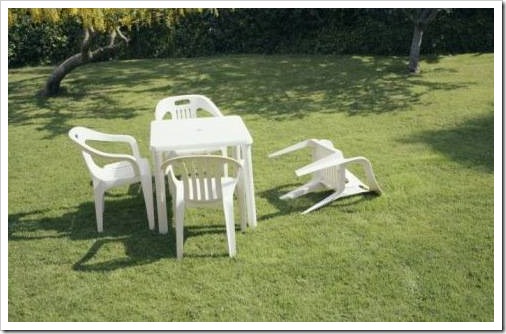
Last week while sitting around a conference table, the building began to shake. We all stopped, it really was shaking. As the G20/G8 was just about to kick off, the first thing that went through my mind was ‘Wonder if it is a bomb or something?’.
Turns out it was a genuine earthquake in the Ottawa region, felt as far away as New York city. A colleague passed on a picture of the devastation from a trusted source.
I was reading the story of the Battle of Omdurman in a Military History magazine on my flight yesterday. A traditional colonial slaughter:
At the Battle of Omdurman (2 September 1898), an army commanded by the British General Sir Herbert Kitchener defeated the army of Abdullah al-Taashi, the successor to the self-proclaimed Mahdi Muhammad Ahmad. It was a demonstration of the superiority of a highly disciplined European-led army equipped with modern rifles and artillery over tribesmen with older weapons (note: spears, arrows, swords) and marked the success of British efforts to re-conquer the Sudan. However, it was not until the Battle of Umm Diwaykarat, a year later, that the final Mahdist forces were defeated.
At the end of the article, the author provided the following insights into the battle, he called these “Lessons”:
Good advice all round.
This weekend saw a number of ‘protesters’ in Toronto for the G20. Riots broke out, windows were broken, cars fired. As the Toronto Star put it:
On Saturday afternoon, as TV stations played and replayed images of anarchists torching a police car at the iconic intersection of King and Bay Sts., the mayor noted he had spent the week trumpeting Toronto’s story to international journalists — a financially stable, diverse and vibrant city.
“Does today send signals about Toronto that I wish weren’t sent?” Miller said. “Yes, absolutely, but the underlying facts about are city are still there.”
As it was going on Saturday night my son asked me:
‘What are they protesting?"’
I did a web search. We watched the news. We could find nothing. So I responded ‘I don’t know’.
So these ‘protestors’ did not get a message out. Why? Because they are a bunch of hooligans, who will justify their destructive actions on their anarchist, anti-government approach where the ‘cause justifies the means’. But in the end, nothing was accomplished – they sent no message of value.
The only message that I took away from the whole thing is that we should lock them all up, that they are simply hooligans who do not respect others and that hopefully no Police were hurt while apprehending them.
Besides, this is Canada. We don’t do that kind of thing here.

So much for the ‘cause’ …. common thugs.

Update: Check out 25 amazing photos of the event here.
The leadership call that President Obama made yesterday, sacking his top General in Afghanistan, represents a good topic for debate.
When I was last interviewing for a leadership role I was asked a question I had never been asked before;
You have a super star sales rep. I mean that rep is blowing it out of the water, all the time. But the rep is disruptive, not being a good team player. Not following process, being demanding, among other things. What do you do?
My answer was pretty simple. In that case i would set expectations, encourage mentorship, actively engage, coach as things happened, and seek results and change. If there is not agreement to seek change (the rep didn’t see the problem at hand, which is common. Many people are in denial of their own shortcomings), then i would take a more formal route like a plan.
I wonder if the President missed an opportunity here, considering the following;
In the end, we will never know because it is all about that last point. The general has been involved in 2 cover up scandals, has shot off his mouth before and is clearly trying to play general and politician (which he is clearly not adept at .. He is a tool, to be employed by a skilled leader). He also prides himself a little too much on being the rebel or cowboy. If achieving 5 was not possible then he made the right decision.
After all, success will be all about people and the team, not one general.
A few years ago I blogged about Generation Kill, the HBO miniseries based on a Rolling Stone reporters experience in Iraq while embedded with the marines. The article was The Killer Elite and spawned the book Generation Kill. The article was not good for the marines. On a personal level, I found the whole thing quite sad and it painted an unpleasant picture of the war and the future for that country. Not inspiring. For several of the marines in the book, it lead to grave consequences:
Sergeant Espera was forced to leave the battalion and SSgt. Eric Kocher was disciplined for his actions in retrieving a fellow Marine who was wounded after stepping on a landmine.[2]
I am not sure how Rolling Stone does it, but their latest expose is even more damning. The article The Runaway General is a candid portrait of the situation in Afghanistan. Most people are ignoring the real issues in that country as the personal drama of whether or not President Obama will fire General Stanley McChrystal for his teams inappropriate comments in the article and open disdain for the White House.
Reading the article, I was left scratching my head. The strategy that the military is employing is a mix of military suppression, infrastructure rebuilding and active recruitment of a positive image within the Afghan community, called counterinsurgency:
From the start, McChrystal was determined to place his personal stamp on Afghanistan, to use it as a laboratory for a controversial military strategy known as counterinsurgency. COIN, as the theory is known, is the new gospel of the Pentagon brass, a doctrine that attempts to square the military’s preference for high-tech violence with the demands of fighting protracted wars in failed states. COIN calls for sending huge numbers of ground troops to not only destroy the enemy, but to live among the civilian population and slowly rebuild, or build from scratch, another nation’s government – a process that even its staunchest advocates admit requires years, if not decades, to achieve. The theory essentially rebrands the military, expanding its authority (and its funding) to encompass the diplomatic and political sides of warfare: Think the Green Berets as an armed Peace Corps. In 2006, after Gen. David Petraeus beta-tested the theory during his "surge" in Iraq, it quickly gained a hardcore following of think-tankers, journalists, military officers and civilian officials. Nicknamed "COINdinistas" for their cultish zeal, this influential cadre believed the doctrine would be the perfect solution for Afghanistan. All they needed was a general with enough charisma and political savvy to implement it.
With billions of dollars being deployed and hundreds of thousands of troops, the future does not look so bright:
When it comes to Afghanistan, history is not on McChrystal’s side. The only foreign invader to have any success here was Genghis Khan – and he wasn’t hampered by things like human rights, economic development and press scrutiny. The COIN doctrine, bizarrely, draws inspiration from some of the biggest Western military embarrassments in recent memory: France’s nasty war in Algeria (lost in 1962) and the American misadventure in Vietnam (lost in 1975). McChrystal, like other advocates of COIN, readily acknowledges that counterinsurgency campaigns are inherently messy, expensive and easy to lose. "Even Afghans are confused by Afghanistan," he says. But even if he somehow manages to succeed, after years of bloody fighting with Afghan kids who pose no threat to the U.S. homeland, the war will do little to shut down Al Qaeda, which has shifted its operations to Pakistan. Dispatching 150,000 troops to build new schools, roads, mosques and water-treatment facilities around Kandahar is like trying to stop the drug war in Mexico by occupying Arkansas and building Baptist churches in Little Rock. "It’s all very cynical, politically," says Marc Sageman, a former CIA case officer who has extensive experience in the region. "Afghanistan is not in our vital interest – there’s nothing for us there."
Military men acting as enforcement, government and diplomat. A volatile mix and it would appear that the despair continues for that region with very little hope, a lot of wasted money and no end in sight.
What I don’t see is someone looking at the big, monster UN with a critical eye.
I experienced good old fashioned selling a few weeks ago from the Culligan rep, as we bought a soft water system. I was an easy sell, I knew I wanted Culligan (this would be my third purchase) and it was simply a matter of picking which one and working through the details.
The rep did a good job of walking through the steps, and as this is an industry that seems quite stable and without change, their sales model was pretty by the book. A binder, with his sales materials and good old fashioned reference letters from happy clients.
And when I received my final bill from them in the mail, it had a form asking me to reference them to another client with the offer of free bags of salt for the reference.
Good old fashioned selling, that worked.
I don’t usually watch these videos when they float around, but if you can keep a dry eye while watching this video of US soldiers coming home to their families and children then you are truly a rock. I don’t know how they do it, leaving their families for 6 months+ at a time. I know I couldn’t.
Hats off to the troops and the sacrifice they make on our behalf.
I have been enjoying Esquire magazine lately. Very well written and a great cross section of articles. The article How a Man Ages .. or Should is the chronology of the transitions that we ‘men’ should go through as we age, made me laugh and think. A few highlights.
Age 26
Having whatever everyone else is having. → Having a usual — Scotch neat, a gin martini, a manhattan, whatever. Know thy drink, know thyself.
For me, it is Gin & Tonic. Preferably Hendric’s, with a slice of cucumber.
Age 27
Renting a tux. → Owning a tux.
I have to say I am on the fence about this one. Black Tie isn’t really Black Tie anymore. Most events that are ‘formal’ leave a lot of room for interpretation. I didn’t buy a tux until last year, and did fine. But I have to admit, it was way overdue. So on this one, I would say it is more of a 35 requirement (unless you live in England, where they are simply mad for Black Tie).
Age 30
Boot and rally. → Call it a night.
I have to agree on this one. The all nighter has not been in my blood for a very, very long time … around this age actually and the arrival of children. Who wants to be the Dad with the headache in the morning?
Age 33

Using quotes from Porky’s, Meatballs, Office Space, and Old School in conversation. → Using quotes from assorted wise men. Faulkner is good. Churchill is better.
I prefer to do both. Name that quote, “I was a one man wolf pack’. For the record, I own a few Churchill quote books.
Age 40
Knowing your fantasy-football ranking. → Knowing your cholesterol levels. And your blood pressure. Start getting annual checkups, and ask for the works, and listen to your doctor. Listen.
So true. Things start to break when you cross 40 …. I am a 3. A little less bacon, sad but true.
Age 43
Saving money whenever you can. → Realizing that some things in life — flying first class, a good watch, good liquor — are always worth the money.
Absolutely. It isn’t about quantity, it is about quality.
Age 44
Playing sports that leave your knee/shoulder/wrist aching for days. → Making exercise a top priority. If you’re not getting stronger, you’re getting weaker.
This one hit me around 36. I was sitting in my office and experiencing lower back pain and I realized, ‘what the heck? you are way to young for this. Change it’. As an Orthopaedic Surgeon said to me last week, ‘I don’t operate on overweight 90 year olds.’ ‘Why? too risky?’ I asked. ‘No’, he responded ‘they don’t exist’.
And last … Age 58 and on …
Doing, watching, and listening to things because you’re supposed to. → Doing, watching, and listening to whatever you want.
Life is good. Lots of adventure left ….
One component of a lot of travel is that you catch all the movies. I had passed the movie Invictus several times before deciding to watch it. I am glad I did. The story of Nelson Mandela and the evolution of South Africa is both a sad and inspiring story. From IMDB:
Nelson Mandela, in his first term as the South African President, initiates a unique venture to unite the apartheid-torn land: enlist the national rugby team on a mission to win the 1995 Rugby World Cup.
The word Invictus is from Latin, meaning unvanquished. The movie centers around the poem Invictus by English poet William Ernest Henley (1849–1903) that Nelson Mandela kept close for inspiration during his years of captivity:
Out of the night that covers me,
Black as the pit from pole to pole,
I thank whatever gods may be
For my unconquerable soul.In the fell clutch of circumstance
I have not winced nor cried aloud.
Under the bludgeonings of chance
My head is bloody, but unbowed.Beyond this place of wrath and tears
Looms but the Horror of the shade,
And yet the menace of the years
Finds and shall find me unafraid.It matters not how strait the gate,
How charged with punishments the scroll,
I am the master of my fate:
I am the captain of my soul.
The author’s life makes the inspiration clear:
At the age of 12, Henley fell victim to tuberculosis of the bone. A few years later, the disease progressed to his foot, and physicians announced that the only way to save his life was to amputate directly below the knee. It was amputated when he was 25. In 1867, he successfully passed the Oxford local examination as a senior student. In 1875, he wrote the "Invictus" poem from a hospital bed. Despite his disability, he survived with one foot intact and led an active life until his death at the age of 53.
I have a few friends from South Africa. While it is recovering, it is still a sad story. A beautiful land, with much hope and opportunity, ravaged and struggling after many, many years with many tough years ahead, like so many African nations.
We live blessed lives.
I was reading through an article on a new company that is entering a mature Canadian market last week. In the article, the CEO made the point that of the five companies trying to enter the mature market, only one would survive. And in a telling statement, he was quoted as follows:
“I know I’m going to be that one”.
What a curious use of the word “I”. I know the impression it left on me.
To this day, I clearly remember how I learned the “I” lesson six years ago. There was a new incoming President and I had a 1:1 with him to walk him through the status of the business I was managing. After the 1:1, I was given this piece of feedback:
“Michael used the word “I” to much”.
“I” have never forgotten that. I was crushed, but “I” was very self conscious of the word from then on. A great lesson. It sounds trite, over used … a cliché, but there is no “I” in team. As a mentor once taught me:
“Focus on the success of your team and the people working with your team and your success is a forgone conclusion”
Remember “WE”.
Two additional NY Times articles on technology and the negative implications on productivity:
An Ugly Toll of Technology: Impatience and Forgetfulness
Has high-speed Internet made you impatient with slow-speed children?
Do you sometimes think about reaching for the fast-forward button, only to realize that life does not come with a remote control?
If you answered yes to any of those questions, exposure to technology may be slowly reshaping your personality. Some experts believe excessive use of the Internet, cellphones and other technologies can cause us to become more impatient, impulsive, forgetful and even more narcissistic.
“More and more, life is resembling the chat room,” says Dr. Elias Aboujaoude, director of the Impulse Control Disorders Clinic at Stanford. “We’re paying a price in terms of our cognitive life because of this virtual lifestyle.”
More Americans Sense a Downside to an Always Plugged-in Existence
While most Americans say devices like smartphones, cellphones and personal computers have made their lives better and their jobs easier, some say they have been intrusive, increased their levels of stress and made it difficult to concentrate, according to a New York Times/CBS News poll.
Younger people are particularly affected: almost 30 percent of those under 45 said the use of these devices made it harder to focus, while less than 10 percent of older users agreed.
Blackberries, iPhones and laptops in meetings are very distracting. A challenge at Microsoft (where everyone sits in meetings with their laptops open), famously written up in the article Minding the Meeting, or Your Computer?. What the article suggests is that laptops are not a problem in MS meetings, which is simply not the case. No matter what the published ‘etiquette’, the reality is that a laptop or Blackberry or iPhone will constantly distract.
I never thought I would say ‘too much technology’.
The N.Y. Times article Hooked on Gadgets, and Paying a Mental Price discusses how people are no longer living in the moment, buried under by the ‘email a minute’ culture and too linked to technology.
Mr. Campbell continues to struggle with the effects of the deluge of data. Even after he unplugs, he craves the stimulation he gets from his electronic gadgets. He forgets things like dinner plans, and he has trouble focusing on his family.
His wife, Brenda, complains, “It seems like he can no longer be fully in the moment.”
Scientists say juggling e-mail, phone calls and other incoming information can change how people think and behave. They say our ability to focus is being undermined by bursts of information.
These play to a primitive impulse to respond to immediate opportunities and threats. The stimulation provokes excitement — a dopamine squirt — that researchers say can be addictive. In its absence, people feel bored.
That is a very dangerous assertion. That in the absence of activity, people feel bored. The act of doing something, of being busy is the ‘rush’ or the goal. An old boss of mine used to make a comment when I would talk about my activity level. He would first ask what I was doing, assessing whether my activities were actually productive or time filling. And often he would help me realize that many of the things I was doing were just ‘busy work’. They were not progressing me to the goal, at that time – the goal was selling more.
Email is a dangerous feeder of the ‘busy work’ feeling. And just because we are busy, it does not mean that we will be successful. It is an artificial sense of accomplishment. There is no correlation to success.
It is all about what you are doing. As an aside, I frequently turn my Blackberry off.
As the G20 and G8 approach in Ontario, Canada has made it clear that we will urge debt reduction among the foreign governments of the world:
Canada will push for the Group of 20 countries to develop clear plans for cutting their budget deficits when leaders meet later this month in Toronto, Canadian Finance Minister Jim Flaherty said on Monday.
Meanwhile, the new British Prime Minister has made it clear that the UK needs change. The change is in the form of the UK looking to Canada for radical debt reduction programs, like those that Canada adopted in the 90’s:
The Chancellor will announce a "once-in-a-generation" revolution in public spending inspired by Canada in the mid-1990s, when the government turned a budget deficit of nine per cent of GDP into a surplus.
Canada brought public spending under control guided by the principle that people should ask "what needs to be done by government and what we can afford to do".
Today the UK spends more money on financing debt than they do on education. The UK spends 70Bn GBP annually to service debt. I do not relish what the UK is about to go through, and I remember those times in Canada. But it was a worthwhile endeavour, note the trajectory after Paul Martin’s 1995 budget, the year when the government got serious about debt reduction.

A full history of Canada’s debt can be found here, complete with charts. Interesting read.
Hopefully Canada will take their own medicine. After running a positive budget for the last 13+ years while paying down debt, this recent recession and massive stimulus spending has really put a dent in the debt meter.
I am not a big fan of Twitter. I don’t follow anyone and don’t have an account. Perhaps if I was from a younger generation, I would. After all, I am sure my buddies and I would have one or two jokes being shared, while moving from pub to pub (although, they would all need to be expunged prior to employment).
And of course, as with all technology, companies seek out new uses. Sony has just announced a lifelogging application that uploads to Twitter.
The lifelogging device, which was prototyped in collaboration with the University of Tokyo, is equipped with a camera, an acceleration sensor, a GPS, etc to record the activities of a cat.
Using the data collected by the acceleration sensor, etc, the device deduces the activities of a cat such as walking, sleeping and eating.
The device can be used with the Twitter service and automatically posts comments in accordance with the activities. The lifelog data is first transmitted to a PC via Bluetooth, and, then, comments are posted on Twitter. For example, it is possible to automatically post a comment like "This tastes good" when a cat is eating something.
Now, I love animals. I live in a family of animal activists. At one time we had a dog and four cats at the same time. And it runs in family. My son is on a school trip and he called last night and said they were at the Humane Society and he donated all of the money he had left because it is for the animals.
But knowing everything my cat does? Pass.
I had not heard of the company Foxconn until it started to hit the press over the last few weeks, after a host of employee suicides.
Reading the articles is a fascinating journey into China as you learn about this mammoth company that employs 800,000+ employees. The Foxconn walled city within Shenzhen (which is known as outsource city) is unbelievable, housing more than 270,000 employees with all of the city within a city services (fire, ambulance, hospital, shopping, transit).

Living in a city built by my employer is definitely a foreign concept and the scale is mindboggling. Via.
I am constantly amazed at how different my children’s education is from mine. The volume of homework (they actually have homework in the evening, I don’t remember doing homework in Grade 5, 6 or 7), the rigour (my eldest is going through full 1.5 hour exams in his classes in Grade 7 this week) and the quality of education.
A few weeks ago, our son brought home the class science project …. they hatched them in the class!

Progress, for sure.
A friend shared the following post on Pampas Grass:
I read that having a pampas grass plant in your front garden meant the owners of the house were swingers. Can anyone shed light on what sounds like an urban myth. Does anyone innocently have pampas grass out front and have they had any unsolicited strange visitors ? There are a few round my way and looking at the house owners, I just don’t quite believe it…..
One of the answers made me laugh (actually, more than one comment made me laugh):
Well I jolly well hope it’s an urban myth. When I was a kid, we had one in the front garden and it was my mum’s pride and joy. But I’m now questioning why I was always sent to stay with my grandparents when my mum and dad had ‘dinner’ parties.
For the record I went with Giant Chinese Silver Grass.

The Entrepreneur magazine article ‘The Likability Factor’ opens with ‘For better or worse, the sales process is not much more than a popularity contests. Do you have what it takes to win?’
They go on:
Do your potential clients like you? Do they perceive you as likable–and I mean really likable?
If they don’t, none of the rest of your efforts to establish yourself as the answer to their problems will matter. When you get right down to it, life is a series of popularity contests. You may not want to admit it or believe it. In fact, you’ve probably been told it ain’t so, but ultimately, if you’re well liked, then you’re more likely to be better in sales.
And you have to be able to grab their attention …. ‘Capture your clients’ attention when you convey:’
Interesting article. On a personal note, I just spent a lot of money at the garden center down the road. Is their product better? No. Do they have the best price? No. I figure I was paying 20-30% more. Is the location a factor? Not really. I could reach one of 5 different garden centers within a 5km radius.
So why? Because I really like them. 3 brothers who are friendly, helpful and full of good humour. I like going there. I am guaranteed a laugh a great service.
Their likability definitely lead to sales.
A big day today after Microsoft’s stock continued to drop. It is exactly where it was this time last year (I know – because that is when I eliminated all Microsoft from my holdings).
According to the CBC:
That makes Apple the most valuable technology firm in the world and the second-largest publicly traded U.S. company, behind oil giant Exxon Mobil Corp. Exxon has a market value of $278.6 billion.
Impressive.
In the article ‘You’re Contagious’ in May’s Men’s Health, Chris Woolston refers to a study published in the British Medical Journal that happiness is contagious.
Happiness spreads through social networks like an emotional contagion, according to a study that looked at nearly 5,000 individuals over a period of 20 years. When an individual becomes happy, the network effect can be measured up to three degrees. One person’s happiness triggers a chain reaction that benefits not only his friends, but his friends’ friends, and his friends’ friends’ friends. The effect lasts for up to one year. Conversely, sadness does not spread through social networks as robustly as happiness.
The author make two additional observations. Friends ward off loneliness, (‘people who feel disconnected often alienate their remaining friends’) and help you avoid obesity, (‘Men look to other men for clues about acceptable body sizes’ … ‘people eat more if a nearby stranger is overeating, .. the urge may grow if that glutton is a pal’).
Chris Woolston has a host of articles published on the topic, worth perusing here. As for me, optimism remains the default attitude and socializing with positive people remains job number one.
Me: Do you have Pampas Grass?Him: You mean like the grasses at the end of the driveway on The Golden Girls?Me: (laughing) Did you just reference the Golden Girls?Him: People always come in and ask for the grass from the end of the driveway of the Golden Girls (smiling)Me: OK, sure.Him: No, it does not live in our region. Won’t make it, only in Niagara.

Our new home is unlike our last home in Canada, in that it is a more traditional development so we are closer to our neighbours. In our case, they are very nice people and so it isn’t an issue. But they do have a kitchen window that is oddly placed so it looks right onto our back porch. We both discretely ignore each other when they are at their kitchen sink and we are in the backyard, but it is still a bit of a bother for me.
So, green thumb warmed up, I started to take on the challenge. First go has been planting a few new trees. A flowering almond which will do a great job … in about 5 years. Over the weekend we had my parents over and I was explaining the issue when my father suggested grasses. In gardening, I am not really a ‘grass’ guy. I enjoy traditional English gardens which are billowing with perennial flowers. I was generally at war with grasses, keeping them out of the garden.
Below are pictures of our old Canadian house … and the English gardens that I built over the years.
But the notion of a grass that grows inches a day and can quickly turn into a 4 meter barrier is very appealing. After a lot of web research (which has made my Readers Digest plant encyclopaedia defunct) I landed on the Pampas Grass.
This weekends project.
It has been 3 years since I golfed regularly. When we moved, it simply was not a priority. I was able to get out a few times in the UK, but the focus was on travelling, enjoying the greater London area, a new job that was very time consuming and a shift in family focus to tennis (we all started it for the first time …) meant that golf was a distant memory. So I have slowly watched the handicap climb from a low of 11 (just could not break 80) to the current 20ish level.
Now that we are back in Canada, living beside a golf course, golf is back for our family. I say our family as I am a pretty lucky guy, my wife started golfing when I did and loves the sport. So it paints a great picture of what retirement holds in the future.
But golf has not been a part of my life for a long time. I started a little over 12 years ago out of necessity. Despite having a brother who was a golf fiend (he was one of those golf course rats, playing since he was 12 and spending his summers playing, and then working on the golf course .. and is still a nutty 4 handicap). I never got into the sport until I was at Dell. As a Major Account Rep, it became clear that golf was part of the job. So one day, after much discussion, I put an order in for 2 sets of Callaway clubs and we started golfing.
I have a good friend who also started golfing late in life and he was a good coach, although we have different levels of detail orientation. His approach can be summarized as this:
I went somewhere in the middle, with his coaching:
And now, after not really playing for 3+ years, it starts over because I am surely not breaking 90. It is all about practice in this game. Although I will not be gunning for the 11 handicap, I know what that takes and it would require a time commitment that I am not willing to make at this point. But being around 90 is definitely in the cards.
After a 20 degree weekend that felt like 25, sun shiny brightly and a family foursome (boys have started too) on late Sunday afternoon .. it looks like this is going to be a great summer ….
A month ago I took the boys to a hockey game. While we were there I met a very interesting fellow, sitting beside me, David Ben. International lawyer who left the practice to successfully pursue his life long goal of being a magician. Thanks to his recommendation, we now have tickets to the Luminato Festival of Arts, and Mac King who is taking time out of his vacation from his Vegas show to perform (and who David endorses as amazing).
David is also into social networking and blogs. I read through a host of his posts, and found the entry on Deliberate Practice and the premise that volume of practice is not the key to success in a chosen vocation interesting.
One of my pet peeves has always been listening to people who pontificate how long they have been involved with something as if the length of time at an activity warranted respect. We’ve all heard someone – who is not particularly good at the task – state, “I’ve been doing this for thirty-five years…”
My mental response is usually, “Well, if I had been doing it for as long as you have, and was still that bad, I’d want to consider an alternative career.”
The reason they are bad is not because they haven’t put the time in, but because they have not done ‘deliberate practice’. Tugend cites Professor Ericsson’s notion of deliberate practice: “It involves spending hours a day in a highly structured activities to improve performance and overcome weakness.”
Based on the article ‘For the Best of the Best, Determination Outweighs Nature and Nurture’ in the New York Times.
But it does not follow, Professor Ericsson said, that everyone can become great, or even really good, in a given arena. First of all, you need to have parents willing to put in an intensive amount of resources and time in helping you excel.
In fact, research has shown that most people who are really outstanding in their fields don’t come out of nowhere. Top-notch musicians are usually born into families where music plays a dominant role. The same is true with sports or any other endeavour.
In addition, by studying those who have excelled, Professor Ericsson has found that they engage in something he calls “deliberate practice.” It involves spending hours a day in highly structured activities to improve performance and overcome weaknesses.
The theory is well supported by the Outliers and the 10,000 hour rule. As someone who has not played golf much in the last 3 years and is re-engaging, it also explains why simply running to the range and hitting balls has very little impact.
Never stops amazing me, watching people flail away with no coaching. I hope they are enjoying it, because the above surmises that enjoyment will be the only benefit. It also explains why it makes me feel like I am wasting time if I am not focused on a specific skill practice. Two weeks ago was my first game, and after the game (and affiliated warm-up on the driving range and putting green), I headed straight home and started pulling out my golf books to re-read the things that had gone rusty during my 3 year hiatus. Focus …
The above also explains why my music teacher made us practice 30 minutes a day, on the lessons he dictated for the week.
The CBC article ‘Smoking bans cut hospital admissions: study’ states the following:
In Monday’s issue of the Canadian Medical Association Journal, the researchers reported the following changes since the ban took effect:
- 17 per cent decrease in the heart attack hospitalization rate.
- 33 per cent decrease in rates of admission for respiratory conditions such as asthma, pneumonia and bronchitis.
- 39 per cent decrease in admissions because of cardiovascular conditions such as angina and stroke.
This article isn’t all that fascinating. One would think that this is a logical outcome. Smoke less, live longer and be sick less. Common sense? I thought so until I started reading the comments on the article (obviously, for the smoking community this is a hot topic). A sample:
.. 2nd hand smoke is the biggest hoax ever perpetrated on the general public by its own Govt
A hogwash study to justify the moronic freedom-destroying legislation from our Nannystate.
Yet another example on how one can cheat with statistics. Headline says what it says. Detail makes it pretty clear that the whole thing is baloney.
The Smoker’s History site makes it pretty well known (using BOLD LETTERS) that they believe the whole thing is a hoax:
The stock pretension of the morally depraved anti-smoker spin-meisters (who self-righteously spew unadulterated Nazi pseudo-science in our faces) is to pretend that big-money investments by pension funds are a moral issue of profiting from tobacco. In fact, their financial control gives them voting control, and that is how the anti-smokers elect traitors and appoint stooges who let the anti-smokers get away with their scientific frauds to lie the public about the risks of tobacco, support cowardly sell-out politicians, and throw lawsuits so that smokers will be forced to pay outrageous and unjust "damages."
And they add in analysis that smoking is not responsible for heart disease.
They performed no new studies, and merely uncritically regurgitated "published and unpublished data and testimony on the relationship between secondhand smoke and short-term and long-term heart problems." They ignored the CDC and other data on death rates which shows no discernable effect of smoking bans, and which furthermore reveals that the authors of the anti-smoking studies cynically cherry-picked their study periods and control populations. This data is freely accessible to the public, AND TO THE MEDIA, WHO UNQUESTIONINGLY PARROT THEIR FLAGRANT LIES AS TRUTH. (Secondhand Smoke Exposure and Cardiovascular Effects: Making Sense of the Evidence. National Academies Press, 2009.)
The comment on the article that really caught my attention was this one:
By the way, I do not smoke. However, a study has been made (and ‘interestingly’, not published widely) that smokers actually SAVE tax payers money. They live shorter and health care costs are way more in old age. Hence, total cost to taxpayers is actually LESS for smokers (not even counting the extra taxes they pay).
A leader’s job is to look into the future and see the organization, not as it is, but as it should be.-Jack Welch
We flew from Lapa Rios to San Jose, Costa Rica (a 45 minute flight) and instead of making another 12-14 hour travel day, spent the night at the San Jose Marriott. We were not disappointed, as it was just a relaxation stop to make the travelling more palatable. Great service, beautiful grounds and good food.
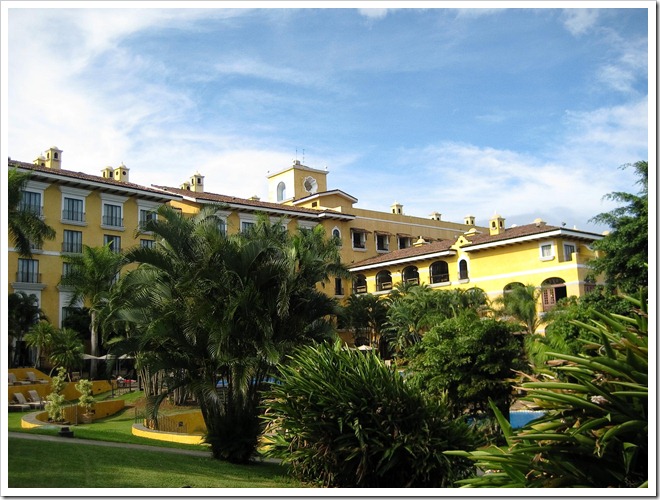
I don’t know if I would make the trip for the driving range though.


I tried to get the groundskeeper to explain to me the name of this tree. It didn’t work out (He did not speak English). The fruit was very interesting looking.

A small colonial church sits on the grounds.

I also stocked up on 10 bags of Costa Rican coffee beans. I have been enjoying them every since. And with that, we left Costa Rica. I would highly recommend it. Next time, we need to get to the volcanoes.
As it was our last day, we returned to our villa in the late afternoon and the boys voted to hang out on the deck until dinner – relaxing. The guide had told me that the best time to see monkeys is from 4-5pm before the sun heads south on the road that leads north of the lodge. The benefit being that the road is on a ridge cutting through the jungle. I spent almost two hours hanging out on the road, watching the wildlife.
The first encounter were these Spider Monkeys. A male, female and a baby about 10 meters from me at eye level (as they were 20-30 meters up the trees, it was a sharp drop off beside the road). They just swung beside me. I think I watched them for almost an hour.

Those babies need to hold on tight.


The dad emerged from a tree beside me.


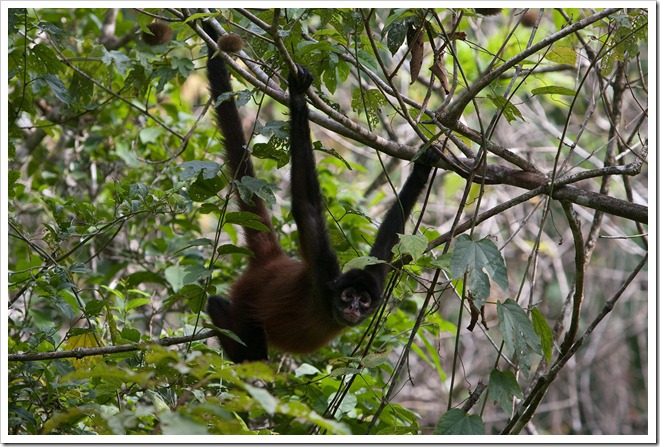
I walked a little farther down the road and watch a group of Howler Monkeys raid the fruit off a tree.


Their agility is remarkable.

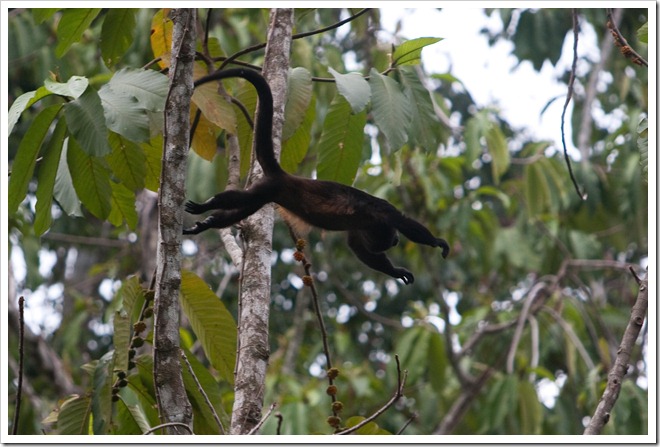

This fellow stood parallel to the ground, thanks to a very strong tail.

As I walked back to the lodge, this little fellow hung about 2 meters above me, enjoying some fruit (unfortunately, he was directly into the sun).


One way to make a few hours fly by. And then it was all over …
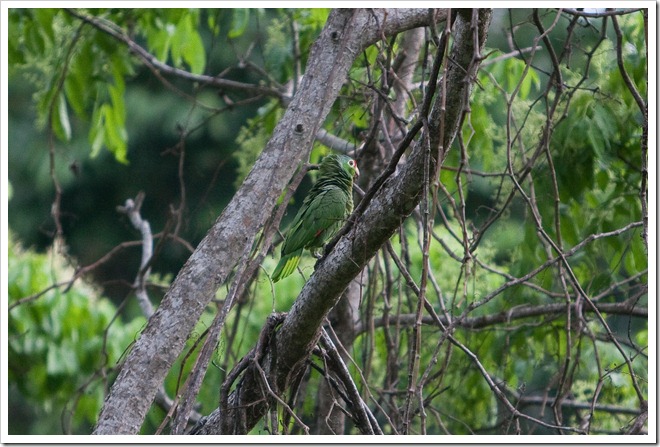
The one thing that we got use to quickly at Lapa Rios was the sleeping. You learn quickly that early to bed is a must, because like it or not, early to rise was in the cards. By 8:30pm it was pitch black. Which is why they suggested that you bring a flashlight as you walk along the path – the lighting is dim. Getting to sleep was not an issue, as it is dark, dark, dark and you didn’t want to leave your light on as it attracted insects.
Lying in your bed, you could hear a hundred different sounds. Hit the play button here for a sample. Of course, there is always the exception. The cicada has to be the loudest, most annoying insect alive. It was like hearing fingernails down a blackboard if one was around.
A cicada (pronounced /sɪˈkɑːdə/ or pronounced /sɪˈkeɪdə/) is an insect of the order Hemiptera, suborder Auchenorrhyncha, in the superfamily Cicadoidea, with large eyes wide apart on the head and usually transparent, well-veined wings. There are about 2,500 species of cicada around the world, and many remain unclassified. Cicadas live in temperate to tropical climates where they are among the most widely recognized of all insects, mainly due to their large size and remarkable acoustic talents. Cicadas are sometimes colloquially called “locusts”,[1] although they are unrelated to true locusts, which are a kind of grasshopper. They are also known as “jar flies”. Cicadas are related to leafhoppers and spittlebugs. In parts of the southern Appalachian Mountains in the United States, they are known as “dry flies” because of the dry shell that they leave behind.
Enjoy the Cicada.
The jungle starts to wake up around 5AM. Enjoy the sounds of the jungle, the ‘whoo whoo whoo’ is the deep call of the howler monkeys. I loved the early morning chirps and sounds of the birds, a pretty cool way to wake up.
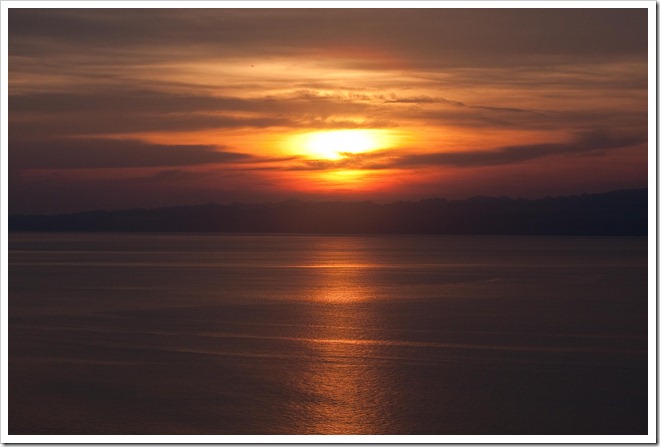
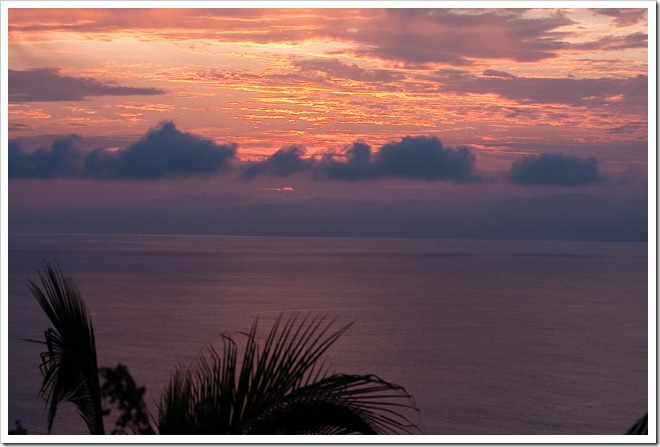
And of course, a pretty amazing sunrise.


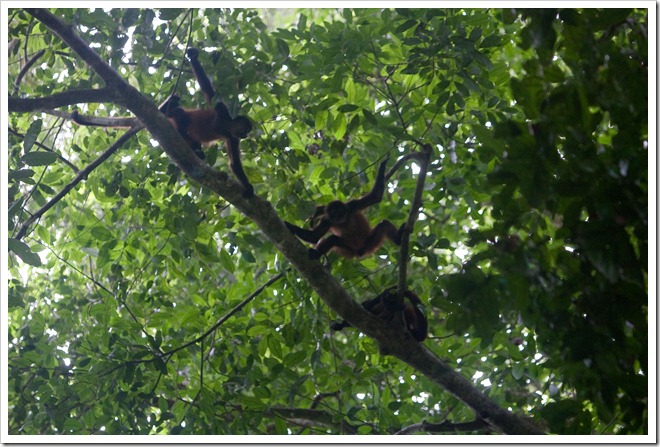
Our favourite jungle hike was the Osa trail, with tons of wildlife and 3 different types of monkeys. Our first encounter was a small family of Spider Monkeys who swung above us (60m up) and seem very interested in our movement. The guide explained that of all the monkeys, the Spider Monkey is the most aggressive. The male spent many moments shaking the trees to signal that he didn’t want us around. The previous day another family told us all about their encounter with the Spider Monkeys who warned them off by throwing feces (LOL). We were lucky.
The elevation changes on the trail were significant, you would often be looking down 60 meters or more as the jungle sloped down. This made for a few great encounters. We came across this Squirrel Monkey as he made his way through the jungle canopy. He was at eye level to us, but about 20 meters up a tree. Fun to watch him meander on his way.
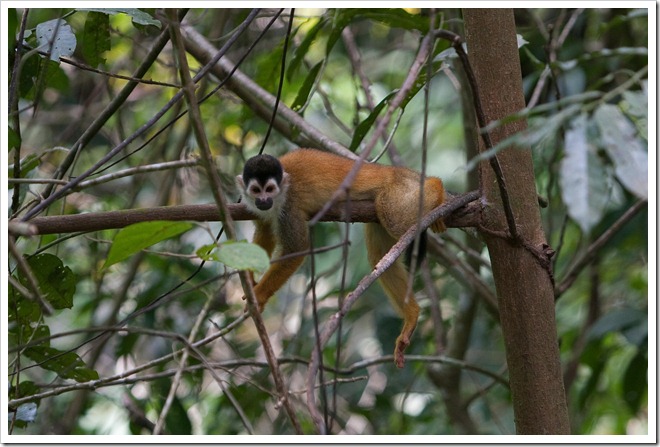
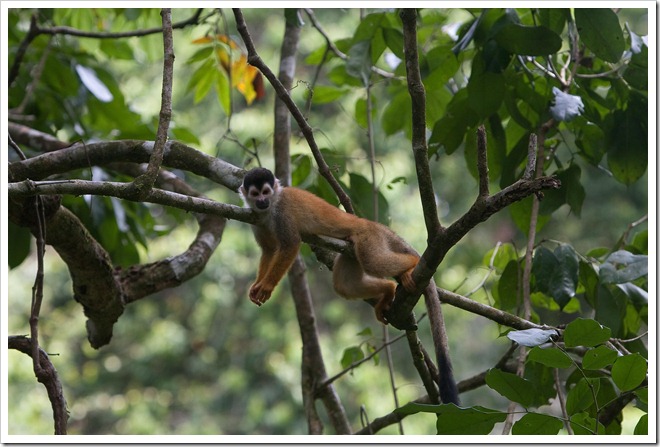
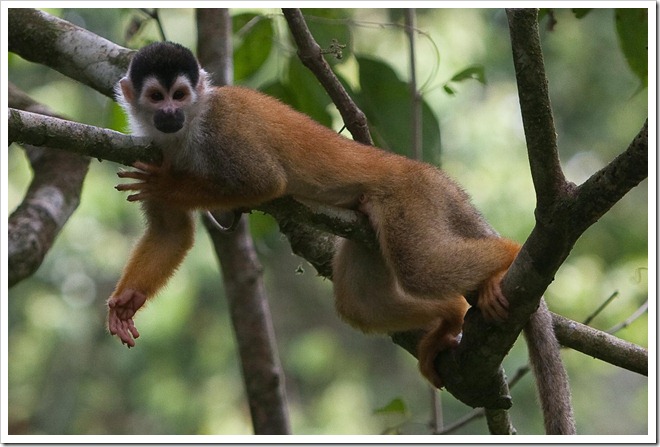
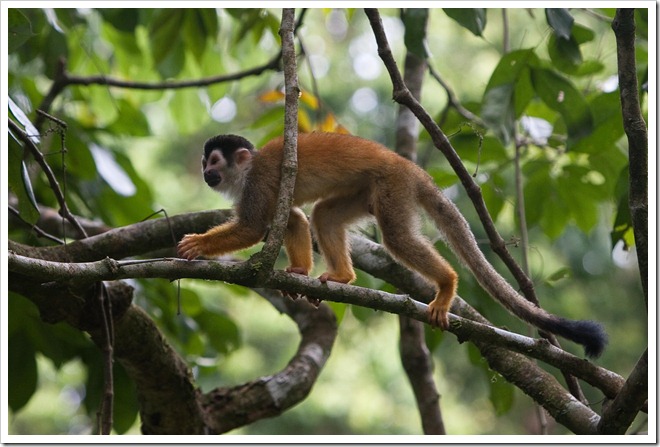
Further along the trail we came across a White Capuchin Monkey, which the guide explained is one of the most famous monkeys – often seen in movies. Also very smart.

He was all by himself. The guide suggested that his ‘tribe’ was around so I climbed off the trail, up a little hill and sure enough, there they were. About 30 of them, hanging around and playing in a huge tree, relaxing during the hottest part of the day.
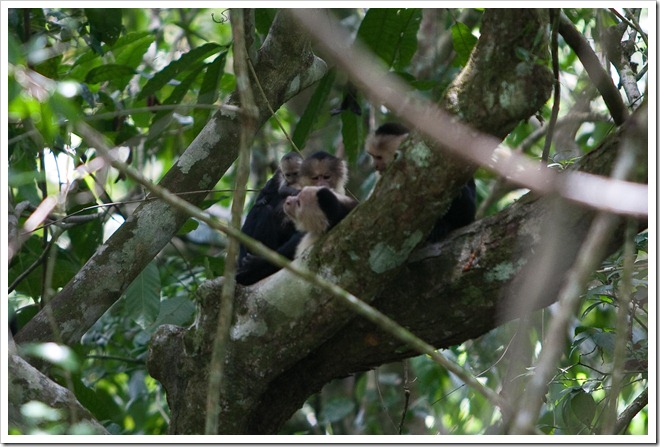
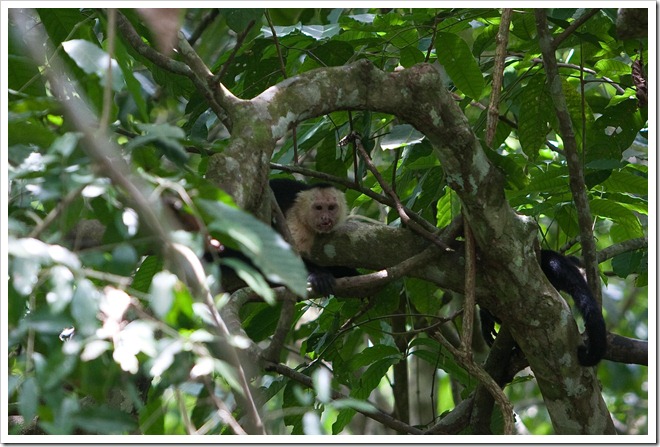
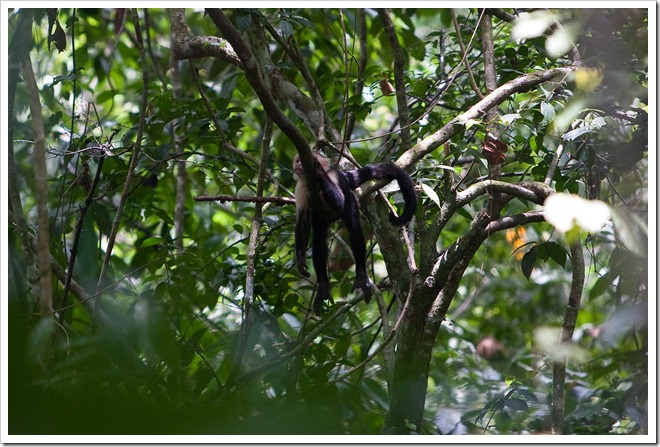
Amazing to watch.
We were walking back to our lodge from lunch. My camera was in my backpack (a big no-no), but I wasn’t really thinking that I would see anything that I had not already shot on the walk back. Ayden stopped and pointed up, there was a beautiful Macaw in full view. He wanted me to take a shot.
I pulled out my camera (with 70-200mm attached) and all of a sudden not 2 feet up from my head was a rustling. We stepped apart (Ayden down the path – me up the path) and barrelling down the tree came this Howler Monkey not inches from us.
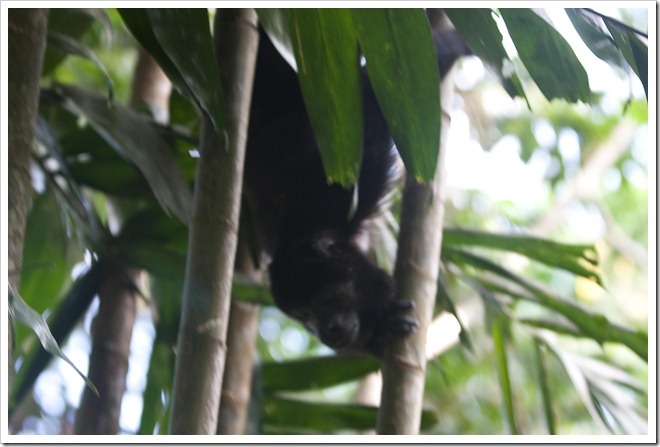
He stopped at the railing. I was stepping back (a bit surprised). He paused. He looked at me. He looked at Ayden. Then barrelled across the path and I just held down the shoot (without aiming). Why are they blurry? Because the lens won’t focus that close – below 1.4m – as it is a telephoto. He was almost on top of us.
He whipped up another tree and stopped for a look back.
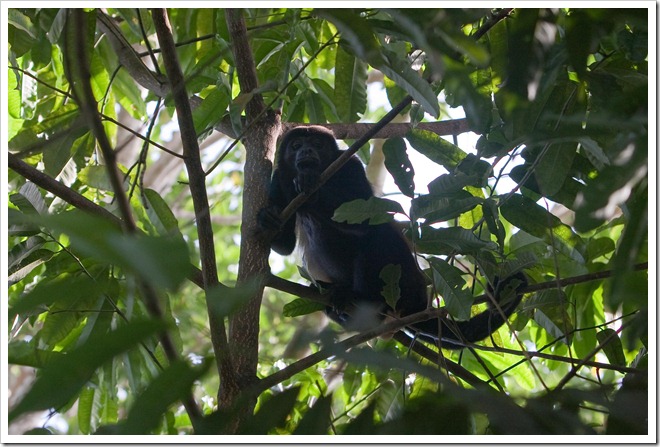 Amazing.
What would a trip to the jungle be without a post on the monkeys? Lapa Rios has 4 type of monkeys and they are a highlight. With a jungle canopy of 80 to 100 meters, as I mentioned in a previous post, they are difficult to photograph as you are shooting up into the sun. But with patience, you will see the right shot. On our second day (and first big hike), this was my best shot, a Spider Monkey. Pretty bad. But it is all about patience.
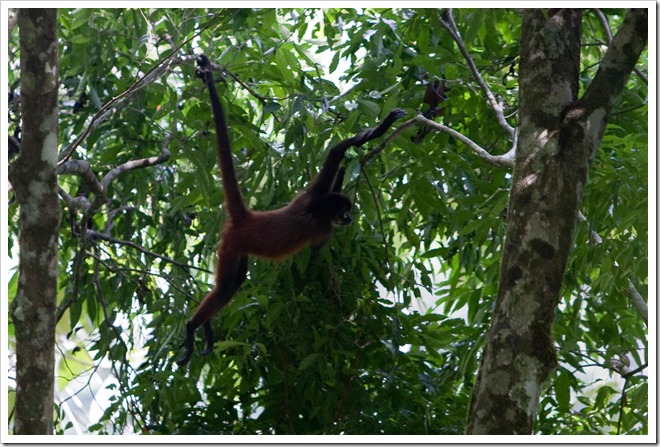
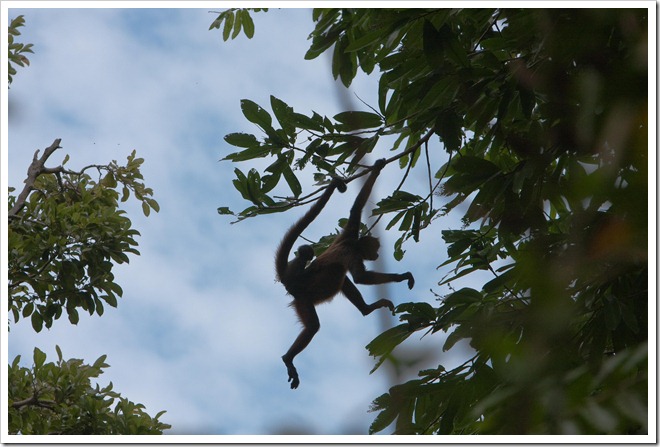
I found myself just watching them, until the guide called us away or it was time to head down the path. They are truly amazing creatures, swinging from tree to tree in huge groups, making what looked like 10 meter jumps from tree to tree. While walking down to the beach, we witnessed our first big jump. A group of Spider Monkeys were working their way through the canopy above us (60-80 meters) and I got these shots.
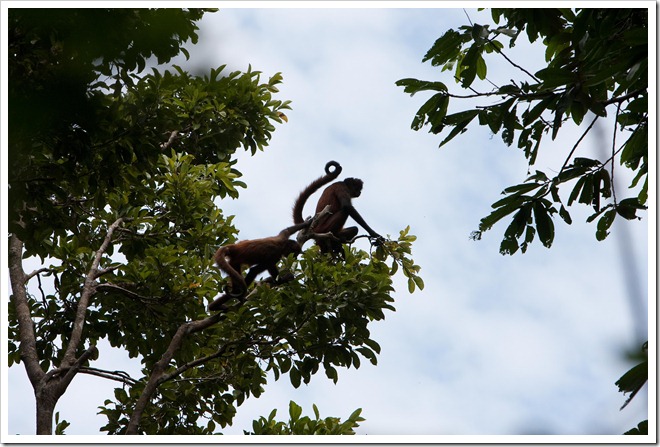
No fear.
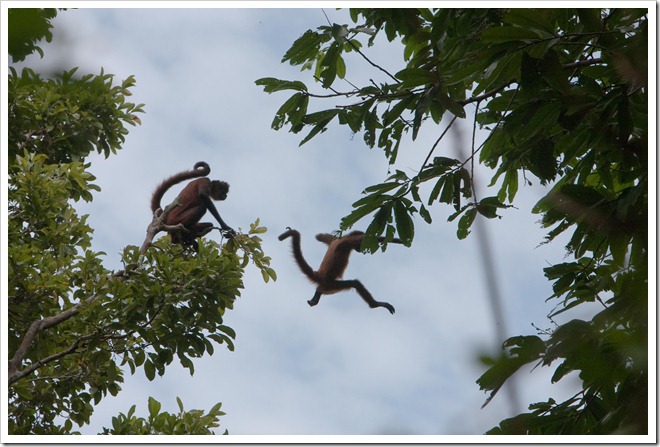
The coolest thing was that the mother jumped with a baby on her back.
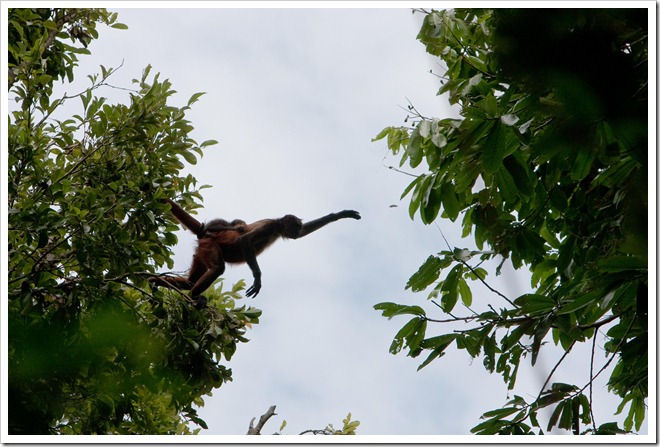
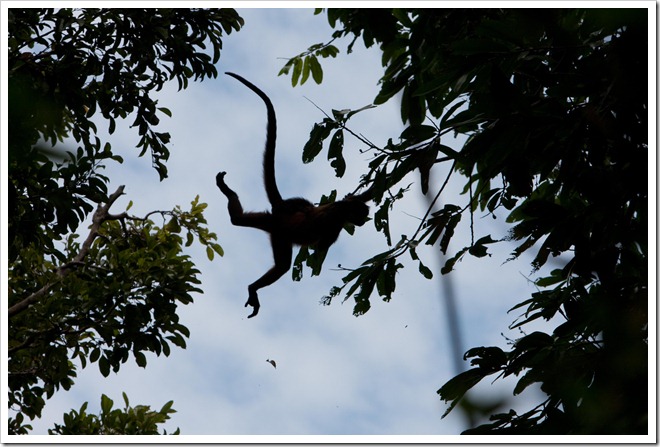
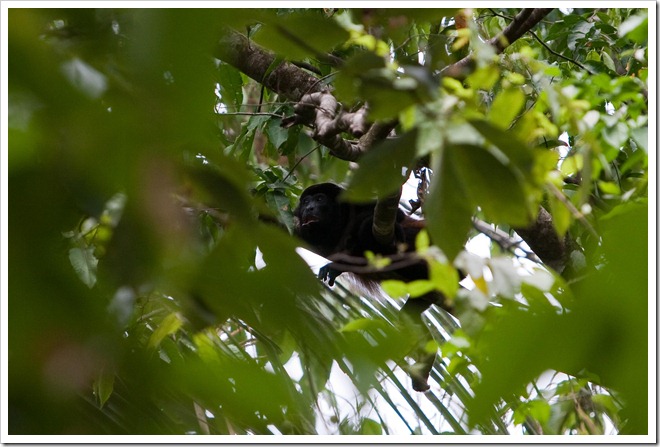
We also got out first glimpse of a Howler Monkey, hanging out. We would hear lots of Howler Monkeys over the coming 10 days. Like nothing I have ever heard.
Costa Rica claiming 25% of the worlds biology is not hard to swallow after you stroll through the jungle. In Canada, we have many different flowers, insects and mammals. But their coloring is much more subdued. Not so in the jungle, on the trip we saw all range of color – from bright colors to metallic.
Everyone knows about the beautiful parrots, macaws and like. There were beautiful birds everywhere. The key thing about spotting something in the jungle is not as much your eyes as your ears. I spotted all of these birds by their sound as they flew in and rustled the branches, or with the case of one bird pair … as they ate fruit and drop the rinds to the ground, through the jungle canopy.
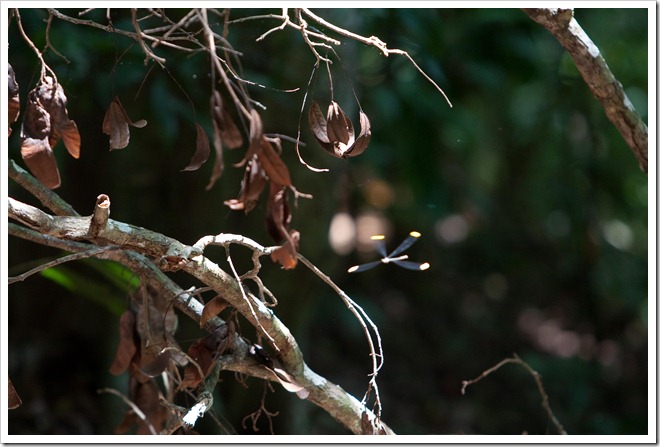
A dragonfly with fluorescent wing tips, just like in Avatar.
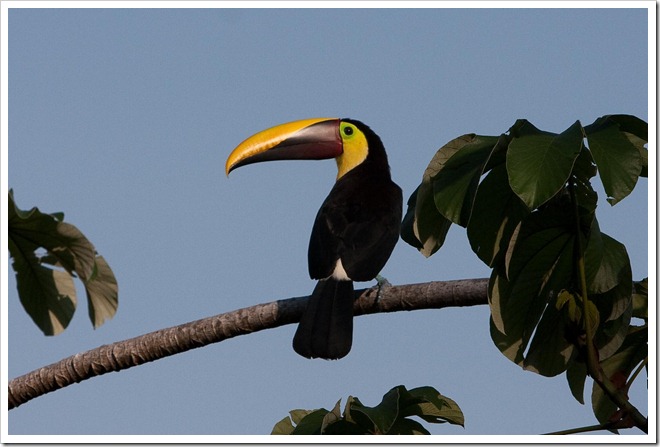
I don’t remember all of the names (I have a laminated card in my office somewhere) .. but below are a few more colorful jungle inhabitants. The fiery billed Aracari.

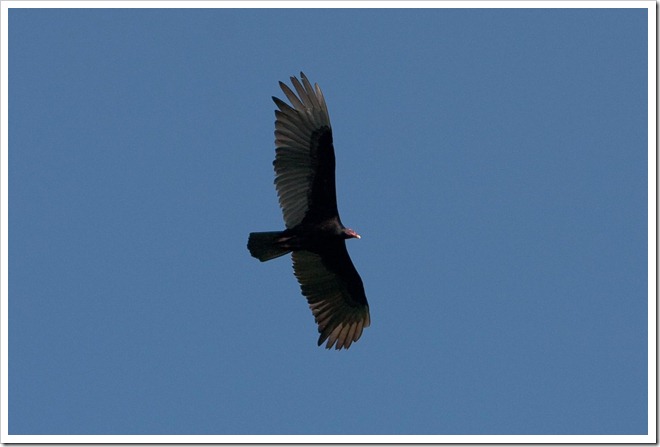
The vultures wing span had to be 8 feet. They just floated over us, day after day.
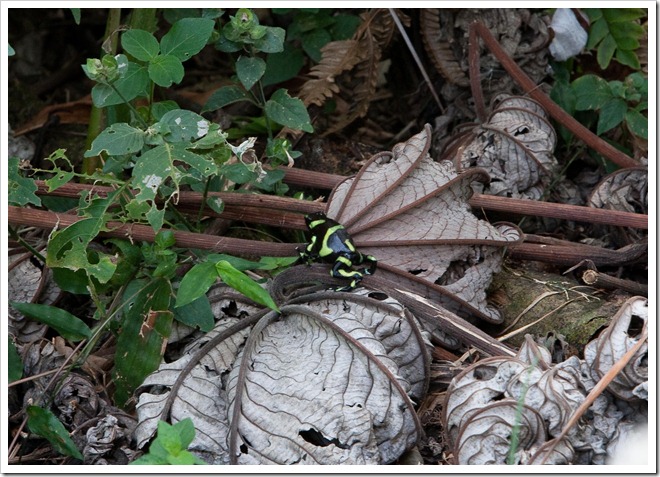
A poison dart frog.
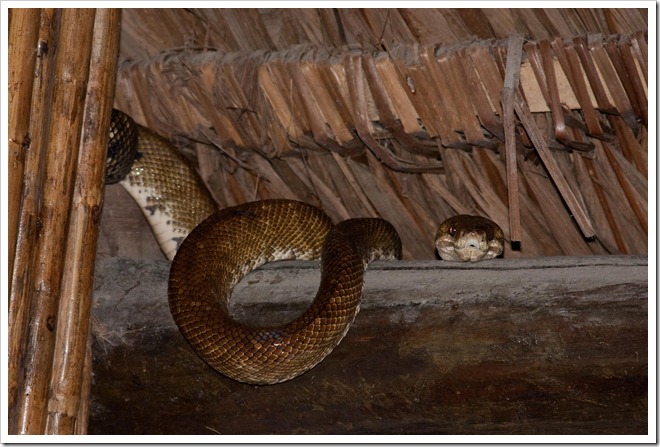
The 8 foot Boa that spent the entire time we were there hanging out in the restaurant. In this shot, he was looking down on the men’s toilet ….

I spotted this Parrot hanging out eating fruit over our room.


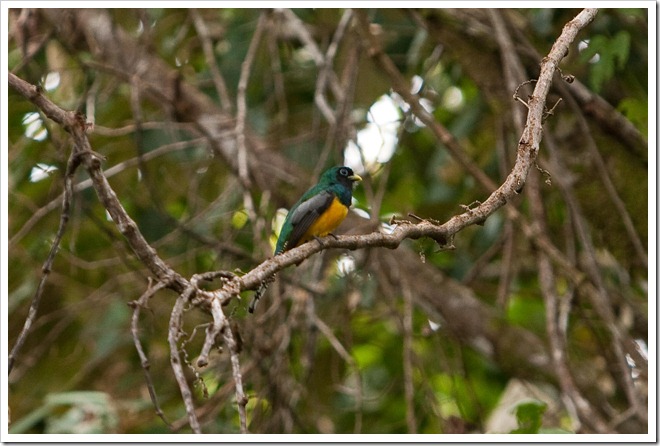
As we hiked, we got lucky. The Trogon is not easy to see.
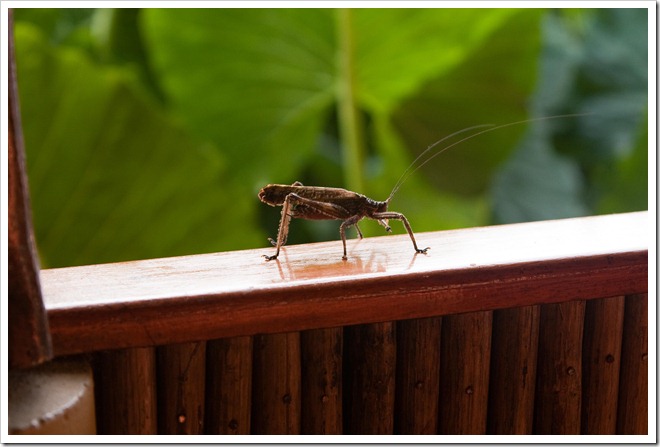
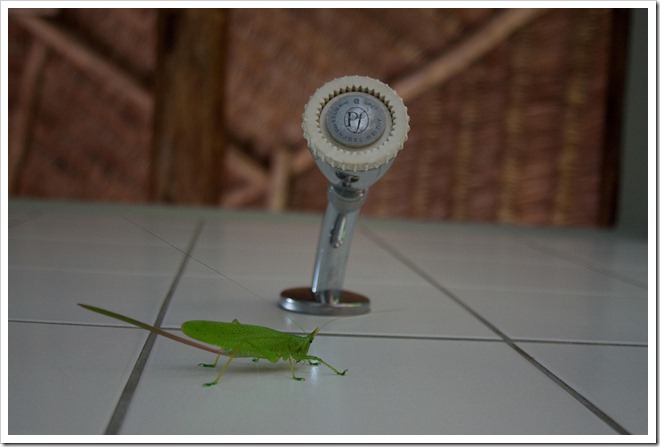
Your room was properly protected with screens. But they always find their way in. This grasshopper was the purest of green.
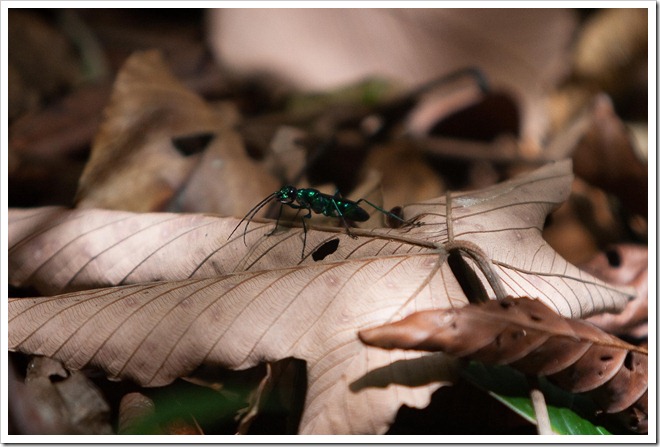
You don’t see metallic green bugs in Canada. It was about 10’ off the path and I just couldn’t stop marveling at the color.
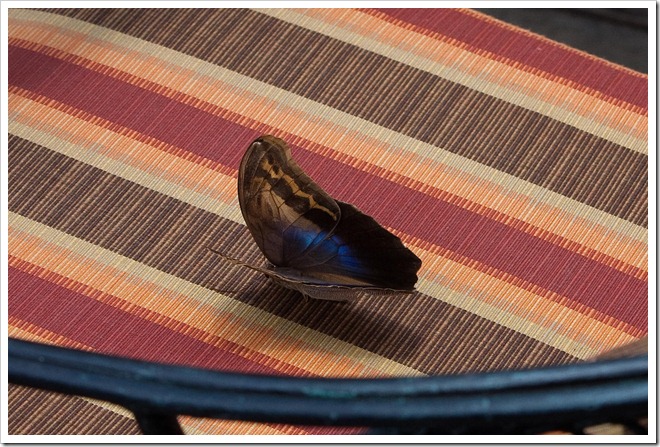
This dung beetle is brightly colored for a reason. Touch it and enjoy a noxious reward.
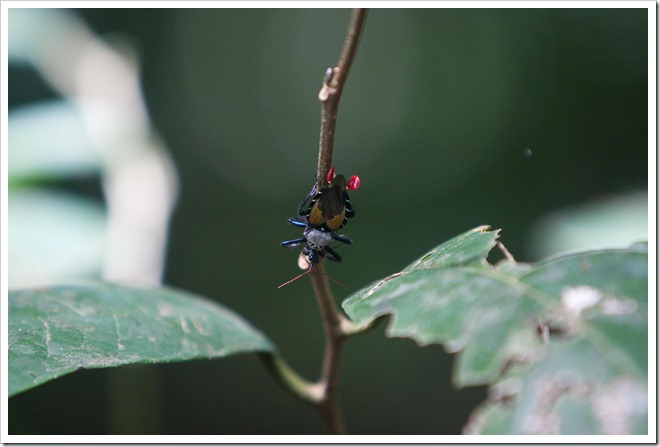
Amazing.
I had the opportunity to enjoy Aruba last week for business. I have been throughout the Caribbean but never Aruba. While there, I frequently heard people say that it is their favorite island. I have to say that it would be right up there.
The beaches are beautiful, there are tons of good restaurants, it is a small island – so easy to get around (only 35 miles long) and of course, it is Dutch. It was odd to see Dutch troops on the island on a few occasions. Once at the airport as they unloaded a plane, once in the evening as they jogged down a street. The best part of being a Dutch protectorate was of course, the easy access to Gouda (smile).
While in a taxi, I asked a local about his schooling. They follow a Dutch curriculum with an active focus on languages. They teach the local language Papiamento, French, Dutch, English and Spanish. When they reach University age, they can travel to Holland and enjoy full Dutch benefits – subsidized schooling, student loans. Makes our system of English and a little bit of French seem inadequate. Something that I have noticed in many other countries, their focus on other languages is much greater than ours.
The island itself is what you would expect, a few sightseeing opportunities but really all about the beach and restaurants. A fantastic ‘relax’ location. It is absolutely beautiful.


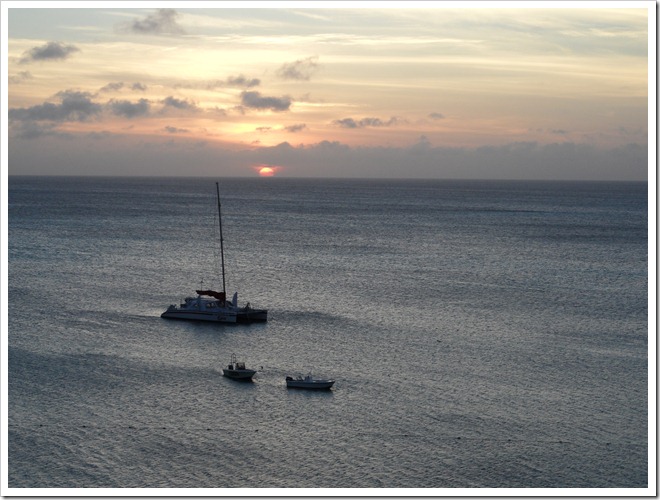
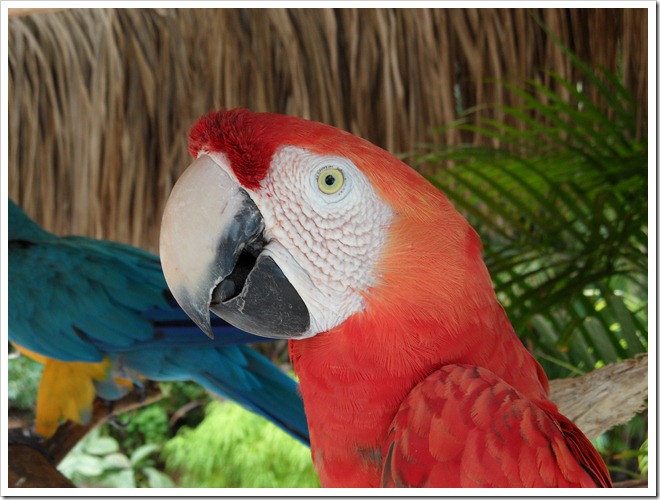
With only 20cm of rain a year, there isn’t a ton of wildlife. But there are some very pretty birds.

Ironically, I caught a cold while down there. HA. Even with that, I would highly recommend it. Especially with a dollar at par to the US.
I bet this small business owner is wishing he had chosen a different business name … As seen on a street in Aruba. (smile)
.jpg "2010 04 Aruba (3)")
While hiking in Costa Rica the guide pointed out what I thought he called ‘fake trees’. After a few days, I realized he meant fig trees. The figs grow around the trunk of another stronger, bigger tree and over the course of a hundred years, slowly choke out the original tree, leaving behind a massive – but hollow – fig tree. Very cool.


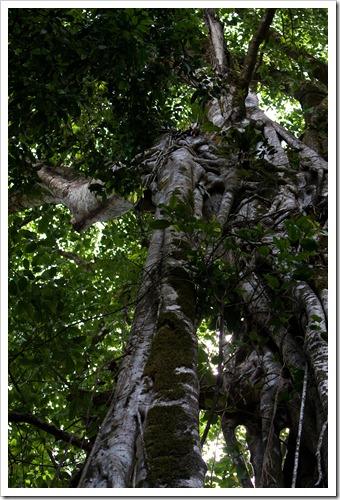
It is neat to see what hides in those fig trees ….

The trees were huge. Our guide pointed out one tree that he estimated at 500 years old. We asked about rings and if that is how they determine age. He pointed out that due to having only 2 seasons, the trees don’t really have rings like in North America.

This is a tourist tree. Why? Because it is red and peeling.
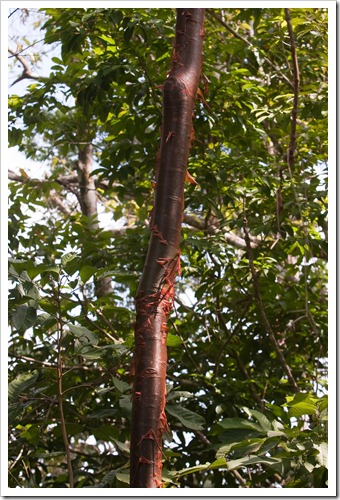
The guide said there were something like 100 different types of palm trees. This one has roots that ‘move’ the tree over time to keep it in the light. New roots will reposition the tree by ‘walking it’ to a new location if needed.

The new roots are well protected.

I asked about this leaf – was it dying? No, this is the color of a new leaf.

Termites were everywhere. Some of the nests were huge.

What I didn’t realize was that termites die in the sun so they build these little tunnels all over the trees. The guide opened one up to show us the activity.

I also saw where citronella comes from. This is a citronella plant in the natural state. Break the berry, rub it on and you smell like a lemon.

Last observation on the plants … big trees … and really big vines. One vine was so big (must have had a .5M diameter) that the boys could stand on it midair.

And I loved the earthy smell.
Looks like the spring update of XBOX live added MKV support. I was surprised, you can now watch your .MP4 files and full HD MKV files natively within the Media Center XBOX shell.
Too bad they didn’t fix the flaw that is seriously making me consider Apple TV …. You must be logged onto XBOX Live (with an active connection, you can’t be logged into your profile) to play media content. If your internet is acting funny, it will ask you to redownload the patch.
So one positive, one negative.
The geckos were a frequent sight at Lapa Rios; on the path, on the deck of our villa, in the jungle. One fellow visited us every single morning as we enjoyed Costa Rican coffee and the sunrise (one of the best resort items – coffee delivered to your door at 6AM). His coloring was breathtakingly beautiful.
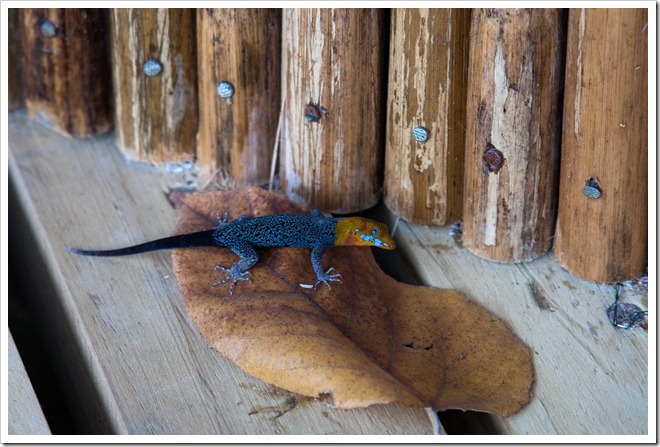
Others hid on the trees or stopped to let me snap a photo (smile)
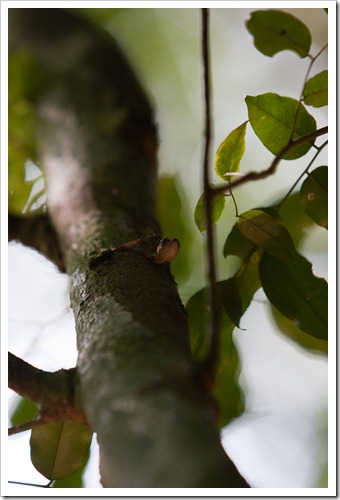

In the evening, there would be 10 clustered around the outside light. I would imagine it made hunting insects easier. Very beautiful, and SO fast! I would imagine they need to be with all the birds around … or this fellow (who I saw a few times around the pool) … He had to be a meter long …. And man was he fast. He was up a tree in seconds.


 Michael Weening: a few pictures
