TSUKIJI FISH MARKET (part 2)


The fish market has many forms of transportation; gas shuttles, two tire scooters, three tire scooters and the old fashioned hand cart. A pile of old ones were stacked down an alley.

2012 07 29 Tsukiji Fish Market_-91

Of course, old fashioned single speed pedal bikes were everywhere, ready to make a delivery. 

2012 07 29 Tsukiji Fish Market_-89

2012 07 29 Tsukiji Fish Market_-90

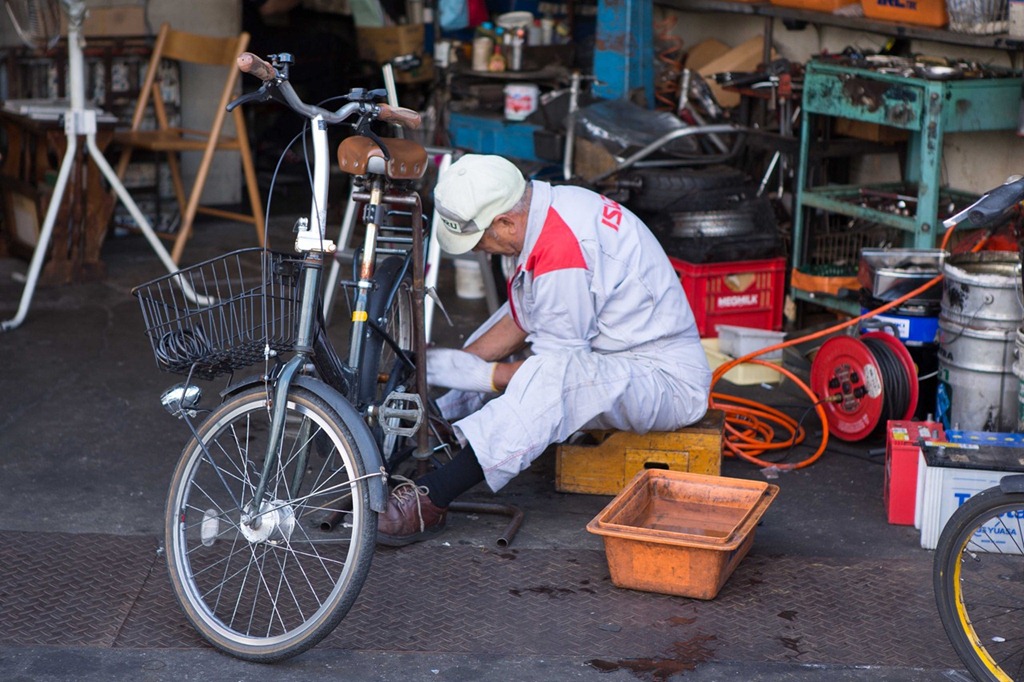
And of course, where there is a need there is a supplier. This gentleman was fixing a lot of flat tires.

2012 07 29 Tsukiji Fish Market_-93

TSUKIJI FISH MARKET (part 1)


A friend mentioned that when the family arrives in Tokyo the best thing to do is get out and see the Tsukiji fish market, which seems to make every “things you must do in Tokyo” list. The reasoning; your body clock is going to be a mess and you will be up very early. To get the most out of the market, you should be there for 4:30am to get in line for the great tuna auction.

Sure enough, I was up around 1AM (after an amazing 4 hours sleep) with the whole family was wide awake by 4:30am. We decided that we were not going to rush out for the tuna auction but would still get down there to enjoy the hustle and bustle of the market, leaving the apartment at 6AM (everything is pretty much done by 9am).

When we arrived, it was an absolute hive of activity. The motorized carts, delivery motor and pedal bikes that feed fish to a city of tens of millions, were everywhere. Step the wrong way and you could get run over (although they are immensely careful).

2012 07 29 Tsukiji Fish Market_-52

2012 07 29 Tsukiji Fish Market_-74

The shuttle carts are an amazing little device. The circle in the middle is a huge wheel that you do not turn but press left and right to steer, with a throttle on the right foot. They accelerate quickly and turn on a dime. They were either loaded with raw fish (note the big tuna head on the right)

2012 07 29 Tsukiji Fish Market_-73

or with styrofoam boxes packed with ice and fish for delivery. We happened upon a fishmonger filling the boxes with ice.

2012 07 29 Tsukiji Fish Market_-79

The pace is so frantic that they need a police officer to keep it all flowing.

2012 07 29 Tsukiji Fish Market_-88

You would think that a large fish market would give off some sort of nasty smell and that it would be messy. Neither was the case, it smelled “fresh” and was very clean. We happened on a indoor alley behind the stalls and were amazed at how clean it was. As we walked past this vendor, the wonderful smell of shrimp wafted down the laneway. Amazing.

2012 07 29 Tsukiji Fish Market_-57

Now if we just knew how to read Japanese and figure out what everything was beyond the extremely obvious … This is clearly one spectacular cut of tuna (upper right).

2012 07 29 Tsukiji Fish Market_-49

This looks interesting …. and I am game. As we tell the boys, you must try something at least 2 times before you decide that you do not like it.

2012 07 29 Tsukiji Fish Market_-62

TIME TO LEAVE


Well, Tokyo here we come. Reflecting back on work over the last 3 years, I had the opportunity to do a few very interesting things with clients. My top 3:

#3. Play in a pro-am with Louis Oosthuizen at the Mike Weir charity event the day before the Canadian Open pro-am. Capilano is the prettiest golf course I have every played. Ever.

IMG_0131

IMG_0366

Louis is a great guy, although a little shy. For the record, my least favourite moment was when I picked it clean out of the bunker jumping it onto the next tee and an older woman exclaimed “Oh dear, that isn’t good”. My favourite moment …. outdriving Louis with a 300 yard bomb. I let him hit first (smile).

image

#2. Joining a SWAT team for a day – rappelling down a building and shooting a fully automatic weapon for the first time. It had been a while since I have shot a gun (other than paintball with the boys) and had never shot full auto (shotguns, hunting rifles, my .22 as a kid), but shooting comes back to you quickly.

2009 11 Hamilton Police

And last, but not least, my most interesting client event over the last 3 years.

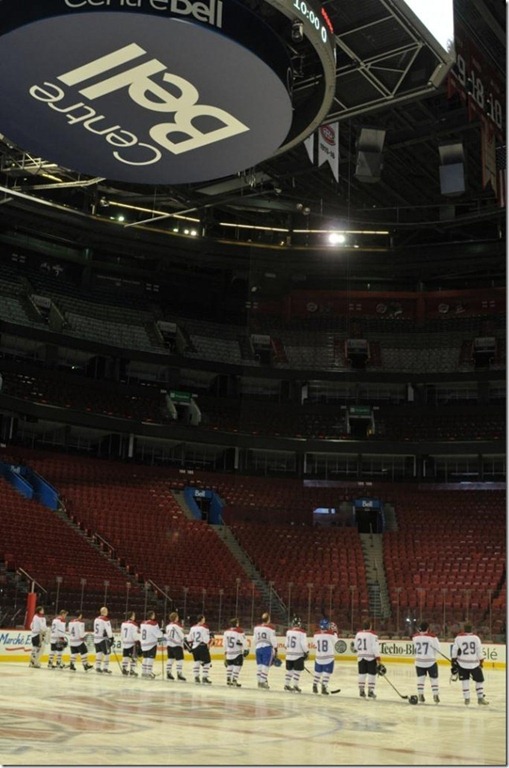
#1. Playing hockey at a client event at the Bell Center in Montreal. Although wearing Guy Lafleur’s number didn’t help my goal scoring. I suffer some kind of Montreal curse … Multiple games, more than a few heartbreakers, but no goals. Standing at the line in the Bell Center (I keep wanting to call it the forum) when the Canadian anthem played gave me shivers – truly awesome and distinctly Canadian.

Anthem_thumb2_thumb

2011-Match-1-10_thumb_thumb

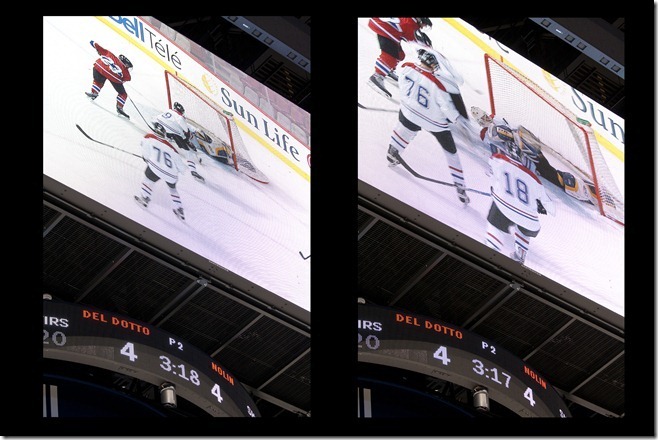
That is me on the left and the goalie making an insane save to keep my record at a whole bunch of assists and no goals … The slacker in the number 76 somehow got a bunch of goals (you know who you are) and wouldn’t let me forget it for 2 months. See the goalie lying on his side? The puck is teetering on his shoulder. I flicked it up twice and ….. no joy (And it would have won the game). My shame forever caught in this photo on the jumbotron (smile).

Joute_Del_Dotto-Nolin_085_thumb1_thu

I will miss you Canada. Ciao for now.

HIGGS BOSSON EXPLAINED


Colliders and the “god particle” are all over the news. I always detested physics in school. In fact, first year honours physics is the reason why I changed studies in University; I loved to code, but detested mathematics and physics so I left computer science. Plus, I couldn’t see myself behind a screen coding for the next 40 years.

But I am interested in what they are doing with the large Hadron Collider so I watched a video that does a pretty good job of explaining what is going on. You can watch hit here.

Thank you NASA.

image

PAYPAL SHIPPING SCAM ON KIJIJI OR EBAY (Updated: Now with Interac)


The theme of this international move has been “the big purge”. Room by room, we eliminated things that we do not use. We also set the goal of “no storage” which means leave nothing behind. We are either going to use it in Tokyo, or it goes. The logic being that the boys are heading off to University in 3 and 4 years (scary) so that provides a simplification/downsize opportunity in the very near future.

This is no small feat when we are moving from a traditional big North American home to a place in downtown Tokyo and required a lot bid decisions – primarily around furniture. Over the last 8 weeks we set about selling off a few very big items, like our 10 piece, 100 year old mahogany dining room set.

Which brings me to PayPal and Kijiji. I like classified sites, they are very handy. But when you sell an item worth more than $1K it brings out the pond scum. In this case, the PayPal scammers. Here is how it goes … first they respond to your post with almost the same line every time (I had more than 10 of these):

From: sx1ra-373@yahoo.com

Anything to add or ads say it all?

The first time this happened, I threw in a few more pictures and some additional color. Here is the classic response or in one case, this was the opening email to me:

From: marmith2000-p@yahoo.com

Sent: Thursday, July 19, 2012 5:12 AM

Subject: Re: Reply to your “Elte Kitchen/Dining Table only 1 year old – as new – paid $5800.” Ad on Kijiji

I appreciate your reply, I’m very interested and I’m willing to pay $2900, The means of payment will be via PayPal and I’ll pay for any charges that may incur. I just relocated to United Kingdom and I’ll be needing the merchandise here. A shipper will come over for the pick up after you receive the payment.

I await pictures(if available) since I won’t be able to see this in person. What’s your paypal email address so that I can send the funds to you asap.

Mary

Which leads to the scam. They will then go into this elaborate scheme which can be broken down into the following steps:

1. They will send you a fake PayPal confirmation email that they have made a payment to you which you will get when they have received delivery with PayPal holding the money in escrow.

2. You must pay for the shipping to get the funds released, but do not worry because PayPal is holding your money plus the shipping fee.

3. You send the money and the whole PayPal email confirmations turn out to be fraud. You lose your money.

The best way to avoid it is in your online ad put at the end “No PayPal payments accepted”. It stopped all fraudulent emails.

In closing, my responses to the fraudsters:

From: sx1ra-148@yahoo.com

Anything to add or ads say it all?

Response:

That I will not take PayPal or ship to another country you pond scum. You should be ashamed of yourself. Just remember: what comes around goes around.

Share with friends. These people deserve nothing. On the plus side, we sold everything with only one item on Kijiji. Everything else simply through word of mouth, emailing a bunch of friends and letting everyone know. A friend tells a friend ….

UPDATE: Don’t tell the scammer to look at this blog post. Play with them. Mess them up. But don’t warn them.

UPDATE 2: If you want to avoid this hassle, simply do what I did when I sold a set of chairs the other day. The last line was this:

No Paypal payments scammers. Cash only.

image

ST. JOHN’S CATHEDRAL PART 2


As is the UK tradition, the flags of a local regiment adorn the church. I always found this a fascinating oddity, to remember the wars in a church. While I understand blessing the troops, these flags are really a form of trophy. I do not know why, but it seems misplaced to me in a house of worship and peace.

These flags are no different than those in the UK, well worn and full of history. I do not know Australian military history well, other than knowing that it is a proud one like Canada. I happened to be reading all about Anzac and their memorials in the paper that weekend, which centers on remembering World War I:

Anzac Day is a national day of remembrance in Australia and New Zealand, originally commemorated by both countries on 25 April every year to honour the members of the Australian and New Zealand Army Corps (ANZAC) who fought at Gallipoli in the Ottoman Empire during World War I. It now more broadly commemorates all those who served and died in military operations for their countries.[1][2] Anzac Day is also observed in the Cook Islands, Niue, Pitcairn, and Tonga. It is no longer observed as a national holiday in Papua New Guinea or Samoa.

image_thumb1

2012-July-08-St-Johns-Brisbane_-49_t

It would seem that this church has a proud history of supporting women leading local churches (good on them – perhaps if others were not so militant on the subject they would be in better shape).

image_thumb3

From their website – the weekly reflection:

Most gracious and loving God,
who calls us all to embrace our calling
as bearers of your divine image and likeness;
we give thanks and praise for the vocation of women
to ordained ministry in your church,
and for twenty years of glorious work of women
ordained to the priesthood in the Anglican Church of Australia.

May we continue to strive as women and men together
to bear witness to your boundless love for all creation,
which breathes us into being
and gathers us into one body;
through Jesus the Christ, who lives and reigns with you and the Spirit,
one God, mother and father of us all. Amen.
(Collect from the Eucharist celebrating 20 years of Women Priests in Australia, St John’s Cathedral on 13th July 2012)

And as you would expect, beautiful glass work.

image_thumb5

Two last photos. The woodworking took a father and son team over 7 years to complete. It is beyond intricate and beautifully done.

2012-July-08-St-Johns-Brisbane_-53_t

A donated sculpture of Jesus on the cross that I found holding my attention.

2012-July-08-St-Johns-Brisbane_-56_t

You can read more here. What a wonderful place.

ST. JOHN’S CATHEDRAL PART I


While on the road over the last couple weeks I had almost no time to enjoy the surroundings, which is the ultimate truth of business travel: it sounds exotic but in reality is just a long commute filled with hotels and office meetings.

That being said, I did spend the weekend traveling from Sydney to Brisbane and had flex. It wasn’t quite as “wintery” in Brisbane so I went for a walk, coming across St. John’s Cathedral, the last gothic style church built in the world:

St John’s Cathedral is the Anglican cathedral of Brisbane and the metropolitan cathedral of the ecclesiastical province of Queensland,Australia. The cathedral is situated on the outskirts of the city centre and is the successor to an earlier pro-cathedral on William Street in the heart of the central business district which was predated by All Saints Wickham Terrace (1862), the oldest Anglican church in Brisbane.

I was surprised to see a building of this nature in “the new world”. I love walking through old churches, filled with history and majesty, bringing about an instant sense of reverence. This cathedral was breathtaking and it turns out, just finished:

William Webber – the third Bishop of Brisbane and previously a vicar in London – was instrumental in initiating the Brisbane cathedral project.[1] In 1885-86, he commissioned John Loughborough Pearson to make sketch plans for Brisbane cathedral.[6] The Brisbane cathedral movement began in earnest in 1887 as a celebration of Queen Victoria’s Golden Jubilee – St John’s was to be paid for by public subscription[6] but the construction of the cathedral in one campaign was found to be financially impossible. As a result, the building has been executed in three stages over two centuries between 1906 and 2009.[1]

The church is perched on the top of a small cliff. Construction of a downtown must have lead to the engineers blowing this side of the hill out.

2012 July 08 St Johns Brisbane_-31

2012 July 08 St Johns Brisbane_-60

There is so much sandstone, the church had to buy their own quarry. As an aside, one of the few blue sky days I saw in a few weeks (And short lived).

2012 July 08 St Johns Brisbane_-59

2012 July 08 St Johns Brisbane_-35

The central cathedral is European in scale. As spectacular as most that we saw during out time in the UK.

2012 July 08 St Johns Brisbane_-38

2012 July 08 St Johns Brisbane_-42

End Part I.

THE FAILING WAR ON DRUGS AND DECRIMINALIZATION


It seems like I have read a number of articles on the failing “War on Drugs” lately. There is no doubt that addictive drugs are a huge burden on society and as someone who actively avoided drugs, I am personally fine with the ban.

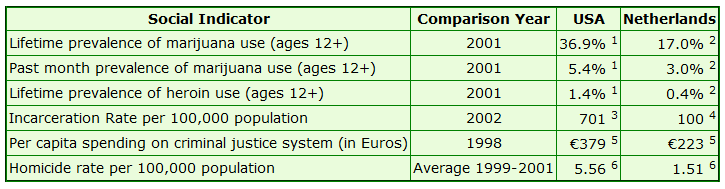
That being said, I really do wonder if other nations have it right and we have it VERY wrong. Most of the news on the failed war on drugs is in the US (although Canada could probably be substituted – just divide all dollar numbers by 10); the border that does not work, tens of thousands killed in the Mexican drug war and tens of thousands before them in Columbia, the ongoing funding that it provides to terrorists, the $20B+ per year that the US spends on the war on drugs which they could divert to education, medical care or debt payments and of course, the fact that the stats prove that it just is not working.

You know it must be failing when Pat Robertson says it is failing and time to consider decriminalization. I have never agreed with anything that Pat Robertson says, he is a nutter. This would be a first.

And the stats prove it all out – just look at Holland versus the US. The US fails on every metric (Canada would similarly fail).

image

What prompted this post? An article which created a sickness in the pit of my stomach on how much we spend and how we restrict people’s choice resulting in much higher usage. Human nature revolves around “If I cannot have it, I want it more. Allow me to have it, and I lose interest” and we are driving more people to drugs.

The article: Portugal drug decriminalization policy works (2012). It is not true Holland type decriminalization but a variant that has seen a radical drop in drug usage:

Portugal’s move to decriminalize does not mean people can carry around, use, and sell drugs free from police interference. That would be legalization. Rather, all drugs are "decriminalized," meaning drug possession, distribution, and use is still illegal. While distribution and trafficking is still a criminal offense, possession and use is moved out of criminal courts and into a special court where each offender’s unique  situation is judged by legal experts, psychologists, and social workers. Treatment and further action is decided in these courts, where addicts and drug use is treated as a public health service rather than referring it to the justice system (like the U.S.), reports Fox News.

The resulting effect: a drastic reduction in addicts, with Portuguese officials and reports highlighting that this number, at 100,000 before the new policy was enacted, has been halved in the following ten years. Portugal’s drug usage rates are now among the lowest of EU member states, according to the same report.

Too bad our a Prime Minster doesn’t have the leadership vision and strength to take this issue on.

You can read the full report on soros.org here. Very sad that our government will not face the facts and stop wasting time, money and people’s lives.

LOST IN TRANSLATION


I have heard this term used a lot recently. In the UK I often heard “separated by a common language”.

Recently the “lost in translation” point was used by one team trying to interpret the emails and Chatter posts of another team as they tried to work through an issue electronically – and unsuccessfully. A team member picked up the phone and even with a language barrier they found out that there was no issue – both teams were on the same page.

The phone and video conference. Magic old fashioned devices that solves so many problems so quickly …..

BRISBANE STORY BRIDGE


While in Asia the time difference played havoc, meaning that I was usually up at 4am. I enjoyed watching the sun rise over Story Bridge. I snapped a few pics, but wish I had my 5D with me.

2012 July 08 Brisbane_-2

2012 July 08 Brisbane Storey Bridge_

Yes. Those are rain clouds. It is winter in Australia.

2012 July 08 Brisbane Storey Bridge_-6

There are a very active set of ferries into the city core. A unique way to commute.

2012 July 08 Brisbane Storey Bridge_-9

FLICKR BADGE & GALLERIES


I have been playing around with WordPress as a colleague told me my site was a little “generic” (He may have said the design is boring (smile)). His is quite intricate.

Over the coming weeks you will see a few updates. I found that Flickr badge generation an interesting way of creating a gallery.

It seems that Galleries are harder to set up than they should be in WordPress if you are not self hosted. A few tidbits were found in the official support site and the “unofficial” site.

I am on a quest of creating a photo stream across the header of my site, it seems to be harder than it should be …..

AUSSIE TAXI


I noticed while popping around Sydney last week that the front seat of the cabs were set back. It made it uncomfortable to sit in the back due to the narrow leg room.

So I decided to jump in the front seat (something you just do not do in North America) and ask “Do your customers sit in the front or backseat in a taxi?”

His first answer was noncommittal, “Wherever you like”

I asked again “Where do most people sit?”

He smiled and said “The self important ones sit in the back seat”

I FEEL 10 LBS LIGHTER


We decided to go on an international assignment many, many months ago and having done this once before we took the opportunity to really look at our house and our “stuff”. The first time around, it happened very fast and we had young boys which meant we had lots of toys and in the end, put lots of “stuff” into storage.

This time is different. We went on the grand purge as the boys are older and we want to simplify. A simple rule was put in place, if you have not used it in a couple years it is gone. The result:

  • Hundreds and hundreds of books sent to the school to be sent to a charity to create a library for a reserve.
  • Roughly 7 truck loads of “stuff” sent to my father-in-laws for a garage sale (The mother of all garage sales). An example of the staging area below (All sold a few weeks ago).

Enforcing the 2 year rule was not easy. But Narda and I were both strong for the other. When that common “Wow, I forgot I had that and am glad that I found it” instinct kicked in, the other would ask “Really? You have not used it for 5 years, will you really use it?” with 9 times out of 10 resulting in the item going to the staging area.

It is very refreshing. The Globe has a great article on why people cannot get rid of stuff and of course, there are reality shows on the topic. But I would council that it is a very, very rewarding process. Now, we only have what we need and after digitize a bunch of school memorabilia, we will be 2 additional boxes lighter .. but that is for a rainy day.

We will go through one final purge as they pack, and then our household will be the lightest it has been in years.

2012 Purge

I’M SORRY DOES NOT TRANSLATE


The use of “I’m sorry” in Japanese culture is very different from Canada. In Canada, it is an apology – for making a mistake. In Japan, “I’m sorry” is not an apology, it is more like “excuse me”.

For example, in Japan someone might say “I’m sorry, but that is not what I was meaning”.

In the Harvard article When Sorry Doesn’t Translate they noted the following statistics:

  • US students apologize 4.51 times a week
  • Japanese students apologize 11.05

Their view:

Our own work found that a core issue is differing perceptions of culpability: Americans see an apology as an admission of wrongdoing, whereas Japanese see it as an expression of eagerness to repair a damaged relationship, with no culpability necessarily implied. And this difference, we discovered, affects how much traction an apology gains.

I would suggest a minor tweak – it seems to me that “I am sorry” in Japan isn’t just about repairing a relationship, it is also used to ensure maintenance of a relationship.

The complexity of language.

THE JAPAN TIMES


My first full week in Tokyo was quite the week, starting with a bout of food poisoning that put me behind the 8 ball for the entire week (Thank-you for offering me 20% off my next flight un-named Canadian airline).  It also meant that I did not get out and about.

That being said, it was my first introduction to the culture and island; an adventure begins……

One of the things I love doing in new countries is read a local paper. A few headlines that caught my eye from the Japan Times:

The government worked out a fresh anticancer program Friday that calls for reducing the rate of smoking among adults to 12 percent by fiscal 2022, down from 19.5 percent in 2010, officials say…. It sets a target to reduce the rate of those exposed to smoke every day at homes to 3 percent in fiscal 2022 from 10.7 percent in 2010 and also to make sure work sites are free from passive exposure by calendar 2020. 

NOTE: I personally did not find the smoking invasive, although it did remind me of England as we moved there just as they started banning it from restaurants. At the restaurant we were at, we received a notice that they would allow smoking at a certain time. What I didn’t realize is that Japan’s smoking rate isn’t that far off Canada’s – which is 17% (2010). Our rigorous laws are not having as big an impact as I would have thought.

Whether it be your neighbourhood toban garbage duty or picking over the big gomi left out on the curb for Big Garbage Day, a fondness of garbage is a sure sign of the aged. Just being in the proximity of amassed garbage will age you by 20 years. If you find yourself attracted to garbage, saying things like “But that’s a perfectly good vacuum cleaner!” and taking it back home, then add another five years. Only old people see the value in these things. Young people buy new, crappy stuff that breaks down in a week.

Tokyo has officially become the world’s most expensive city for expatriates, overtaking the Angolan capital of Luana, while Osaka has moved up to third place. … while a cup of coffee including service averages $8.15 (Y650), the survey showed. (Thank-goodness for my new Jura)

  • The FT had an article on Hiroshi Mikitani who is classified as a “rebel” entrepreneur in Japan. It was explained to me that there are two cultures evolving in Japan, the new business culture which is more western in style and often prevalent in companies that are foreign owned (e.g. no ties, less formal) and the traditional Japanese company which is buttoned up. The article is a worthwhile read as it profiles both.

So much to enjoy and learn.

THE TURTLE SANCTUARY

Another overdue Grand Cayman post. As previously mentioned there isn’t a lot to do on Grand Cayman, but there are a few places to see including the Turtle Farm.

We took the “full tour” which includes access to all parts of the sanctuary/farm and the ability to swim in their interactive pool – which is a small winding man-made lake with a few turtles and fish in it. I will admit that after touring the place we were about to leave disappointed because we didn’t really understand it. That is when we bumped into the head keeper who asked us if we had questions. We had a lot – and he was very open to answering and giving us greater insight into why the farm exists.

He started to explain their conservation focus, how they are hand raising sea turtles, marking and tracking them and freeing thousands back into the wild (31,000 to date). They are doing some fantastic conservation and research work, which made the price worthwhile. In fact, the government is running it at a loss to keep up the work – the tourism angle simply offsets some costs and reduces the loss.

The turtles themselves are beautiful creatures. The first exhibit to greet you is the mature turtle pond. This picture does not provide scale, but these are HUGE sea turtles. They must be 3 feet long and there are a lot of them. In speaking with the keeper, their ages range and it is difficult for them to know exactly how old some are, but a few are in their 70’s.

2012 March 21 Grand Cayman_

2012 March 21 Grand Cayman_-23

Throughout the facility they have holding tanks for turtles at different sizes. At this set of tanks you are allowed to pick the turtles up (if you can catch them, they are very fast).

2012 March 21 Grand Cayman_-29

All over the farm you will find different wildlife running around or in the aviary, relaxing.

2012 March 21 Grand Cayman_-36

And of course, more than a few iguanas.

2012 March 21 Grand Cayman_-34

In the end, a worthwhile trip if you find someone to talk to.

SKYPE


Over the last couple months I have become a big Skype user. Not the free version, but the paid “call any landline in the world” version. I use it on my iPhone via Wi-Fi in hotel rooms and on my laptop when traveling.

The world of voice calls was very unaffordable for the traveler only a few years ago. I cannot imagine being without it now. $13 a month is a small price to pay to be able to call home wherever I am for as long as I want.

UPGRADING THE WIRELESSS NETWORK


Before we head out to Japan I upgraded our wireless networking, grabbing the fastest/strongest wireless router I could find – the ASUS RT-N66U.

However, even with the increased range and range extending antennas on the router, when you are upstairs (3 floors from the router) the signal isn’t as fast as it needs to be. So I took my old D-LINK router and created a second wireless network in the office called “Upstairs”. It took some time to figure out how to do that, I simply repost these instructions to help others (and in case I need to do it again):

If you are connecting the D-Link router to another router to use as a wireless access point and/or switch, you will have to do the following before connecting the router to your network:
Disable UPnPT
Disable DHCP
Change the LAN IP address to an available address on your network. The LAN ports on the router cannot accept a DHCP address from your other router.
To connect to another router, please follow the steps below:
1. Plug the power into the router. Connect one of your computers to the router (LAN port) using an Ethernet cable. Make sure your IP address on the computer is 192.168.0.xxx (where xxx is between 2 and 254). Please see the Networking Basics section for more information. If you need to change the settings, write down your existing settings before making any changes. In most cases, your computer should be set to receive an IP address automatically in which case you will not have to do anything to your computer.
2. Open a web browser and enter http://192.168.0.1 and press Enter. When the login window appears, set the user name to Admin and leave the password box empty. Click Log In to continue.
3. Click on Advanced and then click Advanced Network. Uncheck the Enable UPnP checkbox. Click Save Settings to continue.
4. Click Setup and then click Network Settings. Uncheck the Enable DHCP Server server checkbox. Click Save Settings to continue.
5. Under Router Settings, enter an available IP address and the subnet mask of your network. Click Save Settings to save your settings. Use this new IP address to access the configuration utility of the router in the future. Close the browser and change your computer’s IP settings back to the original values as in Step 1.
Connect to Another Router
6. Disconnect the Ethernet cable from the router and reconnect your computer to your network.
7. Connect an Ethernet cable in one of the LAN ports of the router and connect it to your other router. Do not plug anything into the Internet port of the D-Link router.
8. You may now use the other 3 LAN ports to connect other Ethernet devices and computers. To configure your wireless network, open a web browser and enter the IP address you assigned to the router. Refer to the Configuration and Wireless Security sections for more information on setting up your wireless network.

Works well.

SOCIETY PULLING TOGETHER

The tsunami and affiliated disasters are far from forgotten in Japan. I had the opportunity to attend a charity event where we sampled produce from a stricken farming region (A prosciutto and blueberry stick was an odd combination, and pleasant surprise) and hear stories from volunteers who have made it into the communities that are being rebuilt, but remain devastated.

One big challenge is power. Japan’s 52 nuclear reactors have all been brought down to improve security and ensure that they can handle an extreme event like the tsunami/earthquake that took down Fukushima.

What I find very interesting is the way that Japanese society is moving together to meet the challenges ahead. Factories moved to Wednesday to Sunday manufacturing to spread energy usage and they have implemented something called “Super Cool biz” in Japan.

Businesses are leaving their buildings 5 degrees hotter than normal (it is noticeable) and pins have been distributed signalling a significant culture shift in attire. No ties for the summer and short sleeve shirts, which is supposedly unheard of in Japanese business culture (It first started as “Cool Biz” in 2005, with the recent disaster really pushing the effort forward)

An indicator of their group orientated culture, and a good idea that others should consider.

A FEW JAPAN OBSERVATIONS


The next few years will be filled with new experiences and observations. As someone explained to me … the 1st year in Tokyo is filled with confusion, the 2nd with a sense of understanding and the 3rd is when expats fall in love with the city and will have to be dragged away with tears in their eyes.

My first observations….

  • It is the only place in the ENTIRE WORLD where I have not had a taxi driver fight me on using American Express.
  • On the topic of taxis: The doors automatically open and close. Takes you by surprise the first couple times.
  • I don’t think that there is anyone in Japan who is obese other than foreign business people and tourists. Seriously. According to the article Global weight gain doing more damage than growing numbers (BBC), “The Japanese example is quite strong. Average BMI (Body Mass Index) in USA in 2005 was 28.7. In Japan, it was 22. You can be lean without being really poor, and Japan seems to have pulled that off. (Japanese people have a low average BMI but high standards of living)”
  • Maybe that is because I saw only 1 fast food joint as I made my way around the city: McDonalds.
  • The food is spectacular. Everything is fresh. I am looking forward to a culinary adventure in the city with the most Michelin stars in the world. I only ate one thing I did not like, urchin. Tastes like the bottom of a dirty sink (I had to try it).
  • On the topic of food, I have never tasted beef like Japanese beef. Unlike NA beef which is lean, their beef is very fatty. They find our beef tough and chewy. Which means that it is very high in fat and you do not eat it like you would a Canadian steak. You eat a small portion, sliced. I was blown away, the most flavourful piece of beef I have ever tried.
  • Tokyo is VERY VERY VERY clean. I did not see any litter (funny, I didn’t see anyone cleaning up either, maybe they come out at night?).
  • I happened up on a GROM. Awesome.

July is the official cut-over, cannot wait.

SIX DEGREES OF SEPARATION ILLUSTRATED


I firmly believe in the notion of six degrees of separation, I have seen it in action too many times to not believe in it. For reference:

Six degrees of separation refers to the idea that everyone is on average approximately six steps away, by way of introduction, from any other person on Earth, so that a chain of, “a friend of a friend” statements can be made, on average, to connect any two people in six steps or fewer. It was originally set out by Frigyes Karinthy and popularized by a play written by John Guare.

And how about this for an illustration:

    • Sitting on the patio at the Marriott in Grand Cayman and talking about American schools and our time in England. A woman overhears and says “We lived in England too”. We start to chat and mention that we are considering a move to Japan, and researching what it would be like. Turns out, a good friend of hers lives in Japan – they send an email and introduce.
    • The American friend in Japan is very kind, sending a lengthy email on where to live and a ton of details on life in Japan. Very kind. Including the name of a building that is fantastic and a note that a friend happens to be moving out of that building in June.
    • I spend this week in Tokyo – my first week – and take an afternoon to house hunt, coming across a building which I really like. However, I am not able to see the apartment coming up in a couple days as I am getting on a plane and the family is busy packing. No showings please.
    • Friday night, Narda and I are discussing the building and she says “Isn’t that the building in the email from Linda?” Quick search it is. Could it be that family? I send an email asking Linda if it is her friend and if there is any chance I could see it before I get on the plane (I am in the airport in Narita – 4:15PM Saturday).
    • Email back at 7AM Saturday from resident – it is her home and if I get there between 9am and 10am I can see it before she jumps on a plane.
    • I arrive, see the place and she is wonderful enough to explain a ton about the area from a family perspective, offering to connect and introduce us to a ton of people in the area.

The real estate agent was floored when I said “Please come pick me up, I have an appointment in that apartment for 9am”.

Six degrees of separation in action and a little good fortune.

Updated: Through Facebook Narda found out that a friend of hers from our time in London had also moved to Tokyo, and is living in the apartment that we will hopefully be living in. Wow.

image

AMERICAN POLITICS CONFUSES ME


And when I bring it up with die-hard republicans, it often gets awkward and silent. Here is my confusion; the republicans are supposed to be the “capitalists” and the democrats more like Canadians, with a socialist leaning. If that is the case, why is it the Republicans who have zero fiscal sense and restraint?

Consider the article Obama spending binge never happened.

Now I understand the Republican philosophy of low taxes for the rich. After all, many Republicans are rich white people. But why is it that the Republican “capitalists”, who you would think are well versed on reading a P/L, are the ones who have been spending the US into bankruptcy?

In Democracy’s Debt Dilemma HBR runs through the developing world – it is a problem that many countries face (including Canada):

Nearly every major democracy is now struggling with public debt. According to The Economist, the world’s governments currently hold debts of approximately $45 trillion (relative to a world GDP of $65 trillion). And many of the world’s top debt holders are its largest and most powerful democracies. The following table, based on IMF projections, is a list of the top 20 global economic powers (by GDP):

image

I think the world needs to hire Paul Martin.

BILL MURRAY ON FRIENDS AT WORK


I was reading the Bill Murray article in this month’s Esquire and as always, Bill entertains with his eclectic views and approach to life.

I found his point on work and friendship not unlike my own:

BM: When I work, my first relationship with people is professional. There are people who want to be your friend right away. I say “We’re not gonna be friends until we get this done. If we don’t get this done, we’re never going to be friends, because if we don’t get the job done, then the one thing we did together we failed.” People confuse friendship and relaxation. It’s incredibly important to be relaxed – you don’t have a chance if you’re not relaxed.

A lot of my current friends are work colleagues – after the job is done. Those shared experiences create bonds.

A MOVE


While making the decision on whether on not to move to Japan, I spent a lot of energy researching the lifestyle, country and culture. Through LinkedIn I reached out to my Asian colleagues and teed up a number of phone calls with friends of friends to discuss their expat assignments in Japan and of course, I read.

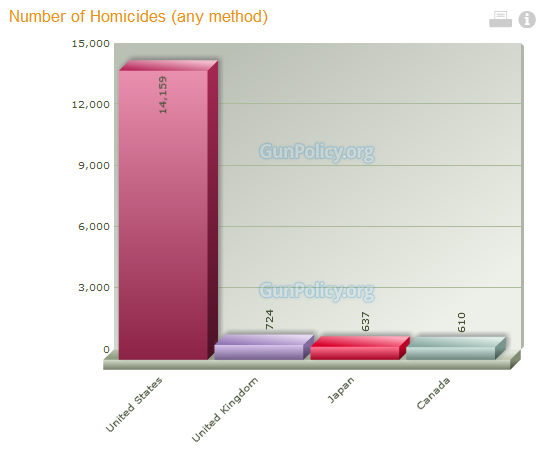
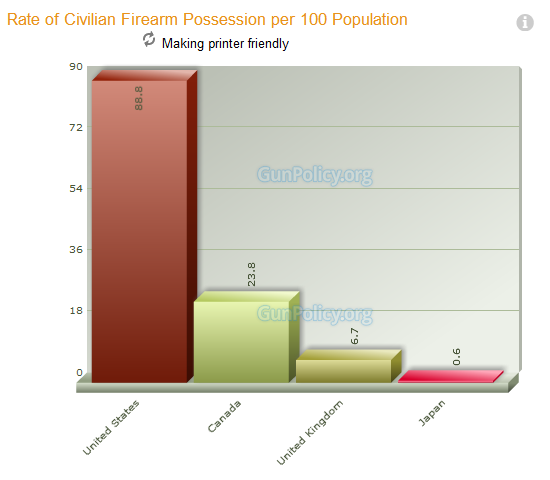
One theme that kept coming up about Japan is how safe it is. I had one executive relate how he would ride the subway in the morning and find it so odd to see a 4 year old by themselves on the way to school, Hello Kitty backpack and all. Another explained how when she landed back in North America she would sit her kids down and say “Now remember, we are not in Japan anymore. Stay close, don’t talk to strangers and don’t leave anything on a chair because you won’t get it back or someone will snatch it”, whereas in Japan if you leave your laptop on the subway there is an almost 100% probability that you will get it back from lost and found. Good luck getting anything back on a Toronto subway.

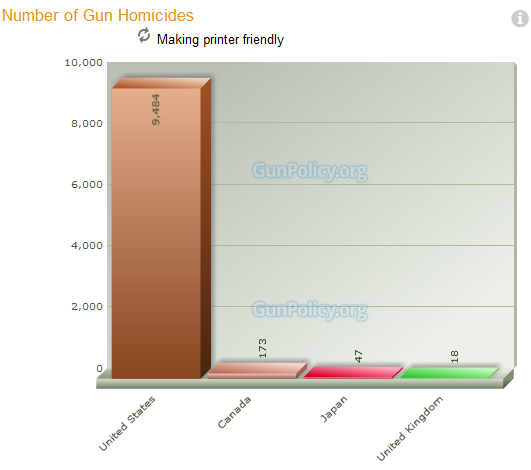
Consider these stats, remember that the US has 330M people, Japan has 128M, UK has 60M and Canada has 32M people. Very eye opening.

imageimageimage

This is just one of the many element of culture that interested/surprised me as I read about our new home. In another conversation, I spoke with an executive who had lived in London and in Tokyo, as we had and in a laughing voice he stated “Japan will ruin you forever with regard to customer service. There is nothing like Japan. Remember how it was in the UK – take the exact opposite and that is Japan – the repairman doesn’t give you an 8 hour window to arrive and show up two days late, they give you a 30 minute window and arrive at that time, and the trains all run on time without fail”.

Thanks to the information age, expat/culture websites abound and the number of books on the topic are only limited to how much time you have. Personally, the thing that I loved the most about the UK is the nuances and differences. The time to experience the Japanese nuances approaches. Camera ready.

TO KISS A STINGRAY


I have not been posting trip adventures as the winter this year was filled with beaches and water football. Not a lot of adventure. For March break we headed down to Grand Cayman for a break and much of the same, beach, swimming, great food and water sports.

The island does not have a lot to do, beyond diving and Stingray city. It was windy so the water was a little bit cloudy, but a fascinating experience. You jump in the water and stingrays come swimming from every direction, acclimatized to boats ready to dole out raw fish for them. They are beautiful animals, gliding through the water and gently nudging into you.

IMG_0161

IMG_0144

We went with Dexter’s tours and I was happy to see that the different boat captains work together to care for the stingrays. While we were there another captain came over to Dexter and asked him to help him with one of the stingrays who had a hook in its mouth.

As I mentioned, not a lot to do in Grand Cayman, but this is well worth it.

IMG_0173

NUANCE


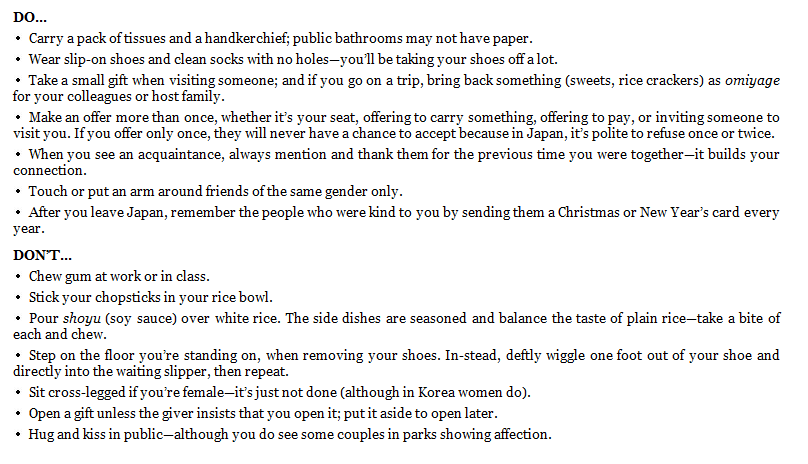
Part of moving is research. I have been reaching into my network to get insight from people who have lived in Japan before and reading … a lot. When we moved to the UK we were surprised by the nuances of the culture, but there was never a “Do-Don’t” list readily available. Not so with Japan, there are many …..

image

WHY I THINK WINDOWS 8 MOBILE WILL ALSO FAIL


Time and time again Microsoft re-launches in the mobile market with a promise of “this time we have it right”. Their product has improved, bloggers like it, but it fails to capture the market. In fact, Mobile 7 had a short blip (at a significant marketing expense) and then fell away into nothing. The irony in all of it is that Microsoft makes more money from IP licensing to Android OEMs than it does on the Windows Mobile licenses.

With Windows Mobile 8 on the horizon the market is buzzing with the question – will they get it right this time? In my opinion, the answer is no. Here is why:

1. It isn’t about the carrier – it is about the OEM:  Microsoft spends copious amounts of resources on in-country coverage of carriers around the world. These resources meet with the carriers and talk about new product launches, how to align with the local subsidiary and try to influence the carrier into stocking more Windows Mobile products. You could eliminate that organization and it would have no impact on Windows mobile sales for a single reason – they have no marketing money to invest because each license is $14 and are therefore irrelevant. The carriers might talk to them out of courtesy, but they are not taken seriously.

The war is won and lost with the OEM. As so many Windows Mobile reps in the field found out this year, if the OEM does not choose to range the OS, then there isn’t much to talk about.

Think of the math this way:

A carrier decides to range a device that will cost them $400. They decide to order 50K. Revenue to the OEM: $20M. That OEM will offer incentives to the carrier (millions) in co-marketing to move the product.

Microsoft’s revenue for 50,000 units – $700K. Irrelevant.

2. The licensing model is broken:  As you can see by the above, $700K in licensing leads to one question – how is Microsoft ever going to make money in this market? We know how the competition does it – Google released Android to drive search revenue and app store, Apple drives revenue from high margin hardware, the application store and iTunes.

Microsoft doesn’t have many applications and $14 per device isn’t going to scale.  Even if they sold 200M units – that is only $2.8B inside a $65B company. Which is why Microsoft needs to rethink the mobile strategy and drive revenues by taking a holistic mobile first product view for ALL products.

Google gets that if they give Android away to the OEM, they drive share and their core products. If Microsoft were to give away Windows Mobile and ensure that their other products were mobile ready and ready to monetize, the revenues would sky rocket. But for that to be successful on the Windows Mobile platform, it requires the 3rd point – that is the biggest hurdle.

3. Build an OS agnostic product strategy:  Microsoft’s history is built on products that drive users to the Windows platform. SQL Server never made it to Unix, only Windows, Office isn’t out on iOS (although that is changing) and Hotmail is driving users left and right to GMAIL because it doesn’t support IMAP (Although they did make the desperate move to allow iOS to work like IMAP but not on a Mac).

Windows Mobile will thrive if Microsoft unleashes their products to all mobile operating systems. Just think of the Office numbers alone. One of the first things I did when I bought a Mac was install Office 2011 and it is fantastic. On mobile, there isn’t a single good alternative to Office but at the same time, users will not convert to Windows Mobile to get a great Office experience (which is core to Microsoft strategy).

If they took every product and made it work on the other 2 OSs (Android/iOS), then it would build Microsoft brand loyalty that is bound to positively flow to Windows Mobile and maybe even have some try their newest phone.

Unfortunately, their current strategy drives us away. I am a great example:

  • Left Hotmail because there is no IMAP support which means a terrible experience on our Mac and on my Android phone.
  • Left Office OneNote (great product) for Evernote because it isn’t cloud and won’t work on other platforms (My Mac, my Android tablet, my iPhone).
  • Don’t use Bing because the above irritate me.
  • Don’t use SkyDrive because unlike Dropbox it doesn’t support every device.

The list goes on. One last point, think of this – 200M devices with Office mobile at $10 a unit $2B and it would drive Bing, OneNote and others if they took the same approach.

In summary – I am willing to bet that Windows mobile 8 will not be a success simply because it does not appear that Microsoft gets the root of the problem. Sure, they will spend gobs of money on the marketing campaign, they will have a fancy multi-screen pitch showing how well Windows PC, XBOX and Windows Mobile work together and it will make a big splash in the fall. But in my opinion, that isn’t enough. Like Windows 7 phone, it will be a short bump.

I will keep using my iPhone and my Samsung tablet (can’t wait for the pen). We now have 3 Apples PCs in the house (2 laptops and a iMac) which have dramatically reduced the ‘Dad technical support calls’ and over the next 12 months as our last 2 PCs start to wear, I will probably remove them too. Starting at a new company this week I was allowed to choose devices and I took a MacBook Pro and an iPhone (It is kind of like that joke that is floating around: What is the first thing a Microsoft employee does when they quit? Buy an iPhone).

Unless Microsoft changes. The fact that their tablet will be using a skinny Windows desktop OS instead of doing what Google and Apple did – putting the mobile OS on the tablet – are indicators that it won’t happen. Their Windows desktop centric culture remains to strong, and too out-dated. Too bad that there isn’t anyone left who can shift the company with a memo.

Who knows, I could be wrong. But as a recently departed Telco executive who talked to and influenced clients about mobile trends every day, I don’t think so ….

THERE ARE TWO TYPES OF EXPATS


As many of my friends know, our family is planning a move – to Tokyo. We have often talked about Asia and it has been a personal career goal. As with all goals, if you set your mind to it, it will happen.

This will be very different from our “ex-pat lite” experience of living in London primarily due to language. I do not say due to culture because moving to London was a huge culture shock. I personally didn’t think it would be – but I was very, very wrong.

In retrospect, it was those cultural differences that made it such an amazing experience and one that I continue to reflect on fondly; I love the UK. But that requires a certain mindset. What I came to realize as I lived there and mingled in the expat community, is that there are three types of expats:

1. The ‘check-the-box’ expat:  This expat knows that they will only be here for a short while and are looking forward to promptly returning home and therefore decide that they are going to do it all. This generally means an insanely packed schedule with day trips and holidays that are so jam packed with sightseeing that they really don’t experience it. These are people who go to The Louvre and only schedule 1 hour.

2. The ‘I do not want to be here’ expat:  This is the executive who has to do this role for career reasons and is dragging along a spouse who does not want to be there. They are usually counting the days until they can move back into the house that they kept in North America and resume ‘normal’ life. This family shops at the butcher shop in Virginia Water who stocks all kinds of US foods like crappy Skippy peanut butter and constantly complains about everything that is different than at home. Surprisingly, there are quite a few of these people.

3. The ‘make it memorable’ expat: This family may or may not know when they are going home but are there to love every minute. The nuances of the culture, the little differences that are frustrating for family No. 2 become charming. They mix with locals and take trips that are not jam packed sightseeing trips, but also filled with casual brunches at a cafe on a side street. They love the differences and every experience, big and small.

In the UK, we were number 3 and it is best illustrated with cream:

  • Family number 2 looks at cream as an irritant. It is called pouring cream, comes in tiny little containers and expires in roughly 4 days versus the 3-4 month expiry on your 1 litre container in North America.
  • Our family laughed about cream. First thing, it took us 3 weeks to figure out that pouring cream is cream that can be used in a coffee as many shops don’t carry it. The fact that it only lasts a few days is one that we still wish we had in North America, as one has to wonder how our cream lasts for so long – what is in it?

It is all about mindset. In our case we will re-institute our weekend rule – “Do one thing different every weekend”. I cannot wait. Time to blow the dust off my camera …..

A QUOTE AND A COUPLE ARTICLES


A few items shared with me over the last couple weeks:

  • From John Quincy Adams: “If your actions inspire others to dream more, learn more, do more and become more, you are a leader”
  • The 5 Qualities of Remarkable Bosses (via INC.) and well worth reading:
    • Develop every employee
    • Deal with problems immediately
    • Rescue your worst employee
    • Serve others, not yourself
    • Always remember where you came from
  • And from the world of the quirky, but actually really good: Five Leadership Lessons from James T. Kirk:
    • Never stop learning: “You know the greatest danger facing us is ourselves, an irrational fear of the unknown. But there’s no such thing as the unknown– only things temporarily hidden, temporarily not understood.”
    • Have advisors with different world views: “One of the advantages of being a captain, Doctor, is being able to ask for advice without necessarily having to take it.”
    • Be part of the away team: “Risk is our business. That’s what this starship is all about. That’s why we’re aboard her.” (Just don’t be nameless security guy #3 – he always dies)
    • Play Poker, Not Chess
    • Blow up the Enterprise:  ….. We are often, in our roles as leaders, driven by a passion. It might be a product or service, it might be a way of doing things. But no matter how much that passion burns within us, the reality is that times change. Different products are created. Different ways of doing things are developed. And there will come times in your life when that passion isn’t viable anymore. A time when it no longer makes sense to pursue your passion. When that happens, no matter how painful it is, you need to blow up the Enterprise. That is, change what isn’t working and embark on a new path, even if that means having to live in a Klingon ship for awhile.

A few enjoyable reads.

WHAT IS YOUR CULTURAL PROFILE?

I have been reading and re-reading a host of intercultural books and articles over the last month. My favourite is a new book that I read a few weeks ago; Managing Across Cultures: The 7 Keys to Doing Business with a Global Mindset. It isn’t a book that provides specific insight into each culture/country as Kiss, Bow, Or Shake Hands: The Bestselling Guide to Doing Business in More Than 60 Countries does. It is an academic read which focuses on a self assessment across 7 elements and how they will affect you as you work with teammates from other cultures.

The 7 elements are quite straight forward and provide excellent insight through a questionnaire that creates your personal cultural profile. Or you can opt to join their website (which I am trialing) and automate the process.

Below is my personal cultural style compared to the ‘Canadian’ norm; suggesting that I am more ‘group’ orientated than the average Canadian who is highly individualistic, more interpersonal in relationships than the average Canadian, more fluid with time where the average Canadian really focuses on controlling time and a little less formal (I do have a very liberal ‘open door policy’ at work and when called “Mr. Weening” will respond “please call me Michael, “Mr.” is my father”).

image

The below is my profile versus the Canadian and the UK cultural profile. I wish I would have had this at my fingertips 5 years ago as I contemplated entering the UK culture. I would have thought deeply about how my personal cultural style of communication, hierarchy,  control (Whether you view your destiny as on your control or one that is controlled by external factors – call it a measure of self-determinism) and formality differed from the UK norms.

image

A fantastic book that I would suggest to anyone who is contemplating working abroad and a tool that I will leverage as I work with cross cultural teams. Their website is even more fascinating as it has in-depth analysis of each country/culture, country ‘pocket guides’ and provides the ability for you to profile out your team (and different country members) so that each person can understand how they differ from their teammates.

Highly recommended.

THE PERFECT CAMERA BAG (FOR ME)


I enjoy taking photos and over the years have been to some pretty cool places. The problem with lugging around a larger camera and lenses (I am not qualified to call them “glass”) is that it can get heavy and awkward. Plus, I don’t like the traditional camera bag as they don’t cut it for hiking.

I have been using the Maxpedition Gearslinger but it doesn’t have compartments to protect my kit so I find myself using towels (less than optimum). I finally found a worthy replacement from Kata. Working as a backpack or a shoulder sling (I prefer sling), with fully customizable compartments and a rugged exterior. I went for the 3N1-20, a good midsize bag that will carry 2 lenses comfortably and a 3rd in a pinch. Great for a hike or walking around a new city.

WORTH WATCHING: WILLIAM SHAKESPEARE

Last year our son performed in the Complete Works of William Shakespeare: Abridged:

The Complete Works of William Shakespeare (Abridged) (also known as The Compleat Wrks of Wllm Shkspr (Abridged)) is a parody of the plays written by William Shakespeare with all of them being performed (in shortened form) during the show by only three actors. Typically, the actors use their real names and play themselves rather than certain characters. The fourth wall is nonexistent in the performance with the actors speaking directly to the audience during much of the play, and some scenes involve audience participation. The director and stage crew may also be directly involved in the performance and become characters themselves.

The script contains many humorous footnotes on the text that are often not included in the performance. However, improvisation plays an important role and it is normal for the actors to deviate from the script and have spontaneous conversations about the material with each other or the audience. It is also common for them to make references to pop culture or to talk about local people and places in the area where performance is done. As a result, each performance can be vastly different from another, even with the same cast.

The play was written by Adam Long, Daniel Singer, and Jess Winfield, former founding members of the Reduced Shakespeare Company, and first performed at the Edinburgh Festival Fringe in 1987 and later played at the Criterion Theatre in London, where it ran for nine record-breaking years. It has become one of the world’s most popular shows, playing frequently in a variety of languages. It is notable for holding the (self-proclaimed) world record for the shortest-ever performance of Hamlet, clocking in at 43 seconds.

It does not surprise me that it started out at the Fringe. We were there a few years ago (by accident) and it was the most amazing of festivals. Highly recommended watch, you can see it on Youtube. Enjoy ….

IT IS ABOUT THE COFFEE


I am a big coffee fan. Not really the Starbucks kind, more of the ‘hanging out at home using my machine’ kind.

Last week I made a big upgrade purchase – a Jura C9 – as my old Jura (circa 2007) has a UK power supply and when we move, I am not sure I can jerry-rig a solution. My impression? Amazing. I bought my first Jura for the automatic milk frother. Personally, I find frothing milk an arduous task that rarely turns our right and I am not about to get a part-time job at Starbucks so that I can learn to do it the right way on their $20,000 machine.

Not so with a Jura, it is a no brainer. Place the tube into a milk container, turn the dial and voila – a perfectly made cappuccino. The C9 takes it a step further; simply press the button and it froths the milk and then drops in the shot of espresso, following it up with an automatic clean cycle. Doesn’t get much easier than that.

Along the way I came across another find – Bodum double walled glasses. The issue with a traditional coffee mug is that the porcelain absorbs the heat from the coffee – cooling it quickly. The new double wall mugs keep the heat just like a thermos – no loss from a cold hand or from the side wall materials. I bought the espresso and the Pavina glasses/mugs – a cappuccino through a clear glass mug looks fantastic.

Now, where is that guilty pleasure – the Guardian – lying? (smile)

BE A BETTER MANAGER: LIVE ABROAD


From the HBR article with the same title:

Travel and living abroad have long been seen as good for the soul. What’s perhaps less well-known is that they’re also good for the company. People who have international experience or identify with more than one nationality are better problem solvers and display more creativity, our research suggests. What’s more, we found that people with this international experience are more likely to create new businesses and products and to be promoted.

For example, we ran an experiment in which 220 MBA students from Northwestern’s Kellogg School were asked to solve the famous Duncker candle problem. In this behavioral test, individuals are presented with three objects on a table: a candle, a pack of matches, and a box of tacks. They’re asked to attach the candle to a cardboard wall—using only the objects on the table—so that the candle burns properly and does not drip wax on the floor.

The correct solution demands the ability to think creatively: Empty the box of tacks and use it as a candleholder. The solution is considered a measure of “insight creativity” because it involves making the “aha!” discovery that the box is not just a repository for your tools but a tool itself.

We found that the longer students had spent living abroad, the more likely they were to use the box as a candleholder. In fact, 60% of students who had previously lived abroad solved the problem compared with 42% of students who hadn’t lived abroad. Interestingly, time spent traveling abroad had no effect on creativity.

Seven years ago I may not have understood this article, but I do now. Living in the UK was a remarkable experience that changed me as a leader/manager. I naively went into the UK thinking that Canada and the UK were similar and that the cultural integration would be easy. I could not have been more wrong. Those two years taught me how to work with people who were not like me, how to grasp the nuance of corporate and geographic culture and how to adapt.

It will be interesting to see how corporations view moving people around in the future. I was speaking with a neighbour who works for a global bank that is renowned for their international program. She mentioned that they were slowly closing down the program as ‘local talent was now getting strong enough that they don’t need to import people’. That may be the case, but it misses the point that the above article makes – it isn’t just about bringing in good talent – it is about growing the talent pool worldwide. I would argue that there were broader benefits beyond my development or my leading a turnaround – the entire UK team that I worked with grew, changed and benefited. We did it together.

THE COTTAGE GAMING ECONOMY


I was in the Motorola booth (I think) at WMC where a number of developers were showing off their applications. I was interested in the company escapist games.

The founder was there showing off his Starchart application, which he built with his young son in mind. The app (which I need to buy) allows you to point your phone’s camera at the sky and it gives you information on the star cluster you are looking at. Ingenious.

Somehow he mentioned that he lived in Vancouver years ago, worked for EA and left to start his own company. In his case, he started the company with the low cost game in mind. From his point of view, the $50 console game requires big companies and significant investment to make reality with a high chance of failure. As he put it, many gamers have spent the big dollars on a game and been disappointed. However, the low cost gaming model that is overwhelming the smartphone market provides a unique opportunity – if you buy a $3 game and you don’t like it – it doesn’t matter as much. You move on to the next game and that means a booming industry.

He then mentioned two key facts:

  • They are a company of 10
  • They have sold 2M copies at $3 each

Do the math. Low cost of production, significant rewards, an industry that will continue to flourish.

PERSUADE


From Wired – Persuade Someone:

There’s a science and an art to persuasion. Researchers at the U of Michigan analyzed the speech of 100 interviewers as they tried to persuade people to participate in a survey. Here’s what they learned.

TALK FAST:  Researchers found that optimal persuasive speed is a little faster than normal – about 3.5 words per second. Hyperspeed can sound shady, and slow-talkers come across as dull or didactic. (Note: Odd – Seems everyone coaches … slow down)

TAKE A BREATH: Interviewers who spoke perfectly were the least likely to hook a listener. It’s best to pause about every 20 seconds.

MIND YOUR PITCH: Get enthused but be wary of being too boisterous. Men who varied their pitch a lot were less persuasive that those who didn’t. But women who varied their pitch were more successful that those (women) who didn’t. As with men, a lower pitch also helped slightly, which was a surprise, because research has shown that higher female voices are viewed as more attractive.”

Interesting.

EXCELLENCE IN A SALES ORGANIZATION


I was asked for suggestions on a workshop a colleague was running called “Demand excellence in your sales team”. He was looking for content and opinions on how to shape the day. Here were my suggestions:

  • Leaders who must revert to demanding will fail. It is a strategy that only works for a short while. I would call it “Building excellent teams” or “Coaching for excellence”. A notion that Daniel Goleman put forth in Primal Leadership … the pacesetting style sets you on the path to failure and what you call the meeting will set the tone and expectation.
  • My themes would be:
    • Set clear expectations with the team (Performance, development, teamwork, etc.)
    • Follow up with regular 1:1s that are quality meetings. Not just a review of the funnel, but development and coaching events. Set the expectation of the leadership team.
    • Managers need to be in the field (so do executives). Participate with your sales team so that you can coach based on first hand experience. Participate in pre-call planning, sales calls and team activities.
    • Sales success and failure is a team event. Lead by example and invest in the success of your people. A personal motto – “I don’t think about how I will be personally successful. I spend all of my time thinking about how to make my teammates successful knowing that if they succeed, my success is guaranteed”

My 2 cents.

KINDLE


I finally bit the bullet and bought a Kindle Touch – 6”. It arrives Wednesday. Why? My Samsung 10.1” tablet is amazing – with the Kindle and Zinio (magazines) apps – but it simply doesn’t work in the sun. I find myself burying my head under a beach towel or seeking shade; and even then it is a super strain to read. Don’t even try it with polarized sun glasses.

With a few trips on the very near horizon – a beach capable reading device was needed. Someone needs to invent a tablet LCD that works outside. Although it seems to be getting closer.

NTT INTERESTS AS ALWAYS


Every year I make a point of getting over to the NTT booth – there is always something “way out there” and someone who can barely speak English ready to try and explain it.

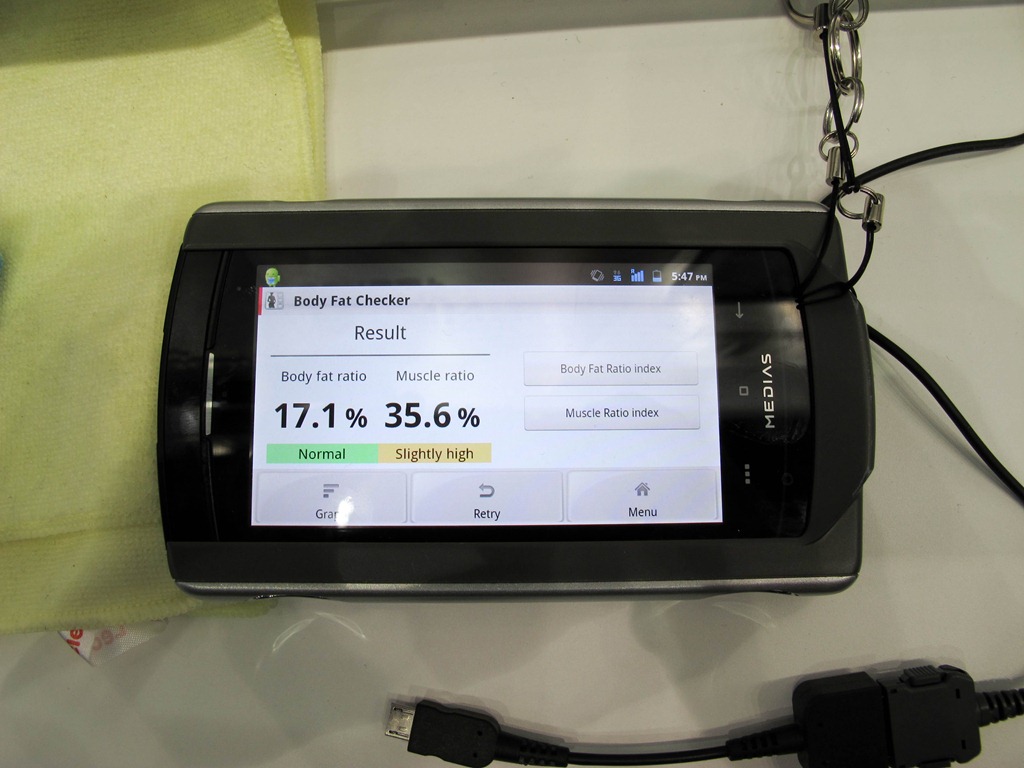
This year’s interesting item was a series of sensor cases that you insert your smartphone into. A ‘breath sensor’ (for halitosis and alcohol), a weather sensor and a body fat sensor.

IMG_0081

I had to try out the body fat sensor. You start by adding in parameters (Which was harder than it should of been as I still think of height and weight in Imperial – not metric) and then you put 4 fingers on these mental contact points on the sensor. Basically you hold it like a point and click camera. He explained that it sends a current through the body and by measuring resistance they make the calculation. My measurements are below … who knows if it is accurate.

IMG_0072

Right beside it was the NEC booth and the marketing display caught my interest as it was profiling people as they stood in front of it. These have been popping up over the last couple years and it is pretty clear that they have some additional work before they hit primetime … look down the left panel and my multiple ages/impressions. I did not move from the same spot and it just kept re-profiling me, and of course I am not female (smile).

IMG_0082

The last one that caught my attention was a docking station for your mobile phone. It caught my attention because I still can’t figure out why I would want one?

IMG_0071

Congrats to GSMA, another great show. Learned a ton.

MY FIRST PROTEST/RIOT (Later in the day)


While I was in Barcelona I had the opportunity to experience my first ‘protest’. I was standing with a man from Columbia and he observed that the protest was around government cuts to education (They were University students – facing bleak prospect in a country with 24% unemployment and 40-50% unemployment if you are under 25 (depending on which news outlet you read)).

IMG_0079

The fellow from Columbia was amazed that the students kept away from police saying “Look at the way they do not approach the police”. I commented that it isn’t that odd. He stated that isn’t the case in Columbia – in his country the police fear the people, not the other way around.

IMG_0078

Moments later 20 paddy wagons came rushing in and riot police moved in. The crowd didn’t stick around.

AUGMENTED REALITY


There is a lot of talk about augmented reality and how mobility can provide depth to static media. I happened to be walking by the HP booth and there were a few people demonstrating the Aurasma application with a phone and iPad (Available on Android – iOS). Simply download the free application, point it at a Aurasma enabled item (Like an ad) and voila ….


The commercial value is enticing – I watched a John Lewis catalogue demo where you point it at the cameras and it brings up mobile ads and a ‘buy now’ button to take you to their website. The newspaper application is also interesting. And the creative opportunities are pretty interesting ….


And of course, you cannot go wrong with dinosaurs.

WINNER OF THE SHOW: SAMSUNG 10.1” NOTE


In my eyes, the winner of WMC has to be the Samsung 10.1” Note (Tablet). I still remember getting my first tablet back in 2002 – the Compaq TC1000. The notion of finally having your notes recorded digitally – truly no more paper – was very appealing. Unfortunately, the battery life and speed (It was so slowwwww….) were not up to expectations and it never really took off.

Last year HTC came out with a 7” tablet with a pen. I was very excited. Fantastic integration into applications, but the screen size was too small.

This year, Samsung brings out a 10.1” tablet with a pen and they seem to have got it right. The only thing missing is some deeper application integration (Specifically – native support for Evernote). But I am sure that will come.

IMG_0074

CNET review here.

They were demoing Adobe Ideas on the Samsung – very impressive tablet based art and editing. The creative possibilities are very interesting. I can imagine our boys going to school with this tablet and no paper, drawing on it, taking class notes, watching videos, surfing the internet, reading books and on and on.

The tablet finally becomes what it was always meant to be.