BARCELONA: PART 4: TOURING AROUND

After lunch we hit the Museu Picasso (no pictures allowed) dedicated to Pablo Picasso’s personal art collection and life. One half of the museum covers works that he collected through friendships with artists of the time and through his travels. It is an extensive collection with works from Matisse, Renoir and a host of unknown artists who were clearly his friends and colleagues.

The other half of the museum is dedicated to his life, tracing his early days, through the various periods (blue period, rose period) culminating in the works that made him famous – cubism and surrealism. Personally, I enjoyed his early works much more than his late works. But in the end, you left with a feeling that he lived a very rich life and there is no doubting his talent.

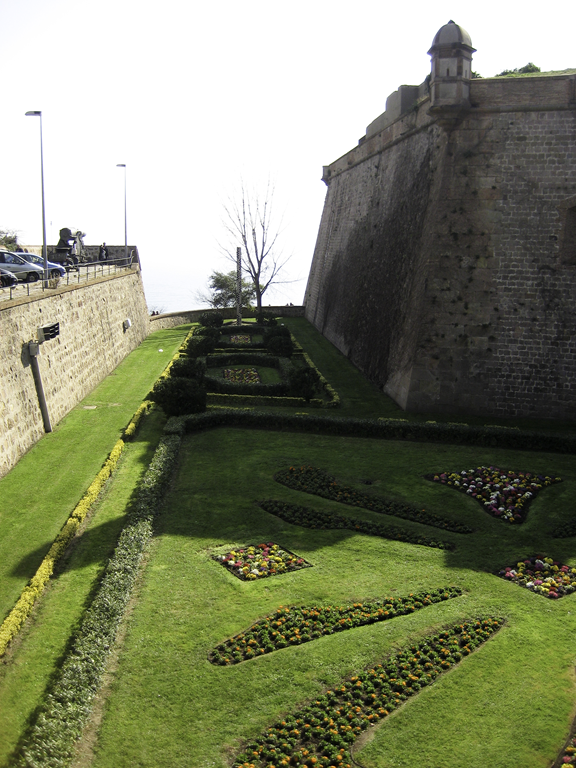
Our next stop was hill Montjüic (Jewish Mountain) the 17th century fortification that sits on top. Our goal was to take the gondola up the mountain to the castle, then take the gondola from the mountain to the harbor. Again, the public transportation made this remarkable simple with the subway actually going up the mountain.

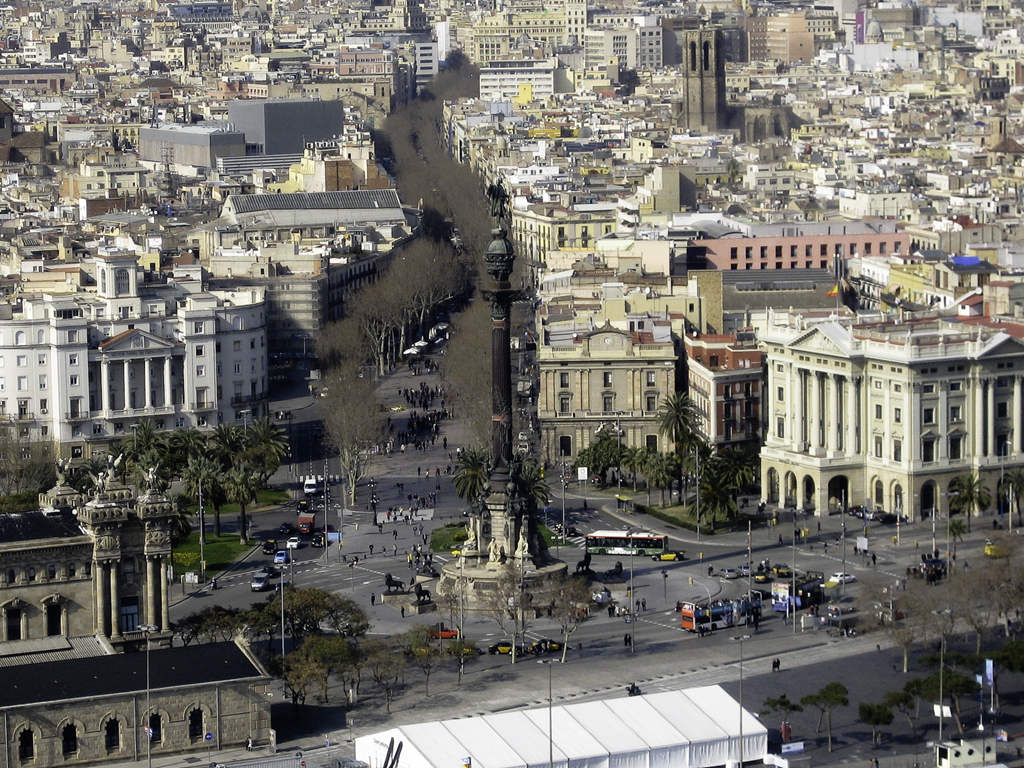
Unfortunately, the first gondola was closed for repair so we forced to bus up the hill to the top. The views of the city were spectacular and the boys loved climbing over the World War II era harbor guns.

 imageimage

image

The ride down the mountain afforded a great view of the city. I found the contrast between the old world architecture and the 1970’s style – square – brick and concrete – featureless building interesting and in stark contrast to my experience in England. While people in the UK complain about the planning councils, it seems that one impact is that ‘the old’ is more prevalent than in Barcelona.

image

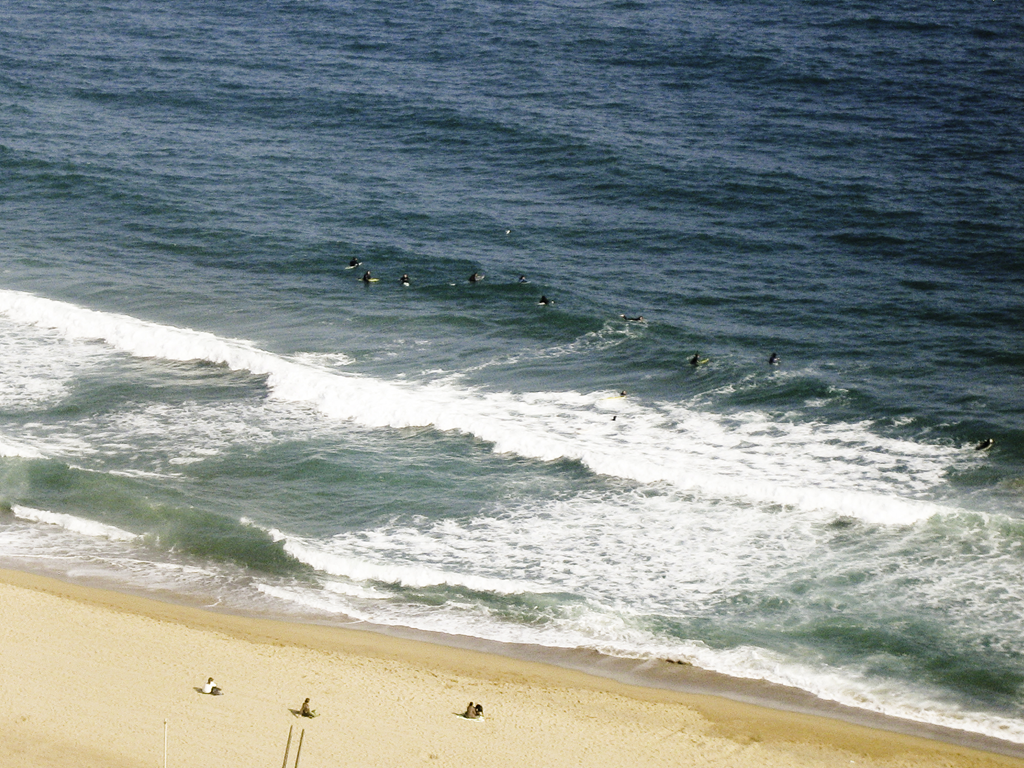
The craziest thing was the ocean. Sure, it was 65 degrees out and sunny but when the wind kicked up on the beach, it was cold. But not cold enough to stop these guys. Yes, they are kite surfing and wave surfing. It must have been REALLY cold.

image

As we walked back to the hotel we came across this architectural anomaly. Whale? Fish? Bird? Big copper thing that is supposed to make the office building look different than other office buildings? Government funded boondoggle? Probably.

image

In the short time we were there, we saw quite a bit – but there is more and as I mentioned, it is a perfect ‘couples’ city. The adventure continues.

BARCELONA PART 3: TOURING AROUND


With only a point and shoot (smile).

Barcelona is a beautiful city and we spent a few days touring around. On a personal note, I could definitely see coming back for a ‘couples’ weekend. The streets are filled with cafes and plenty to see. It is still a wonderful feeling to sit on a patio in the middle of February, a feeling that my Canadian heritage still has trouble adjusting to.

2008 Bacelona Feb 15  (6)

Most notable within the city are the various architectural works of Gaudi. The story of Antoni Gaudi is a fascinating one:

Gaudi was an ardent Catholic, to the point that in his later years, he abandoned secular work and devoted his life to Catholicism and his Sagrada Família. He designed it to have 18 towers, 12 for the 12 apostles, 4 for the 4 evangelists, one for Mary and one for Jesus. Soon after, his closest family and friends began to die. His works slowed to a halt, and his attitude changed. One of his closest family members – his niece Rosa Egea – died in 1912, only to be followed by a "faithful collaborator, Francesc Berenguer Mestres" two years later. After these tragedies, Barcelona fell on hard times, economically. The construction of La Sagrada Família slowed; the construction of La Colonia Güell ceased altogether. Four years later, Eusebi Güell, his patron, died.[6]

Perhaps it was because of this unfortunate sequence of events that Gaudí changed. He became reluctant to talk with reporters or have his picture taken and solely concentrated on his masterpiece, La Sagrada Família.[6]

On June 7, 1926, Gaudí was run over by a tram. Because of his ragged attire and empty pockets, many cab drivers refused to pick him up for fear that he would be unable to pay the fare. He was eventually taken to a pauper’s hospital in Barcelona. Nobody recognized the injured artist until his friends found him the next day. When they tried to move him into a nicer hospital, Gaudí refused, reportedly saying "I belong here among the poor." He died three days later on June 10, 1926, half of Barcelona mourning his death. He was buried in the midst of La Sagrada Família.[6] although Gaudi was constantly changing his mind and recreating his blue prints. The only existing copy of his last recorded blue prints were destroyed by the anarchists in 1938 at the height of Franco’s invasion of Barcelona. This has made it very difficult for his workers to complete the cathedral in the same fashion as Gaudí most likely would have wished. It is for this that Gaudí is known to many as "God’s Architect". La Sagrada Família is now being completed but differences between his work and the new additions can be seen.

The Temple Expiatori de la Sagrada Familia is one of those must see spots. The tourist books set my expectations high and they were not disappointed. Witnessing a temple of this magnitude still under construction after more than a century is breathtaking and the architecture is like nothing I have ever witnessed before.

The entrance is adorned with The Passion Facade tracing the death of Christ. This work was overseen by Josep Subirachs and appears to be quite controversial as it is very stylistically different than the Gaudi work – very blocky, minimalist. What is fascinating about the work is that you can literally track the death of Jesus from the last supper to the ascension across the face of the temple.

2008 Feb La Familia Barcelona  (11)

2008 Feb La Familia Barcelona  (4)

2008 Feb La Familia Barcelona  (6)

The first indication of the difference in style is apparent when you look up to the 18 towers that represent the 12 apostles, 4 evangelists, Mary and the tallest – Jesus. The cranes make for an interesting backdrop and foretell the experience inside the temple. We did not climb the towers (there is a multi-hour wait to take the elevator) because we did not realize there are stairs (there are) – or we would have for sure! We saw people peeking out the windows and over the edge of the bridge.

2008 Feb La Familia Barcelona  (3)

Entering the temple is to walk into this massive construction site that is magnificent in scale. Workmen everywhere. Scaffolding erected. Amazing – one big jigsaw puzzle. You can actually read the work reports on the temples progress here.

2008 Feb La Familia Barcelona  (15)

2008 Feb La Familia Barcelona  (12)

2008 Feb La Familia Barcelona  (17)

The final part of our journey is where you exit the back to see Gaudi’s original facades. The nativity scene detail was awe inspiring.

2008 Feb La Familia Barcelona  (28)

2008 Feb La Familia Barcelona  (29)

These two pictures will hopefully give you a sense of the scale of the facade:

2008 Feb La Familia Barcelona  (21)

2008 Feb La Familia Barcelona  (30)

In the entire facade, there was one scene that kept me staring – A Roman soldier following Herod’s orders to murder all male children under a year in an attempt to kill Jesus. Vivid is the only word.

2008 Feb La Familia Barcelona  (26)

I will admit. Another scene made me smile. Not sure why the fruit was there? But it is in a newer section, so must be a different architect.

 2008 Feb La Familia Barcelona  (27)

The thought that crossed my mind as we exited was when it is complete, I wonder what it will be like to worship there? I wonder whether the people who are on this construction journey are still doing it for the glory of God or for other reasons? If you read the Gaudi biographies, it appears clear that he was focused on that goal. I wonder if the others were – are?

Fascinating. No wonder 2.5M people visit every year. We never got to the other Gaudi works like the park (which is supposedly amazing) – but you can view his works here. A small virtual tour.

CAN IT BE SIMPLE? CANON 40D


It seems like very few purchases these days are simple. There is so much choice. Discerning between what will actually provide value and what is just a marketing exercise to create perceived value is not for the faint of heart.

Take for example my recent camera purchase. If you look at this web page and compare products, they begin to all look the same. Do I really need 6.5 fps versus 3 fps? Will the E-TTL flash system result in a better picture?

How do you find the right web site that can be trusted for a recommendation? Is it sponsored by a vendor which impacts their review?

In the end, I ended up getting my best advice by putting together an opinion based on comments on web forums; people’s candid opinions and experiences, highly influenced by their statements of what they were upgrading from (i.e. upgrading from a point and shoot to their first DSLR or from an old DSLR to a new one). In the end, this was a laborious process where I spent many hours trolling the web. But it did allow me to get a balanced view (lovers and haters) and make an informed decision that in the past, would have been heavily reliant on the 16 year old ‘expert’ salesperson (NOT a winning proposition).EOS 40D

And in the end I changed my mind. I moved up the food chain to the Canon 40D due to the magnesium alloy, water/dirt resistant chassis (after all, I know that I broke the other one by banging it around). Right choice choosing resilience over size? (The other is a lot smaller). We will see. Review to be posted after we get back from Egypt.

But it was painful. Maybe I need a personal shopper (smile).

DARIUS & DOWNEY: URBAN ARTISTS


The Guardian had an interesting write up on two urban artists or visual protestors who take their subversive humor to the streets. You can view their work here. It would appear they are part of this artist cooperative. Their goal – how long will it stay up before the authorities remove it?

darius 006 darius 014darius 1   darius 016 darius 029

ATTITUDE 101


I am a fan of the John C. Maxwell books on leadership and have started to read his pocket books, the 101 series.

Attitude 101: What Every Leader Needs to Know

The first in the series is Attitude 101 and I enjoyed it. A few highlights and quotes I pulled out:

  • He does a lot of leadership workshops. One of his greatest concerns is that people come to the conference and do not change. They enjoy the ‘show’ but fail to implement the ideas. We overestimate the event and underestimate the process. So true. How many people have gone to a self help course – walked away enthused and then fell back into the old routine.
  • Life is like a grindstone. It can either wear you down or polish you. It all depends on what you are made of.
  • From NBA hall of famer Bill Russell: ‘the most important measure of how good a game I played was how much better I made my teammates play’
  • There was a great story in the book about a teacher who conducted an experiment with her art class (pottery). At the beginning of the term she told one group they would only be marked on the quantity of their output. She told the other group that they would be graded on quality. Off the two went, with the first team making item after item while the quality group focused on ‘what does quality mean?’. In the end, she found that the highest quality art pieces were not from the quality group – quantity had the best output because they failed early, often and learned while the others pondered perfection. This is an item that he advocates often – try, try again.
  • When supporting people – value people, praise effort and reward performance. Throughout the book he focuses on failure as a key element of success. He points to the notion that failure creates resilience. William Saroyan is quoted ‘Good people are good because they’ve come to wisdom through failure. We get very little wisdom from success’
  • In the last chapter he makes an interesting point: When you become a leader, you lose the right to think about yourself. So true. I have a philosophy – if you make others successful, you will be successful. Simple really.

Good quick read.

OBSERVATIONS FROM BARCELONA: PART 2


Barcelona is an interesting city and while I was there the weather was beautiful (15 degrees, sunny). Not beach weather, but quite pleasant. A few random observations on the city:

  • Old Europe fascinates me with regard to smoking. It is alive and well. It seemed like everywhere I went there were people smoking. This should not be that surprising as Britain just banned smoking in pubs and restaurants – but it still dismays. Nothing worse than sitting on a patio, enjoying lunch in the sun and having it negatively impacted by the smokers around you.
  • Unlike most other cities, English is not prevalent. In most European cities, English is everywhere and in most cases, service staff speak ‘some’ English. Not in Spain. I am not sure why this is, although I could hypothesize that this is due to a strong nationalist pride that goes back to when Spain was a relevant world power (i.e. medieval times). No where is this more obvious (and irksome) than in the taxi drivers. I did not meet a single taxi driver during the entire week who even knew a ‘little’ English. Not even the airport taxi. They would just stare a blank stare. Funny, even the French taxi drivers knew a little English.
  • The lack of English makes the Spanish radio stations very ironic. I had to laugh when every single service industry staffer would shake their head when I asked if they spoke English as bad 1980’s WHAM blared in English over their radio station. I found it even more ironic when every other song in the cabs were English.
  • We purchased the DK Top 10 Barcelona guide for the trip and part of the guide was the subway maps. The subway was fast, clean and very easy to use. It made us feel like we were really exploring the city and at €5 for a day pass, it is a lot cheaper than taxis.
  • I love coffee. I strongly dislike coffee with milk (One of only two things that bother me in the UK: you cannot get cream in your coffee and the bacon is ham – NOT bacon!). I had my first cortado by accident – which is espresso with a little bit of milk. I enjoyed it quite a bit (Actually, I mean, I enjoyed them over and over and over).
  • They have this very interesting setup for bikes in Barcelona run by a company called Bicing. I cannot read their website but I hypothesize from observation that you put in your card and the bike pops out of the rack. You can then ride around and deposit it at one of the many, many racks scattered through the city. Interesting idea. It looked like many of the locals use the service (more so than my fellow tourists).

Interesting city.

 2008 February  14 168

CHILD SAFETY AND THE POOL


We built our first pool when our son was less than a year old. A shedload of thought went into child safety as we had heard more than one horror story of a child unattended and drowning. My mother told us the story of my brother and I playing in one of those tiny little round pools (with 12" of water) and the phone ringing. She ran in, told the caller she would call back (no answering machines in those days) and ran straight back out to find me holding my brother under the water. As he turned blue I proudly proclaimed ‘Look mom, Brad is blowing bubbles’.

For us, the second planning factor was our big moronic lab who would do anything to get in the water. I can still remember when we was 9 months old and he jumped into the open water of a Toronto river in -20 weather. He walked out with icicles instantly forming on his belly, shook once and dove back in.

With these goals in mind we set to building a child and dog proof pool. With regard to the children we proudly proclaim success. With regard to the dog and one almost drowned squirrel – we failed. The dog was in the pool more often than we were and the squirrel required 2 months of rehabilitation.

It would now appear that our efforts to save the children are being augmented by new child drowning training. Take a moment to watch this video, you will amazed. If we had known about it when our children were young we DEFINITELY would have taught them (while also fencing in the pool). If you know someone who has a young child – pass the video on, they will thank-you for it.

2005-07-20 13 2005-07-20 16

We will miss that pool and I miss my buddy.

THE DEATH OF A CAMERA


Not sure how this happened, but my two and a half year old Canon Rebel died. It will not turn on and so I am left with the big question: Do I spend $100 to have to ‘assessed’ (with a high probability of it being very costly to fix) or do I simply buy a new one.

After much deliberation and a few conversations with various camera shops, I have decided to buy a new one. This leads to a whole new process of which to buy? This can be quite the confusing process – so much information, so many choices and so many different reviews. As I now have two lenses, do I stay with Canon or go with Nikon and abandon my investment?

In the end the best web site for reviews appears to be the Digital Camera Review web site. It is amazing with up to 30 pages of reviews per camera covering every nuance.

I stated the journey doing a like for like (Canon 400D). Then I moved to the unit one level up (Canon 40D), but was hesitant as it is bigger. I also questioned, why is it 2X the price of the 400D? A little research uncovered that the 400D is being discounted because a new model was announced a few weeks ago with most of the 40D features and a smaller size: The Canon 450D. Confused yet? I was. Now I am not. That is the one … I think?

On an even sadder note, I was forced to take Barcelona with a tiny little point and click, what a travesty (smile).


OBSERVATION FROM BARCELONA


This is my second time to Barcelona in the last few months. It is an interesting city with 1960’s run down apartment buildings sitting beside magnificent, centuries old buildings and monuments like the one below.

IMG_0887 - Copy 

I have almost no time to venture into the city so I have not seen much. But I did enjoy the sunrise from my hotel room this morning, breaking through the clouds ….

IMG_0890

Exploring will have to wait.

15 EUROS EVERY 24 HOURS


There is nothing more annoying to me than going into a hotel and having to pay for an internet service. To me that is like the lights, the bathroom and the bed – it should be part of the price. What is even more irksome is the wide variance in price. At my latest European hotel they want 15 euros for 24 hours (6 euros for an hour).

So for the first time I did not pay. Instead, I hooked my handy 3G ready device to the laptop via USB and off I go. I just won’t be downloading huge files – and it is fast enough (especially when Outlook is in cached mode, as I will not be surfing the web).

It did make me reflect on how easy it is via wireless … for a short moment. Then the network started giving me ‘Waiting for network errors’ and timing out.

I paid the 15 euros.

THE IRON CURTAIN

A few months ago I was having dinner with quite a broad group: Polish, Czech, UK and German. I asked what it was like growing up behind the iron curtain and the response was very interesting:

‘It was very grey’

Confused, I asked for an explanation. The Polish speaker went on to describe life: lack of product choices, clothing looked all the same (lack of choice), the buildings that were going up were grey concrete jungles (Just look outside of the Prague airport – you will understand). Everything was grey …. and then he smiled …. except the women.

He marveled at the women and how they would take the simple life, the world of grey and splash it with color to stand out in the crowd. Very grey … except for the women.

TOP 10


The end of the year brought many Top 10 of 2007 lists. I ignored them all until now. The following are a few that caught my eye:

  1. Top 10 viral videos of 2007. Poor Dan Rather – collar up or down?
  2. Top 10 TV commercials via Time. Way to go Dave!
  3. Top 10 games of 2007. Rock Band? Come on, Wired you disappoint.
  4. Top 10 science discoveries of 2007. The dinosaur finding is amazing.
  5. My favorite, the top 10 gadgets of 2007. I don’t agree with all of these, but I do agree that insulation that does not itch is absolutely top 10 material (no pun intended).
  6. And last, not really a ‘Top 10’. Instead 10 very remote homes in a photoblog. Beautiful. I will take the one in Greece.

Chapel on an islet off the coast of Kos

HOPE IN BUSINESS


The word ‘hope’ seems an odd thing when speaking in a business context. But it is hope or optimism or the ability to see the future in a certain way that allows us to reach the next level.

A few weeks ago I was reading through a Harvard Business Review in my stack of ‘too read’. In the February 2007 issue Ideas with Impact, number 7 is ‘The Leader from Hope’. The final paragraph sums it up:

Our study of effective executives has uncovered many ways in which their decisions, words, and actions make the people they lead more hopeful. Collectively, these practices are the basis of a leadership tool kit for building and sustaining hope. But the most important change comes when a leader is simply more mindful of this vital part of her or his mission. Much can be accomplished in a reflective pause to ask, "Is what I am about to do or say likely to be destructive or accretive of hope?" It is useful to notice how people express a sense that things might change for the better: They often say of some key actor, "He gives me hope" or "She gives me hope." If you are an executive trying to lead an organization through change, know that hope can be a potent force in your favor. And it’s yours to give.

One could definitely take this in a greater context, at work, at home, with friends. Hope is ours to give.

LEADERSHIP


I had the good fortune to hear Lord Victor Adebowale, CEO of Turning Point and one of the first ‘People’s Peers‘ speak yesterday about leadership. It was a personal discussion where he talked about his experiences as he turned a not for profit health care entity that is heavily regulated into a ‘business’, growing it from 900 people that was about to be cut off by the government to a highly successful 2800 person team of professionals that is green across the board and delivering on their promise of ‘Turning Lives Around’.

A few discussion points stuck with me:

  • The first lesson in leadership is that it is a risky business. When you are leading, risks need to be taken and the responsibility lies with you. In his role, he was the 5th CEO in as many years.
  • Change will feel very uncomfortable. He discussed how there were people in the organization trying to change when he go there and they were not well liked because they were not part of the cultural norm, ‘doing it differently’. Many of those people and their unique projects were fostered and in the end became some of the biggest growth and innovation areas.
  • There are times where you just have to say ‘Just get on with it’. Buy in and discussion is required, but some times you just have to go!
  • Most organizations have an ‘us’ and a ‘them’ mentality (i.e. Front line staff and management). To be successful, it needs to be ‘we’.
  • Individual brand buys fellowship, whether you are a CEO or a line manager.
  • During the change, when at the lowest point, he had to keep reminding himself to remain neutral in viewpoint. Do not celebrate the positive too much, it could be false and do not get despondent about the negative, it could be short term pain. Remain neutral and realistic, keep that steady head.
  • Turning Point

On a personal level, he is an admirable man. When asked where does he take his inspiration from, he did not turn to Nelson Mandela or some great theologian, he talked about the guy who drives the bus who lives in public housing, in a rough neighborhood, who has raised 3 children who are all off to university. You could tell, he is an authentic leader and he does wake up each day ready to turn people’s lives around.

THE ONION


Narda sent me one of the funniest videos I have seen in a long time, from the ONION. Enjoy (It is office friendly) …


My all time favorite ONION article?     A ‘letter’ from the CEO of the Gillette Company: £$^%^ Everything, We’re Doing 5 Blades. Warning – profanity and a lot of laughter. This is pretty funny too.


image

XBOX AND DIVX / H.264


In December the XBOX team announced that the 360 would support DIVX and H264. Much to my chagrin, I could not get it working for the last month and so I reached out for some help. Turns out, they are supported through the XBOX360 dashboard – not the Media Center Extender interface. All the details are in this FAQ.

It works great – although it was PAINFUL to figure out. I would expect to see Media Center interface support soon (I hope). It still works GREAT for my music, pictures and home videos.


Scenario

Supported Codecs

From USB storage device to Xbox 360 Dashboard Video Player

WMV(Unprotected),

Mpeg4,

H.264,

AVI

From Windows Media Player 11 to Xbox 360 Dashboard Video Player

WMV(Protected),

WMV(Unprotected),

*Mpeg4,

*H.264,

AVI

From Zune Software to Xbox 360 Dashboard Video Player

WMV(Unprotected),

Mpeg4,

H.264

From Windows Home Server to Xbox 360 Dashboard Video Player

WMV(Protected),

WMV(Unprotected),

AVI

From Windows Media Center to Xbox Media Center Extender

WMV(Protected), WMV(Unprotected),

Mpeg2


THE WEATHER IN BRITAIN


I continue to marvel at the weather in Britain. While it is much wetter in the north – southern UK is spectacular. The Brits love to talk about the weather, other people like to talk about how crappy UK weather is and I remain perplexed.

For example, last weekend we went out as a foursome and spent the afternoon golfing. It was spectacular – 14 and sunny. Granted, a little cold as the sun dropped down but still – we were golfing in January.

According to this site, London is one of the driest cities in Europe and the city with the least variance in weather:

10 driest cities Avg annual precipitation in inches

1. Athens, Greece 14.82007 Jan Natural History Museum  (2)

2. Madrid, Spain 18.0

3. Prague, Czech Republic 18.8

4. Stockholm, Sweden 21.7

5. Berlin, Germany 23.1

6. London, England 23.3

7. Paris, France 23.8

8. Helsinki, Finland 24.9

9. Vienna, Austria 25.3

10. Copenhagen, Denmark 25.4

The wettest city in Europe? Zurich with 42 inches.

The family starts tennis lessons next week. I honestly do not know what they are talking about when they complain, not a snow bound 100 car pile up to be found!

TERRACOTTA ARMY: BRITISH MUSEUM

 Armoured infantryman, terracotta

One of the big events in the city right now is the Terracotta Army display at the British Museum. Requiring more than a year of negotiation and as much prep, this display has been set up in the Reading Room with much ado. The BBC filmed a documentary on the entire event. which is quite fascinating.

The museum is very different than the Natural History Museum as it is dedicated primarily to the evolution of civilization. From their site:

The British Museum holds in trust for the nation and the world a collection of art and antiquities from ancient and living cultures.

Housed in one of Britain’s architectural landmarks, the collection is one of the finest in existence, spanning two million years of human history. Access to the collection is free.

The Museum was based on the practical principle that the collection should be put to public use and be freely accessible. It was also grounded in the Enlightenment idea that human cultures can, despite their differences, understand one another through mutual engagement. The Museum was to be a place where this kind of humane cross-cultural investigation could happen. It still is.

On a personal note, I would not consider it the most exciting museum for children but one of great interest for adults. One of the most interesting items is the Rosetta Stone, a tablet that provides a guide that helped researchers decipher hieroglyphics:

The Rosetta Stone is one of the most important objects in the British Museum as it holds the key to understanding Egyptian hieroglyphs – a script made up of small pictures that was used originally in ancient Egypt for religious texts. Hieroglyphic writing died out in Egypt in the fourth century AD. Over time the knowledge of how to read hieroglyphs was lost, until the discovery of the Rosetta Stone in 1799 and its subsequent decipherment.

Everywhere you walk you see ancient text and walls that have been moved to the museum, like the one below which is the architrave of Ptahshepses, Fifth Dynasty, recording his birth, marriage and career under 4 kings of the Fifth Dynasty:

2007 Jan Terracotta Army Brit Museum  (10)

One hall was dedicated to King Ashurbanipal (635-645 BC) and stone engravings from Nineveh, his North Palace in Assyria.The panels were entitled ‘Royal Lion Hunt’. The ‘royal’ hunt went something like this, lions were released while the king flew around the stadium on either a horse or a chariot. He would shoot the lions with a bow while attendants guarded him if a lion got to close. I found myself staring at the walls and feeling very sad as so many of the pictures showed the poor, noble beasts being slaughtered by a cowardly king, hiding behind his attendants. There is nothing noble in killing an animal for sport. Below are the photos of the walls, you will see what I mean.


2007 Jan Terracotta Army Brit Museum  (13)

This one was particularly poignant. You can almost see the pain.

2007 Jan Terracotta Army Brit Museum  (15)


2007 Jan Terracotta Army Brit Museum  (18)

You can view more here and here. Interesting insight from their site:

Struck by one of the king’s arrows, blood gushes from the lion’s mouth. Veins stand out on its face. From a modern viewpoint, it is tempting to think that the artist sympathized with the dying animal. However, lions were regarded as symbolizing everything that was hostile to urban civilization and it is more probable that the viewer was meant to laugh, not cry.

There was a very long tradition of royal lion hunts in Mesopotamia, with similar scenes known from the late fourth millennium BC. The connection between kingship and lions was probably brought to western Europe as a result of the crusades in the twelfth and thirteenth centuries AD, when lions begin to decorate royal coats of arms.

Sad.

The finale was the Terracotta Army, brought to life by Qin Shihuangdi, the first founding emperor of China. His story is fascinating as he took what was one of the smaller feudal kingdoms and quickly conquered the kingdoms around him (It took 9 years).

During his reign, he also introduced a host of innovations that would spur the growth of China:

  • Farmers, no longer enslaved servants, were allowed to own their land, and production increased.
  • He reoganized the feudal kingdoms into 26 jun (provinces) that were ruled by appointed officials. Military and administrative appointments, which had previously been determined by noble birth, were now decided by merit.
  • He introduced a standard coin, standard written language and a weight and measure system to facilitate trade. He also built roads, canals and started construction of the Great Wall of China.

He also built the Terracotta Army which is estimated to have taken 36 years and 700,000 workers to build:

The Terracotta Army (traditional Chinese: 兵馬俑; simplified Chinese: 兵马俑; pinyin: bīngmǎ yǒng; literally "soldier and horse funerary statues") or Terracotta Warriors and Horses is a collection of 8,099 larger than life Chinese terra cotta figures of warriors and horses located near the Mausoleum of the First Qin Emperor (Chinese: 秦始皇陵; pinyin: Qín Shǐhuáng líng). The figures vary in height according to their rank; the tallest being the Generals. The heights range is 184-197cm (6ft – 6ft 5in), or more than a full foot taller than the average soldier of the period. The figures were discovered in 1974 near Xi’an, Shaanxi province, China by a local farmer.

The Terracotta Army was buried with the Emperor of Qin (Qin Shi Huangdi) in 210209 BC (his reign over Qin was from 247 BC to 221 BC and unified China from 221 BC to the end of his life in 210 BC). Their purpose was to help rule another empire with Shi Huangdi in the afterlife. Consequently, they are also sometimes referred to as "Qin’s Armies".

Unfortunately, no pictures were allowed and in the end my son was left with the following comment:

‘Is that it? There are supposed to be 7,000 of them – not 30?’

Image:Xian museum.jpg

A cool trip.


Technorati Tags:

WALMART CALL DOWN


I heard a very interesting story the other day. A CEO was accompanying the CEO of Walmart to a Saturday board meeting. They arrived early and the Walmart CEO asked if he could excuse himself and make a few calls.

What the other CEO heard was the head of Walmart getting on the phone and calling individual store managers to find out how it was going in the field.

That is a great story that reinforces a few key leadership lessons for me:

  • The power of being there: Getting it straight from the field is key for leaders. The higher up you get, the more filters the information travels through. Getting out with the field provides context that is invaluable.
  • The power of contact: I can only imagine how those store managers felt after speaking with the CEO. They must have been walking on cloud nine. I still remember the email of congratulations that I received from Michael Dell more than a decade ago congratulating me on closing one of Dell’s first big server deals (He used a smiley face which made me laugh). People like to be recognized for their great work.

A good leadership lesson.

OH CHRISTMAS TREE

2007 Dec 11 Sunrise Virginia Park_-3


In our British home there is a lot less room so one of the things to go this year was the 14′ tree that we usually have. We also skipped the process of a) going to a farm and cutting one down ourselves and b) getting a fresh tree. We went artificial for the first time ever.

At least it was not a cursed tree. There is always that.

GADGET ROUNDUP


As I round the web I have tallied a few gadgets that caught my eye:

  • The Jawbone: Their site calls it the highest rated Bluetooth headset every. Described as:
    • Jawbone is the world’s first adaptive Bluetooth headset for mobile phones. Its revolutionary Noise Shield technology combines the latest innovations in acoustics, audio processing and product design to produce a quantum leap in headset performance.

      Not only does the Jawbone technology virtually eliminate all background noise from your call, but as your background changes it also seamlessly adjusts the speaker output so you can hear your caller’s voice better. Jawbone’s intelligent system of sensors, software, and ergonomic features allows you to use your mobile phone in any environment without shouting or straining to hear. The result is a clear, uninterrupted, and productive conversation.

      Jawbone identifies your speech: A proprietary voice activity sensor identifies precisely when you are speaking, in any noise environment. Unlike other headsets, Jawbone can easily separate your speech from other sound nearby.

      Jawbone eliminates noise: Jawbone uses highly directional microphones and powerful signal processing algorithms to remove background noise from your ongoing speech signal. This allows you to be heard clearly in any environment without the need to shout and disturb others around you.

      Jawbone automatically enhances incoming audio: The volume and frequency content of the incoming speech is dynamically adjusted to maximize intelligibility in any noise environment. No matter where you are, Jawbone will adapt to your environment.

  • The evolution of the SSD cards is very interesting. For boosting a laptop or grabbing a fast, low power drive – this is very interesting technology. I also find the pricing quite interesting – in the sub $400 price range for a monster 32GB.
  • The Nvidia 8800 series of video cards is getting rave reviews. Low price, amazing performance. Already ordered (smile).
  • The boys are loving Asian Dynasty – Age of Empires III. Amazing game continues to expand.
  • Have been playing with Adobe Lightroom which seems to be a nice middle point products between the entry GN9350 Product shotlevel and professional products. It is amazing what you can do with a picture.
  • I have been using the Jabra GN9350 with Office Communicator in my home office. Amazing flexibility and a dramatic impact on my performance. I plug it into my laptop and instantly I have full access to our corporate back end voice network. This is the next big leap in productivity – that is for sure.
  • Check out the Mimobot series. Halo, Star Wars memory stick. If nothing else, they made me laugh.


Technorati Tags:

MADISON WHO’S WHO


MadisonWhos

Dear Michael Weening , 

You were recently appointed as a biographical candidate to represent your industry in the Madison Who’s Who Among Executives and Professionals, and for inclusion into the upcoming 2007-2008 "Honors Edition" of the registry.
     We are pleased to inform you that on August 27th, your candidacy was approved. Your confirmation for inclusion will be effective within five business days, pending our receipt of the enclosed application.
     The Office of the Managing Director appoints individuals based on a candidate’s current position, and usually with information obtained from researched executive and professional listings. The director thinks you may make an interesting biographical subject, as individual achievement is what Madison Who’s Who is all about. Upon final confirmation you will be listed among thousands of accomplished individuals in the Madison Who’s Who Registry. There is no cost to be included.
     We do require additional information to complete the selection process and kindly ask that you access this form on our website:
Click here to register
Or you can manually enter this address into your web browser:
http://www.madisonwhoswho.com/basiclisting
To ensure your biographical data is received in time, please complete the online form above as soon as possible. Our editorial deadline is quickly approaching.

Sincerely,
Matthew Johnson
Managing Editor  

Madison Who’s Who is not associated or affiliated with Marquis Who’s Who or any other Who’s Who.


Madison Who’s Who, Inc. 30-01 Northern Blvd. Long Island City , NY 11101 USA


…. Social networking with a twist …. impressive marketing. They almost had me.

FIRE


I was reading a very interesting article on the weekend about fire alarms. In this story a family was saved by their young son who woke up as a fire erupted from the dryer downstairs. The family of 5 quickly vacated the home, no one was hurt and the fire department arrived quickly. I have heard that dryer fires are common (lint build up).

They had a fire alarm. It had no batteries in it. Amazing.carbon_monoxide_detector.jpg

In our last house, we had fire alarms that were linked into the alarm company (total cost – $25 per month to monitor). We also had carbon monoxide monitors. In our new home, the previous owners were American consulate people who appeared very paranoid. The house is like Fort Knox: highest quality locks, fire alarms in every single room and a state of the art alarm system.

The only problem? When the batteries start to go, the go in mass. A few weeks ago, one went .. then another .. at one point, I had 6 spread out on the kitchen table. In the end, I just replaced all the batteries to be done with it.

A pain, a little bit of investment but worth every penny.

PASSION


In the book Never Hire a Bad Salesperson Again they identify drive as the number 1 predictor of sales success:

‘Drive – the Lance Armstrong type of Drive – is the most important factor for sales success. In a 1998 analysis of more than 45,000 salespeople, psychology professor Andrew Vinchur and his colleagues found need for achievement a critical component of Drive, to be more predictive of sales success than any other trait’

‘These 3 traits – need for achievement, competitiveness and optimism – are all necessary elements of drive’

Another element of drive is passion. Do you believe in what you do? Do you love what you do? Do you believe that your customer will be better off when you walk out that door – deal in hand?

When I was younger I was lured away from Dell Computer by an IT company that paid very well. It was not uncommon to see people earning $1M a year. The culture? Poison. Screw the customer, get the deal at all costs, underhand dealings and a classic 1950’s – pick the worst – sales culture. I hated every minute of it and left after 4 months. I was not passionate about what I was selling and I did not feel good about how they did things.

For me, if the passion is gone, I am gone. Watch this video – it is a great demonstration of passion. Love what you do – believe in what you do – play hard or go home.

You can read the inspiring story of Paul Pots here. Mobile phone sales guy to famous opera star. Inspiring.

Technorati Tags:

THE ECONOMY RINGS THE ‘TOUGH TIMES AHEAD’ BELL


Many think sales is an easy profession. The comments of ‘anyone can sell’ or ‘all you guys do is golf’ have been heard around the world thousands upon thousands of times.

One of the first sales professions to swell when times are good is the real estate market. People decide ‘I can do that’, take their test and thanks to an employment program which is usually 100% commission (meaning low risk to no perceived risk to the real estate company), they become an agent.

A friend of ours is an agent (called estate agents in the UK) and we were discussing the impact that the decline is © Roy McMahon/Corbishaving on her business: never better, she doubled her income last year. Why?

Simple. As this article points out, all of the part-time – I think I will give sales a go – agents are dropping out at a fast and furious pace. As times get tough and they are required to actually apply skill to win business, they realize that they are not up to the task and customers (people selling their houses) are realizing that it is getting tougher to sell the house (As an aside, she mentioned that $600K+ homes are not moving at all). Which means that customers are turning to the agents with a good reputation, who market effectively, who have been referenced by friends to them, to sell the house.

I have known a few very successful real estate agents earning $300K++ a year. It is a 7X24 grueling pace, relies on great reference selling and professionalism.

Real estate sales are anything but easy – especially in the years ahead. Buckle up. The economists say here comes the recession ….

Technorati Tags:

UK TELEMARKETING


The phone rings and call display is not working (I found out this weekend from my provider that while I had this feature for the last 5 months, it had not been turned on. Good thing I spent ALL THAT TIME fiddling with the phone). I pick up.

‘Hello?’

‘This is … from HSBC, I am … about …….. … … ….. if you …. … … today?’

Huh? ‘Buddy, I can’t understand a word you are saying, sorry’

I know, after 6 months, I should be able to tell if he is Irish or Scottish or from Manchester, but I have no bloody idea. The only thing I do know is that I can only understand certain words.

‘ I em coooling ta tawk to you about your HSBC acccant’.

Got it. ‘OK, what would you like?’

‘We have this … …. …. … new …. like ..’

He has gone back to his script and has sped up. I have no idea what he is saying. It does not sound like English.

‘Uh, sorry. But I can’t understand’. Now I do feel like an ass, after all, it is their country.

‘We huv … new .. … … … . … … like ….. … … ‘

I interrupt. ‘OK, you are going to have slow down. I am sorry, but I cannot understand you’.

‘We huv these new surice’

‘What?’ I say.

‘We .. huv .. thees … new … suurvice .. dat .. wee .. wuld ..like ..ta  .. inform’ He has started talking to me like I am deaf. It is working, I understand.

‘Oh, you are calling to offer me a new service. Thanks, but I am great. Have a great night’. We say good-bye.

Separated by a common language.

RETIRING


I know a few people who have retired and are now taking their money and moving to traditionally 3rd world nations where their money goes a long way.

One friend built a place in Costa Rica, which you can check out here.

I came across an article on Corazal, Belize which is a former British colony near Mexico.  There is no capital gains tax on buying and selling property with prices for a 2 bedroom apartment starting at $140K. The official country language is English. Atlas International has an interesting site to peruse.

If you are a little more adventurous you could go to Bali. Interesting retirement options where the dollar goes a long way.

Technorati Tags:

A FEW MORE BRITISHISMS


I did a presentation in Paris this week around the state of the business and threw in a slide on a few unique things that make me chuckle about the UK. They are as follows:

  • They deliver the mail on Saturday but the post office closes at 11 each day.
  • All the magnificent museums in London are free but it costs £10 if you drive there.
  • You can get your car washed in the supermarket parking lot but the 16 year old at the supermarket check-out sits on a chair and refuses to help you pack your groceries.
  • The pharmacist is very helpful but if you want to get Ibuprophen you have to get it from the ‘trained’ 16 year old who keeps it in a protected cabinet behind a desk.
  • In North America grocery carts 9 times out of 10 drive straight. In the UK they call it a grocery trolley and they are manufactured to run sideways. There is nothing funnier than watching a parking lot full of people driving loaded carts sideways.
  • No one knows what a Q-TIP is, it is a cotton bud.
  • It is a resource constrained island where everything is ‘carbon neutral’ and ‘save the planet’ but if I want to recycle an empty food can, paper that is not a magazine or cardboard, I have to drive it to the car park down the street and manually place it in different bins.
  • You can get your groceries at most gas stations (They are all partnered with some supermarket chain) but I have never seen a station that will actually pump the gas for you.

On the purely observational side:

  • The distinct lack of fast foods is fantastic. In North America you hit a fast food restaurant every couple kilometers. In the UK, pubs and restaurants are everywhere but fast food is not prevalent. Interesting that even with the lack of fast food the UK still ranks number 3 in obesity. It is the fish & chips and the ‘gravy on everything’ mentality  I would wager.
  • One of the best things in the UK is Ocado – the internet grocer. Head online, pick your groceries, a delivery time and you are done! Delivered. Amazing low value task eliminated.
  • We have a milk man. He comes at 6AM 3 times a week and he delivers eggs and other products also. How retro cool is that?
  • Most shops close at 6. A few Saturday nights ago we went out for a quick dinner and thought to do what we have done in Canada many times before, perhaps pop over to the shopping area and get a few things out of the way (needed a few groceries) then into the coffee shop for a cappuccino before we head back. Not a chance. The 9 to 9 mentality is definitely not alive and well here.

The adventure continues.

AMERICAN EXPRESS


A personal observation on this company. It is our corporate credit card, I have been a member since 2003ish and I really like their service. A good company.

However, there is one thing I do not like. If you ever use them with a small vendor or most small retailers (i.e. taxi), they look at you like you are robbing them of their hard earned money. I have had this happen to me more times than I can count (I actually feel guilty). It is clear that Amex charges retailers more than other credit card companies and it ticks them off. This leads to many retailers only carrying Mastercard or Visa. It has been such a pain in the past that my wife refuses to carry her card or try to use it.

AMEX, wake up. Lower your rates and go broad to the market.

The second observation is not necessarily AMEX only, but financial institutions and their systems. It still amazes me the lack of connectivity from system to system. Consider this story:

I now carry 4 AMEX cards (2 corporate, Canadian and UK) and 2 personal (Canadian, UK). The UK personal AMEX is new and was provided to me quickly. While moving over we purchased a few items of furniture that added up quickly to the £3K range. Not a crazy amount. I went to use my AMEX and it was refused.

Confused, the merchant called in and was told by the service agent that it was over my limit. Now, if you know AMEX, ‘no limit’ is a key marketing phrase (it is false advertising). Confused I got on the phone and asked what she meant.

Because I have no history on this card I have to start out with a low limit and it is slowly raised. Calmly I explained my broad history with AMEX, but she would not budge. So, I asked for a supervisor. Now it is getting a bit tense, children are getting a bit sick of sitting in a furniture store on a Saturday.

Supervisor comes on and will not budge until I have the idea of giving her my old card numbers so she can look them up on a different system. Seconds later, the apologies were flowing, approval processed, sorry for the inconvenience.

Wasted time? 35 minutes.

It annoys me to no end. Web services, Web 2.0 and architects that just love to talk about it but they are still challenged to get one internal system to talk to another.

IRISH


I was reminded of a story about myself by an old Irish boss recently. It made me laugh.

After losing to Larry Skinner in the demorama at OE* for not using humor. I accused you of being culturally disadvantaged.  I said asking a Dutchmen to exhibit humor is like asking an Englishman to exhibit passion.  To which you immediately replied "or an Irishman restraint". 

* The field sales force of Office Equipment (Division of Canon Canada) competed against each other demonstrating the newest office copier – the GP55 (Their first digital – network ready – fax – copier). The winner received a new computer (A screaming 486DX2), 2nd place was a set of Canon speakers. I still have those speakers. I doubt that if I had won the computer that I would still have it. So in the end – I won (smile).

Addition: A Scottish joke sent to me:

A bloke walks into a Glasgow library and says to the prim librarian, ‘Excuse me Miss, dey ye hiv ony books on suicide?’

To which she stops doing her tasks, looks at him over the top of her glasses and says, "Pes off, ye’ll no bring it back ."


Technorati Tags:

BULWER-LYTTON FICTION AWARD 2007


I blogged about this award a few years ago. From wikipedia:

The Bulwer-Lytton Fiction Contest (BLFC) is a tongue-in-cheek contest that takes place annually and is sponsored by the English Department of San José State University in San Jose, California. Entrants are invited "to compose the opening sentence to the worst of all possible novels" — that is, deliberately bad. A prize of US$250 is awarded.

The contest was initiated in 1982 by Professor Scott Rice and is named "in honor" of English novelist and playwright Edward George Bulwer-Lytton, author of the much-quoted first line "It was a dark and stormy night." This opening continues floridly:

"It was a dark and stormy night; the rain fell in torrents, except at occasional intervals, when it was checked by a violent gust of wind which swept up the streets (for it is in London that our scene lies), rattling along the housetops, and fiercely agitating the scanty flame of the lamps that struggled against the darkness."

The site is worth a look. The 2007 overall winner was Jim Gleeson, a media technician from Madison, Wisconsin. His entry was:

"Gerald began — but was interrupted by a piercing whistle which cost him ten percent of his hearing permanently, as it did everyone else in a ten-mile radius of the eruption, not that it mattered much because for them "permanently" meant the next ten minutes or so until buried by searing lava or suffocated by choking ash — to pee."

A few more worth mentioning:

The 2006 overall winner was Jim Guigli, a retired mechanical designer for the Lawrence Berkeley National Laboratory, from Carmichael, California. "My motivation for entering the contest," he joked, "was to find a constructive outlet for my dementia." His entry was:

"Detective Bart Lasiter was in his office studying the light from his one small window falling on his super burrito when the door swung open to reveal a woman whose body said you’ve had your last burrito for a while, whose face said angels did exist, and whose eyes said she could make you dig your own grave and lick the shovel clean."

The 2005 overall winner was Dan McKay, a Microsoft analyst from Fargo, North Dakota. His entry likened a woman’s breasts to carburetors:

"As he stared at her ample bosom, he daydreamed of the dual Stromberg carburetors in his vintage Triumph Spitfire, highly functional yet pleasingly formed, perched prominently on top of the intake manifold, aching for experienced hands, the small knurled caps of the oil dampeners begging to be inspected and adjusted as described in chapter seven of the shop manual."

Prior winners of the award include Gary Dahl, inventor of the Pet Rock, in the 2000 contest.

Winners in different categories for 2007. I laughed out loud at the children’s book.


Winner: Children’s Literature

Danny, the little Grizzly cub, frolicked in the tall grass on this sunny Spring morning, his mother keeping a watchful eye as she chewed on a piece of a hiker they had encountered the day before.

Winner: Detective

I’d been tailing this guy for over an hour while he tried every trick in the book to lose me: going down side streets, doubling back, suddenly veering into shop doorways, jumping out again, crossing the street, looking for somewhere to make the drop, and I was going to be there when he did it because his disguise as a postman didn’t have me fooled for a minute.

Winner: Fantasy Fiction

Lady Guinevere heard it distinctly, a sharp slap, as if a gauntlet had been thrown, and yet it was hardly plausible that she, perched delicately on the back of her cantering steed, should be challenged to ride faster, since protocol determined that Arthur should ride in front, then she, then Lancelot, for that was the order prescribed by Merlin, ever since he invented the carousel.

Winner: Purple Prose

Professor Radzinsky wove his fingers together in a tweed-like fabric, pinched his lips together like a blowfish, and began his lecture on simile and metaphor, which are, like, similar to one another, except that similes are almost always preceded by the word ‘like’ while metaphors are more like words that make you think of something else beside what you are describing.

Technorati Tags:

JOBY GORILLA POD


After taking a shedload of bad pictures in Brugge thanks to poor lighting/evening walks and no tripod, I realized I needed to put something into my travel bag. I refuse to lug around a tripod as pictures are a byproduct of our trip – not the goal. I was contemplating a monopod, which looked pointless.

Until I came across this wonderful little invention, the Gorilla Pod. Not only does it solve the stability issue (A key tip for night shooting that I recently read was to use the timer on the camera to avoid the shaking when pressing the button if you do not have a remote), it allows me to get into a few more pictures AND is a second tripod for our every important Lego movie shoots. Cool – and very compact.

              Joby Gorillapod SLR                          Gorillapod with a webcam      

Interesting positioning …. watch me 3 putt this ….

BRUGES, BELGIUM PART 3


After leaving Bruge, a few key stops remain foremost in my mind:

The Church of Our Lady (Dutch: Onze-Lieve-Vrouwekerk) in Bruges, Belgium, dates mainly from the 13th, 14th and 15th centuries. Its tower, at 122,3 meters in height, remains the tallest structure in the city and the second tallest brickwork tower in the world. In the choir space behind the high altar are the tombs of Charles the Bold, last Valois Duke of Burgundy, and his daughter, the duchess Mary. The gilded bronze effigies of both father and daughter repose at full length on polished slabs of black stone. Both are crowned, and Charles is represented in full armor and wearing the decoration of the Order of the Golden Fleece.

The altarpiece of the large chapel in the southern aisle enshrines the most celebrated art treasure of the church—a white marble sculpture of the Madonna and Child created by Michelangelo around 1504. Probably meant originally for the Siena Cathedral, it was purchased in Italy by two Brugean merchants, the brothers Jan and Alexander Mouscron, and in 1514 donated to its present home. The sculpture was twice recovered after being looted by foreign occupiers—French revolutionaries circa 1794 and Nazi Germans in 1944.

A terrible picture of the central alter … I could not use the flash in such a place and I do not carry a tripod. Although I just bought a Gorilla Pod so it never happens again. Magnificent. We remained very quiet. We also lit candles and took the time to pass on our silent thoughts.

2007 Dec 28 Church of Our Lady Brugge 47

2007 Dec 28  40

The Market square is dominated by the cloth hall and the 83 meter high Belfry tower, one of the symbols of the city. The original cloth hall and tower date from 1240. The first tower, however, was destroyed by fire in 1280. At the time of the fire the four wings of the cloth hall already existed, as well as the two square segments of the belfry. The present octagonal lantern was added to the tower between 1482 en 1486. The wooden spire that crowned the tower was again destroyed by fire in 1493 en 1741.

After the last fire it was never rebuilt. Like in most cities of the Low Countries the belfry tower was the place where the important documents of the city were preserved. At the same time such towers were used as watchtowers. Inside hung bells, each bell having a distinct sound and function (e.g.: bells for danger, bells for important announcements, bells to indicate the time, etc.).

The entire complex still bears witness to the importance of Bruges as a medieval trade center. In the cloth hall, the Flemish cloth which was manufactured in different other cities was sold to the rest of the world. In 1399, for instance, there were 384 sales stands inside the hall.

Nowadays, the belfry tower charms the visitor with the lovely music of a carillion, which consists of 47 bells. Other more recent decorations are the sculpture of the Madonna in renaissance style and the weapon with a Belgian lion.

For our family – the Belfry tower was a huge climb. It is 366 steps up and 366 down. The final stages are in this tiny little stairwell with wooden stairs where people were climbing into alcoves to get by each other. Quite an event and quite a view.

The tower from the bottom. The wooden door that is at the bottom of the picture is half way up (roughly).

2007 Dec 28 Belfy Tower from the bottom before climb! 366 steps one way 3

 2007 Dec 27 The Belfy Tower 17  A picture as the evening arrives.

At the top level the ledges are engraved with distances and pointers to other cities. Berlin is below, which I would assume is 700KM.

2007 Dec 28 That way to Berlin from Belfry Tower 16

  • City hall was magnificent. The boys enjoyed sitting in the mayors seat and exploring the different rooms. The walls are adorned with paintings and the outside of the building is engraved with statues of the heroes of Bruges.

2007 Dec 29 City Hall 18

2007 Dec 29 City Hall painting 22

2007 Dec 29 The Burg at night 24

  • As we walked back to the hotel a parade moved down the street. From the dress of the people we surmised that this was a parade to collect money for the poor. Three wise men were riding HUGE horses, which was quite the sight.

2007 Dec 29 Parade for the poor 36

  • Everyone says you must visit the Groeninge Museum, I would agree. My observation on the museums is this – they are fantastic for an older crowd. The works are very ‘heavy’, laden with religious symbolism. I would wager that we saw 15 depictions of Christ on the cross and more than one beheaded saint at the museum. Candidly, the boys enjoyed the art gallery next to the hotel more as it was full of modern works that were colorful, fun and interesting to the eye. Still, the anatomically correct statues in the garden were very interesting if not a bit disturbing?

2007 Dec 29 Groeninge Museum 34

Last, if traveling to Bruges make sure you hit the information center and purchase the museum pass. It gets you to 5 or 6 museums at a very low cost. Although, the real must see museum, the chocolate museum, is not covered.

Technorati Tags:

LEGO MOVIES: ONE OF THE BEST WAYS TO ENJOY A DAY


Technology is very accessible these days and one of my boy’s favorite pastimes is doing Lego movies. After many experiments, I believe that I have found the simplest and most enjoyable way to make this happen – so here is my step by step guide.  What you need:

1. A digital camera.

2. A computer.

3. A tripod for the camera. You can buy these for as low as $15.

4. The more Lego – the better!

The steps:

1. Set up a small ‘stage’ for your shots. This can simply be a box or a table. Your call. Make sure you have a Lego baseplate(s) on which to build the scene. Set up some type of background (The kids can draw one or you can do what I do, just put up a big blank sheet of paper).

2. At this point, I leave the artistic component up to the kids. If they want to draw out a story – let them. If they want to go free style – let them. It is all about the fun of the process, not the rigor of the process. They will evolve the process over time.

3. Set up the tripod. Turn the flash off on the camera (if you leave it on, you get uneven lighting). Make sure there is enough light (you may need to shine a lamp onto the scene).

4. Start taking pictures. The process is simple, take a single picture for each movement. Move everyone/everything a little bit, take a picture. Move everyone, take a picture. This will take some time to get accustomed too. A few tips:

  • Less is more. If there are tons of things in the picture, it will be difficult to follow the story.
  • Remember, slow. They take a single picture for each movement. So, move everyone a little bit, take a picture. Move everyone, take a picture. After they have done a few they will understand exactly how this works. My sons have now evolved to where they will slowly remove body parts to show someone sinking into a lake. Their creative juices will start flowing.
  • Show people flying or vehicles in the air by using clear Lego below the figure or vehicle.
  • Remember, it will take a LOT of photos to make a short movie. A lot! At least 100 shots for a little over a minute.

 IMG_4059 IMG_4060 IMG_4061 

5. Once the pictures are taken, move to the PC. I initially started by using Pinnacle Studio (full blown movie making suite) but that is overkill and adds complexity that is not required. If they keep doing this and want to start doing complex movies, then migrate to that product. For me, Windows Movie Maker (free – good overview in the link) works amazing and is surprisingly robust with transitions, sounds, etc. The steps to video processing:

  • Load the pictures to the PC. I found it is best to import them into My Pictures first, then choose the Import>Pictures option in Movie Maker.

    Picture of the Collections pane

  • Simply drag each photo to the storyboard (viewed below). You will want to go into Tools>Options>Advanced and adjust the timing between pictures (This is the amount of time that each picture is shown in the movie). I found the best settings are around 3/4 of a second per picture. I set the picture duration to 0.5 seconds and the transition time to 0.25 seconds.

Picture of the storyboard view

  • Play around with transitions (great for going from scene to scene) and effects.
  • Switch to timeline view (below) and add in sound. Adding in sound is as simple as clicking Import, Audio or Music. What I have done is scour the web for cool sound clips that the boys can add (Try WavSource or Daily Wav or .WavCentral. So many out there!) Simply take the audio clip and drag it to a spot in the timeline and it becomes part of the movie. You can also use the narration feature (Options>Narrate timeline) to add voice.

Picture of the timeline view

  • At any point, you can review the ‘status’ of the movie by clicking on the play button in the right corner viewing pane.
  • If you want to get really fancy? Import the pictures into a picture program (As simple as Microsoft Paint (free)) and you can add in special effect (i.e. An orange ‘burst’ behind a space ship or a ‘laser cannon burst’ from a gun). They love that. Personally, I used PowerPoint and saved it as a JPEG. The reason? It is dead simple and PowerPoint 2007 has a boat load of shapes, fancy text options and a huge amount of clip art (HUGE if you use the ‘web’ collection – which is free to users). Much easier than a painting program as the majority of our editing is not actual picture editing – but adding cool effects like star bursts and the below (which is a PowerPoint shape where I re-colored it). Also – note the clear Lego below supporting the spaceship (We had some clear and some bluish. As you can see the pure clear ones are almost invisible).

2006 067

  • Last click on ‘titles and credits’ to add in a title page and of course, the all important ending credits! Make sure you get special mention in the credits as technical support (smile).

Now publish (Click on ‘Publish To’ on the left side). You can publish to a file (which I do) or to a DVD, etc. Simple and limitless.

There you have it. Truly one of the easiest and coolest things to do with your kids. If they like Lego and are creative, they should love it.

Technorati Tags: ,

BRUGGE, BELGIUM PART 2


Brugee is a fascinating place, starting with the Brugse Zot brewery tour. This centuries old brewery is in the heart of Bruges (The last of 24 breweries still operating in the city) and provides a tour of the brewery as it used to operate. The majority of the brewery operations now happen on 1 floor (consolidated from 4 floors due to technology changes) and all bottling operations happen outside the city due to cost and logistics (Bruges streets are tight and in most places, one way). Our tour guide was wonderful and was full of anecdotes, my favourite being (paraphrased):

In the old days the poor people drank a lot of beer, as much as 8 pints a day to supplement their diet as it was cheap, nutritious and proper meals were hard to come by. In those days, deliveries were by horse drawn carriage to the pubs and to people’s homes. At one point, deliveries were becoming a real problem as delivery times were getting longer and longer and the drivers were getting paid more and more overtime, primarily due to the driver’s stopping off at each bar for a drink – or six. So the brewery owner decided to change up the delivery routes and join one of the drivers for his run. As the horse moved down the street it came to the first pub and stopped. This pub was not on the drivers route and the horse would not budge as the driver became more and more embarrassed. From then on, delivery routes were changed frequently.

The beer was fantastic, rich in flavour and a treat to drink. A great stop that we all found interesting, humorous and enjoyable.

On the tour the guide had 3 or 4 Canadian pins on her jacket. When she found out that we were Canadian she mentioned that the people of Bruges love Canadians – turns our that a regiment from Manitoba liberated the town during WWII:

The 4th Brigade then moved to the southern outskirts of Bruges to assist the 4th Armoured Division in that sector. Fortunately, the enemy withdrew without contesting possession of the city, and the Canadians entered the city to an enthusiastic welcome from the people.

Brugge still has more than 50 Godshuis‘ in place. These are homes where the elderly and poor can stay. Historically they were run by rich patrons or the church. They are characterized by a chapel and small prayer room. Interestingly enough, they were secularized under French rule a long time ago under French rule but continue on.
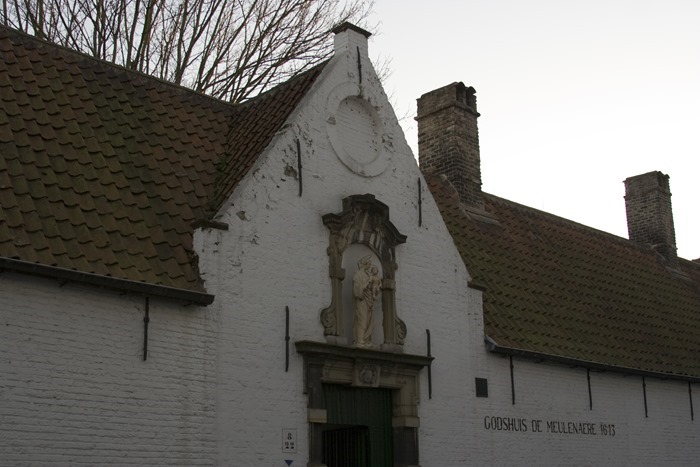
Godshuis Brugge

Brugge is recognized as one of the most well preserved cities in Europe thanks to a few interesting events:

In the 15th century Brugge experienced its heyday as an international center of finance and wealthy trading port. However, when the port silted up at the end of the century Brugge’s fortune began to change with commerce migrating to Antwerp – the golden city of the 16th century. For the next four centuries, the town lay dormant and when the 18th century industrial revolution happened it skipped Brugge. There simply was no money, entrepreneurial spirit or machinery to demolish the old buildings and erect new factories. Nothing revolutionary happened so it all stayed the same – in hindsight, paving the way for today’s prosperity as a historic jewel and tourism favourite.

During WW I a defensive line was built down the Zeebrugge-Bruges-Gent-Terneuzen canal to block off allied troop advances. But the German officer sensed the futility of a bloody ‘Battle for Bruges’ so he called in the mayor and told him in confidence that if the Allies broke through, the Germans would retreat out the back bridges to spare Bruges and prevent being surrounded. This happened and the German’s retreated without harming the city.

During WW II a battery of heavy cannons 18KM from Bruges were ordered to level the town as the allies advanced. Commander Hopman refused to carry out the order as ‘it is the most beautiful city for miles around’ with little military significance. One of the commanding officers agreed and Bruges was spared.

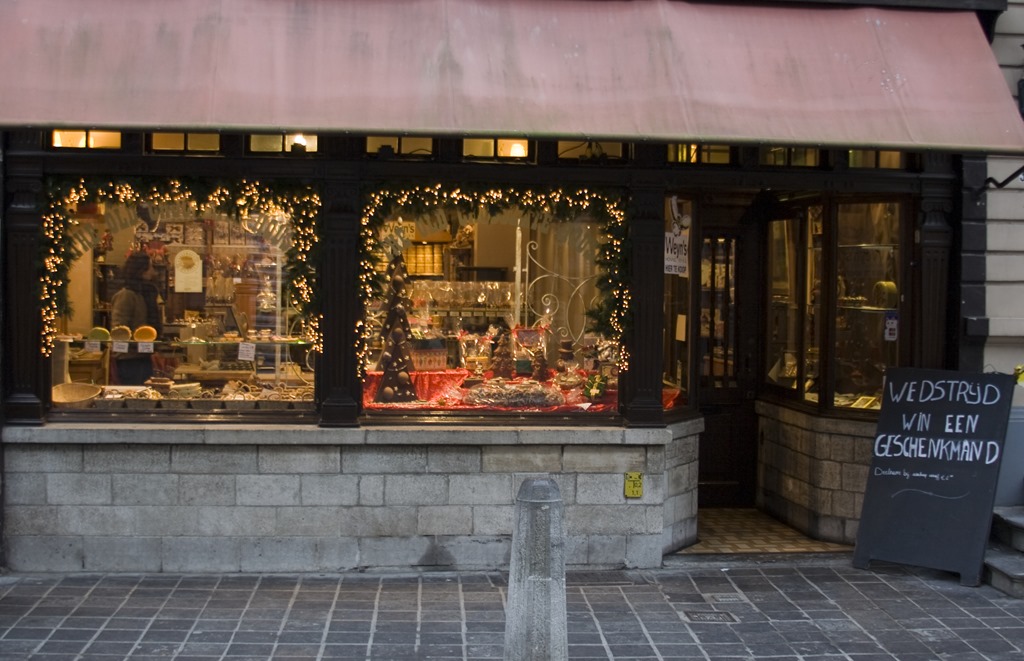
And in the city, chocolate is a centerpiece. The number of chocolate shops that we visited: 15. Below is the first … of many. Although, there is something to be said for ‘Don’t settle for the first’. It was not the best. Good thing that we only bought a little bit at each one. The best chocolate was from Galler although they were very snobby. When my wife said ‘A girlfriend said you have the best chocolate in Belgium’ the guy behind the counter looked up with a bit of a sneer and simply said ‘Yes’ and then turned his back.
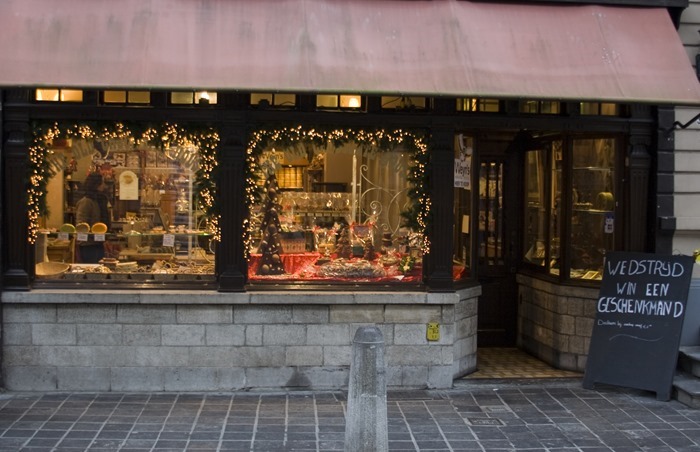
Our 1st Chocolate Shop - A mistake

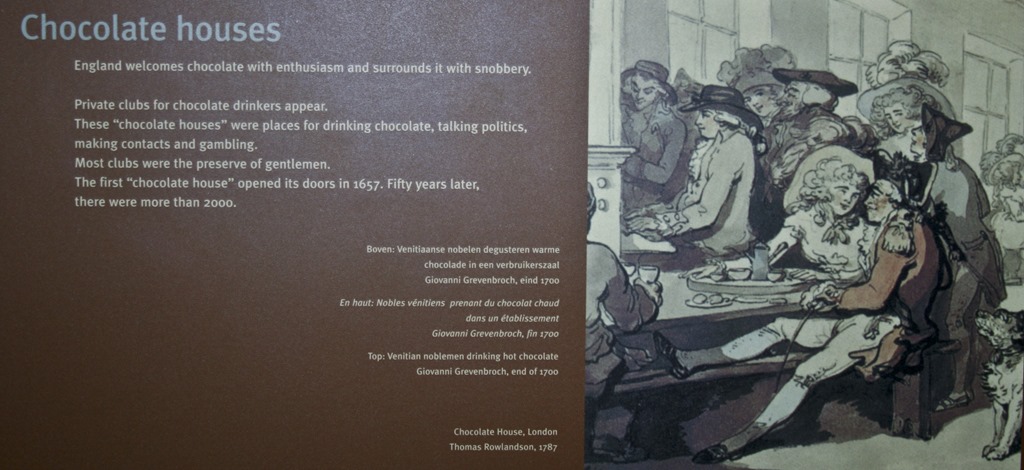
You can blame the Brits for making chocolate snobby according to the below plaque in the Chocolate Museum.

England welcomes chocolate with enthusiasm and surrounds it with snobbery. Private clubs for chocolate drinkers appear. These ‘chocolate houses’ were places for drinking chocolate, talking politics, making contacts and gambling. Most clubs were the preserve of men. The first chocolate house opened the doors in 1657. Fifty years later there were more than 2000.
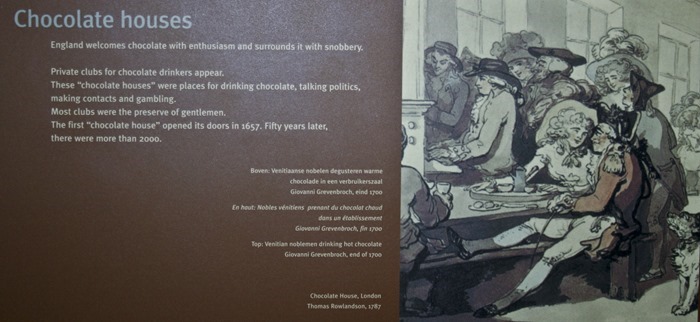
The brits make chocolate snoby

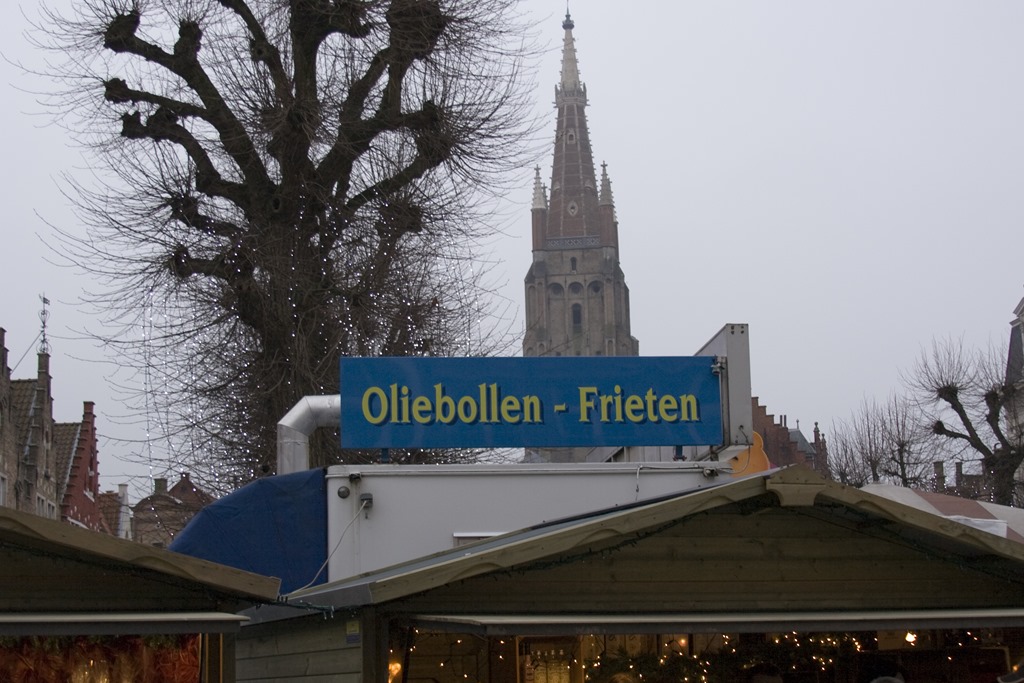
I stopped dead when I saw the below sign and then bee lined for the vendor. What is Oliebollen? Think of it as a Dutch donut. Deep fried dough sprinkled with icing sugar. Personally, it brings back many happy memories of my youth where our greater family would gather together and enjoy Oliebollen while playing in the basement of the church. .. courtesy of my Beppe (grandmother). There were delicious. Why the basement of a church? No house would hold us all. I think I have over 100 first and second cousins.
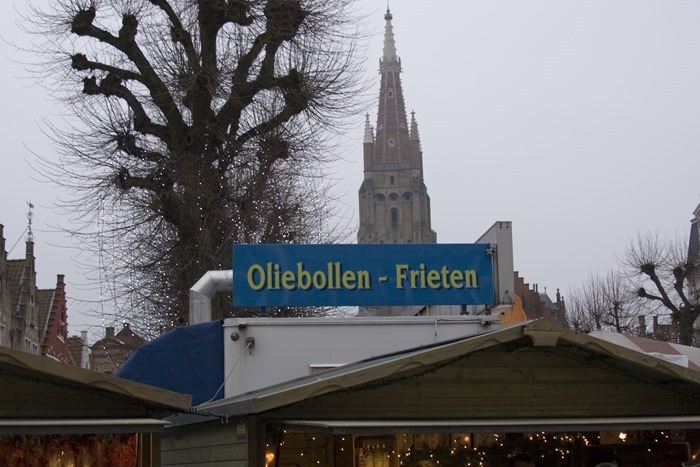
Oliebollen

At the brewery tour the guide also mentioned how the view from the top of the brewery is beautiful thanks to local governments guidelines around keeping building levels at 4 floors and not allowing odd protrusions (like Satellite dishes on roofs). Of course, they then built a concert hall that towers over the city and is a huge, red brick monstrosity. View it here. Ugly.

I found myself walking down the street marvelling at the architecture. It is a beautiful city.

2007 Dec 28 Markt Square 1

The market square.

2007 Dec 27 Brugge Markt at Night 16

City hall.

2007 Dec 29  25-2

Read part 1 here.

HAVING FUN WITH AN APPLE: 2 HOURS OF FUN


The time it took me to get a printer working on a Apple over Christmas.

The problem? The Apple required me to install multiple files to function and the driver did not sense that one of the ink wells was depleted. Reinstall. What is this file? Well install it too. Still not working? Where is the frigging print center on this thing? So many big logos .. so little functionality. Why do things keep popping up and down and bouncing? Making me nauseous and unleashes a strange desire to return to kindergarten.

I plugged it into my handy dandy Lenovo laptop – downloaded 1 file and realized what was wrong in a grand total of … (insert drum role) … no more than 5 minutes.

It goes both ways oh ye Apple bigots. Oh yah .. and this is a gamer family. We have 4 kick butt PCs with big processors and video cards sporting a minimum of 512MB RAM. Although I will admit I used to LOVE Swashbuckler on the Apple IIe. Left key, left key, SPACE BAR, left key, left key, SPACE BAR …

The swashbuckler in combat.   The title screen from Swashbuckler.

BRUGES, BELGUIM PART 1


After our trip through the Eurotunnel to Calais we hit the road traveling 117KM to Bruges (Also spelled Brugge), a beautiful city in Belgium.

Bruges (Dutch: Brugge, stemming from Bryggja, which assumedly used to signify ‘landing stage’ or ‘port’) is the capital and largest city of the province of West Flanders in the Flemish Region of Belgium. It is located in the northwest of the country.

The historic city centre is a prominent World Heritage Site of UNESCO. It is egg-shaped and about 430 ha in size. The area of the whole city amounts to more than 13,840 ha, including 193.7 ha off the coast, at Zeebrugge ("sea-Bruges" in literal translation). The city’s total population is more than 117,000, of which around 20,000 live in the historic centre.

Bruges has, because of its port, a significant economic importance and is also home to the College of Europe.

We spent three evenings in Bruges, which was one evening too long for our boys as the city is marvelous but I would suggest a bit mature for our young boys. If we were there as a couple, the 3 days would have been marvelous as there were many sites that we did not see as the boys can only take so many consecutive art museum visits on a trip.

When I asked a waiter ‘What language do you speak? French?’ he explained that there are really 3 languages in Belgium. French, German and the most predominant – Dutch. That would be a wonderful thing for children, as one could argue that another language – English – is also predominant (everyone spoke English). To grow up with 4 languages is a long term benefit, although I am sure it is painful for them at times. 

We stayed at a small hotel in the heart of the city on the ‘Den Dijver’, the Hotel De Tuilerieen. The service was impeccable and while the pricing is a bit off the planet, being in the heart of the city made all the difference. A simple walk to every site that we wanted to see. I would agree with trip advisor, a wonderful Christmas destination.

Our boys particularly enjoyed the breakfast which included a large chocolate fountain and home made Belgian chocolate spread. Everything in Belgium is about either the chocolate or the beer.

A few pictures: The Christmas lights of the hotel.

2007 Dec 29 Our hotel Brugge 26

The canal in front of the hotel and the view of the Belfry tower.

2007 Dec 29 The river to the Belfry Tower 23

The view of the Belfry tower from our hotel room. We were on the 3rd floor, a magnificent view of the roof tops.

2007 Dec 28 Belfy Tower from Hotel Room in Morning 31

Another view of the canal facing Church of Our Lady. The hotel is on the left.

2007 Dec 27 Dijver street river 28

I would highly recommend Brugge as a destination if traveling Europe, it is definitely worth a few days.


Technorati Tags: ,

SOCIAL NETWORKING


Sick of reading about it? Or hearing how it is going change the way that people live and work, change the world? I am.

The Economist had a great article in their ‘The World in 2008’ issue called ‘The rediscovery of discretion’. The tag line is ‘Older people, too, will extend their social networks online without feeling awkward’. From the article:

In 2007 things got more complicated for the Xs. Thanks to Facebook, many middle-aged office types were expected to join in. But there was no rule-book for how to reject the “friend” request of a boss, or whether doing so was permissible at all. If not, should he be allowed to see the naked baby photos? While some Ys became more cautious after their excesses in 2006, many Xs began squirming in new forms of awkwardness in 2007.


This will change in 2008, as social-networking technology changes to fit human nature, rather than forcing human nature to fit the technology. The industry leaders in 2007 were really old-fashioned “walled gardens”. They came in generic templates, with the crucial sociological aspects—what sort of information to give on a profile, for instance—pre-determined by programmers. Yes, they allowed users to customize their start pages, but so did the walled gardens of the early 1990s, online services such as AOL or CompuServe.

They point to a service called Ning which is co-founded by Marc Andreessen (Who built Netscape, which AOL will finally decommission February 1st) which morphs social networking from a static web page to ad-hoc networking. Looks interesting (but again, will it hit critical mass?).

A newsletter from the Fox Group states:

Technology that will make a difference

Development of social networking technology – Next generation Internet applications such as Facebook and YouTube are, and will continue, to change the way people work, play and communicate together. 

What we find interesting is the fact, that like many other new technologies such as chat and blog services, these applications started at the consumer level, and are now moving rapidly into the enterprise. 

The user communities pressure to move these applications into the enterprise is driving IT, network and security professionals to adapt at an ever increasing pace. They continue to struggle with how to support these type of cross-over applications, combined with pressure to maintain or reducing corporate network and IT operations budgets.

New technologies such as these with their ease of use and ability to instantly communicate with millions of people in real time on a global level will have a long-term impact on our financial, political and social environment  beyond what we can imagine.  

Here are a few of my thoughts:

1. The biggest problem with social networks are that they are a walled garden. I have been invited to no less than 5 different ‘social networks’. The most common are Linkedin (Corporate market focus) and Facebook (broader). If I were to join each – I would have to maintain and use each – discreetly. So which do I choose? I don’t have enough time and as the Economist article points out – how I discern between family, friends and business if people start sending me invites?

  • Personal observation: Social networking will have an impact on business, but not in the way that the Fox Group thinks (i.e. I don’t think it will happen ‘rapidly’). I think that social networking technology will impact the enterprise by forcing companies to improve their collaboration technology focus. A few focus areas: Tighter links between the directory and HR data (Please, if a corporation cannot deliver an automated org chart out of Active Directory, how will they be able to move to the next stage?), implementation of applications like SharePoint where employees are allowed to host their own page (with their shared documents, data) and richer collaboration though the unification of communications (Where Active Directory/Exchange contact information, mobile phone, internal voice and data network, instant messaging and presence are combined to allow people to communicate with others whenever, wherever).

2. How connected do I really need to be? I have Outlook for contact management, I have Live Messenger for chatting and I blog with clear knowledge that anyone could be reading the blog. As you will note, there are no pictures of my family on the blog – a personal choice. But I have lots of friends keeping in touch through the blog and have had more than a few reach out and contact me after many years.

3. I share pictures with family through a Live Spaces account that is tightly controlled. I transfer boat loads of pictures and videos to family and friends via the amazing folder sharing feature in messenger. Simply take the folder, drop into the shared folder and VOILA they can be copied to that person’s local machine. Handy.

4. I am sick of reading about how it will revolutionize everything – it will not.

In a nutshell, I am not joining in. The technology is seeing commercial application by encouraging business software providers to implement features which make corporate collaboration easier. But, enterprises have been doing that for a while and one could argue that this isn’t that new of an idea (Think of monster.com – that is, in the simplest of terms, a social networking site linking employers and potential employees).

In the end, just like Instant Messenger became Office Communicator, the enterprise will adopt the things that make sense.

But on the consumer end I wonder, will it last? The consumer is a fickle beast. Instant Messenger remains but blogging has now become hardcore only (Like social networking, it was a ‘big’ thing a few years ago but many have abandoned for social networking). YouTube remains strong but has many, many competitors. And as for social networking we are now starting to see people write about the death of Facebook. Facebook, Ning, mySpace, Xiaonei, Geezeo, Wesabe,Yodlee and on and on …. Personally, I don’t have enough time to be interested.

Maybe it will be like corporate blogging, the consumer trend that would revolutionize corporate communication in 2005-2006. Where did that go?


Technorati Tags:

EUROTUNNEL

As part of the holiday break we made our first trip to Europe via the Eurotunnel. I labeled it a ‘scouting trip’ as one of the goals is to explore the ins and outs of traveling via car to Europe. The Eurotunnel is a pretty amazing thing:

The Channel Tunnel (French: le tunnel sous la Manche), also known as Chunnel or Eurotunnel (after the company that operates it), is a 50.450 km (31.35 mi) long rail tunnel beneath the English Channel at the Strait of Dover, connecting Folkestone, Kent in England (51°5′49.5″N 1°9′21″E / 51.097083, 1.15583 (Folkestone end of tunnel)) to Coquelles near Calais in northern France (50°55′22″N 1°46′50.16″E / 50.92278, 1.7806 (Coquelles end of tunnel)).

It was a megaproject with several false starts, but it was finally completed in 1994. It is the second-longest rail tunnel in the world, with the Seikan Tunnel in Japan being longer, but the undersea section of the Channel Tunnel, at 37.9 km (23.55 mi), is the longest undersea tunnel in the world. The American Society of Civil Engineers has declared the tunnel to be one of the Seven Wonders of the Modern World.

You can review the history of the tunnel here. Quite the engineering masterpiece. Personally, it means that a trip to Belgium from the London area is roughly 4 to 5 hours (and 3/4ths of a tank of gas – return!).

  • 2 to 2.5 hours to travel to and board the train.
  • 35 minutes with exiting from Dover to Calais on the train.
  • 1 hour to Brugge (a little farther to Brussels)

The experience was surprisingly painless. You drive to the gate, go through a quick passport check then move to a waiting area. You have the option of heading into the mini-mall to shop duty free or wait in the car until your letter is called.

Our letter (M) came up and we drove into a queue for the train. A few minutes later the line started moving and you approach the Eurotunnel Shuttle that has to be a mile long! You drive through a door and onto the train. The back half of the train are 2 levels for cars, the front half is single level for larger vehicles. Engage the parking break and 35 minutes later you are in Calais. Significantly less painful than the airport.

The view of the train from le tunnel sous la Manche:

IMG_7200

The view from inside the shuttle. Quite pleasant.

IMG_6828

I spent a good part of it standing. One needs to stand when digesting the Economist.

IMG_7203 

We will definitely do it again. Europe just got a little closer.

Late addition, additional ways to get to Europe from the UK:

  • St. Pancras International, the new £1B train station that holds the Eurostar.
  • Stena Line – one of many ferries to Europe – this one specializing in Holland. Only a 7 hour ferry ride away.
Technorati Tags: ,

COTSWOLD: THE EARL


While blogging on the Cotswold I marveled at how interesting it would be to be able to look back on your history and see the accomplishments of one’s forefathers. My comments:

From what I can ascertain, these were built by the Earl of Gainsborough, Sir Baptist Hicks as he bestowed his wealth on the church. Interestingly enough, if you read the above entry you will see that the title is still held by a 57 year old man (Earl .. sorry). Imagine … being able to trace your history back that far and see what your family left behind.

My blog caught someone’s eye and the following comment / clarification was provided:

Dear Michael
I am glad that you enjoyed your visit to Chipping Campden, in the Cotswolds.
I enjoyed reading your blog entry about it. However, I would like to point out that the current Earl of Gainsborough is not a 57 year old man; he is my father, an 84 year old man. It is my eldest brother, Anthony, Viscount Campden, who is his 57 year old heir. Anthony also has a son, Harry, who has a one year old son, called Edward, so the succession still has some way to go, God willing.
My father has continued Baptist Hicks’s philanthropic tradition, and has been involved with charity work, including the management of the Chipping Campden Almshouses, throughout his life.

Edward Noel

December 12 2:10 PM
(http://cid-cd7b799e7f62b8c1.spaces.live.com/)

I will openly admit that I still find the UK traditions of Earls and nobility odd, as I come from a country where status is based purely on merit, not lineage. That being said, your father’s philanthropic lineage is a noble one and as your history notes your forefather earned his place in history as a wool merchant. Being able to look back into one’s history is a unique gift, I have enjoyed looking in on it.

Best of the season.

BOXING DAY


After a festive Christmas of building Lego (A castle was on tap this year), playing a few video games and listening to a lot of Christmas music – boxing day arrives. What is it like in the UK? I am not sure, but as with all things in Britain, it does not seem as consumer centric?

My mail slot is not littered with flyers of sales, there are not billboards everywhere and the local electronic shops are not calling me in like Future Shop is in Canada (I have already looked through their site). Check out one of the largest retailers in the UK here – note, no Boxing day signs? And the sales? £5 off here and there. Hardly a sale – where are the gate crashers?

In the end, it does not matter, as I really don’t need anything but it is odd. I do not feel assailed by the marketing engines of the local retailers and it seems odd. Maybe it is part of the culture, as there is definitely a ‘come to me, not the other way around’ mentality here (especially with customer service).

Odd. Especially since Boxing Day probably started here:

There are disparate theories as to the origins of the term. The more common stories include:

  • In feudal times, Christmas was a reason for a gathering of extended families. All the serfs would gather their families in the manor of their lord, which made it easier for the lord of the estate to hand out annual stipends to the serfs. After all the Christmas parties on December 26th, the lord of the estate would give practical goods such as cloth, grains, and tools to the serfs who lived on his land. Each family would get a box full of such goods the day after Christmas. Under this explanation, there was nothing voluntary about this transaction; the lord of the manor was obliged to supply these goods. Because of the boxes being given out, the day was called Boxing Day.
  • In Britain many years ago, it was common practice for the servants to carry boxes to their employers when they arrived for their day’s work on the day after Christmas. Their employers would then put coins in the boxes as special end-of-year gifts. This can be compared with the modern day concept of Christmas bonuses. The servants carried boxes for the coins, hence the name Boxing Day.
  • In churches, it was traditional to open the church’s donation box on Christmas Day, and the money in the donation box was to be distributed to the poorer or lower class citizens on the next day. In this case, the "box" in "Boxing Day" comes from that one gigantic lockbox in which the donations were left. The origins of Boxing Day can be traced back to regular punch-ups caused by excessive intake of alcohol by the aristocracy. It became popular and a pastime for families with unsettled issues of wealth and status.
  • Boxing Day was the day when the wren, the king of birds,[3] was captured and put in a box and introduced to each household in the village when he would be asked for a successful year and a good harvest. See Frazer’s Golden Bough.

    Because the staff had to work on such an important day as Christmas Day by serving the master of the house and their family, they were given the following day off. Since being kept away from their own families to work on a traditional religious holiday and not being able to celebrate Christmas Dinner, the customary benefit was to ‘box’ up the left over food from Christmas Day and send it away with the servants and their families. Hence the ‘boxing’ of food became ‘boxing day’.


Thank-you British retailers, I will keep my money. Well other than a small video card upgrade (smile).

A FEW CHRISTMAS THOUGHTS


First: I am surprised that in the UK they actually still call it Christmas – proudly. In North America it has slowly but surely been whittled down to a generic holiday where everyone says ‘Happy Holiday’ and are almost ashamed to say ‘Merry Christmas’. I say respect the religious views of others and express Happy Holidays, Merry Chanukah and happy Kwanzaa, and let us all say our respective greeting without judgement.

Second: I love this quote from Andy Rooney:

“one of the most glories messes in the world is the mess created in the living room on Christmas day, don’t clean it up too quickly”

Third: I have blogged on my favorite Christmas albums before – click here to see the list. But Barenaked for the Holidays remains my No.1 album followed closely by Bruce Cockburn – nice to see Bruce signing wonderful Christmas songs and not about rocket launchers. If you hang around the house, you will also hear the boys and I singing 12 days of Christmas the Bob and Doug Mackenzie way .. that is just the way we roll. 

Fourth: What do I want for Christmas? Not much really (Heck, we have no room!). I know what the boys want … Mario Galaxy being top on the list, Star Wars Lego a close second. For me, time to learn a new language. I am exploring Rosetta Stone. A friend told me that in his language research that the common thought that adults are not wired for learning a new language like children is actually wrong. The truth is that children learn faster because they are not afraid of making mistakes, adults are. Over come that phobia and you can learn just as fast. For me, French .. then Spanish.

Last: We will be heading to Belgium for a few days between Christmas and New Year and are booked to see the Terra Cotta army. More on that in January. Egypt is booked for spring break. The adventure continues.

Holiday time, here we come! To all, a Merry Christmas, Happy Holiday, Happy Kwanzaa and great NEW YEAR.

THE TRIP TO DOVER


About a month ago we took a trip to the White Cliffs of Dover. It is an amazing place with so much to see. Our first stop was Dover Castle, which is perched overlooking the town:

Dover Castle is situated at Dover, Kent and has been described as the "Key to England" due to its defensive significance throughout history.

As with all things in the UK, the history goes back thousands of years starting with the Normans and progressing through to the cold war and the secret war time tunnels that are now open to the public.

A few notable facts:

  • During WWII Dover Castle was key to the evacuation of allied troops at Dunkirk. There is a monument to Vice Admiral Bertram Ramsey who lead the retreat and is credited for saving 400,000 troops to fight another day.
  • Later the tunnels were to be used as a shelter for the Regional Seats of Government in the event of a nuclear attack. This plan was abandoned for various reasons, including the realisation that the chalk of the cliffs would not provide significant protection from radiation, and because of the inconvenient form of the tunnels and their generally poor condition.
  • The tour took us through the older parts of the tunnels that held 2000 troops during the Napoleonic wars. One thing was certain, it must have been cold, smelly and miserable in there.

A few pictures:

2007 Oct 27 Front of Dover Castle build in late 1800s

Note the mix of WWII era bricks, Napoleonic era tunnels and in the background pre-Napoleonic. Fascinating. 

2007 October 27 Dover Castle_34

2007 October 27 Dover Castle_14

It was a bit chilly and grey on the coast that day.

2007 October 27 Dover Castle_08

2007 October 27 Dover Castle_21

The view from atop the central fortress. Quite a view. A little grey out .. but beautiful.

2007 October 27 Dover Castle_28 

Amazing.

GREAT LEADERSHIP


I recently had a very good conversation on leadership and a question was raised: Am I the type of leader who builds people and processes so that if I am not there it will continue to function and be successful?

Tricky question. I blogged on the topic a few years back here (‘Leadership thoughts’) and pulled out this quote:

"The best leader is the one that can be replaced. When that leader disappears for a time, the team continues on successfully. That leader created a team of leaders, who’s long term goals and team dynamics supersede any leader".  (Me: Reflecting on the fact that the truly strong leader should not look at this fact as ‘I can be replaced easily’, but as ‘I built an amazing team’.

It is a great point to ponder and something to checkmark myself on to ensure I am doing it. I love the introspection of the holidays (smile).

PETER KAY: Make them laugh


Peter Kay is a very popular comedian over here. I have yet to see or hear him perform (put that on the to-do list). But a few of his classic one liners were forwarded to me, the best of them:


  • I saw a fat woman wearing a sweatshirt with ‘Guess’ on it. I said ‘Thyroid problem?’
  • When I was a kid I used to pray every night for a new bike. Then I realised that The Lord doesn’t work that way, so I stole one and asked him to forgive me.
  • I was doing some decorating, so I got out my step-ladder. I don’t get on with my real ladder.
  • I went to a restaurant that serves ‘breakfast at any time’. So I ordered French Toast during the Renaissance.
  • I saw six men kicking and punching the mother-in-law. My neighbor said ‘Are you going to help?’ I said ‘No, six should be enough.’
  • I think animal testing is a terrible idea; they get all nervous and give the wrong answers.
  • You know that look women get when they want s*x? No, me neither

PETER KAY’S UNIVERSAL TRUTHS


  • Triangular sandwiches taste better than square ones.
  • At the end of every party there is always a girl crying.
  • Sharpening a pencil with a knife makes you feel really manly.
  • You’re never quite sure whether it’s against the law or not to have a fire in your back garden.
  • You never know where to look when eating a banana.
  • You always feel a bit scared when stroking horses.
  • The smaller the monkey the more it looks like it would kill you at the first given opportunity.
  • Every bloke has at some stage while taking a pee, flushed half way through and then raced against the flush.

SOME GREAT QUESTIONS BROUGHT TO YOU BY PETER KAY


  • If a person owns a piece of land do they own it all the way down to the core of the earth?
  • Why is it called Alcoholics Anonymous when the first thing you do is stand up and say, ‘My name is Peter and I am an alcoholic’?
  • Why are they called stairs inside but steps outside?
  • Why does mineral water that ‘has trickled through mountains for centuries’ have a ‘use by’ date?
  • Who was the first person to look at a cow and say, ‘I think I’ll squeeze these dangly things here and drink whatever comes out’?
  • What do people in China call their good quality plates?
  • If quizzes are quizzical, what are tests?
  • Why is it that when someone tells you that there are over a billion stars in the universe, you believe them, but if they tell you there is wet paint somewhere, you have to touch it to make sure.

PANTOMIME

We had a uniquely UK experience over the weekend where we went to our first pantomime:

Pantomime (informally, panto), not to be confused with mime, refers to a theatrical genre, traditionally found in Great Britain, Canada, Australia, South Africa, New Zealand, Zimbabwe and Ireland, which is usually performed around the Christmas and New Year holiday season.

more …

Traditionally performed at Christmas, with family audiences consisting mainly of children and parents, British pantomime is now a popular form of theatre, incorporating song, dance, buffoonery, slapstick, in-jokes, audience participation and mild sexual innuendo.

Our first pantomime was Peter Pan in Woking staring the one and only Henry Winkler – the Fonz himself. The first half was rather traditional with very little audience interaction (Other than booing of Captain Hook). But the second half as a different story, they deviated from the plot in several places and launched into full scale audience interaction including the 12 days of Christmas which ended with the actors grabbing water guns and spraying the crowd. One poor bloke was wearing tan trousers and the ganged up on him, determined to make it look like he wet himself (LOL).

Great fun for the kids.

As an aside: The night before I went on the internet to download a copy of the Peter Pan story to read to the boys (All of our copies are in storage in Canada) and I came across this web site. Wow. A few key facts from this real life Peter Pan: 

  • He is in his 50’s
  • Refuses to give up
  • Has had multiple TV appearances including Conan.
  • His site meter is over 10 million!
  • Take time to review the fashion page. My favorite is Blue Boy.
  • He also runs a ministry.
  • He is married. See the wedding photos here.

The world has many different type of people.