“Ancora Imparo”


This morning my family gave me a wonderful plaque that Narda picked up on a trip to Oxford. It is inscribed with:

‘I am still learning’  michelangelo

The back has the following inscription:

Even in his 87th year, the great Italian renaissance artist Michelangelo, creator of such masterpieces as the Sistine Chapel and the sculpture of David, is quoted as saying ‘Ancora Imparo’ (I am still learning). Given the scope of his achievement, this humility is striking and strongly reminiscent of the Greek philosopher Socrates – "The wise man knows that he knows nothing"


I am still learning.

GET SMART


The latest issue of Wired features Maxwell Smart on the cover and 12 ways to super charge your brain. Two of the 12 caught my eye:

  • On Caffeine: They advocate caffeine but suggest that those monster extra large coffees are bad for your mental alertness. Instead, ‘keep those receptors covered with frequent small doses – like a mug of low-caf tea or half a cup of joe – rather than a onetime blast. Test subjects reported that periodic small shots made them feel clearheaded and calm, both of which enhance mental performance.’  Hydration works too.
  • Think Positive: I am a big believer that a positive mind leads to a positive outcome and that you always need to be learning. Wired:

‘Learning new things actually strengthens your brain – especially when you believe you can learn new things …. when you think you’re getting smarter, you study harder, making more nerve cell connections which in turn makes you – smarter’

‘According to studies studies carried out by Stanford University .. volunteers with a so-called growth mindset about learning (‘persist in the face of setbacks’) have more bran plasticity. In other words, their noggins are more adaptable’

‘Many people  believe they have a fixed level of intelligence, and that’s that’ Dweck says ‘The cure is to change your mindset’

The last line sums it up. ‘Certain that we’re wrong? Enjoy stupidity!’ You can read all 12 here. The SuperMemo article is also fascinating, although it looks like too much work.

As an aside, I will absolutely see this movie. If nothing else, for nostalgia reasons. I watched Get Smart as a kid and loved it.

A LONG SUMMER


The last week in the UK has been brilliant. Sunny. Ranging from 25 to 28 degrees (C). Spectacular. Last night we were playing baseball out on the green until 830 pm in the sun. Amazing.

This morning I made a comment on the beautiful British weather and had the following 2 responses:

  • ‘Don’t get use to it’
  • ‘This is what we call a long British summer’

While last year was very wet (flash flood wet), the year before was a drought in southern England. Random note, the local water supply is hurt by an infrastructure that was state of the art in the 1920s:

‘Last year the company leaked 196million gallons every day – 19 million each day above the required target.

The amount is equivalent of every home in the Thames Water area of London and the Thames Valley losing 55 gallons of water per day. ‘

So what will the year be like? I am curious to experience a London summer. I have a hunch that the UK exaggerate the weather and that it will be quite enjoyable. Which brings me to a fact that I will be putting in front of my colleagues:

Yep, London is drier than Toronto! And of course, beautiful days lead to beautiful nights ….

2008 May 03 1 

and beautiful local plants. This brilliant orange tree caught my attention as I drove down the street. I have never seen such a brilliant colour in Canada.

2008 May 10 131 

2008 May 10 130

XOBNI


There has been a lot of press and Internet activity on XOBNI over the last few weeks. After the 10th person mentioned how cool it is I finally installed it. I have to admit at first, I was taken back by the interpretation of the information in the Outlook info pane after it installed and indexed my machine.

I viewed myself. Seems that I send emails to myself at very odd hours (I will send myself actions or notes to be recorded in GTD). Someone also commented that I send emails at some very early hours. To me, it just looks like I have a lot of mail flowing in and out all the time ….

image

I like the always on access to profile information around the individual who sent you the mail (their phone number, quick click to an appointment, wicked search and the other random tidbits. The conversation thread is interesting as it show historical data (but threading was added in Outlook a while ago). Interesting little gadget.

As an aside, looks like they don’t want to be bought .. yet.

NO CANADA THIS YEAR


As an expat there are a few questions that everyone asks you:

  • How long is your contract?
  • What is next?
  • When are you planning on moving back?
  • When are you going home next?

This is an odd one for me this year, I want to get back to Canada this summer to hang out with friends and family, and will deeply miss being up north with Narda’s parents and my brother/sister-in-law and their kids, but it isn’t going to happen.

As an expat, it is generally the working one who gets the short end of the stick on this one. You see, the family can travel back for an extended period and enjoy the summer, but the working one has a limited amount of vacation. So you must decide, do I take that time off and head back home or do I save that vacation to travel in Europe?

This year I will be away from my family for 3 times longer than I have ever been away from them – 3 weeks. The only upshot is that it is one of the busiest work times for me, with a week of business travel, so I will get a lot done. I also have all this old video I want to digitise and sort ….but it will be a weirdly quiet house.

And when I am in Canada and happen to land in an airport where a friend is, I will do my best to get my calendar straight so that we can have lunch …..I

JUMP THE SHARK


I was reading an interesting article on TV shows that have ‘lost it’. In North American terms this is called Jumping the Shark:

The term jumping the shark alludes to a specific scene in a 1977 episode of the TV series Happy Days when the popular character Arthur "Fonzie" Fonzarelli literally jumps over a shark while water skiing. The scene was so preposterous that many believed it to be an ill-conceived attempt at reviving the declining ratings of the flagging show. The phrase has become a colloquialism used by U.S. TV critics and fans to denote the point at which the characters or plot of a TV series veer into a ridiculous, out-of-the-ordinary storyline. Such a show is typically deemed to have passed its peak. Once a show has "jumped the shark" fans sense a noticeable decline in quality or feel the show has undergone too many changes to retain its original appeal.

There are a lot of people out there who love to tell me about how they are above TV or ‘just don’t watch TV’ as they would rather listen to Chopin and read 18th century literature. I have said it before, I will say it again, I like TV. So for the heck of it, here is my list of current TV favourites categorized by shark status:

Definitely have not jumped the shark ….

  • Supernatural: I came across this series in a hotel a year ago (It was the beginning of Season 2) and was hooked instantly. Well written, great plot and I love sci-fi type stuff. Highly recommended viewing.
  • Battlestar Galactica: Another epic show with a great plot that keeps getting better. This is the last season, so like other smart series, they are ending it while they are ahead. A friend send me a link, looks like they are already filming the prequel – Caprica..
  • 30 Rock: Alex Baldwin, enough said. Love his GE Jack Welshisms.
  • Entourage: Brilliant. HBO continues to make some of the best programming around and anything that is loosely based on Marky Mark is fine by me.
  • Flight of the Conchords: Truly one of the weirdest shows you will watch. Two New Zealand guys trying to make it big in New York. That is what makes it so funny. This months Wired describes them as ‘New Zealand’s second most popular guitar based, digi-bongo, a cappella, rap-funk-comedy folk duo’. They also won this years Grammy for best comedy album.
  • How I Met Your Mother: I am surprised. I thought it would not last, but it has. Really – who does he marry and could Doogie Houser be any funnier?
  • The Office: I am a huge British office fan. I was sceptical about this show. As each season progresses, I hate to say it, I become convinced that it is better than the British version.
  • Life: I am a huge Band of Brothers fan and so was destined to watch this show. Gritty, unique plot, humorous, well written. It was just renewed for a second season. Fantastic. If you can, catch the rerun.

The shark is circling:

  • Dexter: Truly one of the best written TV series I have ever seen. Dark, brooding, cutting humour and a plot that has the twists and turns of a mountain road, a great series. However, the end to Season 2 bordered on too much. We will see if it can survive a 3rd season. I cannot recommend the first 2 seasons highly enough.
  • Boston Legal: How many more quirky characters with weird habits or afflictions can they bring on the show? Well written, Shatner and Spader are fantastic characters. We will see.
  • Carpoolers: A quirky sitcom written by Bruce McCullough from The Kids in the Hall (The best sketch comedy show of all time .. Daves I know and the Eradicator). This scene summarizes the humour. Didn’t think it would work but after a few they had me, just don’t know if it is mainstream enough to survive. TJ Miller is a very funny comedian and the Sliders dude is good too.
  • Chuck: Very funny comedy about a young guy who has a NSA computer downloaded into his head. I know, it sounds silly, but it is quite funny. The problem is that he walks around San Francisco and just ‘happens’ to bump into international terrorists. What, do they all live in San Fran? Sorry, it cannot last.
  • Scrubs: I am on the fence here. Funny show but it comes and goes.

Jumped the shark ….

  • House: Hugh, loved you in the first 2 seasons but it is getting a bit much. Gee, will he figure out the mysterious illness while playing with everyone’s mind? Tune in to find out. Sorry, you lost me with the whole ‘who gets to be my intern’ competition thing.
  • My Name is Earl: It was funny for a while. Now it is just old.
  • Rescue Me: Another truly great show. I am a big Dennis Leary fan – so when this show started I was on it. Dark sarcastic Leary humour, very deep plot (all about firefighters post 911, Leary had a cousin die). Well worth a watch, but expect a roller coaster of emotions. And as an aside, Leary plays a true anti-hero and season 5 (July) is the last. It is time.
  • 24: Oh my goodness Jack, die already. You lost me after the 4th crisis where you implemented your patented TV show framework.
  • X-Files: Look, I loved this show. Great writing and when they were actually solving mysteries, very entertaining. But by the end I was so confused as to who is doing what to whom, I did not know which way was up. Which begs the question – how can they make a second movie? If this movie has any link to the previous story line – who will remember what happened before except for the guy who still lives in his mom’s basement at 40?

Shows that never jumped the shark and I wish would come back …..

  • Firefly: What a great series. Although killing off a main character in the movie makes the likelihood of this come back low. How about if we say please?
  • John from Cincinnati: Too weird to survive, but a very interesting single season show. Bring him back, I want to know who he really is.
  • Seinfeld: Come on? One more season Jerry?
  • Arrested Development: Seriously, I would watch another season. Who doesn’t want to watch the plight of a family caught building houses in Iraq? Will Arnett is just as funny in 30 Rock.

And a few that I have on my ‘too be watched’ queue, and remain un-judged:

  • Lost (Much debate on whether this has jumped the shark. I have not watched it yet, but plan to this year), Nip/Tuck (On my to be watched), Gavin and Stacy (very popular Brit show), Its Always Sunny in Philadelphia (great reviews), Journeyman (Time travelling father? Another with good reviews), Monk, The Shield, Journeyman, Mad Men (watched a few – great show about 50’s ad guys – just watching them smoke and drink in the office makes me laugh), Painkiller Jane, Men in Trees (huge Northern Exposure fan .. is it like that?), Primevil (Brit show about dinosaurs .. one to watch with the boys), Pushing Daisys, Sarah Connor Chronicles (Terminator, of course we have to watch it), The Riches, Doctor Who (how can I be in the UK and not try it out?), Blade (loved the movies) and The 4400 (which was highly recommended to me).

As an aside, here are a few old UK shows that I have come across and recommend:

  • Green Wing: Great UK comedy about a crazy hospital. Good laugh.
  • Life on Mars: The story of a cop who gets hit by a car and wakes up in 1970. Like Mad Men, going back in time and watching their socially unacceptable environment is quite entertaining. They closed this after 2 seasons – perfect.
  • The IT Crowd: A story of 2 hapless IT support guys working out of the basement. A good geek laugh. Enjoy this support clip.

So ends my TV assessment.

A DOUBLE RAINBOW


The UK has been marvelous this week, perfect time to have mom over. She gets to enjoy the UK’s glorious sun – 22 and sunny all week.

Two weeks ago I caught this sight out of the back window, a double rainbow. I don’t think I have ever seen a double rainbow before. Only in the UK I guess. A beautiful night after the rain cleared.

2008 April 28 5 Nardas Bday

It was very cool seeing it up so close. The intensity of the rainbow was amazing. I think I see the pot of gold.

2008 April 28 5 Nardas Bday (34)

2008 April 28 5 Nardas Bday (27)

DIDN’T THINK THAT BASEBALL COULD BE FULL CONTACT DID YOU?


For some reason, whenever I play sports with my boys, someone gets hurt. Case in point, we were out on ‘the green’ the other night playing baseball. Not rugby where people pile on each other.. Not American football where you can get your leg snapped. It is baseball.

First injury was a line drive screamer that missed the glove by a fraction and was caught by a forehead. Next injury was a high pop fly which missed the glove by six inches and was caught by an upturned forearm. I almost took a screamer in the head while pitching (I was standing too close as I was trying to lob them in, no more). Turns out baseball is a vicious sport. Not as crazy as when my moron high school buddies would run around the yard shooting each other with their BB guns, but still, dangerous.

Which is why I was really nervous about attending a family flag football (American) camp on Saturday. The boy’s school ran the multi-hour camp to see if there would be interest from families. It was run by Sweet Feet Academy, a new business run by a few ex-pros. The coolest thing about the camp was that parents could join in and play. Only a few did (Narda and I did) and it was a ton of fun and believe it or not, no injuries!

It also brought out another UK cultural observation. In Canada, when I was coaching the boy’s soccer team, if a child missed a kick or something I would say ‘Good try’. At the football academy and at the boy’s tennis lessons, I have noticed that the coaches say ‘That was unlucky’.  What is interesting is that the statement shifts the thought process from ‘I made a good try but failed’ to one which externalises the miss. I have read about this often, how resilient leaders externalise failure, moving it to situational variables, learning and going again. Small comment, big difference – I like it. No more ‘good try’ comments.

On the humorous side, I caught every single ball during the drills but during the game, dropped a few. On the second pass that I dropped I heard smart-ass-sideline-dad yell out ‘HA. That is two fumbles …’ Couldn’t be because I was more conscious of not squashing the five 10 year olds at my feet than catching the ball …. For the record, I caught that one.

2008 May 03 Michael making the catch 1

TO BE THE OLDEST


As the oldest in a clan of four, I found the findings within the article ‘The Plight of the Older Sibling’ a fascinating read:

‘a new study has confirmed what first-borns like Joshua have always suspected: The oldest kid in the family really does bear the brunt of parental strictness, while the younger brothers and sisters generally coast on through.’

‘By the time the second and third kids come around, many parents lighten up, and realize that they probably overreacted a little with setting rules for their first kid, Leman says. “The first-born’s a guinea pig; we practice on ‘em,” he says. “Once the other kids come in, we lighten up. Or exhaustion takes over.”

As the eldest, I would often look at my two younger sisters and notice that they were treated differently. There was so much more flexibility and I would often think ‘Hey, I was never allowed to do that’. What the study does not allude to is where this goes wrong. When the oldest child gets ticked off with the unbalanced nature of the treatment. I know that as I left home, I clearly rebelled against the strict and stifling rules that I was put under. When I came back into that home environment where the younger children were treated differently, I openly resented it.

In our family, we have often discussed being harder on our oldest. I think back to being a new parent and how we were so worried that the littlest bump would damage our new born baby. As parents, where every experience is new and a book can only tell you so much, there is that natural protectiveness. When our second child arrived, we were easier going – in large part because of experience and confidence (we had done it once before, we knew that a bump on the head would not break the child).

A very interesting parental read.

THE END OF UNLIMITED BROADBAND


It is interesting to watch the broadband fair usage debate evolve on the web. The debate on torrent shaping is raging in many geographies, with Bell Canada throttling P2P applications, Virgin UK trialing broadband caps based on usage at different times (when you hit the limit, your link is throttled for the rest of the month) and there has been much talk about the BBC iPlayer in the UK which has been a smash success while raising the ire of broadband providers as it shifts the viewing load from over air or via a TV subscription service to the Internet.

It is the fight that consumer advocates call net neutrality and broadband providers call fair usage. What becomes very interesting in this debate is that more than media is shifting to the web. It is not simply about people downloading copyrighted music or the latest bootleg movie. It is more than that. A few examples:

  • I have been doing a lot of work around figuring out our digital memories. How do I properly capture our adventures on photos and videos. I upgraded Pinnacle Studio to version 11 online which came with a digital download. The size of that download? 2.5GB. The amazing thing is that the download was unbelievably fast. Under the bandwidth with usage limits model, I would be cooked for the month. Of interest, while doing the download I had to reboot my router as I lost all Internet connectivity for some mysterious reason ….
  • Live Messenger has an amazing file sharing function. I often take my picture or video folders and simply drop them into the sharing folder with family. These folders can be as large as 2GB. What happens there?

This debate will get hotter as we watch applications evolve (software and services), new services like the BBC iPlayer launch and Internet penetration increase – after all, only 20% of the worlds population is on the net. One could hypothesize that something as simple as web cam penetration and usage will have a dramatic impact on this debate.

Personally, I always buy the top packages. I am fine with a higher price as my disposable income (and time) has shifted to the Internet over the last decade. I want a high level of service, a guaranteed quality of service and will pay the premium – but for that price I will resist throttling.

This will be an interesting debate. It has just started.

PHOTOTRACKR


I have been reading about GPS enabling your camera. There are multiple ways with the easiest appearing to be GPS synchronization. The device sits on your pack and tracks your movements and the time. When you sync the data with your camera pictures, it will map the location data to the picture via the time stamp, with full support of RAW and various commercial photo applications (Adobe, Flickr).

There seem to be 2 market leaders, Sony and Phototrackr. A comparison of the 2 found here. We will see how well it works with their software, in a worst case scenario this is a generation one, bleeding edge investment on the way to a market that will expand.        


Just a matter of time before the GPS is embedded in the camera.

Update: In what can only be considered an uncanny coincidence, I came across this article describing Microsoft’s newly released free Pro Photo Tools that enable geotagging. Download it here.

Microsoft's Pro Photo Tools lets photographers geotag their photos and show where they are on a map.

From the article:  "That’s because geotagging, done well, enables people to find photos by searching for the word "Paris" rather than sifting through folders with obscure filenames like IMG_5829.jpg or squinting at hundreds of image thumbnails. Until the still-distant day when computers can recognize your Aunt Polly or the Grand Canyon, geotagging holds potential as a way for people to get a handle on ever-growing digital photo collections."

What I am trying to sort is how I would leverage this (Flickr being an obvious first choice and it may be easier, but it does not appear to automatically reference the GPS data). I see someone has figured this out way before me … Adobe Lightroom also has the GPS metadata field included, which is what I have been using for photo editing.

The blog on the Microsoft pro photo site has an interesting article on CSI using Photosynth (another cool app I have to play with when I get some free time) and the 2.0 update of the Expression tools.

A friend put me onto Expressions. I have been using the encoding tool to convert MP4 video into a more generic format so that it is broadly consumable across every device.

IMPRESSIONS OF PRAGUE – THE SECOND TIME AROUND


About a month ago I did a business trip to Prague and had 2 hours to actually leave the hotel and go for a walk. I had my brand spanking new Camera with me so I used it as my ‘pre-Egypt-figure-this-thing-out’ outing.

My impressions:

  • It is a beautiful city – the architecture is spectacular and the cobblestone streets continue to catch my attention. But it lacks the depth of other cities I have been to. For example, a trip to Barcelona is overwhelming – museums, Gaudi, Picasso and on and on. This iron curtain nation is reemerging and lacks the same depth.

2008 03 04 100_

  • It seemed to be overtaken by branding. Debenhams, Marks & Spencer, McDonalds, Nike. You name it, they were there .. everywhere, as evidenced by the below. 2 McDonalds within 150m. The centuries old statues must be distraught. And of course, the Hugo Boss store had a sign up ‘70% off’ but it was closed for the week I was there .. which was .. well .. just my luck.

2008 03 04 75_

  • Something disturbing happened while I walked along the Vltava river. I came across a small park with a beautiful statue. I walked in and moved around the statue, admiring the figures. All of a sudden I noticed a group of people hiding in the bushes (it was 10 am) A closer look and one of them was pulling a rubber around arm. Sad. Cool statue though.

2008 03 04 94_ 2008 03 04 93_

  • I continue to be amazed by the details within European cities. Everywhere you turn, something unique.

A few random buildings of no particular importance – just the status quo. The Clam-Gallas Palace (circa 1714)

2008 03 04 104_ 2008 03 04 117_ 2008 03 04 64_

Prague Castle. I did not cross the river.

2008 03 04 90_

A photo of the Orloj astronomical clock. The crowd was gathered to watch the clock strike 12, I had no idea what was going on. Should of bought a guide.

2008 03 04 112_

A few pictures of the square and the river.

2008 03 04 115_

2008 03 04 83_

A minor side note, we had dinner in Svata Klara, a restaurant built in a natural cave:

The restaurant "Svatá Klára" (The Saint Klara), was originally a wine-cellar in one of Prague’s vineyards next to the baroque castle Troja. Within living memory wine has been grown here. Its grapes were brought by the emperor Charles IV, in the 14th century. Originally the name of the wine restaurant came from patroness of the nearby chapel. The restaurant was created from a cave situated 16 meters beyond the surface and after completion of the Troja castle, it was used as a storage of wines by the count Václav Vojtìch of Sternberk.

Fantastic food, very unique environment, although we were a party of 20 and our noise carried ….

Next time, I will explore this beautiful city a little deeper.

A UK-ISM


In Canada, a sequence of numbers is spoken as they are written:  1233 44 845. In the UK you would say the above sequence 1 2 double 3 double 4 845.

Funny how the brain is taught to process, because I find it exceedingly hard to follow. Or maybe it is because my brain always reacts with a ‘why are they saying double instead of four four?’ instead of actually processing the information.

HAVING A GOOD MANAGEMENT FIGHT


While in the US recently I picked up the HBR OnPoint focused on teamwork (A compilation of previously published articles on team work). One article caught my eye in particular ‘How Management Teams Can Have a Good Fight’ (HBR July-Aug 1997)

The tag line is particularly thought provoking: ‘The absence of conflict is not harmony, it’s apathy’.

If I think back on the best work environments I have ever been in (or endeavoured to create), they are environments where people can be open, honest and passionate about their beliefs. Where people can have a good vigorous debate, disagree or agree and then move on without it being personal.

The article provides great insight into creating an environment where you can get to the best decisions. Boiled down, it suggests the following model to allow conflict while building a team that gets along:

Strategy 1: Focus on the issues, not personalities. Key tactics:

  • Work with more, rather than less information and debate on the basis of facts.
  • Develop multiple alternatives to enrich the level of debate.

Strategy 2: Frame decisions as collaborations aimed at achieving the best possible solution for the company. Key tactics:

  • Share commonly agreed upon goals.
  • Inject humor into the decision making process

Strategy 3: Establish a sense of fairness and equity in the process. Key tactics include:

  • Maintain a balanced power structure
  • Resolve issues without forcing consensus

I have always thought of conflict as a step to resolution and heard too many people state that conflict should be avoided at all costs. This article provides a very interesting view on how to allow that natural conflict to drive the best decisions, while maintaining a team environment where people still enjoy working together.

Great article.

EGYPT: THE LAST PART

We closed out our day in Luxor and headed to the airport to head to Sharm el Sheik, on the Red Sea, for some R&R.

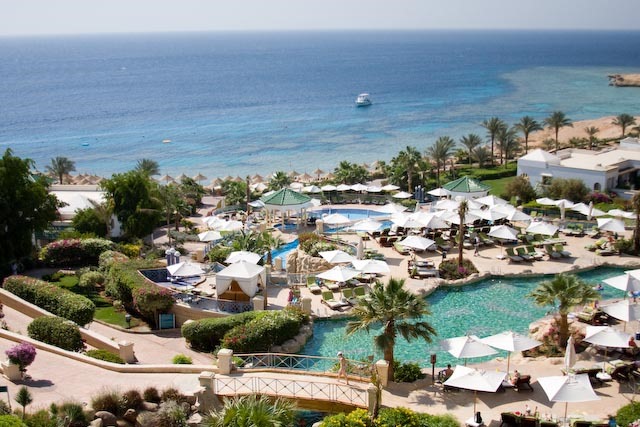
We stayed at the Hyatt  in 2 attached family rooms (versus the Four Seasons which was a single room for the same price). In retrospect, if we were going back we would go to the Four Seasons and take a smaller room for the same money – the experience in Cairo was that good.

Personally, I loved the weather. It was 80 the majority of the time – not too hot. BUT, it was not hot enough for others and I can understand that. One of the things that was very obvious at the resort was the Russian wealth. You could spot them, they were the ones with very big logo wear and lots of gold. In conversation with a Brit, he made the following observation:

‘It is like the UK years ago, we came into a lot of wealth after a long period of no wealth and went on a spending spree – showing that wealth’

Russia is now No. 2 in the world for billionaires. New wealth indeed.

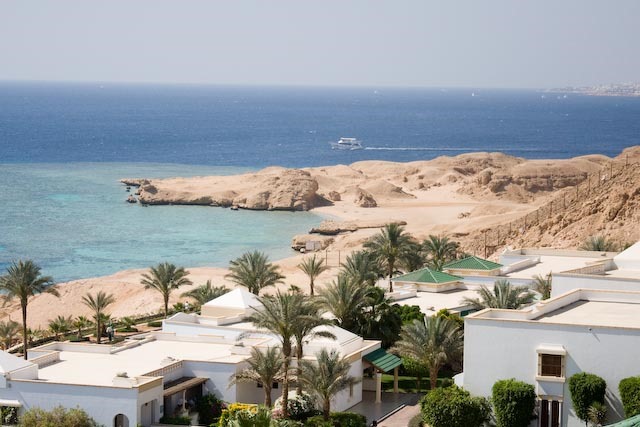
The hotel was beautiful with an 80′ water slide, a lazy river pool with waterfalls and pretty good service. But the highlight was the snorkelling, the Red Sea is known for their diving and right off the beach was a coral garden which was beautiful. A few photos below.

A great way to end the trip.

2008 04 01 636 Egypt

2008 04 01 637 Egypt

2008 03 30 625 Egypt

I bought an underwater camera case for our point and shoot, it worked amazing (great for videos also). A $200 investment I will not regret. I also upgraded all of our snorkelling gear at the dive shop, another good investment.

You swam along the shallow coral from the beach and then it would drop off …

2008 03 31 Red Sea at the Beach  (8)

2008 03 28 Red Sea Sharm  (24)

Truly amazing to snorkel with the family.

2008 03 28 Red Sea Sharm  (18)

There were hundreds of fish and they would simply swim beside you.

2008 03 28 Red Sea Sharm  (24)

2008 03 28 Red Sea Sharm  (26)

2008 03 31 Red Sea at the Beach  (5)

2008 03 31 Red Sea at the Beach  (10)

A few videos from the Canon point and shoot below. I love the movie facility on these cameras, use it all the time. 

And so concludes our Egypt trip. My only recommendation, if you can do it, go. Travelling to Egypt is the opportunity of a lifetime.

EGYPT PART VI: OUR LAST TOURIST DAY

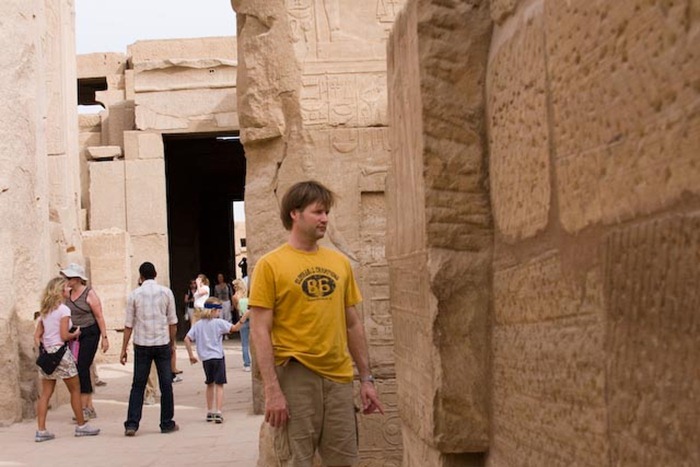
We finished out the tourist part of our Egypt trip with visits to the temples in Luxor, specifically the Temple of Karnak.  For probably the 50th time in 4 days, I was struck by the magnitude of what was standing in front of me. Columns that must have been 100 feet high, intricately sculpted and adorned.

The complex is a vast open-air museum and the largest ancient religious site in the world. It is probably the second most visited historical site in Egypt, second only to the Giza Pyramids near Cairo. It consists of four main parts (precincts) of which only one is accessible for tourists and the general public. This is the Precinct of Amun-Re, and this it is also the main part of the complex and by far the largest part. The term Karnak is often understood as being the Precinct of Amun-Re only, as this is the only part most visitors normally see. The three other parts, the Precinct of Montu, the Precinct of Mut and the Temple of Amenhotep IV (dismantled), are closed to the public. There also are a few smaller temples and sanctuaries located outside the enclosing walls of the four main parts, as well as several avenues of human and ram-headed sphinxes connecting the Precinct of Mut, the Precinct of Amon-Re, and Luxor Temple.

The key difference between Karnak and most of the other temples and sites in Egypt is the length of time over which it was developed and used. Construction work began in the 16th century BC. Approximately thirty pharaohs contributed to the buildings, enabling it to reach a size, complexity, and diversity not seen elsewhere. Few of the individual features of Karnak are unique, but the size and number of features are overwhelming. Construction of temples started in the Middle Kingdom and continued through to Ptolemaic times.

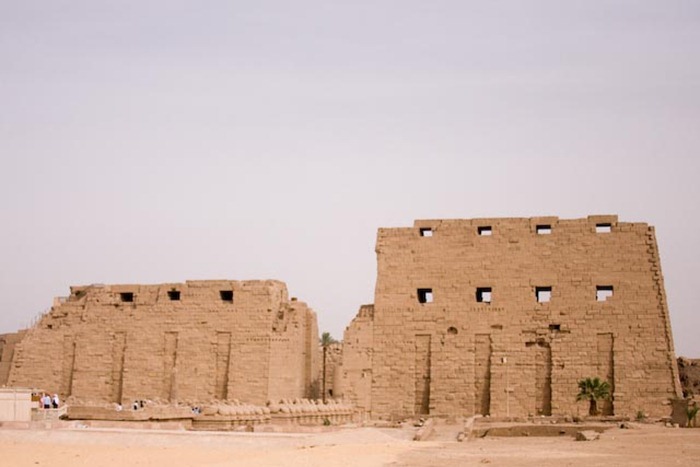
A few pictures. The temple entrance.

2008 03 26 452 Egypt

At one point more than 3000 sphinxes lined the way to the temple.

2008 03 26 456 Egypt

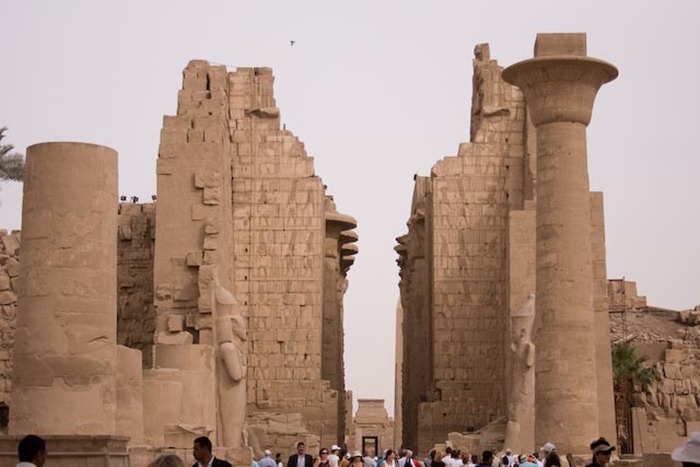
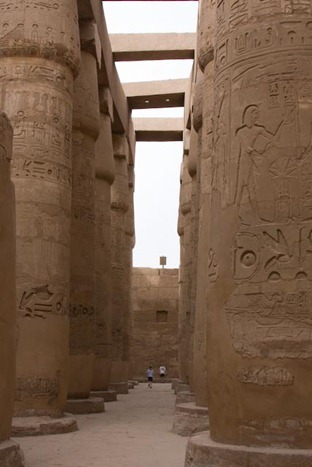
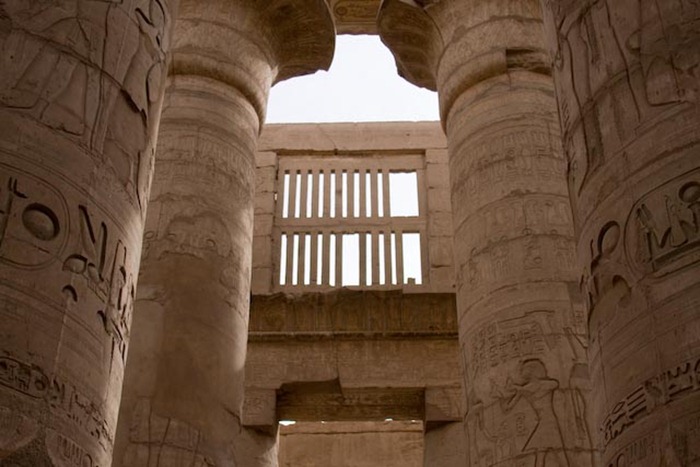
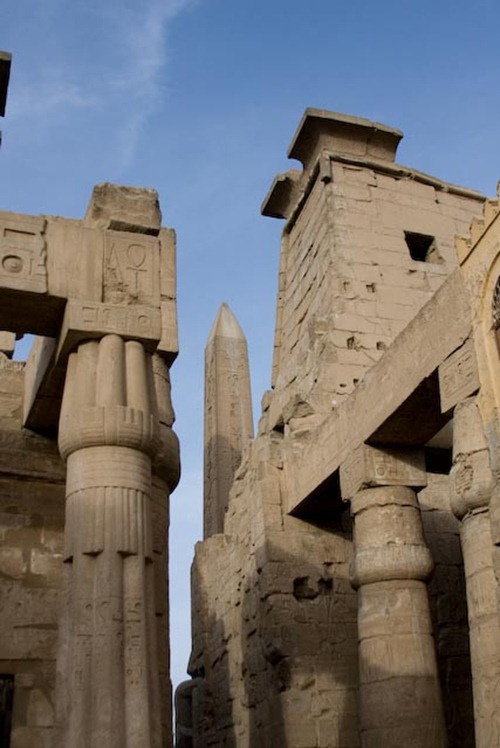
It was a very hazy day – but this picture gives you a good idea of the SIZE of the columns and the temple.

2008 03 26 467 Egypt

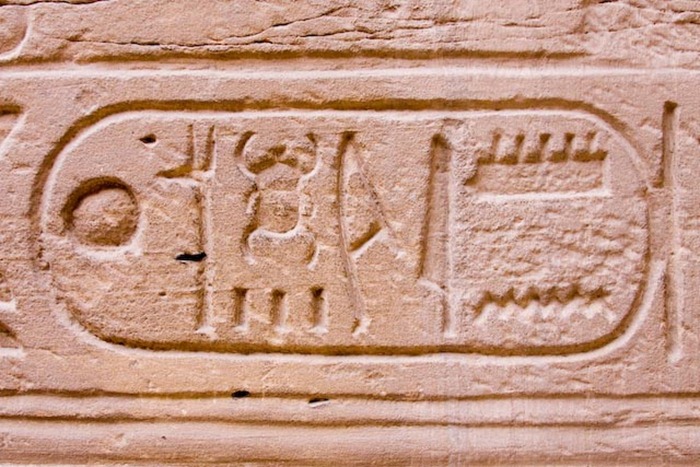
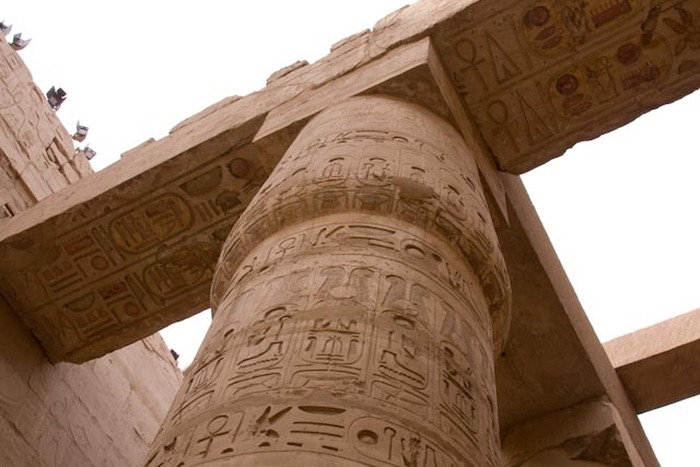
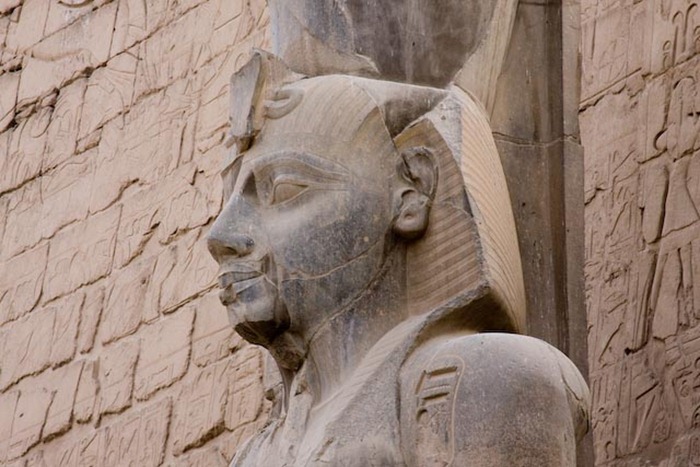
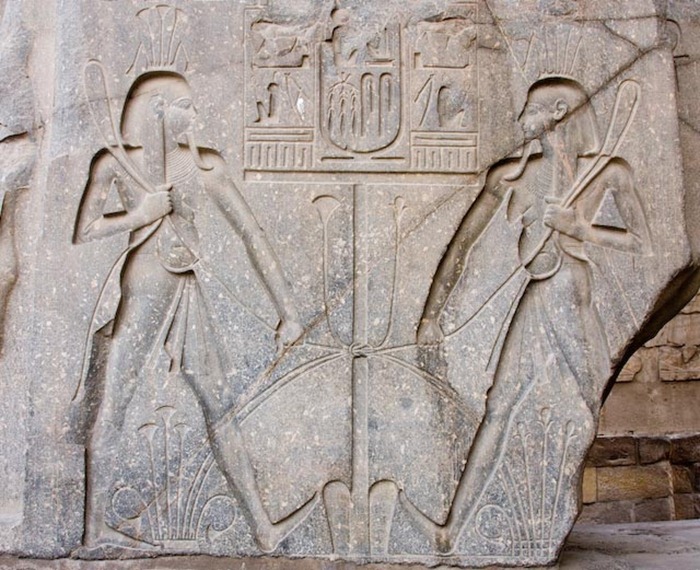
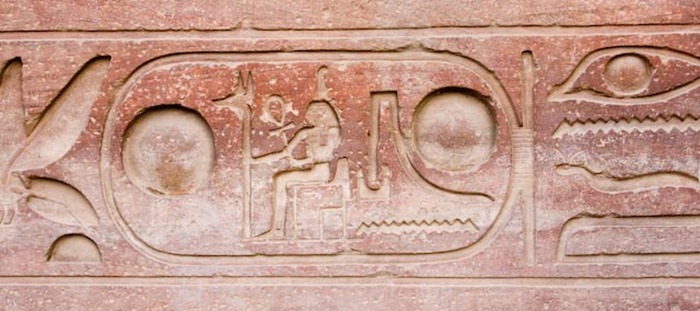
Everywhere you go, the stone is inscribed with the symbols of the time and the cartouches of dead Pharaohs.

2008 03 26 470 Egypt

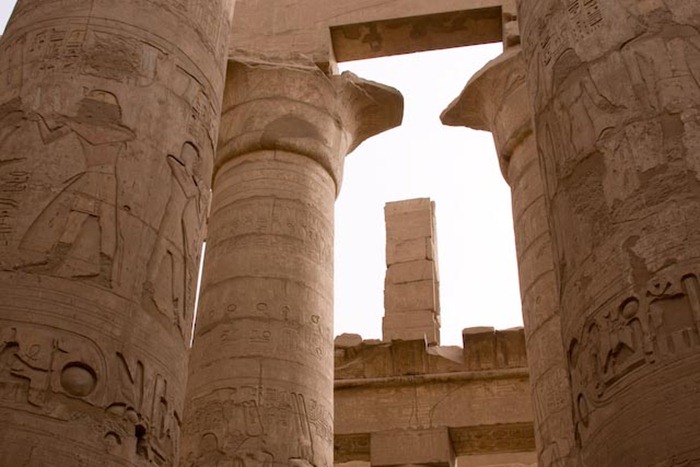
If you view the columns in the right picture you will notice that the markings are wiped away at a certain point. The guide explained that a French archeologist thought it would be smart to wash away the silt within the temple and therefore had a portion of the Nile redirected to the temple to ‘give it a good clean’. This may be an urban myth (cannot find reference of it on the web) as the more likely explanation is that the damage is simply from Nile flooding.

 2008 03 26 480 Egypt    2008 03 26 500 Egypt

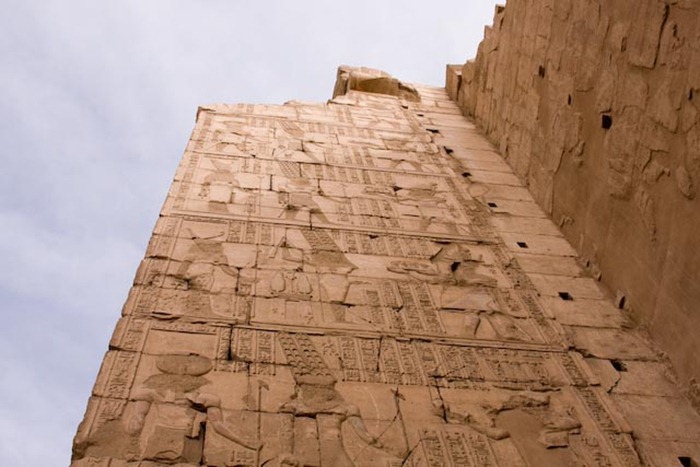
This wall amazed me, it was incredibly high and marked all the way up. What was so interesting is that the inscriptions had survived.

2008 03 26 493 Egypt

This shows what is left of the 2nd floor! I could not believe it when I saw it – you put up these monster columns and then decide, why not put on a 2nd floor?

2008 03 26 506 Egypt

2008 03 26 516 Egypt

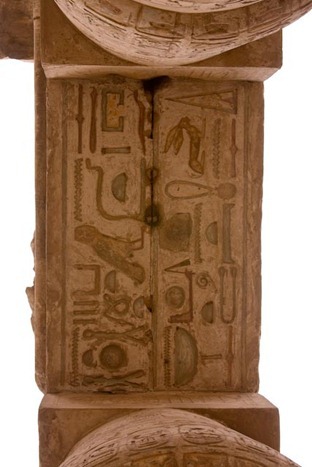
The bottoms of the beams that cross the columns give a hint of the colour that would have adorned the temple a long time ago.

2008 03 26 505 Egypt

2008 03 26 513 Egypt   2008 03 26 521 Egypt

This is the point where my son took an interest in my camera and decided that he would like to take a few shots. He then started asking very pointed questions – How much does it cost? If I were to put together my birthday and Christmas could I have one? When you upgrade, would I be able to have one? Uh huh.

2008 03 26 529 Egypt

2008 03 26 535 Egypt

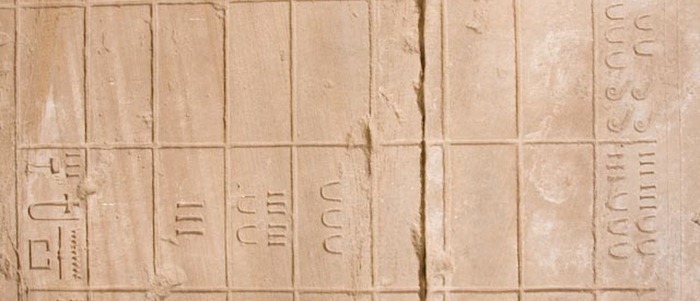
Now this is pretty cool. The guide showed us a wall that they figure was used for teaching. It is their version of math. Look at the below – the upside down U represents 10. Go down the left column – and add to the bottom where the sum sits.

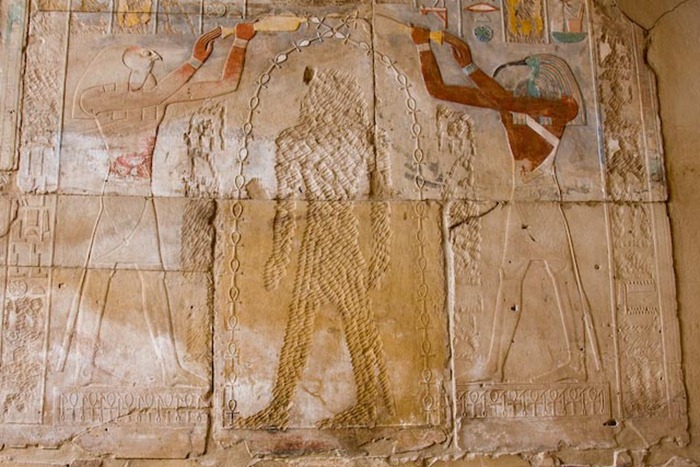
There is a fascinating piece of work in a side temple. If you look closely you will see that the outline of the person in the middle is removed – that is Hatshepsut, one of the few women who ruled as Pharaoh and was recognized as one of the most successful Pharaohs:

In comparison with other female pharaohs, her reign was long and prosperous. She was successful in warfare early in her reign, but is generally considered to be a pharaoh who inaugurated a long peaceful era. She re-established trading relationships lost during a foreign occupation and brought great wealth to Egypt. That wealth enabled Hatshepsut to initiate building projects that raised the calibre of Ancient Egyptian architecture to a standard, comparable to classical architecture, that would not be rivaled by any other culture for a thousand years.

The defacing is very interesting:

Toward the end of the reign of Thutmose III, an attempt was made to remove Hatshepsut from certain historical and pharaonic records. This elimination was carried out in the most literal way possible. Her cartouches and images were chiselled off the stone walls—leaving very obvious Hatshepsut-shaped gaps in the artwork—and she was excluded from the official history that was rewritten without acknowledgment of any form of co-regency during the period between Thutmose II to Thutmose III.[citation needed]

At the Deir el-Bahritemple, Hatshepsut’s numerous statues were torn down and in many cases, smashed or disfigured before being buried in a pit. At Karnak there even was an attempt to wall up her obelisks. While it is clear that much of this rewriting of Hatshepsut’s history occurred only during the close of Thutmose III’s reign, it is not clear why it happened, other than the typical pattern of self-promotion that existed among the pharaohs and their administrators, or perhaps saving money by not building new monuments for the burial of Thutmose III and instead, using the grand structures built by Hatshepsut.

Amenhotep II, who became a co-regent of Thutmose III before his death, however, would have had a motive because his position in the royal lineage was not so strong. He is suspected by some as being the defacer during the end of the reign of a very old pharaoh. He is documented, further, as having usurped many of Hatshepsut’s accomplishments during his own reign. His reign is marked with attempts to break the royal lineage as well.[citation needed]

For many years, Egyptologists assumed that it was a damnatio memoriae, the deliberate erasure of a person’s name, image, and memory, which would cause them to die a second, terrible and permanent death in the afterlife.[citation needed]This appeared to make sense when thinking that Thutmose might have been an unwilling co-regent for years. This assessment of the situation probably is too simplistic, however. It is highly unlikely that the determined and focused Thutmose—not only Egypt’s most successful general, but an acclaimed athlete, author, historian, botanist, and architect—would have brooded for two decades before attempting to avenge himself on his stepmother.

…. A more recent hypothesis about Hatshepsut suggests that Thutmose III’s erasures and defacement of Hatshepsut’s monuments were a cold but rational attempt on Thutmose’s part to extinguish the memory of an "unconventional female king whose reign might possibly be interpreted by future generations as a grave offence against Ma’at, and whose unorthodox coregency" could "cast serious doubt upon the legitimacy of his own right to rule. Hatshepsut’s crime need not be anything more than the fact that she was a woman."[42] Thutmose III may have considered the possibility that the example of a successful female king in Egyptian history could set a dangerous precedent since it demonstrated that a woman was as capable at governing Egypt as a traditional male king. This event could, theoretically, persuade "future generations of potentially strong female kings" to not "remain content with their traditional lot as wife, sister and eventual mother of a king" instead and assume the crown.[43] While Queen Sobekneferu of Egypt’s Middle Kingdom had enjoyed a short c.4 year reign, she ruled "at the very end of a fading [12th dynasty] Dynasty, and from the very start of her reign the odds had been stacked against her. She was therefore acceptable to conservative Egyptians as a patriotic ‘Warrior Queen’ who had failed" to rejuvenate Egypt’s fortunes–a result which underlined the traditional Egyptian view that a woman was incapable of holding the throne in her own right.[44]Hence, few Egyptians would desire to repeat the experiment of a female monarch.

In contrast, Hatshepsut’s glorious reign was a completely different case: she demonstrated that women were as equally capable as men in ruling the two lands since she successfully presided over a prosperous Egypt for more than two decades.[45] If Thutmose III’s intent here was to forestall the possibility of a woman assuming the throne, it failed. Two female kings are known to have assumed the throne after Thutmose’s reign during the New Kingdom: Neferneferuaten and Twosret. Unlike Hatshepsut, however, both rulers enjoyed brief and short-lived reign of only 2 and 1 years respectively.

Read the rest of the story here. Fascinating.

2008 03 26 539 Egypt

We then headed to the Temple of Luxor.

Known in the Egyptian language as ipet resyt, or "the southern harem", the temple was dedicated to the Theban Triad of Amun, Mut, and Chons and was built during the New Kingdom, the focus of the annual Opet Festival, in which a cult statue of Amun was paraded down the Nile from nearby Karnak Temple (ipet-isut) to stay there for a while, with his consort Mut, in a celebration of fertility – whence its name.

2008 03 26 552 Egypt

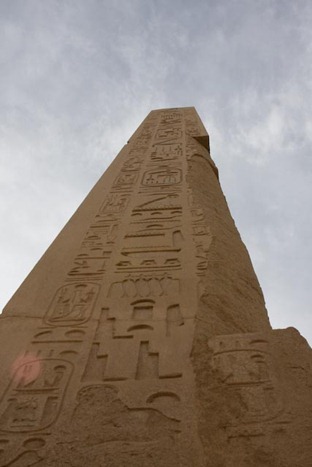
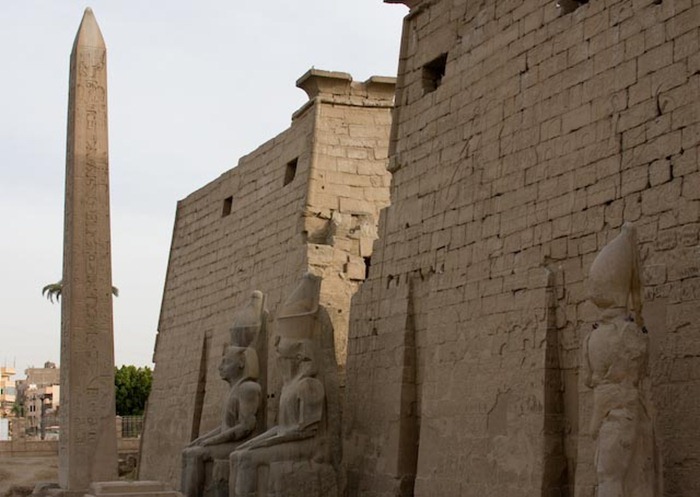
The guide pointed out why there is only one obelisk:

The temple properly begins with the 24 metre (79 ft) high First Pylon, built by Ramesses II. The pylon was decorated with scenes of Ramesses’s military triumphs (particularly the Battle of Kadesh); later pharaohs, particularly those of the Nubian 25th dynasty, also recorded their victories there. This main entrance to the temple complex was originally flanked by six colossal statues of Ramesses – four seated, and two standing – but only two (both seated) have survived. Modern visitors can also see a 25 metre (82 ft) tall pink graniteobelisk: it is one of a matching pair. The other was taken to Paris in 1835 where it now stands in the centre of the Place de la Concorde.

2008 03 26 554 Egypt

2008 03 26 559 Egypt

2008 03 26 562 Egypt

2008 03 26 560 Egypt

It is interested to see Muslim and Christian history scattered among the early ruins. In many historic stories, it was clear that later conquerors disapproved of the Egyptian religious symbols. In this temple there is a mosque built right on top of the temple.

2008 03 26 566 Egypt

This is a fascinating statue of the boy Pharaoh Tutankhamen. What makes it unique is that in all other places, the Pharaoh is depicted as a giant statue with his wife or wives depicted as minor statues at his feet. Here they sit side by side – very different.

2008 03 26 571 Egypt

The below paintings are from Roman times. The plaque below describes how they came to be.

2008 03 26 582 Egypt

2008 03 26 587 Egypt

And so ended our tour of ancient Egypt. One last entry remains, finishing on the Red Sea. All I have to say is I will go back and if you can, go to Egypt. It is beyond words.

EGYPT PART V: LUXOR DAY 1

Luxor is known for a few key things – the Valley of the Kings, Valley of the Queens and Karnak temple. Our tour guide explained that many people on Nile cruises hit those key sites in a single day, then head out. He suggested we take a different approach.

On the first day we hit the Valley of the Kings, as everyone does:

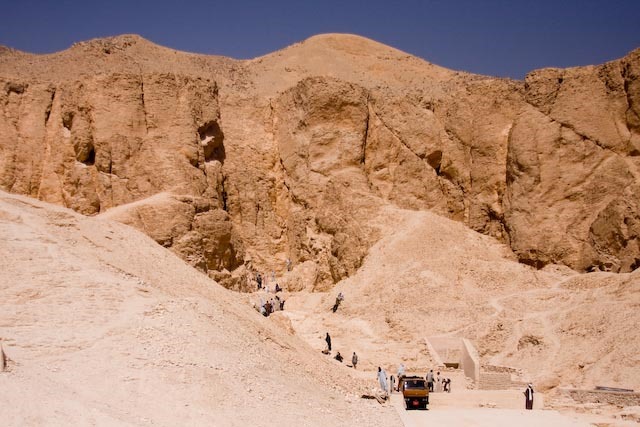
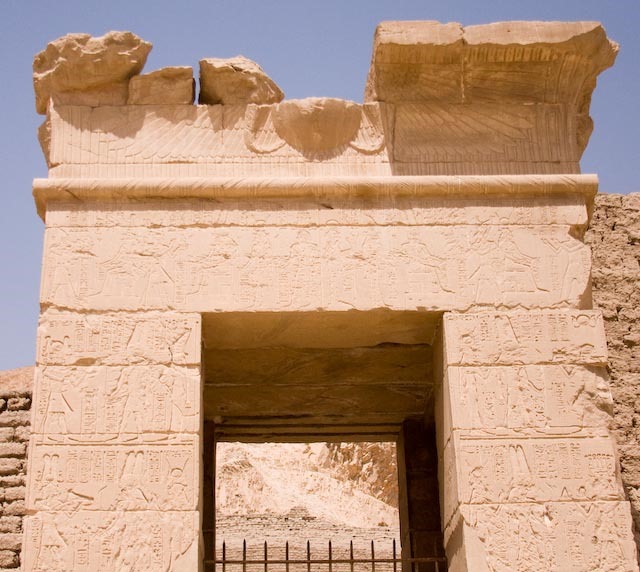
The Valley of the Kings (Arabic: وادي الملوك Wadi Biban el-Muluk; "Gates of the King")[1] is a valley in Egypt where for a period of nearly 500 years from the 16th to 11th century BC, tombs were constructed for the kings and powerful nobles of the New Kingdom (the Eighteenth through Twentieth Dynasties of Ancient Egypt).[2][3] The valley stands on the west bank of the Nile, across from Thebes (modern Luxor), within the heart of the Theban Necropolis.[4] The wadiconsists of two valleys, East Valley (where the majority of the royal tombs situated) and West Valley.

The area has been a focus of concentrated archaeological and egyptological exploration since the end of the eighteenth century, and its tombs and burials continue to stimulate research and interest. In modern times the valley has become famous for the discovery of the tomb of Tutankhamun (with its rumours of the Curse of the Pharaohs[5]), and is one of the most famous archaeological sites in the world. In 1979, it became a World Heritage Site, along with the rest of the Theban Necropolis.[6]

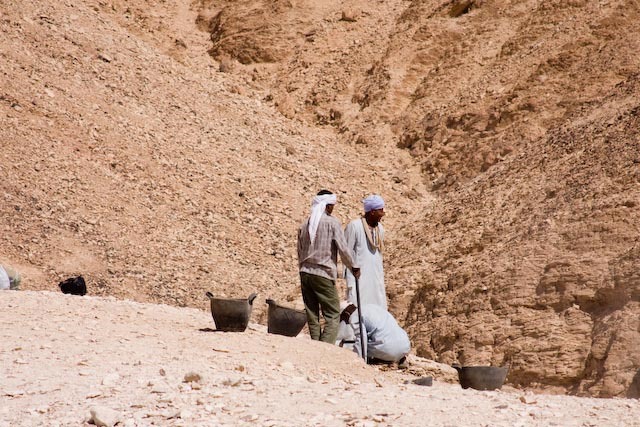
It is an amazing tour, the only downside being that you are not allowed to take pictures in the tombs. They will also confiscate your video camera at the entrance (unless it looks like a camera). All around the valley, work continues as men excavate. I was still left wondering – what was in these tombs? If King Tut’s tomb had so much, what wonders were in a major tomb? We will never know.

Workers in the valley.

2008 03 25 257 Egypt

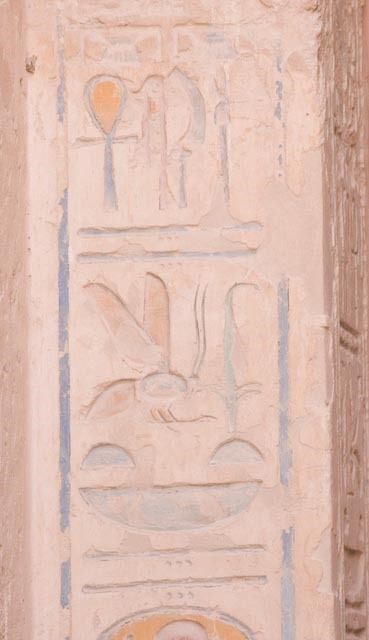
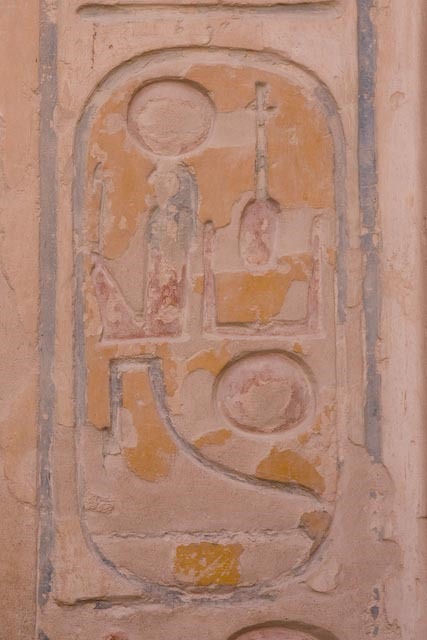
The entrance of a tomb. The circle represents the insignia of the Pharaoh – called a cartouche.

2008 03 25 269 Egypt  2008 03 25 265 Egypt

The workers excavating. All I can say is that in 40 degree heat, it must be hot work. In the summer, tourists go at 530AM as it is in the 50s by 10 am.

2008 03 25 249 Egypt

Perhaps this is the video of the roof of a 3000 year old tomb taken by someone who put his video camera on his arm and swung it around without making it look like it was on … or perhaps not.

Truly amazing and must be done. The vibrant nature of many of the tombs is stunning.

BIG TOURIST TIP: The Valley of the Kings and Luxor International Airport are the BEST places to buy your mementos. As we exited the Valley of the Kings you go through a market with everything. We bought this wonderful hand crafted tile and a few other things. The prices are very reasonable compared to most other places. While we were in Cairo the guide took us to a tourist place to shop and the prices were 4X. Lesson learned. Personal anecdote:

As we moved to escape the market (the guide had warned us – they are aggressive), this guy latched onto me trying to sell me small figurines. I was not interested but he kept at it, $20USD for 3, $15USD for 3, $10USD for 3, $8USD for 3. We are getting close to the parking lot – I am not bartering – just not interested and almost out of USD (personally – with home much these guys make – I refuse to barter them, I can afford it) …. $6USD for 4 ….

The whole time my boys are watching and finding this quite funny because they know I will break. Sure enough, I stop. OK, what do I have to lose? I say OK. He says ‘Come on, $10USD for 3’. Nice try. I walk away with 4 for $6USD and two boys who have a very good laugh about my inability to extricate myself from the seller.

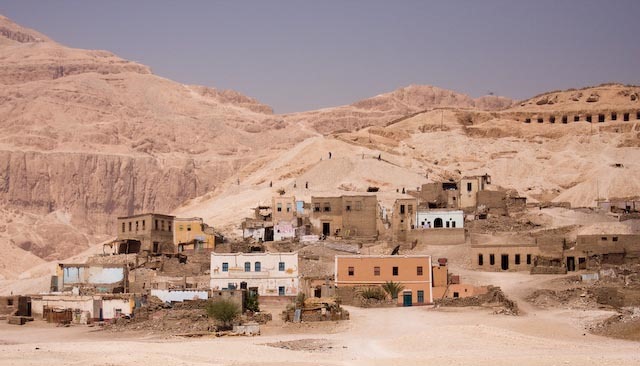
Once our tour was completed we took our guide’s advice and skipped the Valley of the Queens, Deir el-Bahri and the Tombs of the Nobles and headed to the workers village. His logic was simple – Valley of the Queens is just a lesser version of what we just saw and the workers village is under travelled so we will have it to ourselves (he was right). We did drive past the Tombs of the Nobles .. the tombs are in the right hand corner above a village that is being removed by the Egyptian government.

2008 03 25 286 Egypt

The workers village was our last stop for the day and as fascinating as the Valley of the Kings:

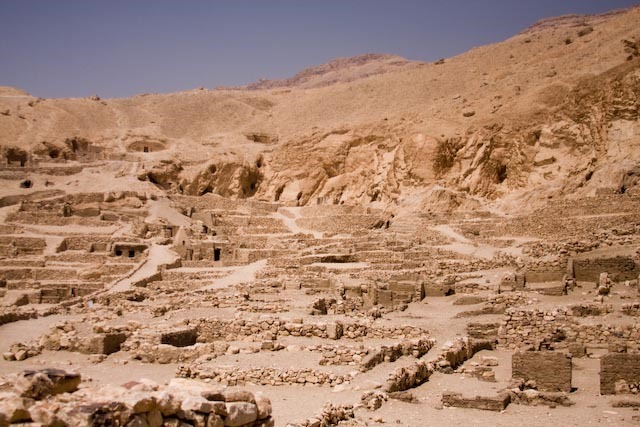
Deir el-Madinah (Arabic: دير المدينة‎) is an ancient Egyptian village which was home to the artisans who built the temples and tombs ordered by the Pharaohs and other dignitaries in the Valley of the Kings during the New Kingdomperiod (18th to 20th dynasties)

The settlement’s ancient name, Set Maat her imenty Waset, means "The place of Ma’at (or, by extension, "place of truth")[1] to the west of Thebes." The village is indeed located on the west bank of the Nile, across the river from modern-day Luxor. The Arabic name Deir el-Madinah (and variants on the transcription) means "the convent of the town": this is because at the time of the Muslim conquest of Egypt, the village’s Ptolemaic temple had been converted into a Christian church. One legend maintains that the inhabitants of the village worshiped Amenhotep Ias the founder and protector of the artisans’ guild.

The people of Deir el-Madinah were responsible for most of the tombs in the Valley of the Kings and Queens and the temples of the Theban necropolis. The workmen of the village often referred to themselves as "servants in the place of truth". The tombs they constructed included the famous tombs of Tutankhamen and Nefertari, and the memorial temples of Ramses II, Amenhotep III, and Hatshepsut – all of which, in their various states of preservation, can still be seen today.

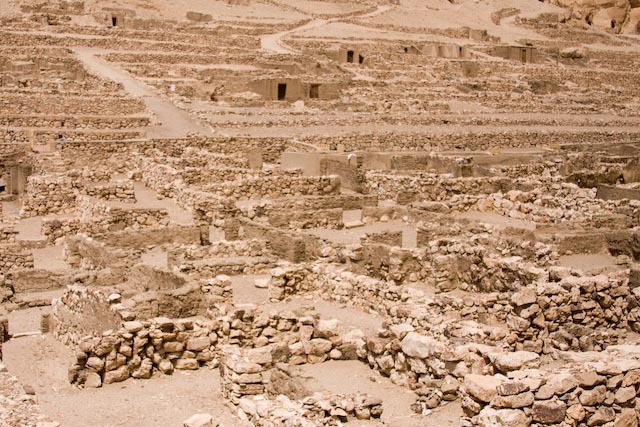
You enter the valley and before you are the excavated ruins of hundreds of village homes:

2008 03 25 322 Egypt

2008 03 25 313 Egypt

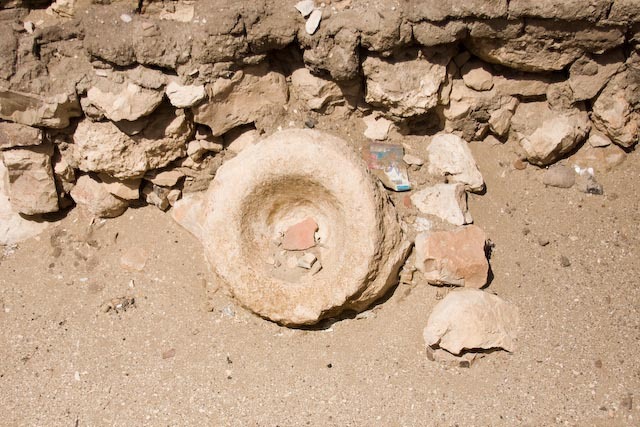
A 3,000 year old kitchen sink.

2008 03 25 316 Egypt

You then have the opportunity to enter their Ptolemaic temple and for the first time, I was allowed to photograph (without flash).

2008 03 25 329 Egypt

2008 03 25 334 Egypt

2008 03 25 341 Egypt  2008 03 25 344 Egypt

2008 03 25 375 Egypt

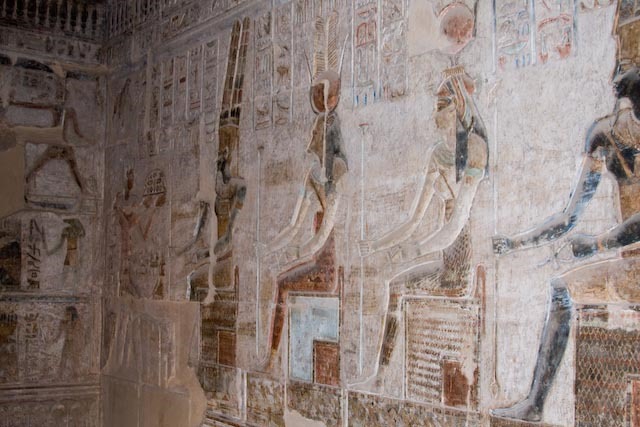
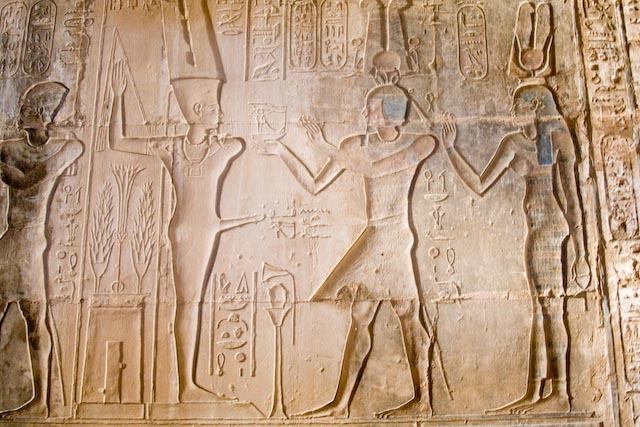
Fertility seemed to be a common theme in the temple. Unfortunately, I did not capture the name of the fertile man/god depicted in the below, but I do remember the story and why he is on the walls of the temple:

(I paraphrase – apologies). The young men of Egypt went to war, leaving behind an old man to guard their women and children. When they returned from war, many, many of their women were pregnant. They took the culprit out into the desert and cut off his limbs, leaving him for dead.

Thirty years later, the young men of Egypt, many being his sons, went off to war winning great battles against their enemies. When they returned, the people realized that the descendants of this man had brought great strength to Egypt so they returned to where he was abandoned in the dessert, thinking that they would bring back his remains and properly entomb them. When they came upon the spot where he had been abandoned, they found an oasis. Fertile in life and death.

2008 03 25 380 Egypt

We finished with a tour of the tomb of Sennedjem, one of the lead artisans who spent his spare time building his own tomb. The paintings (which we were not allowed to photograph) were by far the brightest and most well preserved in our tour of Egypt. Another great end to the day. One more day of exploring to go.

A FEW SIGHTINGS ON THE INTERWEB

A few things I found interesting ….

  • The seven habits of highly effective space ship captains. No.3 – think Firefly. This reminds me of this quiz.
  • Here is where I learned how to give a proper man hug.
  • Time lapsed video of a dude who was stuck in an elevator for 41 hours. Brutal.
  • If you have a car that gets 100MPG, this is the house for you. Your vegan friends will all want to come to the house warming party, which creates a dilemma – where the heck will they all sit or will they be forced to try one of those how many people can we fit’ things?
  • The Zoombak is a really cool piece of kit. Reminds me, I need to figure out how to get GPS working on the camera ….
  • I just bought my first network connected, full color laser printer – HP Color LaserJet CP1515n. Amazing printer – colour is spectacular, they dramatically lowered the consumable costs and I love the network connectivity, Vista picked it up instantly. Bye bye bubble jet. To think, a little over 10 years ago I was selling the only form of colour laser printer available for more than $200K per unit (Laser photocopiers with Fiery print servers).
  • Check out this new way of travelling. The concept is incredibly cool, it isn’t the fastest (222 mph), but think of the leg room. The only downside? The whole Hindenberg thing … Customize yours here.


THE DEATH OF THE BASTARD DEFENSE

I laughed when I read this one. According to the Financial Times, the ‘Bastard defence’ is no longer permissible due to stricter sexism laws. What is the ‘Bastard defence’?

‘Employers will no longer be able to defend themselves against sexual discrimination claims by arguing they are equally offensive to all staff, under new regulations to be introduced tomorrow.

Somewhere in there is a Dilbert cartoon.

ROCKET UP THE LADDER


Men’s Health (yes I read it) had a thought provoking article on career progression in the April 2008 issue. The theme of the article was ‘fast track your career by making the right move at the right time’:

  • 6 months on the job, self assess: They suggest a SWOT (strengths, weaknesses, opportunities, threats). The focus of the SWOT being the job and environment (i.e. strength – pay, threat – downsizing). I think this is the a bit myopic in scope. In my last few roles, I looked at the 6 month mark as a key point to step out of the day to day, take a deep breath and look around. I would suggest the SWOT be more than that. I ask a host of questions to myself to get that 360 degree view of where I am. A few examples:
    • At the 6 month mark you have emerged from the initial 30, 60, 90 plan (XXXXXX) and key initiatives, changes or big bets should be progressing or breaking open. Are they?
    • How is the network internally and externally?
    • Happy with the role?
    • How is the work life balance?
    • What is the next stage of the plan? Is it necessary to simply continue on with the initial plan or change tack?
    • What am I learning? What do I not know and how can I learn it?
    • Most importantly, take stock and think what would I do differently? That first 90-180 is a learning green field.
  • 12 months on the job, keep learning: The essence of their advice, what are you learning? Your efficiency in the existing role should be going up so what are you doing to fill that extra time? Keep learning. I would suggest this is also the logical next step to introduce the next formal stage of your business plan. Take it to the next level.
  • 2 years on the job, swap roles: This is where they lose me. They argue that ‘your CV should show regular changes … or you may look like you lack ambition’. If I think over my career, this was true when I was in my 20s. As I moved into my 30s and more senior roles – tenure became a huge benefit and my company/role changes were replaced with in role promotions. I know that when I hire for a role if I see a CV with a change every 2 years my alarm goes off. In sales this is even more important, a speaker once referenced an IBM study which found that sales professionals were their most productive (i.e. made the most MONEY) at year 4. I know that this was absolutely true when I was a rep – not only was my job 100% easier, but I nailed my quota every year because I knew everyone. It was great, I kept getting promoted, made lots of money, enjoyed the company of some great clients (who became friends) and enjoyed a healthy golf handicap. The key thing? The last point … keep learning, and only you can drive that goal.

An interesting stat, in an interview of 6,000 people, 90% said that further education had increased their job satisfaction while 77% said that it had helped them secure a better job.

  • 4 years on the job, take a break or know when to quit:  They suggest either taking a break (perhaps a sabbatical or extended vacation to recharge) or quitting because you have been passed over. Again, I challenge this thought. If I am in my 20s, yes. Smart sales organizations are working to ensure that there is career progression in role. In this situation, I would suggest self reflection:
    • Do you still love what you do?
    • Are you learning? If not – what can you do to change that? You are the architect of your destiny, no one else.
    • Are you progressing in that role (promotions if available) or are you being rewarded? It isn’t always about the promotion, it is about the package.
    • Most important – are you happy? Do you love what you do? Look inside .. how is life. One of the benefits of the 4 year tenure is life balance. It is all about judging your situation based upon your point in life.

Interesting read. A few more random thoughts that I have collected on career:

  • Moderate drinkers earn 17% more than their abstemious colleagues according to Stirling University. They also increase their chance of moving up the corporate ladder by networking with their superiors. Of note, the study also showed that if you exceed the government limits that salaries drop. Moderation ….
  • Research by the Employment Review into the disciplinary actions of employers found that 59% of knuckle rappings were as a result of poor punctuality. Punctuality is not just to a meeting, it is getting that report in on time, meeting that timeline commitment. This is so true. It is amazing to see someone’s great work get lost in the noise of not meeting deadlines or being sloppy around internal process. Such a simple thing to fix, such a big potential impact.

Of course, be careful as you move up. Make sure this does not happen, I have seen it WAY to many times (put your cursor over the picture to reveal the ‘play’ button).

EGYPT PART IV: THE NILE & OFF TO LUXOR

As we flew out of Cairo I was struck by the Nile. A few pictures of the area around the Nile and the areas in between make it really clear – the Nile means life in Egypt.

2008 03 24 218 Egypt

There is nothing where there is no water .. nothing.

2008 03 24 205 Egypt

2008 03 25 228 Egypt

Turns out that in the Luxor area, agriculture remains a staple industry – focused on sugar and fruit. What was interesting to me was the clash of modern and ancient. Donkeys pulling carts while Russian tractors blew down the road.

2008 03 25 236 Egypt

I had to laugh when I saw the Belarus tractor. My dad and Uncle use to sell those tractors. The Russians desperately needed cash so they started exporting these tractors prior to the end of the cold war. They are what you expect – cheap, simple and a solid workhorse.

2008 03 25 237 Egypt

The other way to move produce.

2008 03 25 235 Egypt

The odd shaped train cars caught my attention. Turns out that when Egypt was occupied by the British they built a railway to move sugar cane.

2008 03 25 232 Egypt

As a diversion, we took a trip to a banana plantation to do something other than a history trip.  It allowed us to sail down the Nile on a beautiful day. Unfortunately for the 2 sailors, there was no wind and they had to work incredibly hard for 2 hours to get us to the plantation – which should have taken a half hour by sail.

2008 03 25 18 Canon Camera_ 2008 03 25 26 Canon Camera_

We stopped to watch this fellow. He is making mud bricks by hand (or to be accurate, by feed). A different world.

2008 03 25 34 Canon Camera_

The plantation’s oven.

2008 03 25 39 Canon Camera_

My son took this picture, sunset on the Nile.

2008 03 25 53 Canon Camera_

2008 03 25 74 Canon Camera_

A beautiful evening.

DEBT, MORGAGES AND WALKING AWAY


The Economist has an interesting article this week on the UK market and the negative equity threat – where the cost of your mortgage is higher than the declining value of the home (homes in the UK declined 2.5% in March). This has sparked memories of the 1989 collapse where it took a decade for home prices to recover.

In the US, the same thing is happening. As this article points out, websites, blogs and services are popping up to help people decide when to simply walk away from your home. Something that the industry calls the jingling mail, when people simply mail in their keys. Consider the following service offering:

While some sites trumpet offers to buy homes from stressed-out owners, another one sells a foreclosure kit. California-based YouWalkAway.com says its kit will enable you to stay in your home "for up to eight months or more without having to pay anything to your lender!" It also says: "With our money-back guarantee, you get it all for only $995.

One could argue that this is long over due. How many people do you know who are spending their way into oblivion? It is so easy to go out and buy that $500K or $1M house because the interest rates are so low. If you could get a 4% mortgage, a $500K house becomes very affordable to many as it is $20K a year in payments – if you adjust for taxes – that is around $2200 per month in interest.

But when interest rates start to go up, the pressure starts. The graph to the right shows the change in debt ratios of the average UK citizen (One could suggest that similar ratios exist in NA, although house prices are dramatically higher in the UK, but so is base salary). In the 80s the ratio of home price to earnings was an average of 1.7 and for new home buyers around 2.8. This meant that the model that I had in my mind as a first time buyer held true (Buy 2X your earnings to be safe).

There was a trough in the mid 90s but a huge spike in the last decade. Look at the current ratios – new home buyers are at 5.2X and the average is 3.8X. That means if you are a new home buyer earning 100K you are buying a house worth 520K and in many cases carrying $500K of that as mortgage debt.

INSANE.

And we wonder why the financial crisis is hitting? People are in debt up to their eyeballs and it is starting to hit the market. What happens to that new home buyer when the $2200 per month interest payment goes to $3000 or $3500? The dike begins to crack.

I think the water is flowing …. Confirms what our realtor friend said, it is a buyers market.

EGYPT PART III: PYRAMID, SPHINX & THE EGYPTIAN MUSEUM

After the pyramids and the surrounding areas, including a quick view of the pyramid of the son Khafre, we jumped in the car and headed to a plateau called ‘the panorama’ – for obvious reasons.

image

The individuals provide a sense of magnitude ….

image

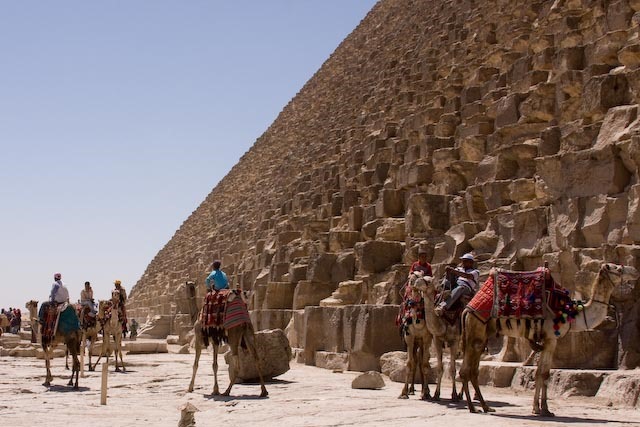
We drove here for a specific purpose, a camel ride. The cost was 50 L.E. each  (£10 or $20USD). It lasts for 20 minutes and gives you a great view of the pyramids. Plus, riding a camel is pretty cool. What is amazing about these camels is the noise, they bellow and grunt at a volume that can be a bit startling.

image

image

While looking through the pictures I noticed that a twister formed and crossed the picture frames in about 10 seconds while the guide was taking our family photo. The first picture shows it starting, the second shows it over my right shoulder (hard to see). By my estimate, it is 200M high – as it is much higher than the pyramid …. cool.

image

The camel camp.

image

image

Our last stop (and it was getting time .. the 40 degrees was starting to take a toll) was the Great Sphinx. The history of the Sphinx is interesting. Many of the Egyptian statues were defaced over time by men, the ultimate insult being the removal of the nose. The head of the Sphinx was used for target practice for Napoleon’s cannons:

The one-metre-wide nose on the face is missing. Some legends claim that the nose was broken off by a cannon ball fired by Napoléon’s soldiers and that it still survives, as do diverse variants indicting British troops, Mamluks, and others. However, sketches of the Sphinx by Dane Frederick Lewis Norden made in 1737 and published in 1755 illustrate the Sphinx without a nose. The Egyptian historian al-Maqrizi, writing in the fifteenth century, attributes the vandalism to Muhammad Sa’im al-Dahr, a Sufi fanatic from the khanqahof Sa’id al-Su’ada. In 1378, upon finding the Egyptian peasants making offerings to the Sphinx in the hope of increasing their harvest, Sa’im al-Dahr was so outraged that he destroyed the nose, and was hanged for vandalism. Al-Maqrizi describes the Sphinx as the “Nile talisman” on which the locals believed the cycle of inundation depended.

In addition to the lost nose, a ceremonial pharaonic beard is thought to have been attached, although this may have been added in later periods after the original construction. Egyptologist Rainer Stadelmann has posited that the rounded divine beard may not have existed in the Old or Middle Kingdoms, only being conceived of in the New Kingdom to identify the Sphinx with the god Horemakhet (citation needed-see ref.11&12). This may also relate to the later fashion of pharaohs, which was to wear a plaited beard of authority—a false beard (chin straps are actually visible on some statues), since Egyptian culture mandated that men be clean shaven. Pieces of this beard are today kept in the British Museum and the Egyptian Museum.

The last removal of sand was 1926 as the desert keeps covering up the Sphinx. The most natural state of the Sphinx is the body covered with only the head showing. Restoration continues ….

image

image

image

I wonder who is buried in the tomb beside the Sphinx?

The next day we went to the Egyptian museum, but they won’t let you take pictures and are really tight on security. The benefit of the tour guide became apparent again as he took us from exhibit to exhibit. The most interesting were:

  • The mummies. Standing over the exhibit, looking at 3000 year old mummies – seeing remnants of their hair and features is amazing. I was struck by an odd thought while I looked on – imagine how distraught these ‘mighty men’ would be if they knew that millions of people walked by the remnants of their once mighty corpses every day. Not what they envisioned, I am sure.
  • King Tut:The only tomb that was never raided from a minor boy Pharaoh, it is the least impressive of all of the tombs but the only one to yield it’s treasures. To see those treasures makes you realize just how much has been lost to tomb raiders. The collection is amazing, one can only imagine what was in a major Pharaoh’s tomb ….
  • Of interest, there are 120,000 pieces of history on display and another 150,000 stored away. Unbelievable.

Of course, I may have snuck in a picture or two (without aiming so I would not draw attention):

image

image

A great start – but only the start.

HOW TO GET YOURSELF INTO A JAM


I will admit, sometimes I really get myself into a jam. Of course, my best incident is the Metamucil fiasco (A high fibre drink) which you can read here. But, yesterday was another quality entry into the journal where I really screwed up.

I was in meetings in North America with clients and they were going great. As I sat in the meetings I felt a sense of calm knowing that my flight was leaving at 1AM. For once, I was not rushing off to the airport. It was going to be a nice leisurely pace to the airport, a bite of dinner, I was going to connect with an old friend who happened to be in the same time zone and the slowly make my way to the plane. Oh, I was very wrong.

Turns out that I had not read my calendar correct. I have my assistant put my flights into the calendar, with the right time zones and all the required data so that I do not screw it up. The problem is, when I first looked at my agenda as I disembarked from the UK, I had not changed my times zone. 1AM is actually 5PM pacific and I had not looked at it since I landed. Why would I? I had looked when I landed. It was 1AM and even though the little voice in my head said ‘1AM, that seems like a weird time to leave?’ – the other voice said ‘Yes, it is. But they did shift the flight out by a few hours so they must be trying to get more flights in’.

After all – why double check? It is much easier to simply rationalize it in your brain. Facts are for sissies.Chuck Norris wouldn’t check facts.

The meetings come to an end. They were great. So I open my laptop and Outlook starts chirping wildly and alarms start popping off:

‘Drive to Vancouver Airport’     OVERDUE 3 HOURS

‘Check into Airport’   OVERDUE 1 HOUR

Oh no. I check the calendar which is now on Pacific time – and there it is – you have 1 hour to get to the airport. You are 220 miles away. Good luck with that..

I feel ill.

I say good-bye to the attendees and head to the phone, ‘OK, we can get you on the Ottawa flight at 8AM tomorrow and then into Heathrow for a Saturday arrival’ GROAN. An 11 hour flight just added 24 hours.

‘Is there nothing else?’   ‘Sorry sir. Everything is sold out’.

So I start the despondent drive to the airport (which takes longer than usual due to traffic) thinking that I just added 20 hours to my trip. But I keep wondering, is there another way. The motto of ‘5 NOS to get to a YES’ kicks in. I call them back ‘Is there a way you get me to London faster? Possible?’ After discussion we come to a solution …

‘There is a flight to Toronto that arrives 6AM and then a connector to London but the Toronto is oversold by 5.’

‘What are my chances?’

‘Low’

‘Alright, please put me on standby, I will try it.’

And so I proceed to hang out in the airport for many hours to get on a plane that is oversold with the chance of not getting on and being stuck there for a night (with the hotel that is attached to the airport being sold out). It was a bit tense .. but I got the LAST seat at the back of the plane that is reserved for the attendants thanks to a lot of smiling at the check-in lady.

I am now sitting in Toronto with a triple espresso and still smiling. Next time I will double check my calendar (LOL).

THE FIVE PEOPLE YOU WILL MEET IN HEAVEN


On our vacation I dialled down the business reading due to our busier than usual schedule (we are more of a hang on the beach family than a ‘see the sites’ family). I also needed to relax and recharge. I did read a couple great bubble gum for the brain books NEXT and Neverwhere. I personally love Michael Chrichton books – they read like a fast paced movie (and often get turned into movies).

I also read a book by the author of Tuesdays with Morrie  – The Five People You Will Meet in Heaven.

A book that made me think and as the other, was touching. In the fast paced world, it is good to stop and contemplate. One chapter was particularly poignant when the central character comes face to face with his family burden and a bad relationship with his long dead father:

Ruby stepped toward him "Edward" she said softly. It was the first time she had called him by name. "Learn this from me. Holding anger is a poison. It eats you from inside. We think that hating is a weapon that attacks the person who harmed us. But hatred is a curved blade. And the harm we do, we do to ourselves’

"Forgive Edward. Forgive. Do you remember the lightness you felt when you first arrived in heaven?"

Eddie did. Where is my pain?

"That’s because no one is born with anger. And when we die, the soul is freed of it. But now, here, in order to move on, you must understand why you felt what you did, and why you no longer need to feel it."

She touched his hand.

"You need to forgive your father."

Thought provoking … a great book.

EGYPT PART II: THE PYRAMIDS

Our first 2 days in Egypt were in Cairo. It is a mad city – 27M people, crazy traffic, people hanging off buses, 20 year old cars belching out smoke. People often call Cairo dirty, I found it fascinating. Everywhere you turned you saw a different sight whether it was ultra wealth or ultra poverty.

We stayed in the Four Seasons right beside the zoo, which was a tactical mistake. It was my first time experiencing a Four Seasons and to say that I was blown away would be an understatement. The service was out of this world. Coincidentally, the week before I had Richard Abraham speak to my broad team about relationship selling and he referenced the Four Seasons as the penultimate in service – I have to agree. The problem … every hotel was disappointing in comparison.

The view of the Nile from the hotel.

image

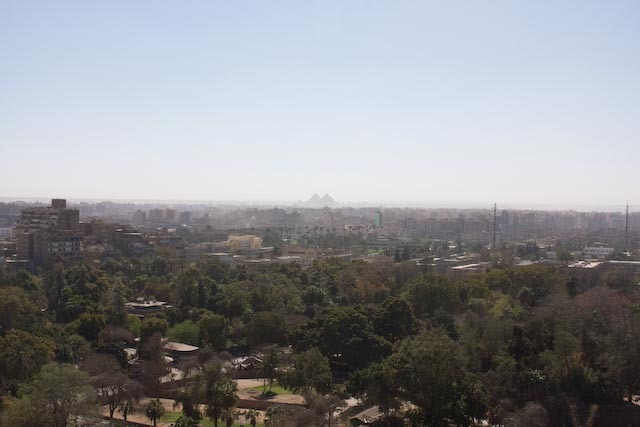
The Cairo skyline from the balcony, overlooking the zoo.

2008 03 23 166 Egypt

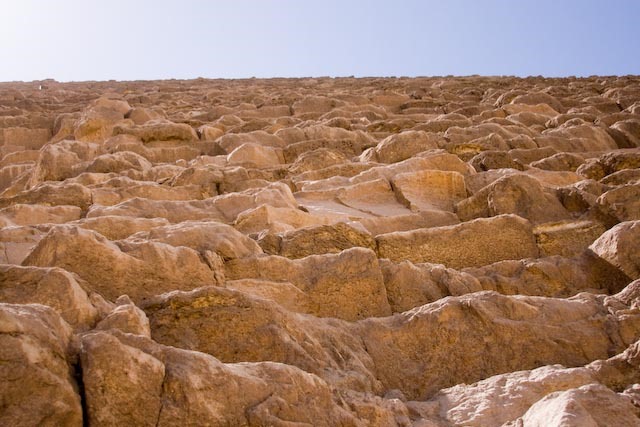
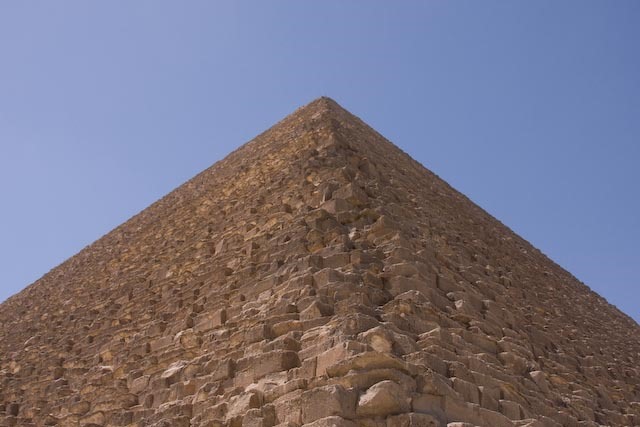
The first day was the Pyramids of Giza. How do you describe this experience? Words like awesome, mind boggling, breathtaking seem to trivialize the experience. Simply put, you stand at the bottom of the tomb of Khufu and look up and you hear the facts – 4,000 years old, the highest standing building in the world for 3800 years (Lincoln Cathedral in London replaced it some time in the 1300s), each stone is approximately 2.5 tonnes, there are a little over 2M of these stones and it is just beyond comprehension. Consider these engineering details:

The accuracy of the pyramid’s workmanship is such that the four sides of the base have a mean error of only 58 mm in length, and 1 minute in angle from a perfect square. The base is horizontal and flat to within 15 mm. The sides of the square are closely aligned to the four cardinal compass points to within 3 minutes of arc and is based not on magnetic north, but true north. The design dimensions, as confirmed by Petrie’s survey and all those following this, are assumed to have been 280 cubits in height by 4×440 cubits around originally, and as these proportions equate to 2 x Pi to an accuracy of better than 0.05%, this was and is considered to have been the deliberate design proportion by Petrie, I. E. S. Edwards, and Miroslav Verner. Verner wrote "We can conclude that although the ancient Egyptians could not precisely define the value of pi, in practise they used it".[7]

The magnitude of effort when they had no form of mechanical support is unfathomable. Early theories on the use of slave labour have now been overturned and the current labour beliefs, based on archaeological study, are quite interesting:

In addition to the many theories as to the techniques involved, there are also disagreements as to the kind of workforce that was used. One theory, suggested by the Greeks, posits that slaves were forced to work until the pyramid was done. This theory is no longer accepted in the modern era, however. Archaeologists believe that the Great Pyramid was built by tens of thousands of skilled workers who camped near the pyramids and worked for a salary or as a form of paying taxes until the construction was completed. The worker’s cemeteries were discovered in 1990 by archaeologists Zahi Hawass and Mark Lehner. Verner posited that the labor was organized into a hierarchy, consisting of two gangs of 100,000 men, divided into five zaa or phyle of 20,000 men each, which may have been further divided according to the skills of the workers.[8]

The site is huge. You start the journey at the ticket office ….

Image:Giza pyramid complex (map).svg

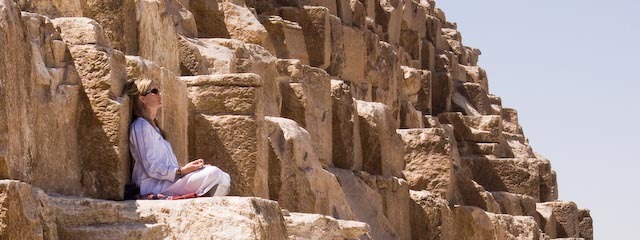
It is very steep, people are no longer allowed to climb it (I wouldn’t anyway!). When you stand at the bottom and look up, this is what you see (the woman provides perspective on angle and size of blocks):

2008 03 23 28 Egypt-2

2008 03 23 37 Egypt

2008 03 23 45 Egypt

I did a lot of this – simply staring. Oh yes, I looked the tourist part (LOL)

2008 03 23 36 Egypt

You can take a gander into the pyramid and we did climb into the entry point but did not wait (it was not open yet). Of interest, it was HOT. It hit 38 degrees that day so we had to remain well hydrated. There are vendors moving around – a bottle of water is usually 5 L.E. (Egyptian pounds) which is around £0.50 or $1 USD – finally a country that does not rip you off. Go to a museum in the UK and you can pay up to £4.

We moved around the side of the pyramid and were greeted by the camel owners trying to sell us a ride (our guide took us past these guys). They did everything they could to try and convince us to take a picture of their camel for only $1USD.

2008 03 23 44 Egypt

You have a great view of Cairo. Amazing, I never saw a single cloud in Cairo or Luxor.

2008 03 23 53 Egypt

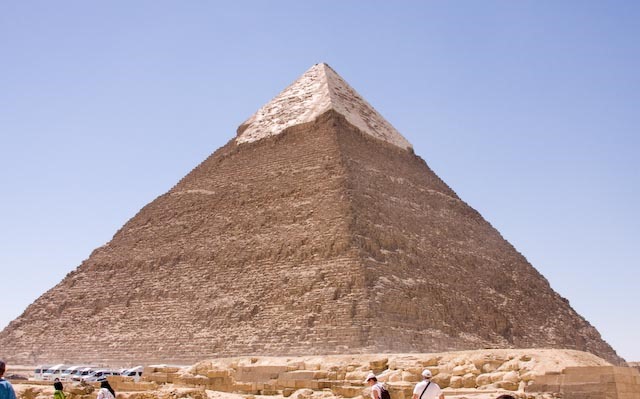
We moved around the pyramid to the Eastern Cemetery and the tomb of Queen Hetepheres.  Our first stop was to enter into the tomb of the builder where no photos were allowed. It is important to note, if you want to take a photo or two – simply have a few USD with you. We saw our first hieroglyphics here. Standing outside his tomb you can see the 2nd pyramid which still has portions of the lime cover in place:

At completion, the Great Pyramid was surfaced by white ‘casing stones’ – slant-faced, but flat-topped, blocks of highly polished white limestone. Visibly all that remains is the underlying step-pyramid core structure seen today. In AD 1301, a massive earthquake loosened many of the outer casing stones, which were then carted away by Bahri Sultan An-Nasir Nasir-ad-Din al-Hasan in 1356 in order to build mosques and fortresses in nearby Cairo. The stones can still be seen as parts of these structures to this day. Later explorers reported massive piles of rubble at the base of the pyramids left over from the continuing collapse of the casing stones which were subsequently cleared away during continuing excavations of the site. Nevertheless, many of the casing stones around the base of the Great Pyramid can be seen to this day in situ displaying the same workmanship and precision as has been reported for centuries. Petrie also found a different orientation in the core and in the casing measuring 193 cm ± 25 cm. He suggested a redetermination of north was made after the construction of the core, but a mistake was made, and the casing was built with a different orientation.[5]

When the pyramids were first finished, one has to wonder – how did the limestone shine in that 40 degree sun? It must have been brilliant.

2008 03 23 56 Egypt

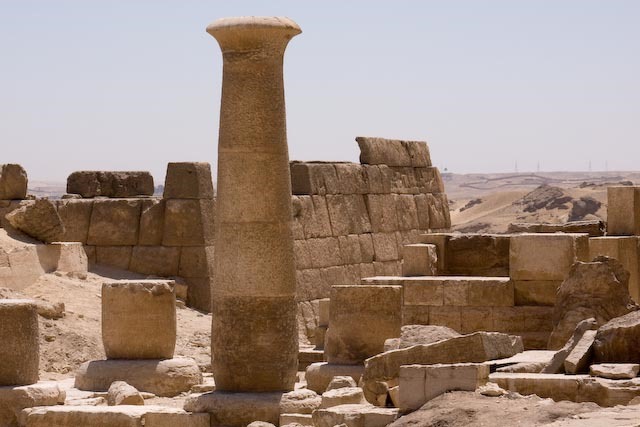
A single standing column in the ruins.

2008 03 23 63 Egypt

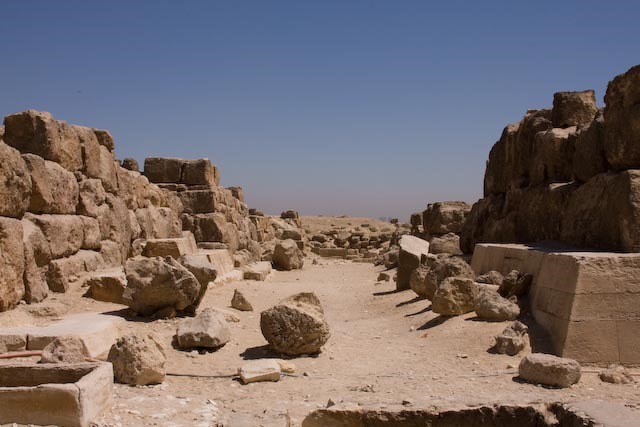
A view of the ruins in the eastern cemetery.

2008 03 23 62 Egypt

2008 03 23 72 Egypt

We carried on to the Queens tomb which was VERY deep. The below shows how steep the climb was, but the tomb itself was unremarkable with no noticeable markings.

2008 03 23 66 Egypt

So ends this entry … The Sphinx and our camel tour came next.

WISDOM


On a plane trip I was doing work with a documentary running in the background – UP THE YANGTZE, the story of the 3 rivers dam and the flooding which required the relocation of 2M people. The starting quote caught my attention:

By three methods we may learn wisdom:

First by reflection, which is the noblest;

second, by imitation, which is the easiest;

and third, by experience, which is the bitterest.

Confucius

SNOW


I have blogged a few times over the last months about the weather in the UK (specifically greater London) – spectacular. If I am golfing in February and experiencing 15 degree weather, sign me up. At the same time, my friends in Canada (specifically Ontario) are enjoying a miserable winter – great for skiing, not so great for keeping the driveway clean or commuting. Massive amounts of snow and according to the Vista weather gadget, frequently in the -25 range.

In a moment of cheekiness last week I sent a note to a friend and finished ‘Well, enjoy the snow this weekend. I am going to get in a round of golf (LOL)’.

Someone was listening. We awoke to this Sunday morning. It was gone in a few hours but was still a shock. Only bad thing? It was not on Monday, I hear that business stops if even a drop of snow hits .. I could have used a home office day ….

2008 04 06 Virginia Park Snow  (9)

2008 04 06 Virginia Park Snow  (6)

2008 04 06 Virginia Park Snow  

2008 04 06 Virginia Park Snow  (7)

2008 04 06 Virginia Park Snow  (2)

2008 04 06 Virginia Park Snow  (3) 

When I was walking around at 8AM taking these photos, the people walking by in their parkas thought I was mad. I was in a t-shirt. After all … this made me feel like home … (smile)

MOTIVATIONAL GENERATOR


I came across this really cool tool. You input a picture, a title and text and out pops your poster. You can then purchase a poster for a low cost or send out. While they use it for parody purposes, I can actually see many practical and positive uses for team building. The power of the net.

A few that are floating around the net from others ….

clip_image001

clip_image001[4]

clip_image001[6]

clip_image001[8]

EGYPT PART 1: MY BROAD IMPRESSIONS

I have talked with many people about how my transition from Canada to the UK changed my view in many ways. The first change being my definition of old. In Canada I thought that our house was old – a 110 year old Victorian. When I came to the UK that changed dramatically as one of my first experiences in a pub was The Bull in Sonning built in the 1400s.

Over the last few weeks our family went on an 11 day trip to Egypt which changed my definition of old and expanded this simple Canadian’s view of the world dramatically.

The trip had 3 stages, a few days in Cairo (pyramids), a few days in Luxor (temples & tombs) and then 6 days on the beach in Sharm el-Sheikh relaxing. Over the week as I dig through the videos and pictures I will blog on each adventure, but thought to start with my impressions of Egypt:

1. Safety:  It was one of the first things that came up in conversation – is it safe? You have the terrorists who are from the region, the 1997 Luxor massacre of tourists and a lot of poverty which leads to crime as people do what they can to survive.

The first thing you notice when you land in Egypt is the armed presence. The military is not as prevalent as in other counties (most notable in Cuba) but the police are everywhere and heavily armed (the below was a common sight).

image

Guards at the pyramids (They must have been hot, it was 40C that day).

image

The end verdict? It is safe, probably one of the safest in the region. But you also need to be smart.

2. The people: The second thing that we noticed was how the people treated us. In all of our travels, the Egyptian people are the most tourist friendly we have ever encountered. In many of the conversations we had, there seemed to be a genuine appreciation of the tourist and the economy that they have created within Egypt. It has taken Egypt a long time to recover their tourist business and it is clear, they are working hard to protect it.

If you read the Luxor massacre story, the most interesting thing is that the Islamic terrorists turned the Egyptian public opinion against them after the event – and it is clear that the Egyptian government has used that opportunity to rebuild the tourism business and create an air of safety.

In conversation and in the newspaper, public opinion against the Islamic terrorists and the negative impact that they have had on the view of Muslims was a hot topic. After all, the Islamic law is that if you have a guest come to you (even if he is your enemy), you must shelter him.

Which brings up another topic – family. Both of our tour guides still lived with their extended family. One lived on the bottom floor of the house with his mother and sister (his dad had passed away). His brother lived with his wife on the second floor and the third floor was where they kept the pig and chickens. The family ties remain very strong in Egypt, I would imagine in part due to economic reasons and in part due to culture (the concept of the village bonding together to help each other).

3. BIG TIP – our tour guide: One brilliant thing that we did on the trip was pre-book all of our tourist events with a local company. Instead of doing the ‘mass tour’ thing where you get on a bus with you and 50 of your closest friends, we booked a private tour guide, driver and private car (usually a minivan). Four days and personalized airport pickup and delivery cost us about £550 for the trip. This made ALL the difference. The tour guide personalized every single outing (when we wanted to start, where we went) and helped us avoid the crowds and do things that others would not have done. For example, when in Luxor the guide said ‘We need to start at 730 am to beat the heat and crowds’. No thanks, we did not come on vacation to get up early. So, we started at 830 am. We did hit a hot time of the day but just took it slower and had more breaks in the shade … which the guide accommodated without issue.

The second biggest benefit was the experience at each site. Unlike the tour groups where the ‘pack’ listened with little interaction because of the unwieldy size, our tours were a dialogue where we asked questions, discussed and gained real insight. Turns out that to be a certified Egyptian tour guide you need to go through 3 years of University training on history, hieroglyphics, etc. They were VERY knowledgeable.

I cannot recommend this route highly enough, we did it through Carrier. Worth every single penny on a tour of a lifetime – it made the trip.

4. Side topic – the police: One last note on the police. In a conversation with our guide, he talked about the police and how the people respect them deeply. However, corruption does happen for one simple reason – income. These guys make nothing. To put it all into perspective, an Egyptian dentist makes $63 per month on average. So the tour guides were constantly tipping the police with one simple point – you can call it corruption but they called it doing the right thing. They provide a valuable service and are not adequately taken care of so the tour guides do what they can.

5. The hot topics in Egypt: Each day I read the Egyptian Gazette. It was a fascinating insight into the culture and what is going on in Egypt. It was also an interesting study in cultural differences. In the western world we are worried about housing prices and the stock market. In Egypt, the big election topic is the wheat and bread shortage. It definitely puts life into perspective – many people in Egypt are still at the survival stage. While I was there, a few interesting articles that caught my attention:

  • Dentists demand higher pay:  the starting monthly salary for a dentist is $23USD per month.
  • Donkey butcher caught red handed:From their web site: Are we heading towards a total moral disaster? The other day a butcher was found selling dead donkeys to restaurants and individual consumers after chopping them into minced meat, adding spices to hide the rotten smell.  (We only ate at places recommended by our guide!)
  • Bread crisis highlights income gap: More than 20 percent of Egypt’s 76M live below the poverty line according to the UN. In the markets, unsubsidised bread sells for more than 10X the subsidized price (sub $0.01 USD) and clashes began to break out due to long lines and waits (One man was killed in a fight). This quote was particularly poignant:  ‘Our life has become miserable’ said one worker … he said he and his coworkers can’t afford unsubsidised bread ‘or any food to eat with it’. The army had been called in to distribute bread and use their bakeries to improve bread output.

6. Infrastructure: This is a country of polarity. On one hand you have magnificent hotels and areas of strong infrastructure development (business communications capability, office buildings, modern shops) and then down the street you have abject poverty and feel like you are driving through 1820 where the people are riding donkeys, are without sewage and living in dilapidated apartment buildings. In no other place is this more obvious than in Cairo – a city of 27M with a huge gap between the haves and have nots. On our way to the pyramids, we drove through a poor part of town and it really did look like the 1800s. A few pictures below …

An open ditch in the city.

image

A view of the apartments from the highway.

image

An alley in the slum.

Alley in a poor part of Cairo

On the ‘other side’ of the Nile.

image

The clash of old and new, the 700 year old Cairo aqueduct through old Cairo bordered by the slum.

Aquaduct in Cairo

The mode of transport for many in a city of 27M.

image

It is a different world, so far away from how we live today in our clean homes, with Internet, lots of food, stores around us and 5 computers. A world away … be thankful. I also ran through a lot of cash in tips – I tipped everyone, frequently. It is the least we can do.

MICROSOFT SyncToy


I came across this really cool little piece of freeware in PCMag the other night – SyncToy:

SyncToy is a free PowerToy designed by Microsoft that provides an easy to use graphical user interface that can automate synchronizing files and folders. It is written using Microsoft’s .NET framework.

SyncToy can manage multiple sets of folders at the same time; it can combine files from two folders in one case, and mimic renames and deletes in another. SyncToy can keep track of renames to files and will make sure those changes get carried over to the synchronized folder.

I run 2 big machines for media. One is running 24X7 and holds a copy of all files, serving up media to other machines and the 2 XBOX extenders. The other machine is RAID protected, runs 4GB RAM, a big processor and is the workhorse for doing video/photo editing, etc. It is also holds the master copy of all data (In other words, nothing external touches it).

This is a really handy piece of kit.

  • SyncToy 1.4 Download
  • SyncToy 2.0 Beta Whitepaper
  • SyncToy 2.0 Beta Download

    I also found the Photo Info powertoy. A quick and easy way to edit photo metadata right from Windows Explorer in Vista or XP. I wonder what other powertoys are lurking out there?

  • WENTWORTH EDINBUROUGH COURSE


    I had the good fortune to play another round at Wentworth golf club this week on the Edinburgh course. The thyme was blooming, daffodils were out and the weather held although it was brisk. A refreshing day for a walk.

    2008 03 18 2008 March Wentworth

    The clubhouse is magnificent. My golf bag point and shoot camera cannot do it justice:

    The 19th century house the "Wentworths" (now the club house for the club) was the home for the brother-in-law of the Duke of Wellington. It was purchased in 1850 by exiled Spanish count Ramon Cabrera, who after his death his wife bought up the surrounding lands to make the full Wentworth Estate.[1]

    In 1912, builder W.G. Tarrant had started developing St George’s Hill, Weybridge – a development of houses based on minimum one acre plots based around a golf course. In 1922 Tarrant acquired the development rights for the Wentworth Estate, getting H.S. Colt to develop a golf course around "Wentworth" house. Tarrant developed the large houses on the estate to a similar Surrey formula used at St George’s Hill. Development of Wentworth Estate ground to a halt due to the Great Depression in the late 1920s. In 1931 when the banks asked for repayment of a large debenture, Tarrant was forced to declare bankruptcy. The ownership of the land passed to Wentworth Estates Ltd, which came under the control of Sir Lindsay Parkinson & Co Ltd.[2]

    When you walk into the front hall the wall is lined with the drivers of famous golfers. You name the golfer, their club is there. A quick walk to the meeting area brings you to the Ryder Cup room which is stacked with memorabilia on loan from a member. The dinner room holds a picture of that great match where the Ryder Cup was born:

    The Ryder Cup is a golf trophy contested biennially in an event called the "Ryder Cup Matches" by teams from Europe and the United States. The Matches are jointly administered by the PGA of America and the PGA European Tour.

    The competition began following an exhibition match in 1926 of a team representing American professionals against a similar one representing the British PGA on the East Course, Wentworth Club, Virginia Water, Surrey, UK.

    The biggest thing that I have noticed about the golfing here is the difference in the fairways. To be fair, this is based on playing 2 rounds in 8 months – something that I will be correcting this summer. The fairways at Wentworth are ‘bumpy’. They are not the pristine, long rolling fairways of North America which have been flattened with rollers over and over and over.

    Is this intentional? Not sure but it does add a different dynamic to the game as your ball lie can be quite different shot to shot even if you hit the fairway. On one fairway I found myself choking down on a 5 iron because my feet were lower than my ball.

    The second thing is that the Edinburgh is a nicer18 than the famous West course. Very picturesque and quite challenging. My game was all over the place ranging from a nice run of pars to a string of very high numbers (smile).

    A few pictures below:

    2008 03 18 2008 March Wentworth-2

    2008 03 18 2008 March Wentworth-3

    My partner seeks his ball in the dead ferns and underbrush. Good luck.

    2008 03 18 2008 March Wentworth-4

    2008 03 18 2008 March Wentworth-5

    2008 03 18 2008 March Wentworth-6

    2008 03 18 2008 March Wentworth-9

    Why yes, it did land pin high although I missed the birdie.

    2008 03 18 2008 March Wentworth-11 

    I have no idea what this flower is but it caught my eye in the bog. A striking yellow flower in the middle of the mud.

    2008 03 18 2008 March Wentworth-7

    Darren Clark was on the range as I passed chatting with what looked like a mob of press. He was there with the Taylor Made truck, so probably part of some press thing. He is a big lad.

    All in all, a great day.

    FUNNY OR DIE


    I came across this site a weeks ago and have been going back. The Will Ferrell landlord video has been viewed more than 50M times and is very funny (Not office friendly).

    Poor Tom Cruise. Jerry O’Connell does a great Cruise a great parody. As an aside, the new sitcom he is in  the Carpoolers is actually very funny. After all, any show that embeds Come on Eileen in a scene is bound to be a winner. The funniest character on the show is Marmaduke, their crazy son.

    If you are a Jimmy Kimmell fan (I used to love the Man Show), then you will also enjoy the videos that he has on there. Make sure you watch the Matt Damon video first (Again, not office friendly).

    Last, but certainly not least, enjoy the stand-up of Demetri Martin. He is one funny comedian – I think I have watched this clip 10 times showing it to people.

    DEMOTIVATION


    A site that I have not been to in a while is www.despair.com, a play on Successories. I will admit that I have bought a lot of stuff from Successories over the years and nothing from Despair, but they do provide a great laugh. My favourite despair items:

    The write up on this card is great – the card is perfect for China, China and of course, China.

    Achievement

    Ah yes.

    Consulting

    A new one that made me laugh. What – a 33 hour work week?

    Effort

    I get dragged into a LOT of meetings just like this …  A LOT. In an effort to stop the madness I have asked for an agenda and a default of 1/2 hour meetings to try and stop the madness.

    Meetings

    This reminds me of the scene in Caddyshack where the Doctor says ‘Well the world needs ditchdiggers too’ 

    Potential

    This one is just simply TRUE!

    Tradition

    I need this mug ….

    And of course, my all time favourite ….

    Individuality

    SANDISK CLIP


    I bought an Apple Shuffle a while back for one simple reason – the clip. There is nothing more annoying that having an MP3 player hanging around your neck or awkwardly attached to your arm while at the gym. But I always found it annoying – the proprietary Apple formats, lack of playlists and iTunes (not a fan).

    Well, now it is gone thanks to someone finally putting out an alternative – the Sansa Clip. Playlists, a clip AND it does MP3, WMA, Audible, WAV, and FM radio at a throw-away price of $60. FANTASTIC. Anyone want to buy a shuffle cheap?

    MUSIC AND SMS


    While at Mobile World Congress in Barcelona a few weeks back I heard a very interesting statistic:

    The point that was made to me: music is an interesting way for mobile operators to generate incremental profits but remains a marginal business compared to core mobile revenue opportunities such as SMS.

    Very interesting statistic.

    GETTING THINGS DONE


    I become a Getting Things Done advocate for a few years on the recommendation of a friend. I just re-imaged my laptop as I have been running a shedload of beta software over the last 7 months and it was time. It is also a good time as I got my hands on Vista SP1.

    Part of that re-image was re-installing the GTD Outlook add-in which has been malfunctioning. While on their site I came across this video, David Allen doing a seminar at Google. A great video, I particularly like his comments on falling on and off the GTD wagon. It is easy to fall off and easy to get back on.

    The malfunctioning add-in was my falling off. I updated the software and I am back on and realize now just how much I have been missing it!

    SPRING


    While my friends in Canada are enjoying -27 degree weather and more snow than they can remember, we are enjoying spring time in Britain. This weekend we visited Hampton Court with family and enjoyed the flowers in full bloom. Quite a pleasant weekend.

    2008 03 09 Hampton Court Lissa George & Kids-15

    2008 03 09 Hampton Court Lissa George & Kids-14 

    I have no idea what kind of fowl this is, but it looked cool.

    2008 03 09 Hampton Court Lissa George & Kids-16

    This swan was amazingly close. He was fixed on the female on the other side of the fence which is probably why he did not bite me (smile).

    2008 03 09 Hampton Court Lissa George & Kids-21

    DRIP FED


    I heard a phrase which made me laugh a few weeks ago:

    Drip Fed Career Assassination: def’n: To subtly damage the perception of someone with people who decide on that person’s career success through well placed comments.

    A sad activity .. but one that I have seen done before and the phrase captures the spirit of the activity exactly.

    HEALING POWER OF CINNAMON AND HONEY


    An email is floating around the web (as they do) espousing the power of honey and cinnamon. As I am now interested in these things due to my forced health consciousness due to arthritis, I read it. I then went on the web and found this site with a post on the topic. A few that caught my eye …..

    TOOTHACHE: Make a paste of one teaspoon of cinnamon powder and five teaspoons of honey and apply on the aching tooth. This may be applied 3 times a day till the tooth stops aching. (Or your tooth rots and fall out).

    ARTHRITIS: Arthritis patients may take daily, morning and night, one cup of hot water with two spoons of honey and one small teaspoon of cinnamon powder. If taken regularly even chronic arthritis can be cured.
    In a recent research conducted at the Copenhagen University, it was found that when the doctors treated their patients with a mixture of one tablespoon Honey and half teaspoon Cinnamon powder before breakfast, they found that within a week out of the 200 people so treated practically 73 patients were totally relieved of pain and within a month, mostly all the patients who could not walk or move around because of arthritis started walking without pain. (I wonder if they forgot to mention that the people were also participating in a test of Ibuprofen in the next building over).

    BAD BREATH: People of South America, first thing in the morning gargle with one teaspoon of honey and cinnamon powder mixed in hot water. So their breath stays fresh throughout the day.

    There are many other benefits – slowing hair loss, curing an upset stomach and on and on. I do know that cinnamon in your coffee is good for you (and is a great flavor).

    Who knows. As I was just knocked flat by a 24 hour flu, perhaps it is time to go drink a gallon of honey?

    NATURAL HISTORY MUSEUM


    An overdue post. After Christmas we finally hit the Natural History Museum. Simply put, I doubt that any country in the world can rival Britain for their museums. The collections are beyond extensive and the buildings magnificent. Simply look at the architecture of the building, beautiful … and ENORMOUS. We covered only a fraction of the building and will definitely go back.

    2007 Jan Natural History Museum 2007 Jan Natural History Museum  (2)

    Our first stop was Ice Station Antarctica. A display and interactive environment where you learn about researchers and their lives as they explore the Antarctic. At the beginning they want to give you a ‘feeling’ for how cold it is. They start off with a warning, if you have a heart condition or medical issues, you do NOT want to step through to the next door.

    We step through into a cooler which is chilled to -10 and the guide starts going on about how cold it is. My youngest son looks up at me and says ‘Dad, this really isn’t that cold’. So true, after all we skied in -40 last year, now that is COLD.

    Personally, I found the very last part the most interesting – the recruitment poster.

    2007 Jan Natural History Museum  (8)

    It would seem that you can join in. At this site they cover the work that the team is doing in the Antarctic, but also have employment opportunities. If I were retired or a young lad, it might be something to consider for a year. Although I would do the quiz first.

    We then hit the dinosaur exhibit (of course) where they have a great T-Rex, it reminded me of the exhibit that is going on at the Toronto Zoo (Dinosaurs Alive). Great fun.

    2007 Jan Natural History Museum  (13)

    2007 Jan Natural History Museum  (15)

    The majority of the dinosaurs are from North America (As in most places, a bunch of them are from the western US and Canada). But there was a story about one of the most important British dinosaur discoveries:

    Baryonyx (pronounced /ˌbæriːˈɒnɪks/ meaning "heavy claw", referring to its large claw (Greek barus meaning ‘heavy’ and onyx meaning ‘claw’ or ‘nail’) was a carnivorous dinosaur discovered in clay pits just south of Dorking, England, and northern Spain. The major part of the skeleton of a juvenile specimen was found in England, while the Spanish fossils consist mainly of a partial skull and some fossil tracks. It has been dated to the Barremian period of Early Cretaceous Period, around 125 million years ago.
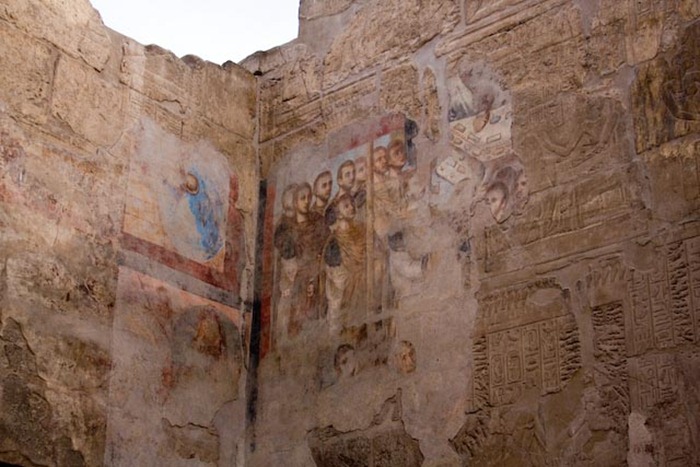
    Baryonyx was discovered in these former deltas. In January 1983, an amateur fossil hunter named William Walker came across an enormous claw sticking out the side of a clay pit, Smokejacks Pit at Wallis Wood, Ockley near Dorking in Surrey. He received some help in retrieving the claw and several other fossil bones from the site. Subsequently he contacted the Natural History Museum in London about his find.
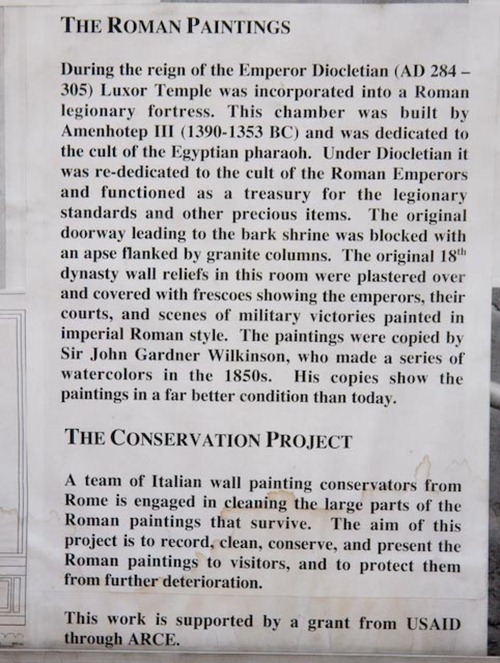
    They also had a great explanation of why the dinosaurs REALLY disappeared:

    2007 Jan Natural History Museum  (17)

    We rounded out the day with a trip through the mammal exhibit which is filled to the rafters with sculptures and preserved animals of every type. Fascinating exhibit, although someone needs to dust the whale (smile).

    2007 Jan Natural History Museum  (20)

    I estimate that we could spend 2 more full days in there and not cover the building. What a great place.