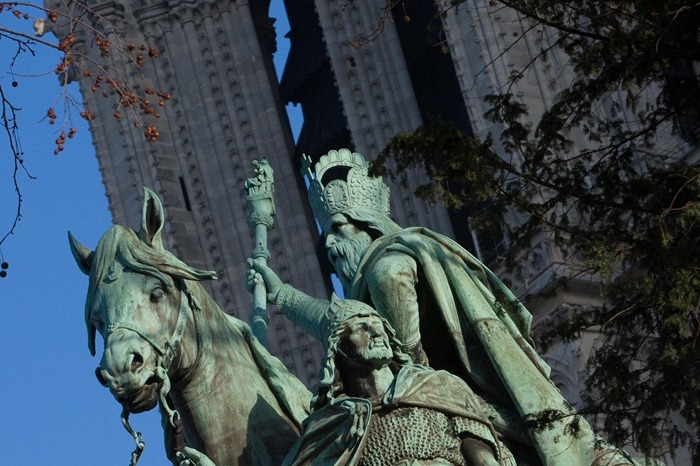
A WEEKEND IN NORMANDY – PART 1

Well, we are finally settling into our new home. That means I can start processing the photos from a few of our last trips, Italy and Normandy in particular. One of the advantages of England is that it is so close to everything. Heathrow is a great jump off to Europe with low air fares (although I doubt that our travel agent every got us a low fare) and the Eurotunnel which is a hop, skip and a jump into France.

One of my personal ‘must do’s’ before we left England was Normandy. As an avid war history buff, there was no way that the opportunity could be missed – and of course, we both knew that the boys would love it. So, on a May long weekend we hit the road. To prepare for the trip, I cracked out an old documentary that I use to love as a young boy – The World at War. We watched the D-Day episode and it set the tone for the trip, giving the family a grounding in what we were about to see. The most significant (and widely watched) piece of footage was shot on Juno beach by Sergeant Bill Grant. The film shows Canadian troops of the Queen’s Own Rifles, 3rd Canadian Infantry Division, landing in the second wave at Bernieres-sur-Mer, Juno Beach, on D-Day.

"It’s the film sequence that epitomizes June 6; that indelible sequence showing darkened but clearly visible figures of the Queen’s Own Rifles of Canada silently exchanging last moment instructions, moving ladders and rifles into final ready position and patting the forward-most troops on their backs for encouragement. The doors swing open and the brighter outside light streams in. The first troops leap out of the landing craft. Ahead of them, clearly captured in Grant’s sequence, are the famous beach-resort houses that the Germans had incorporated into their coastal-defence system. It is point-of-view film of the greatest amphibious invasion in history — the D-Day landings." (from an article by Ted Barris, Friday, June 4, 2004 – The Globe and Mail).

The war footage was rushed to England where it was showed around the world to show the landing in Europe.

As a family, when it comes to trips, we are not the ‘early starter types’. We have a philosophy (which at times I have resisted), if you jam in too much, make the days too long, you lose the moment – and it becomes seeing sights for the sake of seeing sights, instead of truly enjoying it. So we scheduled a Flexipass time for 10AM and headed to France. Our final destination for the day was to be Hotel Barriere in Deauville Normandy. While making the 6 hour drive, we planned to stop at Dieppe to see the sites.

2009 05 02 Deauville  (3)

2009 05 03 Deauville  (10)

The French countryside was beautiful, farms in full swing and mustard fields in full bloom – yellow as far as you could see. As you drive toward Dieppe, the first thing that struck me were the markers. Everywhere you went, you saw memorials to fallen soldiers (many from WWI). It is not unlike England, and Canada, where there are memorials. The difference is the location. There are markers in the towns, but there are also markers randomly scattered along the roads. A reminder that this is where the two great wars were fought, hand to hand.

2009 05 01 Canadian war monument

The second thing I noticed as we drove into Dieppe were the Canadian flags. I have read about Dieppe, and there is much debate on the debacle:

The Battle of Dieppe was a test for the full-scale invasion of western Europe. The plan was to make a frontal assault on the town of Dieppe, across the English Channel on the coast of France. The raid on Dieppe would give the Allies a chance to test techniques and equipment for landing troops from the sea. The Battle of Dieppe was a disaster for the Canadians. Nearly 1000 Canadians died and nearly 2000 were taken prisoner.

In the book Juno: Canadians at D-Day, there are two views. One view states that it was a tragic waste of Canadian life while many others say that it was key to D-Days success. Dieppe taught many lessons to the Allies, some very mundane, but in the end it helped teach the Allies about how to invade. A terrible cost, but one that paid off in many lives saved.

The third thing that I/we realized is that it was a national holiday in France and that the sights that we were going to see (The museum) were in fact closed. Which was fine, as we climbed the hills overlooking the beaches and had our first experience with German bunkers. They are scattered along the cliff, huge concrete behemoths, hidden slits poking out of the ground, some are left as only chunks of broken rebar. Amazing to climb into them and look out on the beach, although you need to be careful – the local kids obviously enjoy hosting beer drinking parties in them.

My fourth realization? That I forgot to put a CF card in my camera. So, no pictures of Dieppe. Well, that isn’t quite true. I had many pictures of Dieppe. The problem is that after I looked at them in the viewer on the camera’s built in memory, they disappeared into the cosmos …..

After a light lunch, we headed down the coast toward our hotel. Driving through the French countryside is a wonderful thing. I constantly found myself staring out the window, enjoying the huge range of architecture, thatch roofs with tulips growing out the top, Wisteria in full bloom. And of course, churches. Beautiful old churches, everywhere.

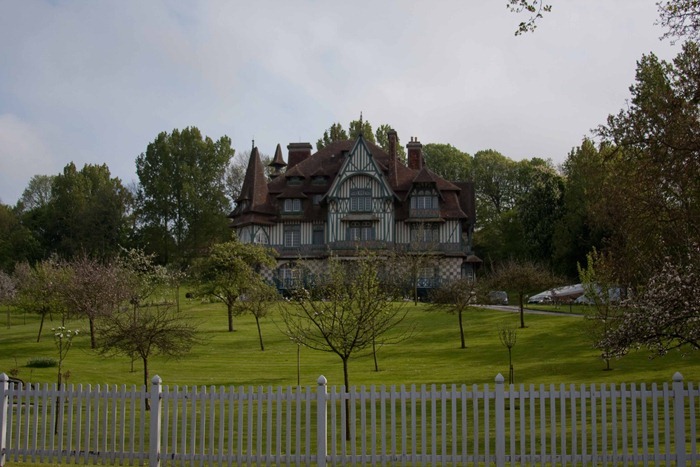
2009 05 03 One of many French churches  (3)

2009 05 02 Deauville  (2)

We arrived at the hotel late and faced our first challenge, the car park was full (groan). A common occurrence in England and Europe. When they were building in the 1800’s, no one really took the time to think ahead to when stables would be displaced by motorcars (smile). At least the French are a bit more commonsensical than the British, they all park in the same direction. It only took 20 minutes of driving around and around to find a spot.

We decided to head down to the hotel restaurant (which is highly rated) and enjoy a quick dinner as we were all tuckered. It was there that I enjoyed what had to be my 400th ‘buyer beware’ experience. I have become quite fond of Gin and Tonic while in England (I am told that drinking ‘G&T is ‘very British’ … so be it). So I ordered up. The waiter brought me a Bombay Sapphire, in the glass with ice, Tonic not poured. It looked like a lot of Gin, the glass was half full. It was. I had to keep adding tonic to distil it down. When I got the bill, I figured out why – €18. For my Canadian friends, that is about $25. My one and only G&T in that hotel (LOL).

Outrageous G&T aside, the hotel was amazing. Any hotel that lets animals in the restaurant and in the room is alright by me. We could learn from the French in that regard – that is for sure.

2009 05 02 Barriere Deauville_

So ended Day 1. Day 2, off to the beaches. And of course, the weather looked ‘very D-Day’ like, clouds ahead.
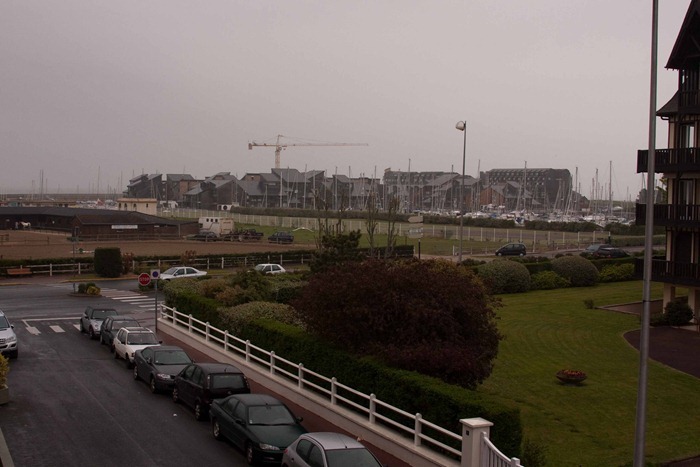
2009 05 02 Barriere Deauville  (2) 
AMAZED


I love watching Canada Geese. They are beautiful birds. Since starting my job back in Canada weeks ago I have been fascinated by these Geese as they wander outside the office. They seem oblivious to cars and people, with the parents walking the kids across very busy streets at all times of the day. People are attentive and slow down, but you have to worry that one will get hit.

All the while they remain so calm, like we are not even bothering them ……

IMAGE_023[1]

WINDOWS 7: PROS AND CONS


Having spent a long time at Microsoft, a few of my Applefanboy friends hypothesized that as soon as I left I would run out and get an Apple. Personally, I ribbed a few of my Microsoft friends that I was going to do it. Time is past, the joke is old, I remain a PC – narry and Apple in the house.

What I have doing it running Windows 7 and I have to say, color me impressed. A few highlights for me (which I can now blog openly as I no longer work there):

  • Speed. Take an old laptop. Put Windows 7 on it. It will scream. Take a Vista machine and put Windows 7 on it, big difference. I don’t know what Veghte did, but his team sure sped it up.
  • Interface: The little things – the tool bar changes and the quick jump feature where you last actions with that program are listed. Great feature. All in all, well thought out across the board from the network sharing to the mobile device management.
  • Sharing:  Love the homegroup and libraries notion, it makes sharing so much easier. Permissions were WAY too complex before. You needed a network administrator. With some of our pictures, I have started to create unique sorting libraries to pull from when running a screen saver.
  • Media Center: Finally, native DIVX support. The ability to sit on a computer and push a playlist to an extender is a brilliant feature. If you run an XBOX and the extender feature, check out the new screen saver. It is guaranteed to make your family and friends mesmerized as it pans and zooms.
  • Gadgets: I know, old hat for many. But the gadgets are great and the sidebar had to go.
  • Compatibility:  When I first upgraded to Vista it was a nightmare. Nothing worked. Old apps crashed, devices were without drives. Other than virus protection, everything works. Many people complain about this, but think about the magnitude of the challenge. Unlike Apple, Microsoft runs an open ecosystem which supports hundreds of thousands of devices and builds. The enormity of the task beat Microsoft in Vista, but thanks to the core system elements being the same, none of those challenges exist this time around.

Now a few things that Windows 7 missed out on (and are easy to fix):

  • More screensavers: Microsoft pitches ‘Memories’ as a key experience. Why is Windows 7 not loaded with different types of screen savers? People want the ability to show their pictures everywhere in different ways. Microsoft has the assets (think Windows XP and the Digital Media add on which had 10 different screen savers that my family loved).
  • The extender never quite gets all the way there:  Microsoft is almost there with Media Center and the extender but continues to fall short resulting in all these little hacks that people need to do to make everything work. In my mind, there are two primary deficiencies remaining:
    • Full codec support: Where is MKV? Why not support every single codec out there that the market loves and make it so everyone can use it right out of the box without a hack. This is short sighted and an ongoing frustration.
    • DVD streaming: Why can I not have a DVD VOB file sitting on my Media Server and see it in the ‘Movies’ section of my extender. It works on the PC Media Center interface, why not on the extender? Seriously, it can’t be that hard. And why can’t I mount an ISO? I don’t have a Bluray yet, but I understand that isn’t support either.
    • Back to the first point, why is the extender not the coolest device out there for showing pictures and family videos? There is an industry to be MADE on this feature alone. Give me 10 great screen savers on my XBOX and I guarantee that every person who comes over will want to do it.

All in all, a huge step forward. All machines are almost upgraded. Of interest, even Mini Microsoft is enthused, for the first time in a long time. The release of Office 10 web is very interesting (And having seen a demo, it is impressive), although I would question whether BING will move share. Interesting times … but no Apple for me.


UNPACKING

 
Well, tomorrow is the beginning of the end. Our stuff starts to arrive. It will take a week or more to get it all unpacked. We are hoping to avoid a summer of Home Depot, paint swatches and house changes. I do not want to become Frank again …. I want my Home Depot days behind me, I have been there way too often in the last month:
 
Frank: I told my wife I wouldn’t drink tonight. Besides, I got a big day tomorrow. You guys have a great time.
College Student: A big day? Doing what?
Frank: Well, um, actually a pretty nice little Saturday, we’re going to go to Home Depot. Yeah, buy some wallpaper, maybe get some flooring, stuff like that. Maybe Bed, Bath, & Beyond, I don’t know, I don’t know if we’ll have enough time.
Almost there.

NEGOTIATION IN A RECESSION


I recently read an article on MSN about personal negotiation titled ‘Haggle anywhere .. Even in big box stores’ on how you can negotiate in places that you never thought possible. Personally, I negotiate in one shape or form all day long as part of my job, so in personal life I just want it done. In other words, if you are a decent sales rep, I am a pretty easy sell. Plus, my dad used to do this and when I was a kid it made me uncomfortable. So I don’t do it often.

In the article they basically said that you can negotiate in all big box stores (although I doubt that this applies to Costco). The opening line being ‘What is your recession price?’.

"The thing people don’t understand about the retail industry, especially brick-and-mortar stores, is that prices aren’t fixed," said Albert Ko, a co-founder of bargain-hunting site CheapCheapCheap.com. "With the economy, it’s all about the numbers and getting goods sold. . . . They’re willing to listen and work with you."

Interesting. By accident I did this two weeks ago. We are almost moved into a house (ending three months on the road for me) and I needed an LCD mounting kit. I went to Home Depot and saw one for $169 but it looked flimsy. So I walked next door to Future Shop. It was dead in there, so they were clearly up for a sale. The one I wanted was $369. I simply looked at him and said ‘I understand this is better quality, but I was over at Home Depot and they have one for less than half the price. It isn’t twice as good’. He said wait a minute and came back to tell me that I could have it for $300.

I saved $100 without even negotiating.

The same goes for contractors. I am not sure if there is a recession out there. As we are moving into a new house, it sure seems like they are not very interested in returning our calls or earning our business. We had a contractor in and we told him we were in a hurry so he gave us a price to paint the house. When I heard it, after sitting down and slowing my heart rate, I suggested to Narda that we should get a few more quotes. I called 8 painters and left messages, getting 3 return calls. Shocking that only 3 returned the call, business must be good. We then went on and got 2 quotes and sure enough, the first guy was way high thinking that we would not benchmark the price. In the end, we will do it for less than half the original quote.

So while I hate doing it, seems like a fair deal only comes from a little haggling.

BETTER OFF TED. LIFE …. BETTER.


As I have mentioned before, I enjoy TV. I enjoy it when it is on a PVR, a DVD or my hardrive and I can watch it when I want. We came across this quirky ABC show recently called Better Off Ted. It follows an executive at Veridian Dynamics, an industrial conglomerate that does pretty much everything. The trailer:


Throughout the show they insert corporate commercials, very witty:


And of course, someone had to make their own commercial, covering when Obama asked for free air time:


Love a witty show. So few out there.

A FEW REFLECTIONS FROM THIS WEEKEND


Another beautiful weekend in Ontario (I do love the sun). A friend told me that the UK is having a heat wave – which was something that we never experienced. I love the UK weather, but a tan was not in the cards. While enjoying the sun, a few things came to mind:

  • I have a new lawn. Being male, I have a chromosome that drives me to have a nice – weed free – green lawn. All males have it. In Ontario, weed killer is now banned and the previous owner was able to deny is internal drive to keep his lawn weed free. This means that the dentist on the left of me has a really nice lawn, the people on the right have a really nice lawn and I have dandelions. Now, I think dandelions and thistles are quite pretty in a country setting. But as part of my lawn, they are irritating. I have an old weed picking tool from Lee Valley Tools that is calling out to me. But I wish that I had not given away the contents of my old tool shed … it was full of ‘labour free’ tools to eliminate weeds.
  • Amazon was one of my favourite sites in the UK. Because the retail experience was so painful, I did everything I could to buy online. The latest addition to the Amazon site was DRM free MP3s. I love DRM free. DRM bugs me on all levels. I should not have to pay for a song and then be unable to use it on all my computers or devices. Amazon in Canada does not have DRM free. In fact, other than going to the much loathed iTunes, it does not appear that anyone has DRM free. And the record companies wonder why people download the music for free?
  • WIRED had an article on the new Terminator movie recently (appears to be a must rent). In it, McG (director) talked about how he made everyone read the Pulitzer Prize winning book ‘The Road’ to get a real feel for what it would be like in a post nuclear world. The book follows a father and son as they trek across the wasteland on their way to the coast. Very ‘Mad Max’, only grimmer – much grimmer. I read the book Saturday night and did not sleep well. What was most disturbing about the book is that it felt so real – everything in it made me think ‘Yep, this is absolutely what it could be like’. Personally, if it comes to that, count me out.

Very appreciative of that fact that I only have to worry about weeds in the lawn.


25 REFLECTIONS ON THE UK (PART 3 OF 3)


5. One more on cars. Parking is very funny in the UK. In North America, when you park on the street you must park in the direction of traffic in the appropriate designated area. In the UK, people park on either side of the road (direction is irrelevant) and often anywhere and everywhere. After all, parking wasn’t an issue hundreds of years ago so they really didn’t plan for it.

4. British people LOVE their dogs. We loved that they loved their dogs. Parks are full of dogs running around. The elderly (who seem healthier than North Americans) are always seen walking around with their dogs. Everywhere you go – dogs. On Wentworth, one of the more prestigious courses in the world, dogs are welcome. Our neighbour would golf every weekend with his lab running behind him. Amazing. We North American’s could learn something from the European’s in this regard – seeing a family with their small dog in the restaurant in Normandy was incredibly refreshing. That is a true ‘family’ out for dinner.

3. Everything has a cost and a benefit. I just realized, after 24 amazing months that one of my costs was that I never got to say good-bye to my dog, Bram. Ciao Bram.

2. It is all about people. England is a diverse culture and I am thankful to have worked with and met many amazing people who have a huge impact on my outlook on life and my character. In two years, I owe many people an enormous debt of thanks.

1. Life is about experiences, not things.

25 REFLECTIONS ON THE UK (PART 2 OF 3)


15. England is very old. Canada is very young. Two years later, driving by an old church or a pub that was built in the 1400s still amazes me. I could spend hours wandering a cemetery reading the inscriptions, history was made in the UK.

14. Stop signs should be banned in North America – long live the roundabout. North America should learn the lesson.

13. Spoiled food is good. In Canada, things don’t spoil quickly. In the UK they do. As an expat it is initially frustrating as you have to hit the store more often. However, you soon realize that quicker spoiling means less preservatives and definitely less salt. All organic is now the family motto. Oh yah, and I now detest chain store fast food – have been without it for 2 years and don’t miss it.

12. Male fashion is all about the brown shoes with the suit or jeans, and the French cuff shirt. Got it. Understood! But still don’t buy into the whole pink shirt thing. Sorry.

11. Parking in England is an adventure. Like everything else, the people building the homes and roads 1,000 years ago were just not thinking! I had a BMW 5 series estate. Parking with that car meant that every time that I got out of the car two things would happen: there would not be enough room so I would have to get out sideways and no matter how hard I tried, my door always touched the car beside me. The only car that actually had enough room to park was the Mini (which is why there are so many of them in England I suppose).  In the end, the UK has cars, but really isn’t made for cars. The UK was made for horses and walking.

10. The world is flat. Ten years ago, going international would have been a lot harder. Web cams, 1 hour phone calls for $1, email, digital photos and videos, cheap flights, social networking and XBOX LIVE keep you as connected .. as you want to be.

9. A Tom Tom GPS got me all around the UK, Washington, Scotland, Belgium, Paris and through Normandy. I cannot imagine doing this without a GPS. And I will never buy in car SATNAV again. Overpriced, hard to update and generally underperforms – mobile satnav for me please.

8. I have become a very proud Canadian. Canada is a great country, with a rich and varied culture (French, English and everyone else in the world) – with a proud link to Britain.

7. Customer service in the UK is a paradox. The milkman comes to the door 3 times a week (good), you can order groceries on the internet (good), Amazon lets you buy pretty much anything you can think of (books, DVDs, shoes, MP3 drm free downloads to filters for my Jura coffee maker) from one central place and have it delivered in 1 day (awesome). But the ‘convenience’ store on the corner closes at 6, the mall is closed at 6 on a Friday night, the 16 year old checkout boy at the counter sits down while checking me out and watches me pack my own bags, and on many occasions, because they thought we were American – they were downright rude.

6. The world owes the UK an enormous debt for their resolve during WWII. If it were not for this nations ability to hold out while the Americans made up their minds, the Germans would not have been stopped.

25 REFLECTIONS ON THE UK (PART 1 OF 3)


A few final reflections ….

25. England has yet to manufacture a cart that goes straight. Shopping cart, luggage cart at the airport, all carts. Every day, hundreds of thousands of UK residents can be seen wrestling their cart down a parking lot – sideways.

24. It does not rain a lot around London. It rains more in Toronto. It is just cloudy. Much better than snow.

23. British humour is exactly like the stereotype. I love it.

22. I was naive about cultural differences. It is always bigger than you expect. Whether a new country, new business, new company …. And the UK and Canada are very different, despite a shared history.

21. Bureaucracy was invented in England. Americans learn that first hand when they try to get their drivers license (which costs them 400GBP, involves driving tests and many failures). But it also works in wonderful ways sometimes …. If you are part of the commonwealth, all you have to do is hand in your old license and they give you a new one. Voila!

20. If you move to England you need to think of a Great Britain Pound as a dollar (great advice from a friend). That means when you see an entrée in a restaurant that is $7 in Canada and £7 for the exact same thing in England (which is $12CDN), you have to stop converting. If you don’t, you will go insane. It is also the reason why I laugh at customs when I come into Canada from Britain and they ask if I have anything to declare from Britain .. I always answer ‘Have you seen the prices of things in England?’

19. I have new respect for English. I have sat through entire conversations unable to understand a word that was being said. The best example being when I sat in a sauna in Scotland and 6 blokes came in and started jabbering on – I understood (maybe) every tenth word. Amazing. Good thing Canadian is the new standard for English – accentless and understandable by everyone.

18. I still can’t call someone ‘mate’. Coming from me it sounds like I am trying too hard to fit in and mentally, it remains a verb – not a noun. I do however say ‘diary’ (calendar), ‘loo’ (bathroom) and a few choice words not meant for print.

17. There are more types of beer in England than there are football teams. But I have converted. I now drink G&T, which always draws a ‘Well, how British of you’. If you can, try Hendricks, and shockingly Scottish!

16. I still don’t get going to the pub after work. I would rather go home to my family. I also don’t understand why Christmas parties are without spouses. Thankfully, that is changing.


THINKING AND CONTROL


I recently had an interaction with a successful leader where he shared his view on the elements needed to achieve success. One of them was very interesting, it was as simple as ‘think’.

In the panic of the global meltdown it is fascinating to compare and contrast leadership styles, and how ‘think’ is applied within organizations and sales. The knee jerk reaction to a bad situation is to put in more process and control. Process and control is needed in all business, but it must be measured – balanced. Neil Rackham provides some great evidence in his work around process and sales productivity. In small and medium business, Rackham notes that there is a direct correlation between quantity sold and quantity of sales calls. These are transactional sales, low quantity and low value per deal, often requiring a single sales interaction. However, in multi-call or complex sales cycles (Upper Medium or Enterprise), it is a different story. Consider this (via):

Whenever it takes many calls to conclude a sale, and the economy tanks, sales leaders may ask their Reps to work harder. Reps then build bigger funnels and half-sell to twice as many prospects. This is a proven recipe for big effort with small rewards. An example which Rackham cited: a capital goods company in which Reps were making an average of 1.4 calls per day. The VP Sales pushed for more effort and got:

  • a 36% increase in calls/day
  • a 16% increase in orders
  • a 1.5% decline in sales (as the average deal size declined)
  • resignations from 4 of his top 10 salespeople
  • subsequently fired

Instead, in these circumstances, Rackham advocates:

  • working smarter, not harder (serve the right few)
  • creating value (rather than communicating it)
  • making calls so valuable that prospects would pay for them
  • focussing on safety (it will matter more than price)

For the sales leader who is not balanced, who prioritizes operational excellence or metrics above all else, this must seem counterintuitive. The VP pushed for sale call tracking and ‘more calls’, surely that will lead to more sales? But what is forgotten is the value of people and thinking. The value of inspiring people to do great things.

Metrics such as volume of sales calls or a scorecard are valuable tools to indicate where an organization is. I have often told my teams, putting contacts and opportunities correctly into a CRM tool is not a negotiation – it is a condition of employment – we need to know where we are. Nothing frustrates me more than having to do a manual forecast – it is a waste of the saleforce’s time and management time. But it must be remembered that metrics are not the end goal, they are a tool to reach a goal. After all – if you raise your number of sales calls but miss your number, or you have the best scorecard inside the company and miss your revenue target – you still failed.

So there needs to be a balance and one must carefully guard against a cultural shift where adherence to the process becomes more important than evolving the business. Thinking must not be replaced by blind obedience. If ‘thinking’ stops, then how will the business find new ways to outperform the competition? After all, a company cannot outperform a market by adhering to the norms – whether external norms (market conditions) or internal norms (doing it exactly like corporate dictates).

In the book ‘What would Google do?‘ there is a great quote:

‘To gain control, you have to give up control’.

There is a balance to be struck. Put in place operational excellence so you know where you are as you pursue your goals, while trusting in people, helping them take risks, watch those risks pay off, make a few mistakes and learn from those mistakes. And as that leaders stated, remember to ‘think’.


ON PATIENCE


When your family belongings are somewhere on the Atlantic, it becomes a little trying on the nerves. I realized that it was getting to me last week after the lawyer incident, followed by the renovator not showing up when I arranged to have the house opened for him, among other things (like not having black shoe polish but knowing that you have 10 bottles of it on a ship).

Funny how it is the little, stupid things that nibble at the edges and frustrate disproportionately if you are not carefully watching. Time to start working out again, now if I could just find my water bottle ……


AUSTRALIAN AIR


I was reading GQ the other day (I have not read a GQ in decades, but picked one up randomly while at the airport a couple weeks ago) and their Joke of the Month page has a few ‘overheard’ announcements from Australian Airline attendants trying to make the announcements a bit more interesting. A few that made me laugh out loud:

  • Before takeoff:  "Welcome aboard. To operate your seat belt, insert the metal tab into the buckle and pull tight. It works just like every other seat belt – and if you don’t know how to operate it, you probably shouldn’t be out in public unsupervised"
  • During the safety briefing:  "In the event of a sudden loss of cabin pressure, masks will descend from the ceiling. Stop screaming, grab the mask and pull it over your face. If you have small children travelling with you, secure your mask before assisting them. If you are travelling with more than one small child, pick your favourite"
  • On departure: "Please be sure to take your belongings with you. If you’re going to leave anything, please make sure it’s something we’d like to have"
  • The farewell announcement: "We’d like to thank you folks for flying with us today. And the next time you get the insane urge to go blasting  through the skies in a pressurized metal tube, we hope you’ll think of us"

From that same article, Michael McIntye:

"They’ve got their own money in Scotland. It’s still the pound, but it’s their own pound. They were offered their own currency but they thought ‘That’s too complicated mathematically, let’s just have your notes with our photos on it’ Have you ever tried to use Scottish money in England? There’s nothing more tense in life. When you hand it over, they look at you like you’ve just handed them a dead baby"

I laughed when I read this one. It is so true. When we went to Scotland we ended up with a bunch of their notes. I had one English fellow tell me that he didn’t know what they were but he wasn’t going to accept them (LOL). And of course, a guy without a British accent (Have I explained how I have no accent yet?) wasn’t going to convince him that it was legal tender. No way, no how.

A few other tidbits:

Best Life (the now dead magazine) had an interesting tidbit on roundabouts:

"… roundabouts move 30 percent more vehicles than traffic signals do … Their circular shape makes all the drivers travel in the same direction and this reduces serious crashes such as head on collisions by about 90%. "

The Brits have this one right. Ban all stop signs, I can’t stand them. They are so inefficient. Bring the roundabout to Canada.

The race to build a good music distribution system is getting more interesting. The Sonos is the most popular, but for those of us who have a home with prewired speakers, Logitech’s Squeezebox Duet is very compelling and half the cost:

Play songs stored on your PC or Mac in your den through the home stereo in your living room. No need to run wires or bring your computer to the living room to listen to your favourite tunes. Play your favourite tracks from the palm of your hand with the color remote.

All you need to get started is a Wi-Fi connection. Simply plug the Squeezebox (TM) Duet receiver into your home stereo system, bedroom stereo or kitchen audio system—anywhere you have audio gear. With the intuitive remote control, it’s easier than ever to browse, select and play your favourite music or discover new music.

So many choices.

A QUESTIONABLE LAWYER


I think that other people’s time is valuable. I think that my time is valuable. Therefore, if I am late to a meeting or for an appointment, I apologize. A month ago I was 15 minutes late for the doctor – I offered to pay the fee and reschedule, after I had called ahead while travelling to let his assistant know that I would be late.

Common professional courtesy. But this is not a common approach.

Last night I arrived with my family for our lawyer appointment 5 minutes early. Prompt. We then waited 25 minutes. At the 10 minute mark, as the receptionist was leaving (it was the end of the day) I asked:

‘Will he be much longer?’

She looked at me funny and said ‘Why, are you in a hurry?’

At that moment, I recognized what this was – a personal growth opportunity. A test of some sort.

I smiled and said ‘Actually, I have had a really long day. In fact, it has been a really long month. We are just back from England and it is a bit crazy. We would really like to get home. That is why I made an appointment’

‘Well, he is usually really punctual. Really punctual. So I am sure he will be with you as soon as possible. His last client was 30 minutes late’. She resumed packing her bag.

‘Excuse me, does that mean he will be 30 minutes late?’

‘I am not sure. I am sure he will go as fast as he can’. She stood up, grabbed her stuff and left for the day.

When we finally did enter his office, he didn’t apologize. Instead, he acted like he had known us for years (first time we met). He then went on to provide long winded explanations to everything that we were signing despite my using very polite prompts such as ‘Thanks, we understand what a deed is’, ‘Thanks, I understand how money is transferred from my bank to you in trust’ or ‘Thanks, this is the 3rd home we have bought, so we don’t need to have that explained’. He just went on and on. To make it worse, throughout the conversation he swore in front of my boys. Not big swear words, but little ones non-stop. Enough so that when we left the boys mentioned it.

To top it all off, for the last signature he looked at me, smiled and said ‘And this is the last signature. Mikey put your signature right here’.

My wife and I walked out of there and started laughing. It was a surreal experience. Of course, I also noticed this book on his shelf …. which made me laugh. Considering what he charged me, that is good margin for 6 minutes of education (LOL). He should have read a 6 minute book on professionalism.

Click to enlarge

INTERNET MONITORING

It is hard to know who is monitoring what you are doing online these days. Obviously, when you are in the office you can expect to have all online interactions monitored. After all, you are working on a company asset. A few months back I had a conversation with a corporate security guy around company internet monitoring and his response was ‘You would be surprised the sites that people go to. You would think that common sense would keep employees away from the obvious ones, but people still go there’. He went on to mention that this isn’t their focus, it is just inconvenient (and irritating). Their focus is on things like corporate fraud, identity theft, etc.At home, it is a different story. With the ever present threat of phishing and other internet attacks, it pays to be smart and attentive. Readers Digest had a good article on how to find out who is monitoring your activity online, in case you want to know:

  • Go to vancouver.cs.washington.edu and let the site automatically check whether your ISP is using monitoring devices.
  • Download Tor from torproject.org which helps block prying eyes.
  • Don’t sign up for email with your favourite search engine, as it makes it easier to link your interests. Google specifically.
  • Or use anonymizer.com or anonymouse.org to browse anonymously.

A few helpful tips.

WHEN IT IS TOO GOOD TO BE TRUE


As part of the move back to Canada, we are moving back into a North American size home. Which means a lot bigger. As part of that, we will now have a rec room for our soon to be teenage boys to hang out in and a TV is required. So I surfed around a few traditional electronics sites and then hit SuperShopper to see if there were any good deals.

There was one. A 60’ Pioneer plasma for $1,000. That was a good deal so I sent an email to the person. I found it odd that they did not include a phone number, which was alarm bell number one, with the price being alarm two.

I received the following email back that night at 1:32 a.m. (or around 7 a.m. Africa time):

hi,ok but  I am sorry,  I am now out of the town with business,so if you want we can arrange the deal via eBay,i will email eBay to create an invoice for payment and shiping details,the transaction is insured and secured,so let me know,thanx

Uh. That seems odd. I responded:

Hi Julie;
Not interested unless I can see the product. When can I see it?

Response:

i am sorry the product is with me,i will be back after sep,and i want to sell the product until then,so the only way will be via eBay,also i have refund options,and the shipping is free and insured ,so let me know,thanx

OK. So let me get this all straight:

1. You are away on business for the next 3 months. That seems odd.

2. You have the product with you. You are carrying around a 60’ plasma? But you will ship it from the aforementioned location where you are doing business?

3. I cannot see it, but you have a refund option if you ship me the product and I don’t like it.

I wonder if Julie is related to the Nigerian prince that keeps emailing me asking for my help in getting his $20M out of the country.

THE TRIALS OF TED HAGGARD AND A FEW OTHERS


When you are travelling across the ocean once or twice (or in my case – a lot over the last 2 months), you get caught up on the latest movies (I figure I can churn through about 100 emails per movie). The International, Marley & Me (which made me want another lab), The Wrestler (My brother will be crushed, he always thought wrestling was real), Valkyrie (which I turned off after an hour – when you know the outcome why bother?), to name a few.

But two shows left me unsettled:

  • Taken: The story of an ex-CIA agent searching for his daughter who was abducted by Albanian criminals who sell women as slaves. Liam Neeson slowly churns his way through the bad guys to find his daughter just before she disappears forever. In the end, the obvious happens. But what I found unsettling was the fact that this stuff actually happens. We all know that the slave trade still exists, that eastern bloc women come to the west with a promise of a job as a maid and are forced into other things. Very unsettling movie.
  • The Trials of Ted Haggard: I know this is a big deal, and it is bound to be a topic that people get very emotional about. I did not know the story but can recall the noise around this one. If you are not familiar with it, read it here. To summarize, preacher rises to fame, preacher commits a sin which becomes very public and falls from grace. A story played out over, over and over again. What was disturbing about this one is how he was dealt with it. The HBO documentary follows him and his family around as he tries to find a new way, after being banned from his home. He is not like some of the other famous preachers that we have all read about who have the million dollar homes and associated luxuries. He comes across as a rather humble man (obviously assisted by his current circumstances). But I was left wondering, what about forgiveness? Why was he banned from his home and state for a year and a half? You watch as the man and his family are slowly but surely torn down, brick by brick with not many forgiving souls nearby.

One final movie which I hummed and hawed about watching but must absolutely recommend is Frost/Nixon. Great insight into one of this centuries most dubious characters and how a talk show host brought out a confession when every newsperson in the world couldn’t even get close.

A HOUSE, 2 CARS AND A CHANDELIER

I often reflect on my own personal purchasing experiences from a professional point of view, always looking to learn. While I don’t enjoy personal negotiating (I do enough of that at work), I find how salespeople treat me interesting. Upon reentering the Canadian market I provided a few sellers with opportunity, I needed a house (and didn’t need to sell a house to get one) and two cars. As I went through the different sales cycles, a few things stuck out in my mind:

  • Be careful about a flippant comment.  During the sales cycles, a few of the sales reps became a little too comfortable or too casual in my opinion. More importantly, certain phrases that they used are imprinted on my brain and really struck the wrong cord. When people are making a big decision, the ‘fight or flight’ mentality is at the forefront and inadvertent comments can send the whole cycle down the wrong path. Here are a few:

A few months ago we travelled to Italy (still not finished processing all of that, will blog it on a future date) with a stop in Venice and Murano for glass. We decided to buy a chandelier. It is a very well engineered sales process to trap the tourist. The hotel offers you a ‘free’ trip to the factory to see glass blowing. You arrive and a super slick salesman shows you the master craftsman as he blows the glass and then you are ushered into their showrooms. In the showrooms all the prices are very high but you are told that by cutting out the middleman and buying directly from the factory you will get 50% off.

The problem in this situation is simple – who knows what a good price is? If he is cutting off 50% will he cut off 70%? So we negotiated to the price we were willing to pay (65% off). We thought we got a fair deal (and when we went back to the island we looked at the shops and we paid ‘around the right price). But as we got on the boat to go back, our salesman said one thing that has stuck with me, making me feel taken as opposed to feeling that I got a fair price.

He smiled and said ‘Thank-you for the business. Please, make sure that you tell your friends about us. We would be glad to service them. We need more customers like you’.

I had to purchase two cars over the last 2 weeks. I have bought one already and know that we got a fair deal as there was a vendor program that took the negotiating right out of it. But I still have one car to go – my commuter car. I don’t care about this car – I am not a big car guy. I need efficient, reasonably comfortable, Bluetooth and an MP3 jack as I love to listen to books as I drive. So the dealer that I bought the first car is trying hard to sell me a second. The sales rep is alright, but I would not hire her. So as I test drove the car, I asked the price. She stated it and I said ‘That is about $3K more than the other car I am looking at and I am not sure that I am willing to pay the extra’. She smiled and made what she thought was a witty comeback ‘Well, then I guess you are buying the other car’.

This is about her 3rd faux pas. So I told her I think I will pass. The sales manager got involved and he said ‘He really wants to sell me a second car’ (What a shocker). So we went back and forth and as I was tired of looking for a car and have much bigger issues to deal with, agreed on a price about $1K higher than the other car. I felt that it was worth it and that I was getting a ‘fair deal’ until he said ‘Well, that was easier that I thought it would be’.

Later today I am going to call him back and tell him the deal is off. I want a fair deal and that just tells me that he took me.

For a house these days it is a buyer’s market. Agents will tell you differently because it is their job to ensure that you don’t take a long time – or they don’t get paid. So we low balled the house that we want expecting to go through a negotiation phase. After the first back and forth the other agent told our agent ‘Look, we are not going to sign back. My client is a wealthy man. He owns a house in England and a few houses here in Canada. He is a busy man and not interested in going back and forth’.

In any negotiation, I was always taught that you can only negotiate (truly negotiate) if you are willing to walk away. I didn’t want to but my wife was unattached and said lets walk. So I called the agent back and said we are walking, please start looking into these three other houses.

Well, magically, he came back. What he doesn’t know is that had he not said that, we would have probably gone $20K higher over the coming 24 hours. But we figured that because he was ‘too busy’ and ‘too important’ that he was also too arrogant and so why bother.

  • No one sent me a thank-you card:  If you have worked with me you know that I am big on thank-you cards. Less than 1% of sales reps do it and I firmly believe that the little things are important (and no, e-thank-you cards and e-holiday cards are not good enough. They show that you are cheap and take too little effort). I have yet to receive a single thank-you card.
  • Very few sales reps followed up:  In the car pursuit, I went to a range of dealers on a Saturday. Each of them had my information. A number of them provided quotes. Only ONE out of the entire car buying experience followed up. Pathetic.
  • It isn’t about you:  It was shocking to hear how little probing the sales reps did around my pain points, my buying cycle or about my personal situation. One extreme situation was at a the Lexus dealership.  By the time the test drive was done I knew that the salesman next to me was divorced, had two kids, lived with his mom in Collingwood, wasn’t ‘really’ a car salesman but really a golf pro, that he loved to give lessons and often did big corporate events for Audi and Lexus, that he had a 5 handicap and was really looking forward to driving home tonight to have a BBQ with an old friend. He didn’t know anything about me (he didn’t ask). He sent me a quote but never followed up even though I told him I was buying two cars. He absolutely didn’t send a thank-you card. He didn’t even get consideration.
  • I appreciate a great sales person: Our real estate agent has been truly awesome. It has been a rough ride dealing with the house and a furnished place (the other agent has been a nightmare). But our agent absolutely believes that ‘5 no’s make a yes’ and has pounded away. Awesome follow-up, open communication, tenacity and a willingness to fight for the deal. And most important, she has shown empathy to our situation and the stress that it can cause. I truly appreciate the person who does it right. Well done.


EXEMPLARY LEADERSHIP


Part of changing companies is the opportunity to ‘purge’, to start your system over (with refinements), to shed a few things that have been hanging around.

Part of my ‘purge’ is to collect up notes from a few leadership conferences that I have attended over the last year. It is interesting to hear all of the different views on leadership, ranging from military obedience to radical concepts such as ‘you must let go of control, to gain control’. The following were processed, according to my estimates, over Greenland on Monday night on the way back to Canada one final time. A few that I found interesting and noteworthy:

The 5 practices of exemplary leadership ….

  1. Model the way:  Talk the talk, walk the walk.
  2. Inspire a vision:  I have seen many leaders false start on this one, promising vision and then letting it fall by the wayside as they become so numbers, process and check mark focused that they forget about the fact that people need to understand where they are going. Without a vision, it is just a daily ‘check-in’, and those leaders find out quickly how uninspiring that is. Set the vision, inspire.
  3. Challenge the process:  When I was part of the UK team, I remember my early months were every question seemed to be answered with a ‘no’ or ‘no, that is not how we do it’. To which the right response is ‘It takes 5 no’s to make a yes’. I had the same experience in Canada too (smile).
  4. Enable others to act:  Allow people to take smart risks, make mistakes, learn and be supported. You cannot outperform a market if you do it the same old way. It requires great people who know that you will be there to back you up and are trying new things.
  5. Encourage the heart:  No one follows the heartless leader, unless they have a gun to their back, and then only until the opportunity appears to change the situation.

 Another speaker on key leadership lessons from his career:

  • Be willing to ask the obvious questions:  Until you understand the business, be willing to ask all types of questions and go deep into the details.
  • Take more risks on people:  Companies don’t do this enough. Empower people to make decisions, support them and make successful.
  • Know when to trust:  Just let your people get on with it. Trust them with the jobs you gave them.

On the course, there was a discussion on attitude and the notion that as a leader you ‘make the weather’. Don’t trust people, constantly criticize, micromanage with little positive reinforcement? Expect a climate of fear. Support, encourage risks, be open with people and watch the clouds clear. One speaker explained it in a great story:

Two cities were separated by a road with a hermit living in the middle. A traveller comes from the city and asks the hermit ‘What is the next city like?’  The hermit responds ‘What was the last city like?”. The traveller responds ‘Beautiful, friendly, amazing’. The hermit smiles and says ‘Well, the next city is probably the same’.

The next traveller walks up the road, stopping to ask the hermit the same question. The hermit responds ‘What was the last city like?’. The traveller responds ‘cold, miserable really’.

The hermit responds ‘The next city is probably the same’

The final executive shared his leadership philosophies as follows:

  1. Be curious, listen and learn:  He was taught, ‘start as an owl, end as an eagle’. Look at business like a puzzle, embrace ‘figuring it out’.
  2. The customer is the north star, the competition is the baseline:  When he has things upside down, he looks to these two to reorient himself, remembering that it is the manager’s job to react and the leaders job to participate and lead.
  3. Play to win and win through/with people:  It is all about the people. He then added a few key insights:
    1. Remember that competition is outside the company, not inside.
    2. Have restless discontent, what is good enough today is not good enough tomorrow.
    3. It is your job, as a leader, to attract, coach and retain talent – to build and grow the best team.
    4. Make sure you bring everyone along, as a team, to the finish line.
  4. Enjoy the journey:  We often get wrapped up in what is next. Smile every day, enjoy the now. It will be tomorrow fast enough.
  5. The most important thing you have is your reputation:  Be your hardest critic. You build a reputation based on how you achieved the results. Achieve the results as a team, in a sustainable manner, the right way.

A few interesting thoughts from a few very successful executives.

TICK TOCK

 
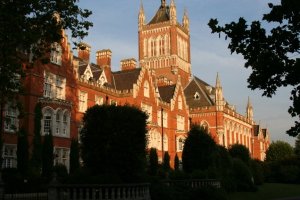
Yesterday was the first day of the end of our UK journey – the movers have arrived. Every day I would come home to this sight, the place where we lived – an old hospital converted into a community. We will miss it.


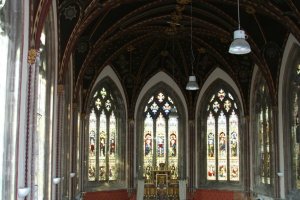
On the site is a deconcecrated church where kids can play. Only in England does a beautiful church get converted into a basketball court. I am sure that the big guy is smiling down on the laughter and happiness it brings to the kids.


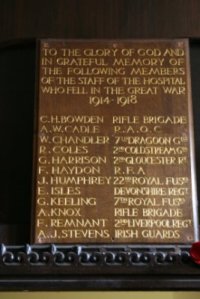
And as with most buildings in England, the church has something to commemorate the price that Britain has paid. I will always admire the British for the part they played in WWI and WWII. We owe them a huge debt of thanks. 


A new adventure begins. 
 

5 LEADERSHIP LESSONS FROM THE UK


As the UK adventure comes to a close, there are many things to reflect on. This week while having dinner with a friend, we talked about what makes a great leader and manager. Over the last 2 years I have learned many valuable business lessons that I will take with me, with these 5 being the ones that ‘stick out’ the most:

  • Better to be red faced once than pink a thousand times:  This was taught to me by a woman whom I have an immense amount of respect for, Martha Bejar. We were talking about having to deliver tough messages, whether on a business loss or a bad forecast. Her logic was quite simple, get the bad news out there – all of it – once, and then get everyone focused on solving the problem. That is much better than what I saw way too often, the drip feeding of bad news up the line because people were afraid of the ramifications. I agree 1000%, get the truth out there, take my lumps and then let’s get solving the problem. I would add ‘good news should travel fast, bad news even faster!’
  • It is easy to be a bully:  When I think about a bully I think of words like disrespectful, always has to have his own way, doesn’t listen and self centeredness – it is all about him. As a leader, the easiest thing to do is to bully your way through situations but it is not the most successful. It leaves people resentful, creates a climate of fear and eventually, it fails. Respect diversity of opinion – creating an open and honest team climate, trust people to do the right things, vary your leadership style, invest in the success of others – not yourself (servant leadership) and exemplify the behaviour that you want to see in the others around you at all times.
  • Never compromise your values:  This one is pretty simple. There is no room for ethical or moral compromise. And if you feel that your leader is making you compromise what you truly believe in, leave.
  • Walk the talk:  If you espouse a leadership virtue as one of your core tenants, then you better walk the talk. There was an article on the turn around of the company ABB and their leader that demonstrates this point well (don’t remember where I read it). The story was about how the company was downsizing and making radical cost cuts. The leadership team was heading to a meeting and the majority of the VPs were sitting in business class. The CEO walked on and as they all watched, he walked past them into economy class, without a word. Walk the talk.
  • Invest in the success of others and you will be successful:  I learned this lesson as a sales rep and have carried it through my management career. If you focus on what will make your customer, partner or teammate successful, then when they succeed – you succeed. As a leader, I always remember, it isn’t about me – it is about the people on the team. If I focus on making each and every single one of them successful, then my success is guaranteed.

I am very thankful to have had the opportunity to have worked with and learn from so many amazing people in the UK. In the end, I am truly blessed to have had the opportunity and it has changed me forever. So my last lesson is …call it the ‘bonus lesson’:

  • Always say thank-you.

THANK-YOU.

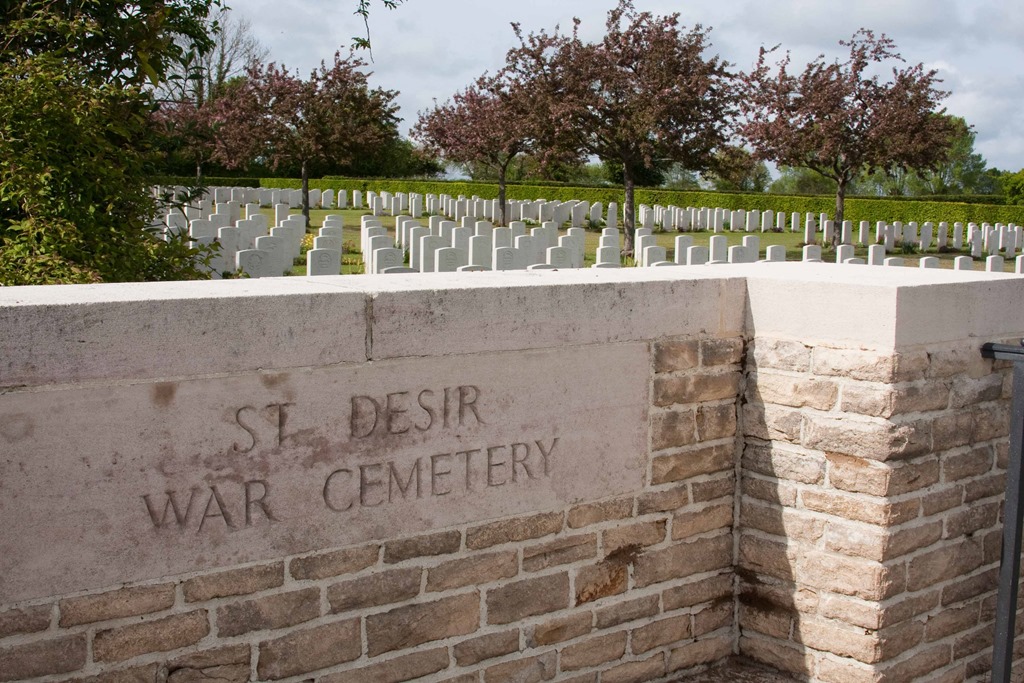
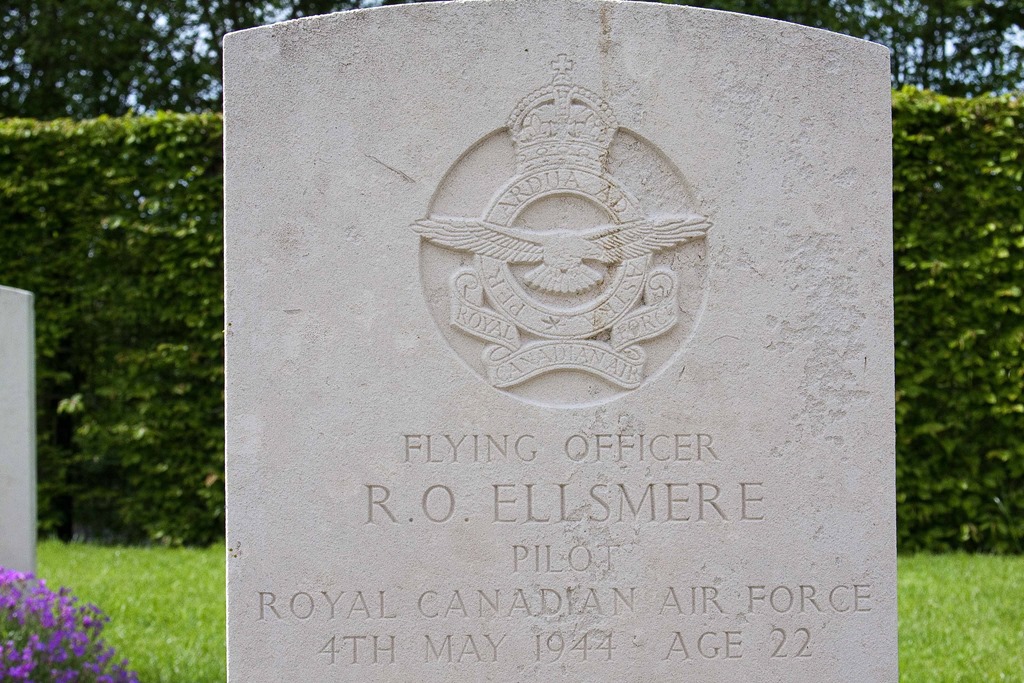
REMEMBER ROSS ELLSMERE, ST DESIR CEMETERY, FRANCE

A few weekends ago our family jumped in the car and headed to Normandy for a long weekend. I will provide additional details on the trip in future entries, as it was one of my favourite trips that we have taken in the last 2 years.

A big part of the trip was the goal of finding one of Narda’s relatives in the war cemetery near the D-Day landings. Veterans Affairs has done an amazing job through the Canada Remembers project of cataloguing where our war dead lay.

2009 05 03 St Desire War Cemetery_

I do not have immediate relatives who served in the Canadian forces during WWII as my family mostly moved from Holland in the 50’s. Ross Ellsmere served in the Air Force as a pilot and died a month before D-Day (probably on a bombing run).  He is buried at St. Desir Cemetery, which is found after a long and winding drive through the French countryside. On the road we were lucky to see the small sign pointing down a side road, in the middle of nowhere. I wondered what it would be like.

Situated just out side of the town of Lisieux, famed for the Basilica dedicated to St Therese is one of the smaller British Cemeteries.

At first the  British and Commonwealth War Graves Commission buried the fallen German troops in a field next doo, where they still are. The Cemetery contains the dead from three different battles. Firstly there are four First Would War Burials who were transferred here after then end of WWII. There are men who fell in 1940 during the retreat to the Seine and those who fell in 1944 during the recapture of the area. Recently the local French village has made a walkway of peace between the two cemeteries

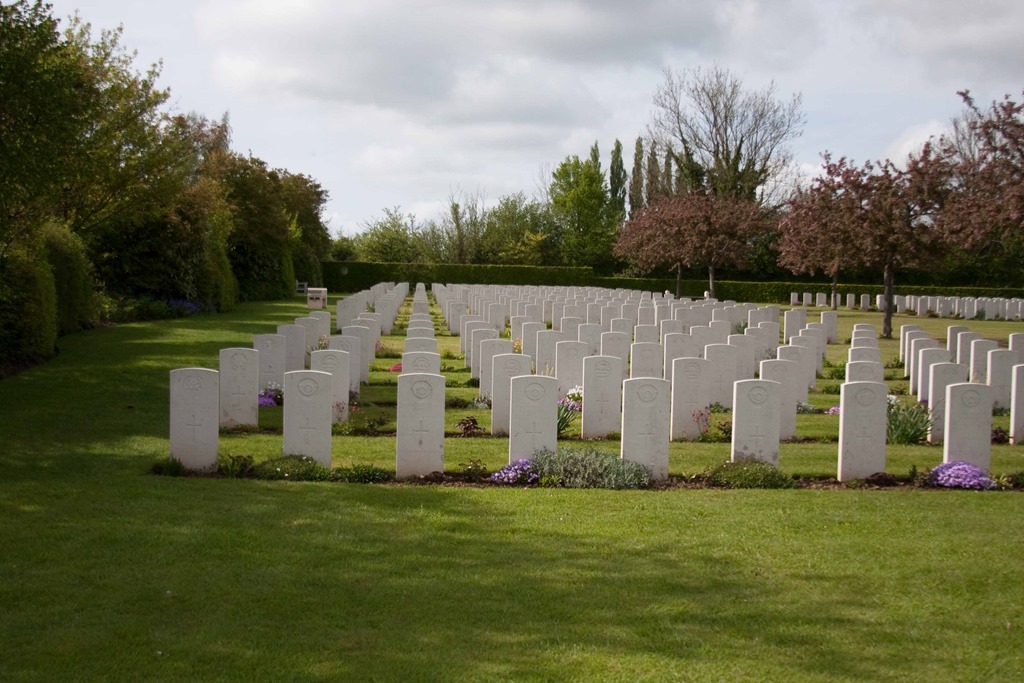
In all there are 598 graves here including 16 Canadian, 6 Australian, 1 New Zealand, 5 South African, and 1 American.

When I stepped out of the car I was hit with two feelings. The first is pride, the cemetery is immaculate – pristine and beautiful. The government is taking care of our war heroes in the right way. The second is a sense of magnitude. This is a small cemetery (550), but the rows and rows of graves is humbling, a testament to the price that was paid for our freedom.

2009 05 03 St Desire War Cemetery  (4)

2009 05 03 St Desire War Cemetery  (17)

The grave of Ross Ellsmere (22) is surrounded by men who died on the same day. It was a bloody day and you are struck by one thing – the age. Very few are older than 22 or 23.

2009 05 03 St Desire War Cemetery  (18)

2009 05 03 St Desire War Cemetery  (11)

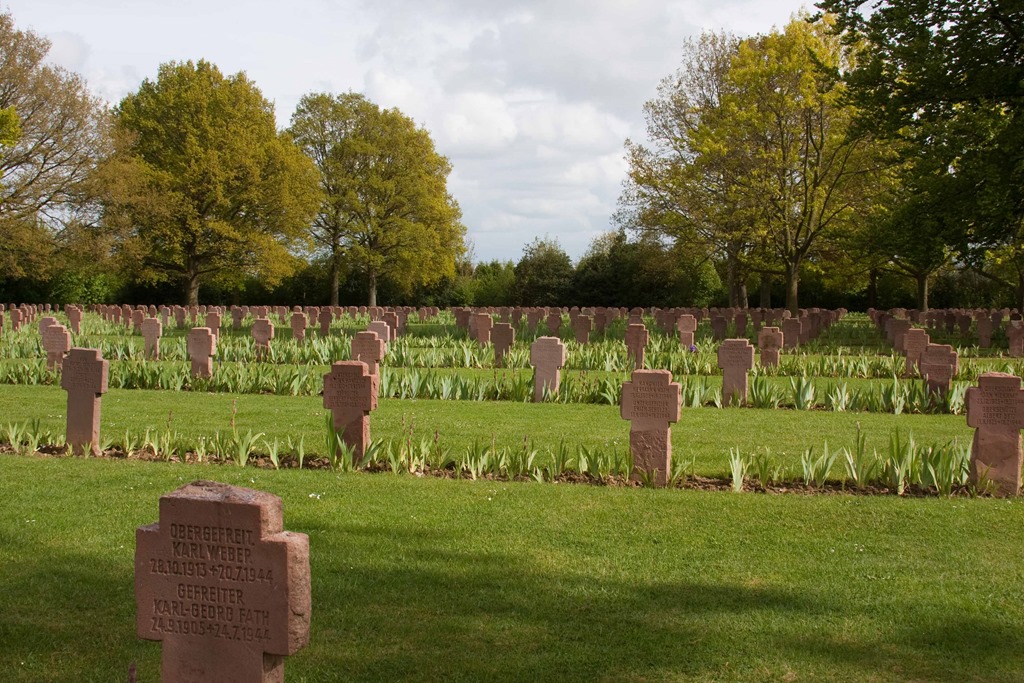
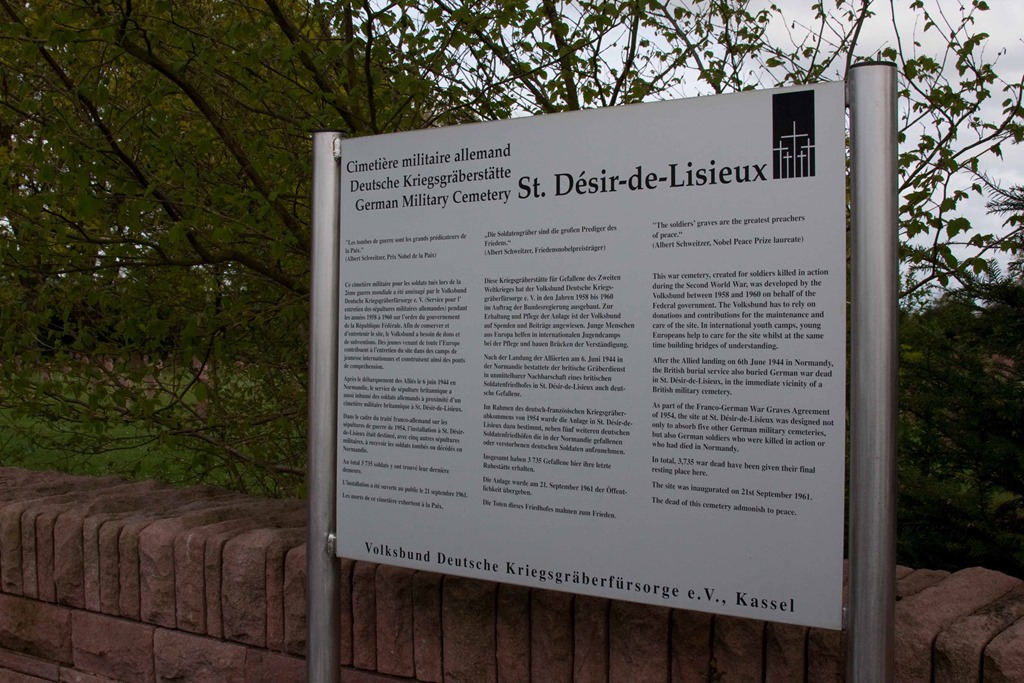
Right beside the cemetery is St. Desir-de-Lisieux, the German cemetery. Unlike the Allied cemetery, there are no words on the graves written from loved ones. There is just name, rank, date. In fact, there are 2 men to each cross and as the picture shows, it is a very big cemetery – 3,735 to be exact.

2009 05 03 St Desir-de-Lisieux German cemetary (5)

2009 05 03 St Desir-de-Lisieux German cemetary (6)

Never forget.

DONT BE INTERESTING – BE INTERESTED


A great piece of advice from Jim Collins, from the now closed Business 2.0:

I learned this golden rule from the great civic leader John Gardner, who changed my life in 30 seconds. Gardner, founder of Common Cause, secretary of health, education, and welfare in the Johnson administration, and author of such classic books as "Self-Renewal," spent the last few years of his life as a professor and mentor-at-large at Stanford University. One day early in my faculty teaching career — I think it was 1988 or 1989 — Gardner sat me down. "It occurs to me, Jim, that you spend too much time trying to be interesting," he said. "Why don’t you invest more time being interested?"

If you want to have an interesting dinner conversation, be interested. If you want to have interesting things to write, be interested. If you want to meet interesting people, be interested in the people you meet — their lives, their history, their story. Where are they from? How did they get here? What have they learned? By practicing the art of being interested, the majority of people can become fascinating teachers; nearly everyone has an interesting story to tell.

I can’t say that I live this rule perfectly. When tired, I find that I spend more time trying to be interesting than exercising the discipline of asking genuine questions. But whenever I remember Gardner’s golden rule — whenever I come at any situation with an interested and curious mind — life becomes much more interesting for everyone at the table.

I remember this exact scenario playing our at a dinner years ago. We were with a client who was particularly cantankerous. My associate did everything he could to try and connect, by being interesting. He talked of his hobbies (no connection), it came up that they went to the same University so he talked about his experiences in University (no connection) and on and on. No connection.

So I stepped in and took a different approach. I found out that he loved Science Fiction (I do too) and instead of talking about what I like, I asked him what he liked. I acquired two great book recommendations in the process. I then found out that he is a renowned woodworker. As I know nothing about woodworking, I spent the next couple hours learning all about woodworking. Fascinating, I had no idea it was so interesting.

Be interested. Not interesting.

THE LAST DUBAI POST: TRAVELLING THE SAND DUNES WITH IRON MAIDEN


Our trip to Dubai had a simple goal – no churches, no castles and no culture. Just fun. But we had to do something local (and the malls did not appeal to us). So we did a desert tour with Arabian Adventures.

It starts with a driver picking us up at the hotel in a big GMC 4X4. We then proceeded to the Dubai Desert Conservation reserve. What they are trying to protect is beyond me … not sure where that wildlife was ….

2009 02 12 Dubai Desert Tour_-3

2009 02 12 Dubai Desert Tour_-4 

The desert is beautiful. Desolate, but beautiful.

2009 02 12 Dubai Desert Tour_-7

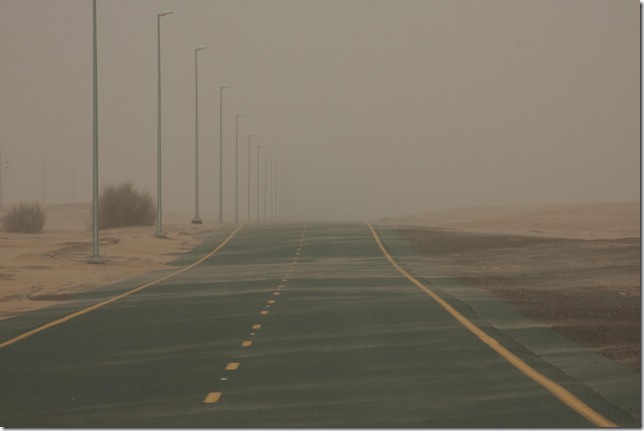
The wind really started to pick up. It wasn’t that warm.

2009 02 12 Dubai Desert Tour_-8

2009 02 12 Dubai Desert Tour_-17

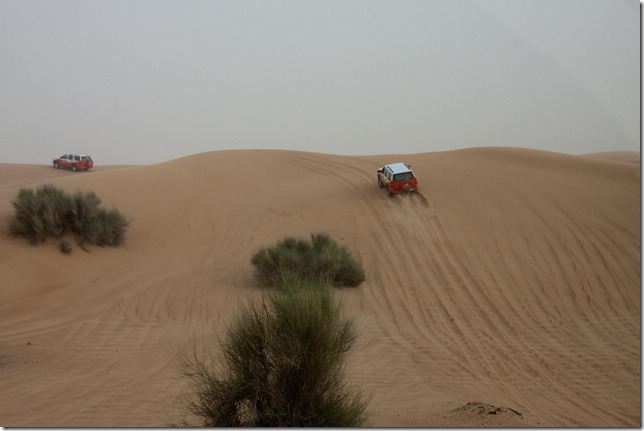
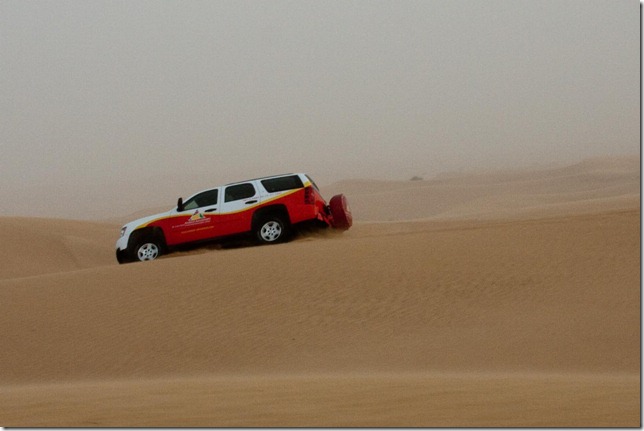
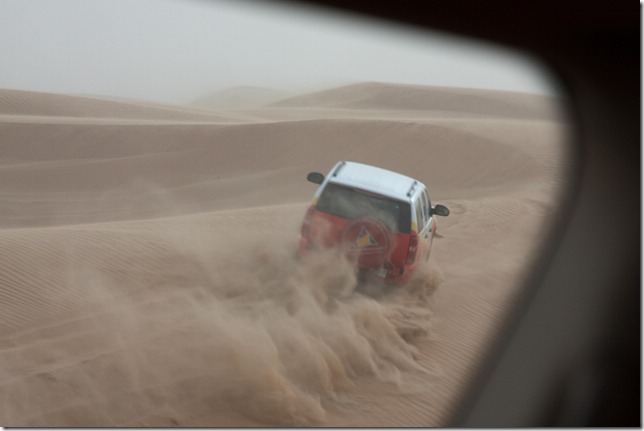
The drivers stop as you get off the road and enter the desert, removing half of the air out of their tires. They explain that if you have full tires, you will get stuck. They then line up the trucks (there were 30) and start bounding through the desert with a clear goal, to make you think that at any moment that truck is going to bloody well flip over.

2009 02 12 Dubai Desert Tour_-11

2009 02 12 Dubai Desert Tour_-14

2009 02 12 Dubai Desert Tour_-12

As we drove, we passed an abandoned Bedouin camp. The driver explained that they had been relocated into government funded housing. We actually passed the housing on the highway – I would like to live in that type of government housing.

2009 02 12 Dubai Desert Tour_-34

2009 02 12 Dubai Desert Tour_-33

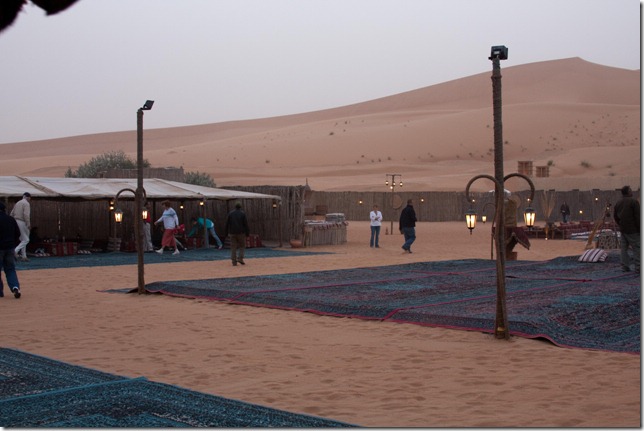
We survived, arriving at a camp for dinner. This is where it gets a big odd. One of the guides walks up to us and asks us if we know who Iron Maiden is. Uh, sure, but for the record I like ACDC better. It turns out that they are on the trip too and these tour guides think that this is just the coolest thing on the planet. Personally, I would not have recognized them had he not said it .. although the dude with the professional video camera videoing it all was a give away that there was something going on. Appears that a band member talked about their gig here. I never took a photo .. (wouldn’t know who they are) .. but I think they are in this photo ..the dude with the camo hat standing by the guy with the dreadlocks (He must have read the Rock Band 101 manual).

2009 02 12 Dubai Desert Tour_-41

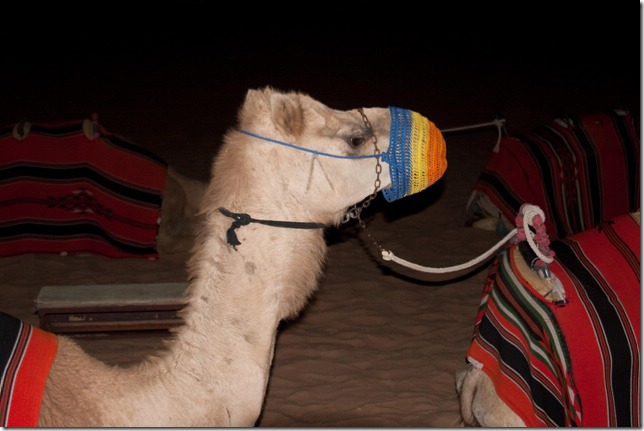
We settled in for a traditional dinner, some belly dancing, a camel ride and this Arabic coffee which was very pungent and not to my taste. It was made from spices .. definitely not coffee. They should probably call it Arabic tea.

2009 02 12 Dubai Desert Tour_-38

2009 02 12 Dubai Desert Tour_-76

So we were able to sneak in a little culture (sans any church or castle or museum!) in Dubai. Just a little. Another cool trip complete.

DUBAI: ATLANTIS THE PALM


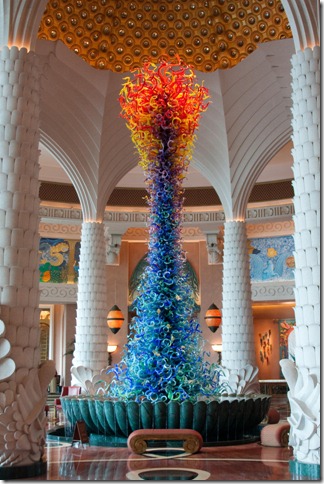
We have had friends and family stay at The Palm in the Caribbean and they all come back with the same feedback; crazy expensive but really cool. The Palm in Dubai is no different – crazy expensive but really cool. Although, when you live in England where everything seems like it is 2X the price of Canada – it is all relative. The entrance says it all ….

2009 02 13 Atlantis Lobby Dubai_-6

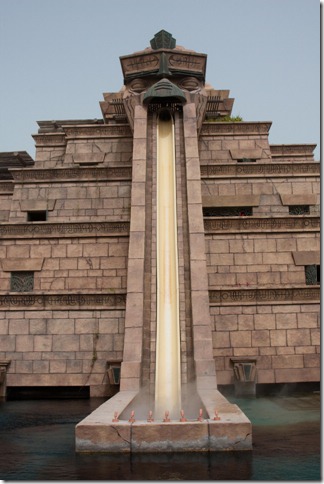
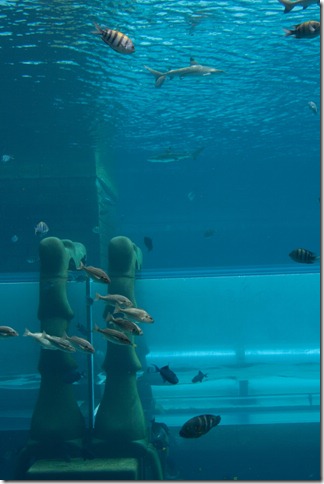
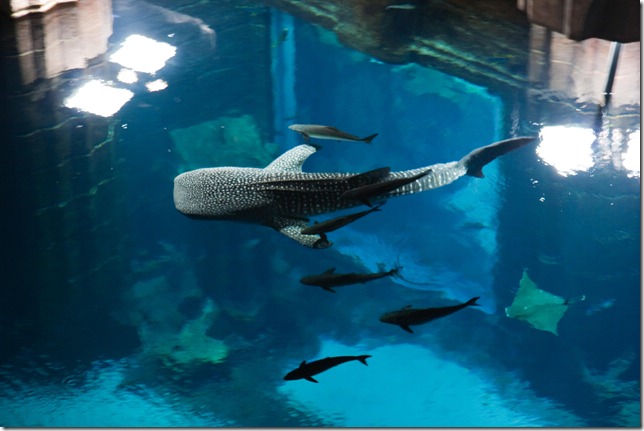
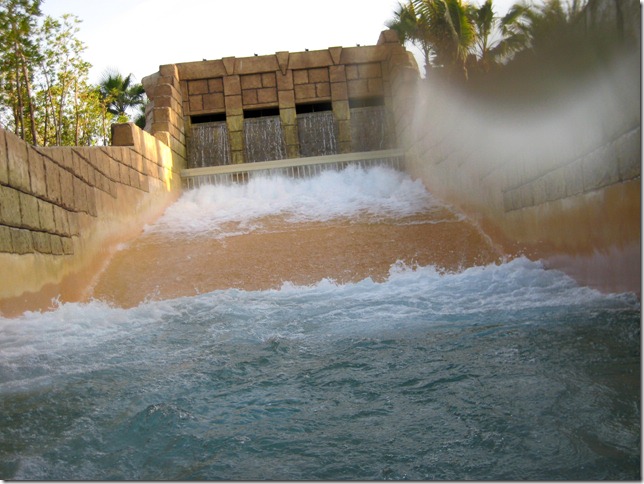
The hotel is impressive – two thousand rooms, billions to build and some of the coolest features I have ever seen in a hotel including a 65M litre aquarium with a 2 story glass viewing area, underwater hotel rooms, celebrity chef restaurant names like Nobu (which was out of this world), a water park with rapids – a lazy river with a wave machine – amazing slides and a 30M straight down (at least it feels that way) slide that rockets through a shark tank. I went on it once – that was enough. The picture on the right is the tube through the tank.

   2009 02 12 Dubai _MG_3144    2009 02 12 Dubai _MG_3139

It is tough to call out what was the highlight, the aquarium or the water park. We spent hours, standing in front of the fish tank which is 2 stories high and contains thousands and thousands of fish, including a huge whale shark. It was mesmerizing. Our room had the additional benefit of a balcony overlooking the tank.

 2009 02 07 Dubai _MG_3014

2009 02 08 Dubai _MG_3030

The water park is just as amazing. There is a huge wave machine (which shoots you down a river on an inner tube), there is a river full of man made rapids and the center pyramid is filled with slides. The wave machine is below … as the waves start crashing toward my tube. I have some amazing video from my camera (the $200 waterproof case has paid for itself many times over). This picture is right before the wave hit us – over the week I got really good and flinging the boys right to the bottom of the wave machine so they could maximize impact (smile).

2009 02 09 Dubai IMG_2645 

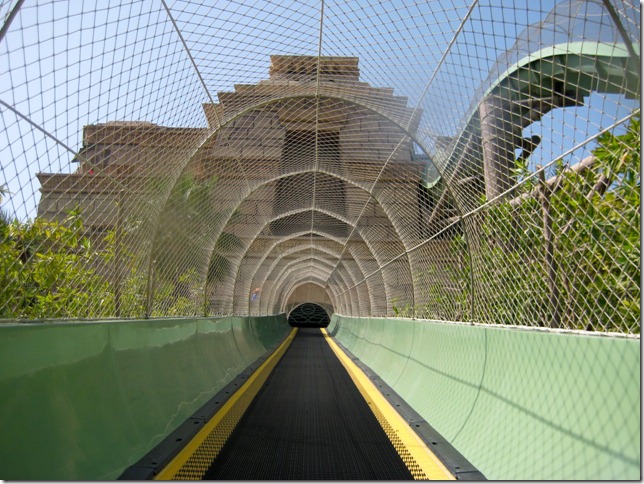
What is ingenious about the slides is how you get up. You can walk up (groan), or you can jump on the conveyor belt which leisurely takes you up to the top in your tube.

2009 02 09 Dubai IMG_2612

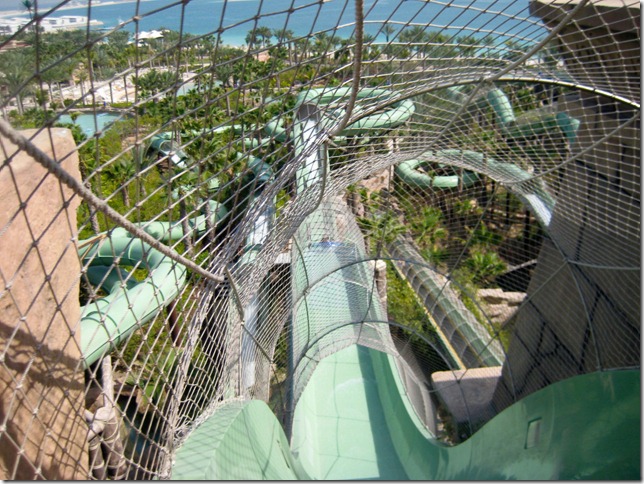
Or you can take the express route. This route was quite surprising. It starts with a cool little jaunt up the conveyor belt. You are thinking, you know what – this isn’t bad. Then you crest a hill and .. well … you look down at these huge jets that basically shoot you up the hill (in stages). Think of having a fire hose pointed at your back .. that pretty much describes it.

A view of the slides. Yes, it is very high.

2009 02 09 Dubai IMG_2599

I would definitely go back to this hotel. No doubt. In the end, the hotel became our destination. We only took one excursion. That is next.

DUBAI: ONE HAS TO ASK WHY?


Time has passed, things are settling down and I have a few destinations to log on the blog. Starting with a trip a few months ago to Dubai. Over the last 2 years, our family has hit 10+ different countries and the boys were getting ACO (All churched – castled out). So we decided to take a break in Dubai where there isn’t thousands of years of culture to tempt us. It is all sand and sun. Just what the family needed.

Dubai is a big European holiday destination – and it just so happens that they had just opened the new Atlantis The Palm, so we booked it. As luck would have it, we booked it well before the financial sector crash so we paid a nice high price … but there is upside, the place was empty.

Dubai is a very odd place. If you have done any reading about the region, you will know that it is very wealthy and that they are reinvesting their oil money in the hopes of building the city into an economic, travel and expat center for the Middle East. It is their hedge against when the UAE runs out of oil (25 years). The pursuit of this goal means one simple thing: construction. Lots of construction.

2009 02 08 Dubai IMG_2574

Everywhere.

2009 02 12 Dubai _MG_3168

2009 02 14 Dubai _MG_3336

It does not take more than a 10 minute drive into the city to realize that their construction philosophy is either ’the bigger the better’ or ‘the biggest – period’. When I was a University student, I lived in an area with the biggest mall in the world – the West Edmonton Mall (went to University there). Dubai easily displaced it with their 1200 shop mall – Dubai Mall (ingenious name) which cost $20B. A few other notable ‘biggest’ (to name a few):

  • Dubai Tower, the world’s largest tower with 162 floors – crushing the closest competitor (100 floors)
  • Dubailand, the world’s largest theme park. It is twice the size of Disney world with 45 megaprojects and 200 subprojects. Six Flags, Legoland .. and on and on.
  • Of course, the world’s largest man made islands (3 different groups, each progressively larger).
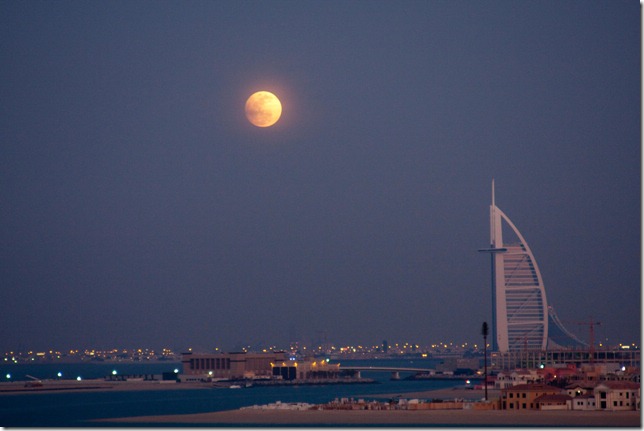
  • Burj Al Arab, the world’s only ‘7’ star hotel, which we had a beautiful view of from our hotel room.

 2009 02 09 Dubai _MG_3088

2009 02 09 Dubai _MG_3075

But in the end, I was left wondering if it is sustainable. I understand why it is being done (genuine effort to create a new economic base), but was not convinced that it makes sense long term. Over the last months, the police have been finding thousands of leased cars abandoned at the airport as workers flee the country, leaving behind piles of bad debt. Real estate prices have fallen 25% (with your own private island a regular millionaires bargain now!) and worries about the states ability to pay back their huge debt continues to plague the region.

Really cool place to visit once. Which I don’t believe is the intent. That being said, we did do some cool things – which are up next.

2009 02 14 Dubai _MG_3340

PERCEPTION IS REALITY AND NIXON


I have blogged about the philosophy ‘Perception is reality’ before, a powerful statement that can be applied to all aspects of life as we work to understand each other. Recently I churned through the book Overcoming Your Strengths by Lois Frankel and she makes a few very interesting points with regards to communication, first impressions and the evolving workplace dress codes.

pg. 84   Dr. Allan Weiner, president of Communication Development Associates has conducted research that suggests in day-to-day communication the impression we make on others is based largely on how we work and sound. The following chart reveals that, in fact, 90% of that impression is based on factors related to other than what we actually say.

image

pg. 83:  Perhaps the seminal defining moment of the importance of image was the Kennedy/Nixon debate of 1960. Although most of us can’t remember the content of the debate, we do remember the physical appearance of the candidates as they sat on the platform. Despite the fact that Kennedy was in poor health, he looked youthful, tan, poised and relaxed. Although only four years Kennedy’s senior, Nixon (who refused to wear television makeup) looked wan and tired. In terms of outcome, polls of television views conducted after the debate gave Kennedy the edge, while polls of radio listeners reported Nixon the victor.

It is something worth reflecting on and takes me back to one of my first sales lessons when I was still in University. I learned my very first sales lessons at a high end men’s wear store that had the highest dollars per square foot in the province in a small blue collar city. I learned it from a man who exuded confidence, paid attention to detail and had tons of local customers. He said ‘You can tell a lot about a man by his shoes’.

I often wonder what message the young intern in the office is trying to convey when they show up in jeans and a sweatshirt? Or what message the gentlemen in the 3 piece suit and tie is trying to convey when he does not see customers and everyone else is dressed business casual?

Personally, attention to these details is a way of life in business. It was reinforced at my second job, where I sold fax machines. I was working from home and went into the office wearing jeans and a t-shirt as I was going to work at the photocopier making fliers for a campaign I was executing in my territory (In the old days … we made our own sales brochures). The sales VP walked by the room and stopped. He was not happy. He walked over and said one simple thing:

‘You are a sales professional. You are the face of our business to the customer. The staff in the office have perceptions of the sales leaders and look at them as our face to the customer. Don’t ever let me or anyone in the office ever see you dressed like that again’

He turned and left. It never happened again.

PS: Dr. Frankel wrote an interesting article on the topic for Fast Company here. A few thought provoking ideas.

A COMMON LANGUAGE KEEPS US APART


Part of my UK journey has been the nuance of language. It caught up with me at a meeting recently where 15 of us were around a table and, to the surprise and joy of my peers, I said:

‘It is like wearing suspenders and a belt’

It was met with funny looks, then laughter. In other words, being overly cautious. When I think of suspenders, I think of this:

File:1Gordon-gekko.jpg

Turns out that in Britain when you say suspenders it means this (sans the lamp shade):

Noted.

READY FOR ANYTHING


While on vacation a few weeks ago I read a lot less than I usually do, only 2 books (The Reapers, John Connolly and Ready for Anything, David Allen).and a few of the usual magazines (Harvard Business Review, Harvard Management Update, Selling and Men’s Health).

The David Allen book is a good (not great) light read. A few highlights for me:

  • ‘Besides the noble art of getting things done, there is the noble art of leaving things undone. The wisdom of life consists in the elimination of nonessentials’   Lin Yutang

It is so hard to leave things undone.

  • ‘All intellectual improvements arise from leisure’ Samuel Johnson.

This struck me as a great insight. That leisure time, just clearing the mind, often leads to the best of innovations (which is why it is always good to have a pen at hand!)

  • ‘The more you sweat in peace, the less you bleed in war’  Asian proverb.

This quote could be the introduction to First 90 Days. Prepare while you can, because when that new opportunity hits, time will disappear.

A few good thoughts.

STAR TREK MOVIE


I am absolutely going to catch the new Star Trek flick as soon as I can (but not willing to fight the dude dressed like Spock for a place in line). I am busy trying to explain to my boys what Star Trek is. While not a Trekkie, I did grow up with it and love Sci Fi. And of course, who didn’t think that William Shatner was one of most awesome over-actors in the world?

MOVING BACK TO CANADA: RANDOM MUSINGS

 
As many, many people now know, we are moving back to Canada. After 8 great years with Microsoft, I have decided to take on a new exciting role with a Canadian company.
 
We have spent 2 years in the UK, and have loved it. As an experience, it has exceeded my expectations on almost every level. I am very grateful to have had the opportunity. It has changed my perspective on so many things.
 
And of course, this has kicked off a whirlwind of activity and a task list the size of my arm. The nice thing is that we will not be going through the house challenge that we went through when we moved to the UK – trying to figure out what should come from our 3,500 square foot home, 200X90 foot yard and huge double garage (and garden shed) to our 2,000 square foot (maybe 1600!) townhouse that costs an insane amount of money each month. In this case packing will be different, the instructions to the movers will be a simple directional point to the house and one phrase ‘pack everything’.
 
I am sitting in the lounge in Toronto after completing a whirlwind house hunt and I have a few reflections:
 
  • I do not miss fast food. I drove down highway 7 in Toronto and passed more fast food restaurants than I have seen in 2 years in the UK. It is kind of sad. Where has the chef gone?
  • North American consumerism is a shocking contrast to England. In England, it is small shops (that seem to open and close at the whim of their proprieters) in quaint little buildings that have been around for hundreds of years. Driving in Toronto it is all new and business malls as far as the eye can see …. It bombards the senses.
  • I did stop for a 7-11 coke slush (or whatever they are called – crushed ice freezie thing). I really enjoyed that. I also had a big breakfast with proper streaky bacon at Wimpeys this morning (after a 7K run and 5K bike in the gym). I enjoyed that too!
  • It is so wide open. Big highways. My goodness – how your perspective changes.
  • No restaurant in Canada will ever seem expensive to me again. After you have paid in euros or the pound, everything in North America seems CHEAP. $45 CDN filet? A bargain!

And last but not least, it will be good to reconnect with so many friends and family. Thanks for all the well wishes. See you soon!


TREVI FOUNTAIN ROME


I have zero time to blog for another two weeks. A very busy time. I will come back online week of May 18th. That being said, I am almost finished processing our Italy pictures and thought to share this Photosynth on the Trevi Fountain.

In 1629 Pope Urban VIII, finding the earlier fountain insufficiently dramatic, asked Bernini to sketch possible renovations, but when the Pope died, the project was abandoned. Bernini’s lasting contribution was to resite the fountain from the other side of the square to face the Quirinal Palace (so the Pope could look down and enjoy it). Though Bernini’s project was torn down for Salvi’s fountain, there are many Bernini touches in the fountain as it was built. An early, striking and influential model by Pietro da Cortona, preserved in the Albertina, Vienna, also exists, as do various early 18th century sketches, most unsigned, as well as a project attributed to Nicola Michetti[5] one attributed to Ferdinando Fuga[6] and a French design by Edme Bouchardon.[7]

Competitions had become the rage during the Baroque era to design buildings, fountains, and even the Spanish Steps. In 1730 Pope Clement XII organized a contest in which Nicola Salvi initially lost to Alessandro Galilei — but due to the outcry in Rome over the fact that a Florentine won, Salvi was awarded the commission anyway.[8] Work began in 1732, and the fountain was completed in 1762, long after Clement’s death, when Pietro Bracci‘s Oceanus (god of all water) was set in the central niche.

Salvi died in 1751, with his work half-finished, but before he went he made sure a stubborn barber’s unsightly sign would not spoil the ensemble, hiding it behind a sculpted vase, called by Romans the asso di coppe, "the "Ace of Cups".

The Trevi Fountain was finished in 1762 by Giuseppe Pannini, who substituted the present allegories for planned sculptures of Agrippa and "Trivia", the Roman virgin.

Click here to view our pictures of the fountain. Rome is an amazing place.

A MEMORABLE DAY

 
For many the cat is out of the bag. For those that have not found out yet, I quote Charles Dickens and Great Expectations:
That was a memorable day to me, for it made great changes in me. But, it is the same with any life. Imagine one selected day struck out of it, and think how different its course would have been. Pause you who read this, and think for a moment of the long chain of iron or gold, of thorns or flowers, that would never have bound you, but for the formation of the first link on one memorable day’
I will not be blogging for some weeks as my family has set down the wonderful path of another exciting change. Cheerio.

STORING YOUR DVDS ON A DRIVE


I watch TV via my XBOX 360. A friend shared a little tip with me about DVDs. If you want to store your DVDs on a hard drive and watch it via your XBOX, follow these simple steps:

  • Decrypt it via tools like Slysoft.
  • Copy the content (VOB files) to the drive.
  • Use this KB article to make a few Vista changes to enable the feature.

Think of this, you can store 200 DVDs on a $100 1TB drive.

Awesome.

OUTPERFORMING THE MARKET


At a recent conference, I watched a presentation on disruption in the market by Atan Burrows from the agency Tequila. In the presentation he presented 3 ‘rules’ for disruptive thinking:

  1. NEVER ATTEMPT TO PREDICT THE FUTURE – BEHIND EVERY MEDIOCRE STRATEGY THERE IS A FALSE ASSUMPTION
  2. YOU CAN NEVER PLAN FOR THE FUTURE IF YOU DON’T KNOW WHAT YOU’RE NOT PREPARED FOR
  3. YOU CANNOT OUTPERFORM A MARKETPLACE IF YOU ADHERE TO ITS CONVENTIONS

He showed this video to demonstrate point 3. It demonstrates the point very well.

So in the end, we all must ask ourselves: In this new economy, how are we going to be different to thrive? Interesting times.

THE MYTH OF SLOW METABOLISM AND WEIGHT


The debate on the impact of metabolism is an interesting one. You often hear comments like this:

"I’m super lucky with my metabolism. I have to be realistic – that might not always be the situation. That’s why I chose really intense training."

A recent article in Men’s Health (March 2009) states differently:

Overweight people, on average, have slower 3,000m steeple chase times than slim people. They also close the fridge door slower. Overweight people DO NOT, however, have slower metabolisms. To blow this myth out of the water, a recent study by the Petersburg Nuclear Physics Institute discovered that most groups of organisms favour the same optimum metabolic rate, while Germany’s Journal for Nutritional Science found overweight people actually have faster basal metabolic rates (presumably because of the extra effort shifting that excess weight around).

Personally, as I have crossed into 40land, I have noticed weight gain when my lifestyle becomes less active and my consumption of food outstrips my bodies ability to burn it off.

Time and time again, it all comes back to lifestyle and staying active. The only thing that will slow down is my choice to get off that couch!

NURSE CAVELL


I arrived at Waterloo an hour early for a meeting last week. It was a beautiful day out, so I decided to walk to my meeting instead of taking the tube (about 40 minute walk away). While enroute I came across the below statue dedicated to Edith Cavell. I had no idea who she was but was curious. Turns out that ‘humanity’ is the right word for her, although they could add ‘noble’ and many other words:

Nurse Cavell helped hundreds of soldiers from the Allied forces to escape occupied Belgium to the neutral Netherlands, in violation of German military law. She was arrested on 3 August 1915 and charged with harbouring Allied soldiers, not for espionage. She was held in prison for 10 weeks, the last two in solitary confinement [2], and court-martialled. The British Government said they could do nothing to help her – Sir Horace Rowland of the Foreign Office said, "I am afraid that it is likely to go hard with Miss Cavell; I am afraid we are powerless." The sentiment was echoed by Lord Robert Cecil, Under-Secretary for Foreign Affairs. "Any representation by us", he advised, "will do her more harm than good."

The United States, which had not yet joined the war, did not agree. Hugh S. Gibson, First Secretary of the American legation at Brussels, made clear to the German government that executing Cavell would further harm their nation’s already damaged reputation. Later, he wrote:

"We reminded him (Baron von der Lancken) of the burning of Louvain and the sinking of the Lusitania, and told him that this murder would stir all civilized countries with horror and disgust. Count Harrach broke in at this with the rather irrelevant remark that he would rather see Miss Cavell shot than have harm come to one of the humblest German soldiers, and his only regret was that they had not ‘three or four English old women to shoot.’"

Baron von der Lancken stated that Cavell should be pardoned because of her complete honesty, and because she had helped save so many lives, including those of German as well as Allied soldiers. However, the German military acted quickly to execute Cavell so higher authorities would not issue the pardon.[3]

She made no defence, admitting her actions, and was ordered to be executed by firing squad at 6am on 12 October, less than ten hours after sentence was passed.

The night before her execution she told the Anglican chaplain, Reverend H. Stirling Gahan,[4] who had been allowed to see her and to give her Holy Communion, "Patriotism is not enough, I must have no hatred or bitterness towards anyone." These words are inscribed on her statue in St Martin’s Place, near Trafalgar Square in London.

IMAG0046

THE AIRPORT IQ TEST


I believe that there could be an IQ test based on airport check in. It would have common sense questions such as:

  • You are allowed to bring canisters of gasoline on the aircraft as you never know if the gauges are right and the crew may need it:   A. True B. False

Recently, the woman ahead of me in the security line up (It was 6:05 am) was crying and pleading with the security staff. She was in hysterics. There was no way she could check the item that they had just examined. No way! Do you know what they do in luggage check in – they will destroy it – she wailed – a fresh bout of tears streaming down her puffy cheeks.  

Had there been an IQ test based on airport check in, she would have failed this question:

While boarding an airplane, which item are you not allowed to bring as a carry-on item?

A. Toothbrush

B. Flight of the Conchords doll

C. Your new bright pink shirt

D. A pair of freshly sharpened figure skates.

She would not have answered D.

While in Paris the other week I witnessed another act of airport stupidity. A North American tourist (decked in gold,  bright red lip stick, big hair and obnoxious track suit clothing) was standing in the line at security with her stuffed Gucci bags, getting more and more agitated. Her husband clearly knew what was going on and was becoming increasingly uncomfortable – shooting her quick glances.

She was in line 3, with approximately 3 people between her and the X-ray. She kept looking over at line 1 where 3 guards were standing and talking. There were no people in line 1, it had a fancy carpet and was separated from line 2 and 3 by a red velvet rope. I now started to observe, wondering ‘How long?’.

Not long. She mumbled something to her husband in an exasperated tone and started to lumber through line 2 (which is cumbersome with all the bags – and no ability to say ‘excuse me’), plucked the velvet rope off the hook and proceeded to the X-Ray machine in line 1, with husband in tow. The French guard gave her one look as she walked up and proceeded to put her stuff on the conveyor belt. The guard pointed – back in line – with not a word of English.

Now, this is where it got funny. What was she going to do? We are all looking at them with a smile on our face. Do you traipse back to line 3? Go to the end of the line? Nope. She just walked over to the rope, plucked it off the hook and decided to insert herself (and her poor husband) 3rd from the front of the line. OK, that ticked me off a bit. But what happened next made up for it.

As soon as she was back in line, the French security guard walked over to line 2 and asked the person BEHIND the woman to come over to security. Two minutes later she walked back and took the person in FRONT of the woman and her husband. You should have seen the woman’s face. I burst out laughing.

So what question did this woman fail?

When in France, you should recognize that the locals love tourists, love when you speak English to them, are focused on customer service and love when tourists take liberties (circle one)  A. True. B. False.

You have to admit, the French are the masters of the snub. All hail the French.

RICHARD TEMPLAR RULE NO. 4: HOLD EFFECTIVE MEETINGS – NO REALLY EFFECTIVE


A couple weeks ago I churned through an easy read by Richard Templar, The Rules of Work. Written in a conversational style, filled with anecdotes and very simple – conventional business wisdom, although I don’t agree with everything in there (he is a little too calculating). A book I would definitely recommend to graduates and younger staff members, or to a few who have forgotten some of the basics.

I am now whipping through The Rules of Management (sense a theme?). I love Rule No. 4 on meetings:

To be effective you shouldn’t allow anyone to reminisce, ramble, rabbit on, refuse to shut up or relax. Keep ‘em moving fast and get them out of the door as soon as you can.Rules of Management: The Definitive Guide to Managerial Success (The Rules Series)

You don’t do ‘any other business’ – ever. If it’s that important it should be on the agenda. If it isn’t, then it shouldn’t be there at all. ‘Any other business’ is invariably someone trying to get something over on someone else.

Hold all meetings at the end of the day rather than at the beginning. Everyone’s anxious to be off home and it keeps meeting shorter; at the beginning of the day everyone has ages to digress and chat.

… Useful tip – never schedule meetings to begin exactly on the hour, always say 3:10 rather than 3 o’clock.

The end of day idea is brilliant (for large meetings) and the 3:10 feature is one that I wish was in Outlook. How is it possible for me to be on time when I am back to back in the calendar? If Outlook had a feature defaulting to 50 minute meetings it would make a world of difference.

PS: I also read David Allen’s Ready for Anything while on vacation and was quite disappointed. Hundreds of pages of ‘buy into Getting Things Done and you will be more successful’. Got it, believe in GTD, use GTD, didn’t need to read 52 reasons of why I should continue to use it.

CLOSING OUT PARIS

As we walked back to our hotel, we came across this monument which I have had a tough time puzzling out. It says ‘memorial national de la guerre d’algerie’ which I assume is a monument to the Algerian War which is worth reading about here. A few tidbits:

The Algerian War remains a contentious event today. According to historian Benjamin Stora, doctor in history and sociology and teacher at Paris VII, and one of the leading historians of the Algerian war, memories concerning the war remain fragmented, with no common ground to speak of:

"There is no such thing as a History of the Algerian War, there is just a multitude of histories and personal paths through it. Everyone involved considers that they lived through it in their own way, and any attempt to take in the Algerian War globally is immediately thrown out by the protagonists."[41]

Stora further points out that "The phase of memorial reconciliation between the two sides of the sea is still a long way off."[41] This was recently illustrated by the UMP‘s vote of the February 23, 2005 law on colonialism, which asserted that colonialism had globally been "positive." Thus, a teacher in one of the elite’s high school of Paris can declare:

"Yes, colonisation has had positive effects. After all, we did give to Algeria modern infrastructures, a system of education, libraries, social centers… There were only 10% Algerian students in 1962? This is not much, of course, but it is not nothing either!"[42]

2008 December 29 Walking Back to Paris Hotel  _MG_2811

As we walked back to the hotel, we stopped at the Ferris wheel in the Place de la Concorde. The sun was going down and it was a great way to end the trip.

2008 December 29 In The Paris Ferris Wheel _MG_2850

2008 December 29 In The Paris Ferris Wheel _MG_2852

2008 December 29 In The Paris Ferris Wheel _MG_2865

So much still to see. Wonderful city.

A MESSAGE TO PRESIDENT OBAMA: METRIC AS AN ECONOMIC STIMULUS


Like anyone else in the world who reads a newspaper, I could not help but notice the US budget with the many placeholders for pet political projects.

My message to President Obama: Implement metric. Think about it. The US will be spending all kinds of money on bridges, pet projects and other stimuli, so why not metric? If the US government were to impose a quick conversion to metric, it would have a huge economic impact, businesses and government agencies around the country began working on the project. A few impacts:

  • Computers systems would need to be prepared, replaced or revamped. Think Y2K – which had a WW cost estimated at $300B.
  • Across the country, signs would need to be changed from miles to KM.
  • School books would need to be reprinted, education programs would need to be updated.
  • Every piece of product packaging that included weight or volume would need updating.

The impact would be huge. President Obama, think about it. You know where you can reach me if you need more ideas ….

MORE PARIS

After the Louvre we headed to the Eiffel Tower (of course). We did not feel like fighting the crowds and were unable to get a reservation in the tower restaurant (despite an amazing effort from the Concierge). Exiting the metro at Trocadero (Paris has an amazing subway system), we enjoyed the view across the river.

image

As you exit the metro, you come across a WWI monument to the people who fought the war.

2008 December 29 Touring around Paris  _MG_2628

As we looked  down on the Eiffel tower from the Trocadero, we did not realize the importance of the location:

For the Exposition Internationale of 1937, the old Palais du Trocadéro was demolished and replaced by the Palais de Chaillot which now tops the hill. It was designed in classicizing "moderne" style by architects Louis-Hippolyte Boileau, Jacques Carlu and Léon Azéma. Like the old palais, the palais de Chaillot features two wings shaped to form a wide arc: indeed, these wings were built on the foundations of those of the former building. However, unlike the old palais, the wings are independent buildings and there is no central element to connect them: instead, a wide esplanade leaves an open view from the place du Trocadéro to the Eiffel Tower and beyond.

The buildings are decorated with quotations by Paul Valéry, and they now house a number of museums:

      2008 December 29 Touring around Paris  _MG_2633

    2008 December 29 Touring around Paris  _MG_2629

    I never knew who Foch was. Interesting quote from him:

    He advocated peace terms that would make Germany unable to ever pose a threat to France again. His words after the Treaty of Versailles, "This is not a peace. It is an armistice for 20 years" would prove prophetic.

    2008 December 29 Touring around Paris  _MG_2642

    2008 December 29 Paris Boat Ride  _MG_2786

    2008 December 29 Paris Boat Ride  _MG_2799

    Enjoying a baguette, in the sun on a brisk December day in front of the Eiffel tower was a magical experience. We then headed down to the river and enjoyed a boat ride – a Paris must do. A few sights captured below.

    Alexander III bridge:

    Pont Alexandre III is an arch bridge that spans the Seine, connecting the Champs-Élysées quarter and the Invalides and Eiffel Tower quarter, widely regarded as the most ornate, extravagant bridge in Paris[1] [2].

    The bridge, with its exuberant Art Nouveau lamps, cherubs, nymphs and winged horses at either end, was built between 1896 and 1900. It is named after Tsar Alexander III, who had concluded the Franco-Russian Alliance in 1892. His son Nicholas II laid the foundation stone in October 1896. The style of the bridge reflects that of the Grand Palais, to which it leads on the right bank.

    2008 December 29 Paris Boat Ride  _MG_2652

    2008 December 29 Paris Boat Ride  _MG_2655

    Not the kind of detail you would ever see on a Canadian bridge.

    2008 December 29 Paris Boat Ride  _MG_2774

    2008 December 29 Paris Boat Ride  _MG_2782

     2008 December 29 Paris Boat Ride  _MG_2784

    Another Egyptian obelisk liberated, the Obelisk of Luxor in the Place de la Concorde:

    The center of the Place is occupied by a giant Egyptian obelisk decorated with hieroglyphics exalting the reign of the pharaoh Ramses II. It is one of two the Egyptian government gave to the French in the nineteenth century. The other one stayed in Egypt, too difficult and heavy to move to France with the technology at that time. In the 1990s, President François Mitterrand gave the second obelisk back to the Egyptians.

    The obelisk once marked the entrance to the Luxor Temple. The viceroy of Egypt, Mehemet Ali, offered the 3,300-year-old Luxor Obelisk to France in 1831. The obelisk arrived in Paris on December 21, 1833. Three years later, on October 25, 1836, King Louis-Philippe had it placed in the center of Place de la Concorde, where a guillotine used to stand during the Revolution.

    2008 December 29 Paris Boat Ride  _MG_2658

    The Louvre.

    2008 December 29 Paris Boat Ride  _MG_2681

    2008 December 29 Paris Boat Ride  _MG_2777

    The architecture of old European cities is breathtaking.

    2008 December 29 Paris Boat Ride  _MG_2693

    2008 December 29 Paris Boat Ride  _MG_2673

    2008 December 29 Paris Boat Ride  _MG_2770

    2008 December 29 Paris Boat Ride  _MG_2761

    Notre Dame. We did not take the time to visit, the boys are all ‘churched’ out.

    2008 December 29 Paris Boat Ride  _MG_2721

    2008 December 29 Paris Boat Ride  _MG_2714

    And it was finally time to start walking back to the hotel.

    LOCAL PAPERS & CREATIVITY WITH COWS


    One of my favourite parts of travelling has now become the local paper. It gives you a real feel for the nation, the local events, culture and different perspectives.

    While in Dubai, I read the Gulf News each morning. A few highlights that I kept with me:

    A few nights ago, on the way back from a lovely weekend, my car broke down. My wife and I had to wait three hours before the car got towed. We were desperate and more than 100 kilometres away from home. A while later, two cars stopped and the drivers – both Emirati men – offered to drive us home, knowing quite well that they would have to drive a long way. I thank those men and more such Emiratis for making this country a safe, lovely and special place to live. Each time I recall the incident, I feel amazed.

    • Dubai Modern High School is raising fees by 90%. Parents are not rejoicing.
    • The cost of war in the Middle East is estimated at $12,000,000,000,000. The military expenditure versus health care is shocking (2004 numbers): Egypt: $3B on military, $2.2B on health care. Lebanon: $4.4B on military, $3.2B on health care. Oman: $12B on military, $2.4B on health care. Syria: $6.4B on military, $2.2B on health. Wars are good for the military industrial complex, bad for humanity. After watching the documentary Why We Fight, I cannot help but hear Eisenhower’s warning and how it has come true:

    On January 17, 1961, Eisenhower gave his final televised Address to the Nation from the Oval Office.[49] In his farewell speech to the nation, Eisenhower raised the issue of the Cold War and role of the U.S. armed forces. He described the Cold War saying: "We face a hostile ideology global in scope, atheistic in character, ruthless in purpose and insidious in method…" and warned about what he saw as unjustified government spending proposals and continued with a warning that "we must guard against the acquisition of unwarranted influence, whether sought or unsought, by the military-industrial complex… Only an alert and knowledgeable citizenry can compel the proper meshing of the huge industrial and military machinery of defense with our peaceful methods and goals, so that security and liberty may prosper together."

    Heartstoppingly accurate and scary.

    • Iman warns about celebrating Valentine’s Day. Of course, this was surrounded by a special insert covering 20 local Valentines love stories and ads about what you should get that special someone.
    • India approves a soft drink made of cow urine.

    The new drink, to be known as Gau Jal or Cow Water, is being developed in the Indian holy city of Haridwar by the RSS’ Cow Protection Department and should be ready for marketing in six months.

    Fascinating stuff.

    DRIVING IN ENGLAND – SUNNINGHILL

    I often tell friends about driving in the UK. It is an amazing country, buildings that are full of history which leads to some interesting challenges. How do you travel down roads that are built for horses, not parking and cars?

    The answer is …. like this:


    PASSCHENDAELE


    I was told recently that if you fly over the north of France from Britain you can still see the trenches of WWI – fields upon fields of trenches of hell. I came across the Canadian film Passchendaele by chance the other day. Being a Canadian film, you never know what you will get – and I was surprised. It was incredibly moving. The final scene says it all, a small town grave yard with white tombstones crossing up and over the hill.

    File:Chateau Wood Ypres 1917.jpg

    The Sunday Telegraph had an article a few month back on Canada’s contributions to the world, wars and peace keeping.        Salute to a brave and modest nation, Sunday Telegraph:

    Until the deaths of Canadian soldiers killed in Afghanistan, probably almost no one outside their home country had been aware that Canadian troops are deployed in the region. And as always, Canada will bury its dead, just as the rest of the world, as always will forget its sacrifice, just as it always forgets nearly everything Canada ever does.. It seems that Canada’s historic mission is to come to the selfless aid both of its friends and of complete strangers, and then, once the crisis is over, to be well and truly ignored. Canada is the perpetual wallflower that stands on the edge  of the hall, waiting for someone to come and ask her for a dance. A fire breaks out, she risks life and limb to rescue her fellow dance-goers, and suffers serious injuries. But when the hall is repaired and the dancing resumes, there is Canada, the wallflower still, while those she once helped glamorously cavort across the floor, blithely neglecting her yet again.

    That is the price Canada pays for sharing the North American continent with the United States, and for being a selfless friend of Britain in two global conflicts. For much of the 20th century, Canada was torn in two different directions: It seemed to be a part of the old world, yet had an address in the new one, and that divided identity ensured that it never fully got the gratitude it deserved. Yet it’s purely voluntary contribution to the cause of freedom in two world wars was perhaps the greatest of any democracy.
    Almost 10% of Canada ‘s entire population of seven million people  served in the armed forces during the First World War, and nearly 60,000 died.

    The great Allied victories of 1918 were spearheaded by Canadian troops, perhaps the most capable soldiers in the entire British order of battle. Canada was repaid for its enormous sacrifice by downright neglect, it’s  unique contribution to victory being absorbed into the  popular Memory as somehow or other the work of the ‘British.’  The Second World  War provided a re-run. The Canadian navy began the war with a half dozen vessels, and ended up policing nearly half of the Atlantic against U-boat attack.  More than 120 Canadian warships participated in the Normandy landings, during which 15,000 Canadian soldiers went ashore on D-Day alone. Canada finished the war with the third-largest navy and the fourth largest air force in the world.

    The world thanked Canada with the same sublime indifference as it had  the previous time.   Canadian participation in the war was acknowledged in film only if it was necessary to give an American actor a part in a campaign inwhich  the United States had clearly not participated – a  touching scrupulousness which, of course, Hollywood has since abandoned, as it has any notion of a separate Canadian identity. So it is a general rule that actors and filmmakers arriving in Hollywood keep their nationality – unless, that is, they are Canadian. Thus Mary Pickford, Walter Huston, Donald Sutherland, Michael J. Fox, William Shatner, Norman Jewison, David Cronenberg, Alex Trebek, Art Linkletter and Dan Aykroyd have in the popular perception become American, and Christopher Plummer, British.   It is as if, in the very act of becoming famous, a Canadian ceases to  be Canadian, unless she is Margaret Atwood, who is as  unshakably Canadian as a moose, or Celine Dion, for whom Canada has proved quite unable to find any takers.

    Moreover, Canada is every bit as querulously alert to the achievements of its sons and daughters as the rest of the world is completely unaware of them. The Canadians proudly say  of themselves – and are unheard by anyone else – that  1% of the world’s population has provided 10% of the world’s peacekeeping forces. Canadian soldiers in the past half century have been the greatest peacekeepers on Earth – in 39 missions on UN mandates, and six on  non-UN peacekeeping duties, from Vietnam to East Timor, from Sinai to Bosnia. Yet the only foreign engagement that has entered the popular non-Canadian imagination was the sorry affair in  Somalia, in which out-of-control paratroopers murdered two Somali infiltrators. Their regiment was then disbanded in disgrace – a uniquely Canadian act of self-abasement for which, naturally, the Canadians received no international credit. So who today in the United States knows about the stoic and selfless friendship its northern neighbour has given it in Afghanistan?   Rather like Cyrano de Bergerac, Canada repeatedly does honourable things for honourable motives, but instead of being thanked for it, it remains something of a figure of fun. It is the  Canadian way, for which Canadians should be proud, yet such honour comes at a high cost. This past year more grieving Canadian families knew that cost all too tragically well.

    Lest we forget.