MUNICH


I had the good fortune to spend 28 hours in Munich at the beginning of the week. I was promptly informed that Munich is now the most ‘liveable’ city in the world (I could not find validation).

Although my stay was short, I was left with a few impressions:

  • Very clean place. Amazing airport – not like Frankfurt, that is for sure.
  • Quite a pretty city. They had this HUGE Christmas tree in the main square that was spectacular and in the European tradition, huts all over town selling mulled wine. Very festive feeling.
  • It was cold like Canada. But you have to love a temperature in the winter that hovers around 0C and is an hour and a half drive to the Alps. I liked the prices of thing too … London is so expensive.
  • Usually when I am in a city I just cab it. It is €15 for a cab downtown where I was meeting a friend versus €5 for the subway. So I ventured out and quite enjoyed it. Like the airport, clean, efficient … German. What I really liked was the retro ‘70’s decor in the subway. Reminded me of a bungalow from my childhood.

Cool city. Next time I will stay for 36 hours.

IMAGE_003

 IMAGE_005

A GREAT OPPORTUNITY


Last night I heard an interesting perspective on what we face in business over the coming months, a great opportunity to learn. The business leader said that we will learn hard lessons but at the end of it we will know our business better than we did, we will implement changes that we might not have done and we will come out stronger.

A good perspective. There is a lot of opportunity to learn ahead.

CRAWLING THE INTERWEB


A few sites enjoyed one evening over an Amarone


  • There are a plethora of great hits on the horizon. I am not a big graphic novel guy, unlike Wil, but I do own the Watchmen ( A Time magazine top 100 book of all time). The trailer for the new flick is promising and as it is from the director of the 300, probability of success is high.
  • I think that they would need to have a team of PHDs to figure out the timeline of the Terminator series. I have been enjoying the television show but the whole time travelling back and forth has probably got some internet geek in an uproar over inconsistencies. Where does the new Terminator Salvation fit in? Good question. But as Christian Bale is John Connor, I have no choice but to see it ….
  • In a world where people are cutting travel, I have become a video conferencing convert and our Roundtable product with Live Meeting has been blowing me away over the last month. The power of seeing people cannot be underestimated and at a few $K per unit, can’t go wrong.
  • My brother and I were joking about how we both love watching TV. I know, people who do not watch TV are smarter and happier. Well, I like TV. The new Jay Mohr sitcom Gary Unmarried hooked me with this scene. Gary is speaking to his 13 year old son about a girl who he is seeing and his son is complaining about how she is clingy and always wants to hold hands.

Gary: ‘Tommy, this is a good thing. This girl likes you. Plus, you’re getting hand’

Tommy: ‘I am the first of my friends to get it’ (looking cocky)

Gary: (laughing and hitting him on the shoulder) ‘Thatta boy’

Tommy: ‘But if she wasn’t so hot I would think she was crazy’ (walks out)

Gary: (looking unsettled) ‘Yaaaaa, its a good thing that hot ones are never crazy’

trek_logo_small

HUGE VIRUS COMING!!!!!!!!!!!!


I received this email (a couple times) late last week and by my count there were almost 300 names on the forward. Ignorance is the greatest friend of nasty people.

Bulletin: Subject: Fw: Huge Virus Coming
http://www.snopes.com/computer/virus/postcard.asp

Hi All, checked with Norton Anti-Virus, and they are gearing up for this virus.
I checked Snopes (URL above:), and it is for real.
Get this E-mail message sent around to your contacts ASAP.
PLEASE FORWARD THIS WARNING AMONG FRIENDS, FAMILY AND CONTACTS!
You should be alert during the next few days. Do not open any message with an
attachment entitled ‘POSTCARD FROM HALLMARK,’ regardless of who sent it to you.
It is a virus which opens A POSTCARD IMAGE, which ‘burns’ the whole hard disc C
of your computer. This virus will be received from someone who has your e-mail
address in his/her contact list. This is the reason why you need to let all your
contacts know about this.  It is better to receive this message 25 times than to
receive the virus and open it.
If you receive a mail called’ POSTCARD,’ even though sent to you by a friend, do
not open it! Shut down your computer immediately.
This is the worst virus announced by CNN. It has been classified by Microsoft as
the most destructive virus ever. This virus was discovered by McAfee yesterday,
and there is no repair yet for this kind of virus. This virus simply destroys
the Zero Sector of the Hard Disc, where the vital information is kept.
COPY THIS, AND SEND IT TO YOUR FRIENDS. REMEMBER: IF YOU SEND IT TO THEM, YOU
WILL BENEFIT ALL OF US

Quick shut off your computer. No wait, but an anti virus program and keep going. I wonder if a security company started this thread?

Can you spell ‘H-O-A-X’?

YOU HAVE TO BE AN ACTIVE PARENT


I had a bit of a shock last week when I cranked up the new copy of Call of Duty, World at War. I cranked it up because the boys love Call of Duty, but whenever it is an older rated game I go through and check it out first.

Good thing I did. While it is a kick ass game, the initial cut screen of the Japanese solider beating the American captive with a bamboo stick and then jamming his cigarette into his eye was enough to pull the game from family general circulation. Same as Gears of War II and maybe Fable II (I need to look into that one, there is a reference in a review to prostitution and a number of other questionables). I remember when one 10 year old came over and explained how his parents let him play Grand Theft Auto. I just shook my head.

It is all about being active and not letting a company dictate what you allow your kids to do. A rating isn’t enough.

THE WIND DRIVES US INTO KRITSA

On our second day in Crete, with the wind blowing and the sun ‘not quite hot enough’ we packed up and headed into the hills and the town of Kritsa, a haven for Cretan linen with a few cool sites on the way.

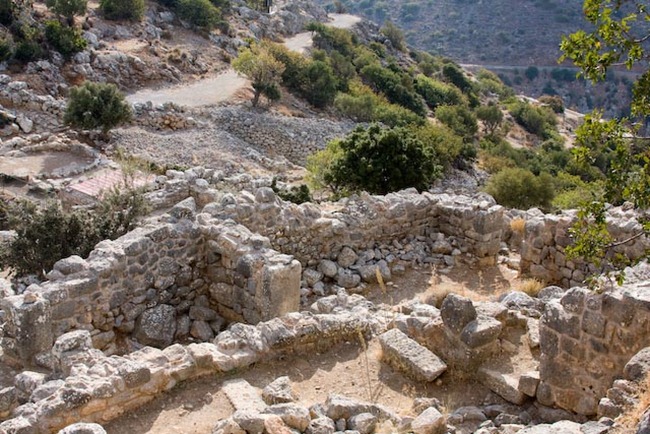
Our first stop was the abandoned town of Lato:

Lato (Ancient Greek: Λατώ[1]) was an ancient city of Crete, the ruins of which are located approximately 3 km from the small town of Kritsa. The city was built in a defensible position overlooking Mirabello Bay between two peaks, both of which became acropolises to the city. Although the city probably predates the arrival of the Dorians, the ruins date mainly from the Dorian period (fifth and fourth centuries BC). The city was destroyed ca. 200 BCE, but its port (Lato Etera or Lato pros Kamara), located near Agios Nikolaos was in use during Roman rule. This has led to the confusion, repeated by Stephanus of Byzantium quoting Xenion, a Cretan historian, that Kamara and Lato were one and the same. Modern scholarship distinguishes the two.

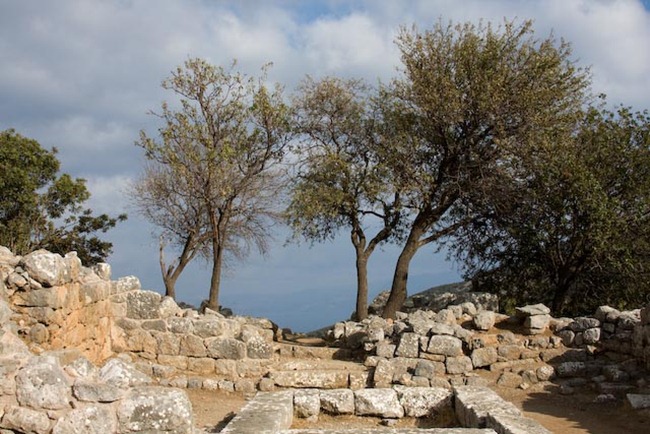
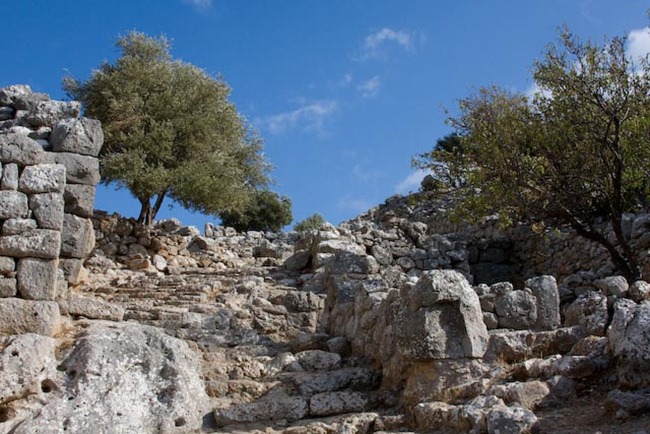
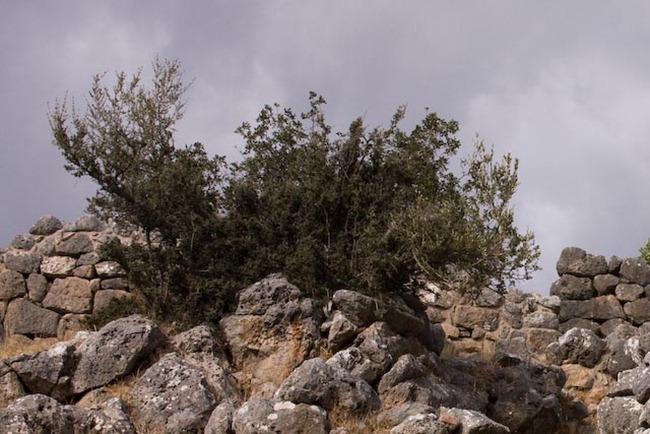
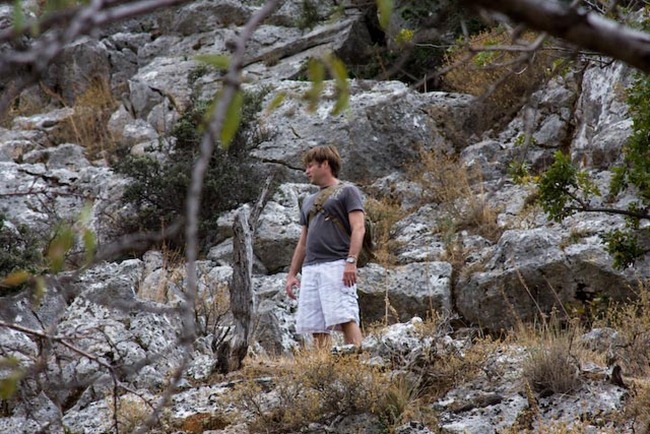
Over the last year, we have found that we are a hiking family, especially the boys who are boundless in energy and fly up the hills. So out of the car and up the mountain we went. The pictures below give you an idea of how the town stretches over the mountain, built into the hills and spreading out over miles. There is something very cool about crawling around and climbing over a village that is thousands of years old. Nestled into corners you see stone wash basins and small rooms and wonder, what was life like so long ago? What possessed them to build right up on the top? We will never know.

2008 Oct 22 Abandonded city of Lato Crete  (78)

2008 Oct 22 Abandonded city of Lato Crete  (81)

This gives you a good idea of the slope of the hill that the town is built on.

2008 Oct 22 Abandonded city of Lato Crete  (104)

Notice the sky. Turn one way and it is black. Turn the other and it is clear and blue.

2008 Oct 22 Abandonded city of Lato Crete  (5)

One advantage of building a town at the top is the view of the mountains, olive groves and valleys. Breathtaking.

2008 Oct 22 Abandonded city of Lato Crete  (54)

2008 Oct 22 Abandonded city of Lato Crete  (35)

The only man left in Lato.

2008 Oct 22 Abandonded city of Lato Crete  (76)

2008 Oct 22 Abandonded city of Lato Crete  (85)

This gives you a good idea of how steep and rough the hike was. Narda did it with a sprained ankle.

2008 Oct 22 Abandonded city of Lato Crete  (90)

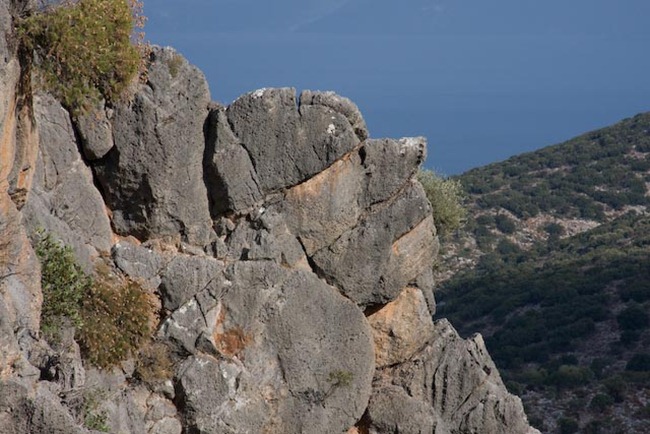
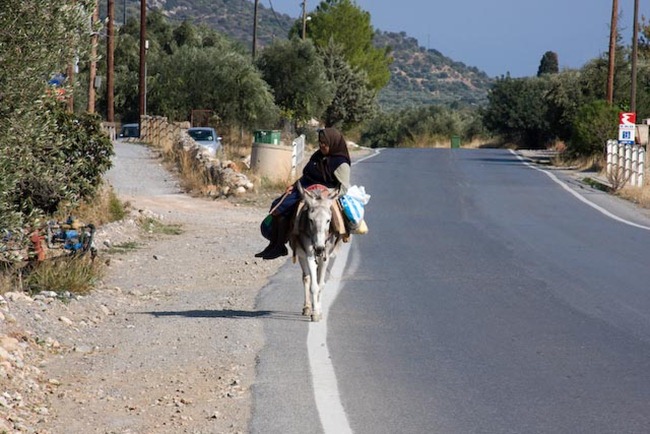
We jumped back in the car and headed into Kritsa. I had to stop and take this picture. In Crete, the old way of life remains.

2008 Oct 23 Road to Kritsa  (2)

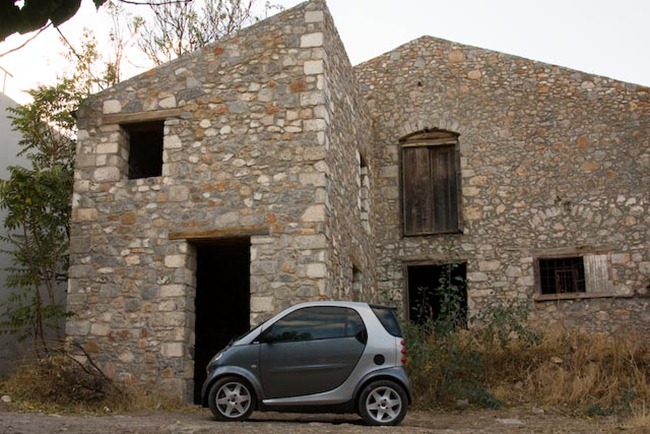
As we walked through Kritsa, this sight caught my eye. Old meets new.

Oct 22 Kritsa Crete  (4)

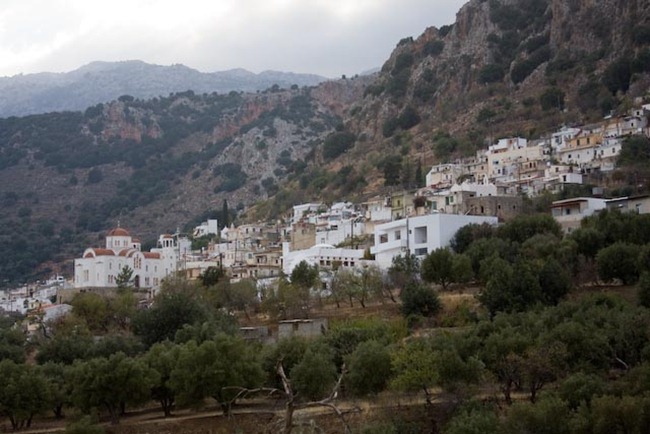
Like all the towns, it is nestled into the hills and I am left to wonder how they survive. Two industries seem obvious, agriculture and tourism. But nothing else. Note the church on the left, one of many. Kritsa is described as one of the most picturesque towns in Crete:

Kritsa is one of the oldest and most picturesque villages in Crete, Greece, built amphitheatrically on a rock hill, named Kastellos, surrounded by olive groves, at an altitude of 375 m. It is part of the municipality of Agios Nikolaos. During the Middle Ages, it was thought to be the largest village in Crete. Kritsa has been destroyed many times during the last centuries because it participated in all of Crete’s revolutions. It is located 10 km from Agios Nikolaos and has about 2200 inhabitants who live in different neighborhoods named Palemilos, Koukistres, Christos and Pergiolikia.

Oct 22 Kritsa Crete  (2)

And  as promised, it was a great little town filled with linen shops. But beware the grandmothers, they suck you in and sell you like the hardest used car salesman around.

AGIOS NIKOLAOS, CRETE

After Athens we headed to Crete for a few days of R&R. As the southern most island in Greece, we were hoping for sun and were sort of rewarded, 20-24 each day and sunny. But not the best ‘hanging out on the beach’ weather, so we did something we usually don’t do when near a beach – we did some touring.

Crete is a remarkable little island with a fierce island pride and history to match. Landing in Crete, we started the drive to Agios Nikolaos, a seaside town:

Agios Nikolaos (or Aghios Nikolaos, Greek: Άγιος Νικόλαος) is a coastal town on the Greek island of Crete, lying east of the island’s capital Heraklion, north of the town of Ierapetra and west of the town of Sitia. In the year 2000, the Municipality of Agios Nikolaos, which takes in part of the surrounding villages, claimed around 19,000 inhabitants. The town is the capital of the nomos (province) of Lasithi, and sits partially upon the ruins of the ancient city of Lato pros Kamara.

We took the time on arrival to walk the town and were promptly rewarded with a €20 parking ticket. What I did not realize is that you are only allowed to park on that side of the street on alternate months (try and figure that out from the signs).

2008 Oct 21 Exploring Agio Nikolaos_

The towns are brightly coloured, with thriving markets and negotiation alive and well. The people were very friendly, tourist orientated (that is for sure) and the food was fantastic. Although everyone smoked and I still find smoking in a restaurant odd (and annoying).

We stayed at the St. Nikolaos Bay hotel on the ocean. As the shoreline is very rocky, they have built a unique seaside area, with a man made sand beach that was sheltered from the ocean and tiered stone decks for catching a few rays. Nice thing about Crete in October is that there was no one there. We had the run of the place and the staff were fantastic.

2008 Oct 21 St Nikolaos Bay enjoying the sun  (24)

2008 Oct 21 St Nikolaos Bay enjoying the sun  (22)

2008 Oct 24 St Nikolaos Bay Resort_

One oddity is the prominence of Nescafe in the Greek culture. To me, Nescafe is low end instant coffee that I simply will not drink. To the Greeks, it appears that Nescafe has become a descriptive – to describe their coffee. For example, via:

Greek coffee – kafe eleniko: the coffee is cooked together with water in a little can. You order it
sketo – unsweetened
metrio – half sweet
gliko – sweet
Nescafe sketo, metrio, gliko and with milk – me gala
Frappe is iced Nescafe and a very refreshing drink

I paid €8 for an iced Nescafe …. once.

In the bay across from the hotel were two islands. The first island use to be a Boy Scout retreat according to the locals.

2008 Oct 21 St Nikolaos Bay enjoying the sun  (41)

The second island has a single church on it that people go to once a year – Christmas. It is also inhabited by sheep.

2008 Oct 21 St Nikolaos Bay enjoying the sun  (38)

2008 Oct 22 St Nikolaos Bay hotel  (4)

As mentioned previously, the Christian religion is prominent in Greek culture (an interesting paradox considering the prominence of long dead religious sites as tourist attractions). The hotel was no different, with a small and beautiful chapel by the beach adorned with old art.

2008 Oct 24 St Nikolaos Bay Resort  (2)

2008 Oct 24 St Nikolaos Bay Resort  (4)

A beautiful little fishing town and a great place to launch our exploration of Crete from.

THE LONG TAIL MEETS BLINK


Reading the Long Tail has made me think about the challenge, the opportunity and the conflict that it creates. For those who have not read the book, the fundamental premise is as follows:

The phrase The Long Tail (as a proper noun with capitalized letters) was first coined by Chris Anderson in an October 2004 Wired magazine article[1] to describe the niche strategy of businesses, such as Amazon.com or Netflix, that sell a large number of unique items, each in relatively small quantities.

The concept of a frequency distribution with a long tail — the concept at the root of Anderson’s coinage — has been studied by statisticians since at least 1946.[2] The distribution and inventory costs of these businesses allow them to realize significant profit out of selling small volumes of hard-to-find items to many customers, instead of only selling large volumes of a reduced number of popular items. The group comprising a large number of "non-hit" items is the demographic called the Long Tail.

In the book Blink, the author focuses on decision making and points to a study where a stall with 23 jams sold less than a stall with 6 jams, suggesting that people become confused by too much choice.

So where does that leave us? One obvious solution is a system of ‘suggestions’, where our friends and social network helps us sort through the myriad of choice to find what we like. Amazon was the first company to popularize this model. But is it enough?

While in the US recently someone explained the Zune service to me (Apple fan boys can now stop reading). It is $15 per month, I can run it on 3 Zunes, on 3 computers and pipe it to my stereo via my XBOX 360. Essentially, he was giving his entire family access to 3 million songs for the price of 10 CDs a year. From their site:

Songs you get with a Zune Pass can be copied to up to three computers and three Zune players.

Setting it up to share over the network with the XBOX 360 is explained here.

Over the years I have spent hours categorizing my music by genre (Using decade and one of three choices – Hard, Soft or General) and using star ratings (1 to 5) so that I don’t listen to the bad songs in my library. The possibility of accessing 3 million songs left me with one thought – where would I start?

I felt like the guy looking at 23 jams. But the more I think about it, the easier it sounds. No backing up my music anymore, no buying and ripping from CD, whenever I want it ……. That being said, even if I do choose to start the service, no matter how much my boys beg and plead, all Gears of War 2 items are off limits including the game.

Gears of War Zune 120GB

MR SURGEON


I recently went to a specialist surgeon in the UK and was surprised to hear that he calls himself ‘Mr’, not doctor. As I love the unique aspects of British culture I had to ask why. He explained that it goes back hundreds of years to the period where the barbers were the surgeons. In fact they were called barber-surgeons:

The barber surgeon was one of the most common medical practitioners of medieval Europe – generally charged with looking after soldiers during or after a battle. In this era, surgery was not generally conducted by physicians, but by barbers.

They often took up residence in castles where they also provided medical assistance to the rich and wealthy.

Barber surgeons in the United Kingdom

Formal recognition of their skills (in England at least) goes back to 1540, when the Fellowship of Surgeons (who existed as a distinct profession, but still not "Doctors/Physicians" as we think of them today) merged with the Company of Barbers to form the Company of Barber-Surgeons. However, the trade was gradually put under pressure by the medical profession and in 1745, the surgeons split from the barbers to form the Company of Surgeons. In 1800 a Royal Charter was granted and the Royal College of Surgeons in London came into being (later it was renamed to cover all of England – equivalent Colleges exist for Scotland and Ireland as well as many of the old UK colonies). [1]

The last vestige of barber surgeons’ links with the medical side of their profession is probably the traditional red and white barber’s pole, which is said to represent the blood and bandages associated with their older role. Another link is the UK’s use of the title Mr. rather than Dr. for consultants and registrars in surgery (when awarded an MRCS or FRCS diploma). This dates back to the days when surgeons gained an RCS diploma rather than a University Doctoral Degree. Even though all surgeons now have to gain a basic medical degree and doctorate (as well as undergoing several more years training in surgery), they still retain their link with the past.

So you train for 5 years and become a doctor, thus gaining the title ‘Dr’. You then train for another 5 years and shed the title of ‘Dr’ to go back to ‘Mr’ so that you can remain linked to the days when your profession also cut hair.

Got to love history.

LONDON


Samuel Johnson stated, "When a man is tired of London, he is tired of life; for there is in London all that life can afford."

Agreed.  Via.

2007-10-21 London Eye 12

This weekend we hit the west end for Stomp. It was a great show, right across from The Mousetrap which has been playing for 56 years and 23,000 performances, which makes Toronto’s run of 30 years look short. What is it with this play?

2008 Nov Lynn & Nick Over  (24)

AROUND THE ACROPOLIS


Obviously the big draw for our trip to Athens was the Parthenon and the affiliated sites. The nice thing about the city is that if you stay in a central location it is very ‘walkable’. We only took one taxi ride over the 3 days. Scattered throughout the city are small monuments and buildings such as the Monument of Lysikrates, on the street of Tripods, a tribute to Dionysus. The monument was later incorporated into a monastery of Capuchin monks.

2008 Oct 18 Monument of Lysikrates  (4)

And everywhere you went were churches, something that struck me about Greece as a whole. The Christian religion was everywhere, in the form of churches (scattered on streets, in villages, in the country side) and holy icons (e.g. Large crucifixes on buildings).

2008 Oct 18 Around Plaka Athens_

In the Ancient Agora (which is the area at the base of the Parthenon) we came across this 11th century Church of the Apostles, which had been changed many times over the centuries, but the roof paintings remained and were still beautiful.

2008 Oct 19 Athens Ancient Agora  (2)

2008 Oct 19 Athens Ancient Agora  (6)

Across from the church is the Stoa of Attalos (a stoa is a covered walk way):

The stoa was in frequent use until it was destroyed by the Heruli in 267. The ruins became part of a fortification wall, which made it easily seen in modern times. In the 1950s, the Stoa of Attalos was fully reconstructed and made into the Ancient Agora Museum, with funding donated by the Rockefeller family. The building is particularly important in the study of ancient monuments because the reconstruction of 1952 – 1956 faithfully replicates the original building.

It was filled with remnants of days gone by, most notable being the statues:

 2008 Oct 19 Athens Ancient Agora  (24)

I would imagine that it was always Antoninus’ hope that he would live on through his statue …. and 2,000 years later he does.

2008 Oct 19 Athens Ancient Agora  (23)

We spent a little time climbing up some ‘hill of the war god’ (or something) … I could not figure out what it was, the sign was all ‘greek’ to me (smile).

2008 Climbing the War gods hill  (3)

And of course, the Athenian Acropolis (the hill that the Parthenon sits on) was breath taking.

2008 Oct 19 The Acropolis Tour  (18) 2008 Oct 19 The Erechtheion in the Acropolis  (5)

The steps to the Parthenon.

2008 Oct 19 The Acropolis Tour  (11)

The old Temple of Athena.

2008 Oct 19 The Acropolis Tour  (23)

At the gates we met Stavros, our guide who must have been approaching 70 and was quite entertaining.

2008 Oct 19 The Acropolis Tour  (30)

One of his first points was around the marble of the Parthenon and how many parts of the temples have made their way to other museums (sounded a lot like Egypt):

Today, the Parthenon Marbles which were removed by the Earl of Elgin are in the British Museum. Other sculptures from the Parthenon are now in the Louvre in Paris, in Copenhagen, and elsewhere, but most of the remainder are in Athens in the Acropolis Museum, which still stands below ground level a few metres to the south-east of the Parthenon, but will be soon transferred to a new building.[42] A few can still be seen on the building itself. The Greek government has been campaigning since 1983 for the British Museum sculptures to be returned to Greece.[43] The British Museum has steadfastly refused to return the sculptures,[44] and successive British governments have been unwilling to force the Museum to do so (which would require legislation). Nevertheless, talks between senior representatives from Greek and British cultural ministries, and their legal advisors took place in London on 4 May 2007. These were the first serious negotiations for several years, and there are hopes that the two sides may move a step closer to a resolution

2008 Oct 19 The Acropolis Tour  (17)

Stavros also talked about the sad destruction of the Parthenon:

In 1687, the Parthenon suffered its greatest blow when the Venetians under Francesco Morosini attacked Athens, and the Ottomans fortified the Acropolis and used the building as a gunpowder magazine. On 26 September a Venetian mortar, fired from the Hill of Philopappus, blew the magazine up and the building was partly destroyed.[39] Morosini then proceeded to attempt to loot sculptures from the ruin. The internal structures were demolished, whatever was left of the roof collapsed, and some of the pillars, particularly on the southern side, were decapitated. The sculptures suffered heavily. Many fell to the ground, and souvenirs were later made from their pieces. Consequently some sections of the sculptural decoration are known only from the drawings made by Flemish artist Jacques Carrey in 1674.[40] After this, much of the building fell into disuse and a smaller mosque was erected.

Another point worth noting is the reconstruction. It would seem that in the 1930s many of the marble parts were reinforced with iron that was improperly treated, leading to splitting:

Originally, various blocks were held together by elongated iron H pins that were completely coated in lead, which protected the iron from corrosion. Stabilizing pins added in the 19th century were not so coated and corroded. Since the corrosion product (rust) is expansive, the expansion caused further damage by cracking the marble.[48] All new metalwork uses titanium, a strong, light, and corrosion resistant material.

He took us over to a marble slab with a piece of 1930s metal that was rusted and flaked apart, and then over to the below piece, which did not have a speck of rust and was as hard as … well .. iron … even though it was 2000 years old. New meaning to the phrase ‘they don’t make ‘em like they use to’.

2008 Oct 19 The Acropolis Tour  (20)

As we walked past this door, he mentioned that its’ replica adorns the entrance to the White House.

2008 Oct 19 The Acropolis Tour  (34)

And as a point of pride, that it is Canadian titanium that is now being used to fix the roof.

2008 Oct 19 The Acropolis Tour  (35)

 2008 Oct 19 The Erechtheion in the Acropolis_

Another great city explored.

RAMBLINGS AROUND THE INTERWEB


  • Whenever the news latches onto a child and video gaming, the addiction stories and media frenzy comes out in spades. The Globe is no different. News flash:  It is about active parenting, coaching restraint and balance. If my mom wouldn’t have kicked my butt out the door with the order ‘Go outside’, I guarantee I would have spent more time on my Intellivision or playing Head to Head Quarterback. It is about teaching balance. I hope the boy returns! 
  • Came across an interesting site called Lifehack.org that seems to be a smattering of people’s writings on life. I came across it thanks to a leadership newsletter which lead me to the article ‘Letter to a teenage daughter’ which could easily be switched for a boy. 
  • My next Christmas album will be from Yo-Yo Ma..
  • Spent the evening reading the boys the fascinating story Nature’s Revenge from Best Life magazine. The fascinating story of Chernobyl 20 years later. Amazing.


MY CHANGE


I detest loose change. It seems to accumulate everywhere. In my car the ashtray slowly fills. In the house we have a ‘change cup’ that keeps growing. I detest it because it always leads to a task of having to get rid of it. 

Sure, you can roll it. Or when I was in Canada you could take it to the supermarket and pay 10% to have the machine count it (which seems a rip-off to me, especially when we dropped $700 into the machine when we were moving).

So now we let the cup fill and then we sort it into piles of £10. I then take the aforementioned piles, put them in a little bag and use them at the corner store. But every time I do it, I feel guilty or embarrassed (not sure which). Of course the customary response from the clerk at the till does not help. Common responses to my statement of ‘I am going to pay for this with the change from my car’ are ‘groan’, ‘oh-no’ or a grimace. 

Which is why it was a pleasant change to hear from the pizza restaurant ‘Thank-goodness, I need the change desperately’ (I unloaded £30). Although he did groan when I forced him to take £2 worth of pennies and 2P pieces as part of the deal.

Which leads me to a final question, why do we have pennies? After all it costs Canada between 1.5 and 6 cents to make one (It must be the same in the UK). A few interesting penny facts:

Lots more penny (or pfenni) facts here.

ADVERTISING IN A DOWNTURN


It is interesting to live through the downturn and watch the different business reactions. This weekend I had a conversation with a CEO of a billion dollar company and he had just banned all ‘non-customer facing’ travel (a common step). The cascading impact or ‘snowball’ effect of companies tightening their belts is not hard to fathom:

  • Company puts in tight travel controls reducing airline, hotel, car rental and restaurant expenditures
  • These businesses buy less consumable product to support their business (oil, paper, sundries, etc.)
  • Commodity or primary industries see their businesses reduce revenue resulting in their tightening belts

A big circle of cascading impact. In the US, a high profile example is Circuit City and their recent announcement to close 155 stores due to poor consumer demand. A oft quoted McGraw-Hill article about recessions and marketing spend make the case for not cutting in key areas – one being advertising:

In a study of U.S. recessions, McGraw-Hill Research analyzed 600 companies from 1980-1985. The results showed that business-to-business Firms that Maintained or Increased their Advertising Expenditures during the 1981-1982 recession Averaged Significantly Higher Sales growth, both during the recession and for the following three years, than those that eliminated or decreased advertising. By 1985, sales of companies that were Aggressive Recession Advertisers had Risen 256% over those that didn’t keep up their advertising.

It would appear that for companies with deep pockets, the downturn represents opportunity. They just need to seize the opportunity ….

On the broader topic of leading through a downturn, a Marcus Buckingham quote was sent to me this week which summarizes it well, "What sets real leaders apart is their ability to turn people’s legitimate anxiety about the future into confidence. They do that by showing people vividly what the future is going to look like.” 

ATHENS

The boys had their mid-term break a week ago and we took the opportunity to head down to Greece. As we flew down, the sky was clear and we crossed some beautiful land and spectacular mountains.

Landing in Athens at 2PM was like landing at any other airport, the dash through passport control and to your bags. What always amazes me is how passport control never seems to manage manpower well. I have arrived to find 12 empty booths (like last week when I went through Vancouver) and too often I have arrived to 2 people manning their station and a line around the corner (as was the case in Athens). One would think that with the little thing called an airline schedule that they could plan for it.

Leaving the airport I was struck by the taxis, long lines of yellow Mercedes – at least 70 in a long queue. It would appear that all taxis are Mercedes. I noticed that our taxi had 469K on it but was astonishingly well maintained.

I always enjoy our first drive into a city, looking this way and that, quizing the driver (luckily, his English was excellent). In all cities, you have that first ‘ah ha’ moment, and in this case it was the Parthenon, towering over the city.

2008 Oct 19 Climbing to the Acropolis  (9)

We dropped our bags off at the hotel and off we went exploring. First to a wonderful Greek taverna down the road for lunch enjoying great local food and the music from an accordion. It was then off into the old city of Plaka.

Pláka (Greek: Πλάκα) is the picturesque old historical neighbourhood of Athens, clustered around the northern and eastern slopes of the Acropolis, and incorporating labyrinthine streets and neoclassical architecture. Plaka is built on top of the residential areas of the ancient town of Athens. It is visited by hundreds of thousands of tourists around the year, and is under strict zoning and conservation regulations, being the only neighborhood in Athens where all utilities (water, power, cable television, telephone, internet, and sewage) lie underground in fully accessible, custom-made tunnelling. Motor vehicles are not allowed in Plaka, and most streets are narrow enough, not being able to accommodate them anyway.

A few things struck me about Athens:2008 Oct 18 Walking around Plaka (2)

    • The city:  the city itself has an interesting feel to it. Safe (we walked out at night every night). Well lived in. Friendly (the people are very, very friendly) but run down – as there are a lot of people crammed into the city.
    • The animals:  The Greeks have a wonderful regard for animals. Everywhere you go there are cats and dogs. The dogs wander around the town unmolested with people feeding then and petting them everywhere. Our boys loved it, we spent the day wandering and petting dogs and cats everywhere. At one point, we watched a shop keeper come out with a huge heap of meat and kitchen leftovers for the 5 dogs that had congregated outside her shop. And the dogs … you would pet them and they would slowly roll over, loving the attention. Wonderful.
    • The people:  Very friendly and amazing. We loved the Greek people and their willingness to help (and sell – beware the grandmotherly Greek woman, she is a sales champion who just will not take no for an answer of the smile off her face).

2008 Oct 19 Exploring Athens  (7)

  • Litter:  One thing we were shocked by both in Athens and Crete was the litter. A local explained that this is a big cultural problem with Greeks still ‘generally’ thinking that littering is not a problem. The Greek government is educating and trying to change that in the school, but as the woman explained ‘The little girl in class said that she understands but her Dad tells her to do it’. Not unlike in Egypt, it is a real problem.
  • Flash:  At the end of the second day we got hit by a flash rainstorm. Like nothing I have ever seen, it was dumping down so hard that the streets were flooding with 3-4 inches of water and flowing at an insane pace.

2008 Oct 19 Exploring Athens_

And like so many European cities, intermingled in with daily life is thousands of years of history. It never ceases to amaze me.

2008 Oct 19 Exploring Athens  (5)

This is the glass bottom floor and bathroom floor of a cafe. Below is an archaeological dig that goes off in every direction.

2008 Oct 19 Psiri District Athens  (6)

2008 Oct 18 Parthenon & Acropolis  (5)

An old abandon building caught my eye. Beautiful in its own way.

2008 Oct 18 Athens  (12)

In the end, we took the advice from our agent and spent only 1 full day in Athens (and the half day on the day we arrived). It was perfect flying out the next day to Crete.

DVD WITH THAT NEWSPAPER?


I am back. Have not had time to sort through all of the 10GB of pictures from Greece yet but working on it.

We arrived back on the weekend and as habit dictates, I went straight for my two weekend newspapers which are the perfect compliment to a fresh brewed coffee. The papers: The Guardian, which my UK peers think is communist, and the Financial Times.

I ended up not reading the FT. It is too depressing. But while picking up the papers, I was struck again by the newspaper market over here. In Canada, when you buy a newspaper you get a newspaper (surprise!) and perhaps an insert such as a TV guide or magazine.

In the UK, many newspapers offer much more including free DVDs, CDs or even electronics (A few weeks ago I saw a free MP3 player with the purchase of the paper). I have gotten a BBC Planet Earth dvds, the best of Simple Red and many others things with my £1.50.

It would appear the same phenomenon exists in Greece. But the economics make me scratch my head ….

2008 Oct 19 Exploring Athens  (6)

MEANDERINGS FROM THE INTERWEB …


Read on the weekend that Bell Canada is deploying HSPA. Wonder how Rogers feels right now?

How to procrastinate. ‘Procrastination can be thought of as a health-and-safety measure. After all, it’s only fools who rush in.’

The Sony Ericsson X1 is one sexy phone.

I am thinking of investing with the ultra rich, in this case the Guinness family and their Iveagh Wealth Fund. I met one of the family at a cocktail party, great guy with a life filled with stories of world travel, unique experiences and a very different lifestyle than those of us in the working class.

I am not sure if I want my jet to say ‘Honda‘.

Check out GraphJam. ‘Music and culture for people who love charts’ A few of my favourite graphs below (too many to post!)

song chart memes song chart memes

song chart memes


song chart memes

song chart memes

song chart memes

image

song chart memes

funny graphs

And of course, my own …..

image

MADAME TUSSAUD: NUTTER OR CRAZY COOL?


A few weeks ago we had the honour of hitting Madame Tussaud’s wax museum. It was kitschy, tacky and a TON of laughs. A quick review of this woman’s life makes me wonder: nutter, genius or desperate to make a buck?

Tussaud created her first wax figure, of Voltaire, in 1777. Other famous people she modelled at that time include Jean-Jacques Rousseau and Benjamin Franklin. During the French Revolution she modelled many prominent victims. In her memoirs she claims that she would search through corpses to find the decapitated heads of executed citizens, from which she would make death masks. When Curtius died in 1794, he left his collection of waxworks to Marie. In 1802, she went to London. As a result of the Franco-English war, she was unable to return to France, so she travelled throughout Great Britain and Ireland exhibiting her collection. For a time, it was displayed at the Lyceum Theatre. She established her first permanent exhibition on Baker Street in London in 1835 (on the "Baker Street Bazaar").2008 Madame Tussauds

Whatever the case, it was a lot of fun. A few highlights below.


To celebrate the launch of Little Britain USA on HBO, I posed with the guys. Truly one of the best comedy programs on the television today, although not for the faint of heart.

As you can see, the guys were happy to see me.


2008 Madame Tussauds (18)


Lance, watch your back. Impossible is nothing to me.


I wonder if Fidel would find the ‘Wet Willey’ funny?

2008 Madame Tussauds (38)

2008 Madame Tussauds (42)


Let’s be honest,  some jokes just never get old, right Dick?

Can you guess what I am saying?


Another great day in Britain.

GILLIGANS ISLAND


I have finally got around to reading The Long Tail (I know, you are shocked, how can I exist in the business world without having read that).

The following statement from the author really caught my attention:

‘Would I have sat around watching Gilligan’s Island reruns as a kid if I could have been putting together a clan to adventure through World of Warcraft?’

I find myself trying to convince the boys to go to see the Clone Wars Movie with me and having them respond ‘If we get media time, we would rather play a video game’. They just have no interest in TV or movies. And to be honest, the author is right – if I could have been on XBOX live would I have really been watching reruns of TV programs? I doubt it.

I can’t even imagine their reaction if I tried to show them a black and white episode of Gilligan’s Island …..

LEAVING SCOTLAND


The last leg of our Scotland trip saw us heading down to Stirling to visit Stirling Castle and the Wallace Monument. Of course, the drive was a lot of fun. We passed a tank range, and I just had to stop and take a picture of the tank crossing.

2008 August 18 Tanks!  _MG_1117

2008 August 18 Scotland  Driving (80)

We also randomly stopped off and checked out a meadow. I love the way that the countryside is dotted with hand built, stone walls that are hundreds of years old. In one area in Scotland we drove over this incredibly hilly area and there were hand built stone fences all over which must have taken decades upon decades to build. Unfortunately, it was raining too hard to get a picture. This fence is just as cool …

2008 August 18 Scotland  Driving (37)

A random building beside the road ….

2008 August 17 Scotland  Driving (32)

We started the tourist day at the National Wallace Monument:

The National Wallace Monument (generally known as the Wallace Monument) is a tower standing on the summit of Abbey Craig, a hilltop near Stirling in Scotland. It commemorates William Wallace, the 13th century Scottish hero. [1]

The tower was constructed following a fundraising campaign which accompanied a resurgence of Scottish national identity in the 19th century. In addition to public subscription, it was partially funded by contributions from a number of foreign donors, including Italian national leader Giuseppe Garibaldi. Completed in 1869 to the designs of architect John Thomas Rochead, the monument is a 220 foot sandstone tower, built in the Victorian Gothic style. It stands on the Abbey Craig, a volcanic crag above Cambuskenneth Abbey, from which Wallace was said to have watched the gathering of the army of English king Edward I, just before the Battle of Stirling Bridge.

A performer did a bit on the Battle of Stirling Bridge and provided a very fierce, nationalistic Scottish point of view (go Braveheart!). We then climbed the monument, all 246 steps to the top. Like many places in Europe, climbing to the top of these towers involves squishing past people who are coming down, and the stairs are VERY steep (and small).

   2008 August 17 Scotland  Wallace Monument  (38)   2008 August 17 Scotland  Wallace Monument  (3)   

A view of the monument from Stirling Castle.

2008 August 17 Scotland  Sterling Castle (7)

The countryside from the top.

2008 August 17 Scotland  Wallace Monument  (10)

We then hopped over to Stirling Castle (which we could see from the tower)

2008 August 17 Scotland  Wallace Monument  (6)

Stirling Castle itself was a lot of fun, we love castles where you get to climb on things and run around. The castle itself is quite large and if you look at the above picture (on the right), you see huge areas inside the walls where you can run, and there is nothing like a good run along a castle wall. A little brief:

Stirling Castle, located in Stirling, is one of the largest and most important castles, both historically and architecturally, in Scotland. The Castle sits atop the Castle Hill, a volcanic crag, which forms part of the Stirling Sill geological formation. It is surrounded on three sides by steep cliffs, giving it a strong defensive position. Its strategic location, guarding the crossing of the River Forth, has made it an important fortification from the earliest times. The Castle is a Scheduled Ancient Monument, and is managed by Historic Scotland.

The story of the War Wolf, the largest trebuchet every built is an interesting one.

2008 August 17 Scotland  Sterling Castle (10) 2008 August 17 Scotland  Sterling Castle (18) 

2008 August 17 Scotland  Sterling Castle (23)

2008 August 17 Scotland  Sterling Castle (62)

Many UK castles have a regiment affiliated with them and a museum inside. I love going in these regimental museums, filled with their uniforms, field medals and mementos from wars past. Stirling Castle served as a barracks for the British army until 1964 and there is a museum to the Argyll and Sutherland Highlanders inside.

 2008 August 17 Scotland  Sterling Castle (40)

Eye witness accounts of what these men went through are everywhere and fascinating. Below is an eye witness event that reads as follows (Korea, 1950):

We captured the hill whilst advancing to the sound of Major Wilson’s Hunting Horn … I was on my back when the soldier stuck his bayonet into my upper chest, I instinctively raised my rifle and shot him and as he fell he withdrew his bayonet from my chest … At that point I passed out.

2008 August 17 Scotland  Sterling Castle (41) 

Amazing place Scotland. We loved it.

SIX DEGREES OF KEVIN BACON


I was catching up on some reading when I came across the article ‘Instant-Messagers Really Are About Six Degrees from Kevin Bacon’. I remember this phenomenon, one of the first peculiarities of the Internet, Six Degrees of Kevin Bacon:

The trivia game Six Degrees of Kevin Bacon is based on the concept of the small world phenomenon and rests on the assumption that any actor can be linked through his or her film roles to actor Kevin Bacon. The game requires a group of players to try to connect any film actor in history to Kevin Bacon as quickly as possible and in as few links as possible. The game was especially popular on college campuses in the early 1990s.[citation needed] In 2007, Bacon started a charitable organization named SixDegrees.org.

The Bacon number of an actor or actress is the number of degrees of separation he or she has from Bacon, as defined by the game. This is an application of the Erdős number concept to the movie industry. The higher the Bacon number, the farther away from Kevin Bacon the actor is.

The computation of a Bacon number for actor X is a "shortest path" algorithm:

  • If the lowest Bacon number of any actor with whom X has appeared in a movie is N, X’s Bacon number is N + 1.
  • Kevin Bacon himself has a Bacon number of 0.

Here is an example, using Elvis Presley:

Therefore Asner has a Bacon number of 1, and Presley (who never appeared in a film with Bacon himself) has a Bacon number of 2.

As of December 2007, the highest finite Bacon number reported by the Oracle of Bacon is 8. [3]. The American Civil War general William Rufus Shafter is frequently cited as having a Bacon number of 10, but his number is in fact only 7. [4].

[edit] Notable Bacon numbers

You have to love the way the Internet connects people with crazy ideas.

WHAT COMES AROUND GOES AROUND


There is something right about what happened last Friday: O.J. Simpson convicted and jailed in Vegas. It does not right the fact that he got away from murder or that he tried to profit from it by writing a book called ‘If I Did It, Here’s How It Happened’, (He was paid a reported $3.5M which he subsequently lost in civil court to the families of the murdered). But it is nice to know that he will go away for 15 to life … finally.

I still remember the trials. What a farce. A small justice served.

BAG


I have been on a long search for a good bag for travelling with gear. I find traditional camera bags just too boxy and my current bag (a funky canvas messenger bag) is not protective enough. I am sure that it lead to the demise of my Canon Rebel (seeing how it lead to a brand new D40, that is not a bad thing).

2008 August 17 Scotland  Sterling Castle (87)

After buying and returning a number of bags including some cool Crumpler bags that just didn’t work, I came across the Maxpedition site.

I love these American sites. Built for the family that is all about ‘the right to bear arms’. I settled on the Gearslinger  Malaga which will hold my camera, a video camera, additional long lense and a bunch of other stuff with a single shoulder sling (I didn’t want a traditional backpack). Fantastic. I am ready for our trip to Greece in a few weeks.

MALAGA GEARSLINGER          image      image

And the bonus? A nice little pocket to place a handgun should I ever decide to exercise my right to bear arms (smile).

image

GOLD


During a recent conversation I openly wondered how the US government would avoid a bankruptcy of their own. According to this site, the debt is in excess of $9 trillion:

The debt’s a problem, but we fixed a worse one before!

• Truman, Ike, Kennedy, Johnson, Nixon, and Carter wiped out most of the World War II debt.  Take a look.

• Two parts of the federal government are running big surpluses.

The eye-popping $9 trillion gross national debt is owed by the "General Fund." That’s the part funded by our income taxes. Half of that goes for the military and to pay interest on the debt. Fortunately, two huge parts of the budget, Social Security and Medicare, are running huge surpluses.

The graph is very interesting, sadly proving that deficit spending can win elections (Reagan). It is also a bit shocking to see Clinton (the supposedly social conservative who supports universal health care) paying off the debt.

During the debt conversation, a point was made that the deficit is not an issue due to the US gold reserves. I will admit, I knew nothing about gold other than the fact that countries had untied their currency to gold decades ago. Turns out that gold won’t save the US, even at $1K per ounce the stock piled value is $250 billion. That is about half of what Iraq has cost so far according to this site.

As Rumsfeld was once quoted as saying (I paraphrase), Ronald Regan proved that no one pays attention to deficit spending.

PINK


I own 1 pink shirt that I have worn 2 times. Apparently .. real men wear pink. The Brits LOVE their pink.

Real Men Wear Pink

By Daniel Billett, About.com

There is something alluring about pink. Maybe that’s because psychologically it is known to have a calming effect. Or maybe it’s because pink is complimentary to most skin tones, unless you already have a lot of pink tone in your skin (like me). Or maybe it’s because a man who wears pink exudes confidence, yet is sensitive. It could be as simple as the fact that pink is easy to coordinate with almost every color in your wardrobe–it goes amazingly well with greys, tans, black, navys and other blues tones. And lastly, if you’re still not convinced how great pink is, women love pink and are more likely to give you a second glance. So give pink a try if you haven’t already. I have outlined four ways you can incorporate this magical color into your wardrobe.

Sweaters
If you haven’t seen the movie “Brown Sugar,” you need to just to see how great a pink sweater can look. In a party scene, the actor Boris Kodjoe wears a pink crew-neck cashmere sweater with dark trousers, and I must say it is such a sexy look. It proves how something as classic and simple as a pink sweater can be show stopper.

Dress Shirts
Pink dress shirts are one of the easiest ways to incorporate pink into your wardrobe. They are easily worn with suits, under sweaters or on their own with trousers or jeans. I will say that at my office there is a man who often wears pink dress shirts. He gets many compliments whenever he does because it breathes new life into his suits and makes him look more distinguished. It’s a winning look.

Suits and Trousers
Spring and summer would be the time to wear pink suits and trousers. I know you may be having a hard time visualizing this, but when I say suits and trousers I mean seersucker or light cotton. It’s the perfect thing to wear at a summer wedding or party.

Accessories and T-shirts
If you can’t commit to a more substantial item in pink, start small. Ties, t-shirts, hats (like a pink Kangol) or a scarf with pink stripes would be the way to go.

Via.

RICKROLLING


A few nights ago I was looking for the opening of this seasons Saturday Night Live where Tina Fey plays Sarah Palin and I got rickrolled. Don’t know what that is? Watch this clip and 30 seconds into it you will figure it out. According to Wikipedia:

Rickrolling is an Internet meme involving the music video for the 1987 Rick Astley song "Never Gonna Give You Up". The meme is a bait and switch: a person provides a Web link they claim is relevant to the topic at hand, but the link actually takes the user to the Astley video. The URL can be masked or obfuscated in some manner so that the user cannot determine the true source of the link without clicking (and thus satisfying their curiosity). When a person clicks on the link given and is led to the web page he/she is said to have been "Rickrolled". By extension, it can also mean playing the song loudly in public in order to be disruptive.[1

Rick Astley takes it all in stride and appears to be profiting from it – Sony has republished his greatest hits. The power of the Internet.

You can watch the real clip here. Very funny.

HELLO


A recent conversation.

‘Hello Mr. Weening. This is XYZ bank, we have a few purchases we would like to discuss with you on your credit card’

‘Sure’ (I get these once in a while. I remember one particularly embarrassing situation 12 years ago when I was with clients in Austin Texas and went to put through a $4000 dinner bill and they refused me until I convinced them that I was not on a bender with someone else’s card)

‘Has you wife just attempted and failed to make an Internet purchase at XYZ for £500 and did she make an online purchase at XXX computer store for £480?’

(thinking .. unless she is buying me an early Christmas present …. I doubt it. Although I did tell her that I need another 1TB USB drive and that the boys computers need 2GB of additional RAM …)

‘Let me check … Nope’. They then closed down her card and (to be safe, on my request) my card. That could have been the end of it.

I then did something that I am not sure is allowed, I asked for the web site where the purchase went through and called into the retailer. I explained the situation and they stopped the shipment and cancelled the order.

I could have just let it go into the big Mastercard fraud center where the goods would have been shipped and Mastercard would just looked at it as the cost of doing business. But that is wrong.

A small win for the good guys.

LITTLE KNOWN


Got to love the web, little known Sarah Palin facts:

  • Little Known Fact: Sarah Palin only said she bought a tanning bed – in reality, it was a reverse tanning bed, powering all tanning beds everywhere around the world with the smoldering sun-kissed light from within Sarah Palin.
  • Sarah Palin drives herself to work everyday – in an M1A1 tank
  • Sarah Palin doesn’t actually have an accent, it’s distortion from her telepathic broadcast directly into your brain.
  • Little Known Fact: @Scobleizer is Sarah Palin in drag.

Of course, what would it be without a Chuck Norris contribution:    This is a truly great day. Chuck Norris, the Man himself, has deigned to give an approving fist pump to us as chroniclers of the Little Known Facts about Sarah Palin. He cites his personal favorites as follows:

  • Sarah Palin once carved a perfect likeness of the Mona Lisa in a block of ice using only her teeth.
  • Sarah Palin doesn’t need a gun to hunt, because she can throw a bullet through an adult bull elk.
  • And my favorite: Sarah Palin is courageous and tough enough to shave Chuck Norris’s beard – and face off against his third fist disguised as a chin.

Via.


Late addition from GraphJam:

song chart memes

song chart memes

THE SCOTTISH NORTH


As we headed into the Scottish north we were struck by the beauty of Scotland, ranging from heather covered scrub lands to beautiful pine covered forests (which reminded us of northern Ontario). Our stop for the night was Aviemore which seems like a great place to spend a week with the family enjoying the Cairngorms National Park. Unfortunately for us, it was a stop off before heading to the Loch Ness region and I cannot see us coming back. It would be an amazing place to hike, ski and enjoy the outdoors.

2008 August 15 Aviemore   _MG_0682

The next day we headed up to the Loch Ness region, staying at a hotel near Inverness. At the hotel there was a traditional Scottish wedding going on (kilts and all), which was quite a sight. The region has a plethora of tourist options, travelling a little farther north to watch the dolphins and whales or hitting the traditional tourist spots around Loch Ness.

Our first stop was Urquhart Castle, our favourite castle in the UK so far:

It is not known precisely when the castle was built, but records show the existence of a castle on this site from the early 1200s. The area had been granted to the Durward family in 1229, and they were probably the builders of the castle. It was certainly in existence in 1296, as it was captured by Edward I of England at this time. Sir Robert Lauder of Quarrelwood was Constable of Urquhart Castle in 1329, and his grandson Robert Chisholm succeeded him in 1359. The castle was seized from the Crown in the mid-fifteenth century by the Earl of Ross, but recovered shortly afterwards. In 1509, it was given as a gift to the Grants, whose ownership lasted until 1912. During this period, the MacDonalds captured the castle in 1545, while it was also captured by a Covenanter force in 1644. The castle was then largely destroyed in 1692 by Williamite troops who had been holding the castle against Jacobite forces (Gifford 1992, 217). The intention was to ensure that the castle could not become a Jacobite stronghold, an intention that was fully achieved as the castle was never repaired and remained as a ruin. Subsequent plundering of the stonework for re-use by locals, and natural decay, further reduced the ruins.

2008 August 16 Scotland  Urquhart Castle Loch Ness   (7) 

2008 August 16 Scotland  Urquhart Castle Loch Ness   (9)

2008 August 16 Scotland  Urquhart Castle Loch Ness   (144)

2008 August 16 Scotland  Urquhart Castle Loch Ness   (170)

2008 August 16 Scotland  Urquhart Castle Loch Ness   (87)

2008 August 16 Scotland  Urquhart Castle Loch Ness   (13)


A ruined castle means one thing, that you can run up and down the moat. You can climb on the walls. You can climb all over the walls. In other words, it officially becomes our favourite castle in the UK. Spectacular.

While in the carpark, I was waiting for the family and overheard two North American tourists discuss the castle. They were obviously just married and had hats on that said ‘Just married him’ and ‘Just married her’.

They looked down on the castle and took a token picture with the following comment:

‘I hope the tour bus gets going soon. I am ready to go. Quick, take a picture of us’

‘Yah, me too. Seen one castle, seen em all’

I hope we never get like that.


Our next stop was the Loch Ness Monster Exhibit (think 3D – had to be done) and an exploration of the Inverness region.

2008 August 16 Scotland  Inverness (13)

2008 August 16 Scotland  Inverness (6)

2008 August 16 Scotland  Inverness (17)


I found this sign a good laugh. It was then off to Stirling.

ON MEDIA


In our family we are vigilant around media balance (i.e. not too much). The other day the boys came home and as it was a dreary day they played for an hour on the computer and I was reminded that playing the computer is the same (or better) than the TV. I would often come home from school, plop down and enjoy an hour of cartoons.

This is a challenge that all parents face (or many ignore) that has been around for generations. On the weekend, I found this excerpt particularly funny with regard to the age-old challenge of ‘getting the kids outside’. In the late 1700’s ….

The first lending libraries opened around this time …. In fact, the advent of the novel created concern about young people lying around all day reading when they should have been outside being active or doing something useful.

Via.

TWO QUICK BRITISH OBSERVATIONS


  • In the UK, the TV season is often 6 shows long. Yes – 6. I figured this out when 6 weeks ago I read an article about Spooks 9, a new BBC series and then on the weekend saw an article about the season finale. A stark contrast to the North American season of 20-24 shows. How you can develop a plot in 6 episodes is beyond me. Plus what do you do for the following 46 weeks? Oh yes, reruns.
  • The world is full of different standards. North America drives on the right, the UK on the left. Power systems are different – 110 versus 220 volt. Television is different, NTSC versus PAL. A4 paper versus letter. But come on, binders? Yes, that is right. Our son entered into grade 6 (which is like grade 7 in North America, he moves to different teachers for each class like high school) and so he needs binders for each class. In North America they use the 3 ring binder. In the UK? You have a choice, either the 2 or 4 ring binder. Amazing. Maybe this is some form of unique tariff system which keeps people from importing foreign binders (this could go either way – North America or Europe). Odd.


DALWHINNIE


Our next stop on the Scotland tour was the Dalwhinne Distillery as we headed into North Scotland, on the outskirts of Speyside – the famed Scotch region. I had to ask, what is the difference between Scotch and Whiskey?

To be called Scotch whisky the spirit must conform to the standards of the Scotch Whisky Order of 1990 (UK),[1] which clarified the Scotch Whisky Act of 1988,[2] and mandates that the spirit:

  1. Must be distilled at a Scottish distillery from water and malted barley, to which only other whole grains may be added, have been processed at that distillery into a mash, converted to a fermentable substrate only by endogenous enzyme systems, and fermented only by the addition of yeast,
  2. Must be distilled to an alcoholic strength of less than 94.8%[3] by volume so that it retains the flavour of the raw materials used in its production,
  3. Must be matured in Scotland in oak casks for no less than three years and a day,
  4. Must not contain any added substance other than water and caramel colouring, and
  5. May not be bottled at less than 40% alcohol by volume.

This definition is currently under review and new legislation is expected in the spring of 2008.[4]

Personally, I can’t stand scotch, which is a bit of a travesty as many I know enjoy a great scotch. It goes back to an incident in University which involved a 60 oz. bottle of Crown Royal, 3 days without sleep due to cramming for finals, caffeine tablets and my engineer neighbour who had just graduated. It was not pretty. If I even smell Whiskey I get hit by waves of nausea.

A few interesting tidbits:

  • Turns out that tax is about 75% and if you were to fly to South Africa, you could actually buy their Scotch at about half the price.
  • The Angel’s Share is the amount of Scotch lost due to evaporation during the aging process (Up to 1/3)

2008 August 15 Scotland  Driving (11) 2008 August 15 Scotland   Dalwhinnie Distillery Scotland  (9)

The distillery itself is out in the middle of nowhere. In the town there is this odd little restaurant. Odd because it is a fully organic restaurant during the day (amazing choice of food) and the local disco at night serving up techno DJ mixed enjoyment for the locals (offering buses too and from 3 different towns).

2008 August 15 Scotland   Dalwhinnie Distillery Scotland  (2)

As an aside, while driving through the hinterland of Scotland to get to this place we had the wits scared out of us by a low flying fighter jet which was ducking and weaving along the highway a couple hundred feet up trailing smoke. To me it looked like a Tornado. Cool but VERY loud.

AROUND EDINBURGH


Beyond the Fringe, Edinburgh is a vibrant city with a rich history and in only a few days, it is impossible to take it all in. We often jump on the Big Bus as it is a great way to get a feel for the city. These double decker tour buses are manned by a guide talks his way through the city. A few highlights of Edinburgh:

Greyfriars Bobby is a statue was a Skye Terrier who became known in 19th-century Edinburgh, Scotland, after reportedly spending 14 years guarding his owner’s grave, until his own death on 14th January 1872.[1]

Bobby belonged to John Gray, who worked for the Edinburgh City Police as a night watchman, and the two were inseparable for approximately two years.[1] On 15 February 1858, Gray died of tuberculosis. He was buried in Greyfriars Kirkyard, the graveyard surrounding Greyfriars Kirk in the Old Town of Edinburgh. Bobby, who survived John Gray by 14 years, is said to have spent the rest of his life sitting on his master’s grave. A more realistic account has it that he spent a great deal of time at Gray’s grave, but that he left regularly for meals at a restaurant beside the graveyard, and may have spent colder winters in nearby houses.

In 1867, when it was pointed out that an ownerless dog should be destroyed, the Lord Provost of Edinburgh, Sir William Chambers (who was also a director of the Scottish Society for the Prevention of Cruelty to Animals), paid for a renewal of Bobby’s licence, making him the responsibility of the city council.

Bobby died in 1872 and could not be buried within the cemetery itself, since it was consecrated ground; instead he was buried just inside the gate of Greyfriars Kirkyard, not far from John Gray’s grave.

2008 August 13 Scotland  Edinburgh (9)

  • Aptly named The Last Drop, this pub is where people who had committed ghastly crimes (like stealing a pair of boots or being Protestant) were given their last meal and a whisky for the road before being hanged. Read a great review and history here.

2008 August 13 Scotland  Edinburgh (3) 

Just down the street was another pub named after a woman who survived hanging and was allowed to live. I guess they didn’t have this chart to ensure the right drop length.

  • In what can only be called misguided advertising, this statue of George IV makes him look lean, regal, a king. In fact, George IV was short and incredibly fat (5′ 4" with a 50 inch waste weighing 245lbs).  Our guide said that the only reason why his statue is up there is because he actually took the time to visit. The Times had the following comment on his passing:

There never was an individual less regretted by his fellow-creatures than this deceased king. What eye has wept for him? What heart has heaved one throb of unmercenary sorrow? … If he ever had a friend — a devoted friend in any rank of life — we protest that the name of him or her never reached us.[57]

2008 August 14 Scotland  FAT George IV

John O’Farrell has the following to say in his book:

George IV’s popularity never really recovered but he made little effort to improve his public image – unless you count his desperate efforts to strap himself inside an enormous fifty-inch corset. He was described by the Duke of Wellington as ‘the worst man I ever fell in with my whole life, the most selfish, the most false, the most ill-natured, the most entirely without one redeeming quality’. And then of course when he died, Wellington eulogized about his many wonderful qualities and everyone nodded in somber agreement.

Funny, Wellington’s statue is just down the way.

2008 August 14 Scotland  Wellington_

  • We passed by Usher Hall which has a funny story. The theatre was funded by Andrew Usher who’s fortune came from the Whisky business. Ironically, he banned the sale of all alcohol within the hall.
  • We had dinner at a restaurant across the street which I thought was a unique place, Gourmet Burger Kitchen. Little did I know that it is a chain. Fantastic place, minimalist decor, amazing food (the blue cheese burger went down great with a local pint).
  • We did head up to Edinburgh castle, which has a rich history (primarily centred around fighting the English):

In 1296, King Edward I of England invaded Scotland, sparking the First War of Scottish Independence. Edinburgh Castle soon came under English control after a brief resistance. A large garrison was installed, 347 strong in 1300. After the death of Edward I in 1307, however, England’s control over Scotland weakened. In the spring of 1314, a surprise night attack led by Thomas Randolph, 1st Earl of Moray, recaptured the castle. It was a daring plan, involving a party of thirty hand-picked men making a difficult ascent up the north precipice and taking the garrison by surprise. Robert the Bruce immediately ordered the destruction of its defences to prevent re-occupation by the English. Shortly after, Bruce’s army secured victory at the Battle of Bannockburn.

After Bruce’s death, another dispute of the rightful heir to the throne, which had its origins in the Great Cause, broke out, leading to the Second War of Scottish Independence; that eventually caused the castle to again come under English control. Major repairs were carried out, but these proved ineffective against another assault in April 1341, this time led by William Douglas, 1st Earl of Douglas. Douglas’s party disguised as merchants bringing supplies to the garrison, and managed to drop its loads at the castle gate, preventing their closure. A larger force hidden nearby rushed to join them and the castle was ruthlessly retaken.

2008 August 14 Scotland  Edinburgh Castle  (11)

2008 August 14 Scotland  Edinburgh Castle  (13)

2008 August 13 Scotland  Edinburgh (25)

2008 August 14 Scotland  Edinburgh Castle  (24)

There is so much to see and we missed a lot, most notably Arthur’s seat. The boys saw people at the top and were instantly asking ‘Can we go climb that???’ . Would have been a fun hike. Next time.

2008 August 14 Scotland  Edinburgh (61)

CUT DOWN THE TREES


Wired’s June 2008 ‘Inconvenient Truths: Get Ready to Rethink What It Means to Be Green’ has a few fascinating facts to consider with regard to the environment:

Over its lifetime, a tree shifts from being a vacuum cleaner for atmospheric carbon to an emitter. A tree absorbs roughly 1,500 pounds of CO2 in its first 55 years. After that, its growth slows, and it takes in less carbon. Left untouched, it ultimately rots or burns and all that CO2 gets released.

Look at the environmental protection agency’s CO2-per-kilowatt-hour map of the US and two bright patches of low-carbon happiness jump out. One is the hydro-powered Pacific Northwest. The other is Vermont, where a 30-year-old nuclear reactor, Vermont Yankee, keeps the Ben & Jerry’s cold. The darkest area corresponds to Washington, DC, where coal-fired power plants release 520 times more atmospheric carbon per megawatt-hour than their Vermont counterpart. That’s right: 520 times. Jimmy Carter was right to turn down the heat in the White House.

  • On Air Conditioning: Heating a home emits 15X more CO2 than cooling a home. A hypothesis on this topic, perhaps we think of A/C as a luxury while warmth is required to survive. Still, global warming will reduce the emissions simply by reducing the over all need to heat.

The entire list of facts can be read here: Get Ready to Rethink What it Means to Be Green:

1: Live in Cities

2: A/C Is OK

3: Organics Are Not The Answer (I found this one very interesting)

4: Farm the Forests

5: China Is the Solution (My next home will be solar)

6: Accept Genetic Engineering

7: Carbon Trading Doesn’t Work (This is a big UK one, everywhere I go they have little notes – make this transaction carbon neutral by paying ‘X’ – what a load).

8: Embrace Nuclear Power

9: Used Cars — Not Hybrids (A very interesting statistic on the cost to build a hybrid. Sorry Leonardo).

10: Prepare for the Worst

I blogged on this topic a couple of years ago after reading Michel Crighton’s book State of Fear (great book). In the end, the focus on the environment is a great thing. But we need to balance fact with fiction.

Keep it up Al Gore.

PANTS


Random note …. as seen in an Eddie Bauer store window. I think that if my British compatriots saw this they would snicker. Pants is an interesting word over here.

In Britain, pants does not mean trousers. It means undergarment and there is a saying ‘That is pants’ which took me a bit to understand – it means that is bull. Of course, ‘to pants’ someone in Canada means to yank down his trousers.

Such a vibrant word (smile).

IMAG0006

RECESSION BLESSING?

On the weekend Harry Eyres, FT journalist, wrote an interesting article on life in the slow lane and recession implications. While ‘not sounding mean or heartless’ as recessions cause pain to many, he does point out that a recession can be an opportunity.

‘The word ‘recession’ implies drawing back, rather than proceeding ever onwards and upwards. Now we have a chance not just to stay put but to appreciate being where we are.’

In his case it was walking down a lane in Chiltern Hills. As people put the breaks on vacation spending and big trips, it can be seen as a great opportunity. No greater opportunity than in Britain which is rich in culture, low cost historic sites and events.

It never ceases to amaze me just how much there is here, knowing clear well that when we leave, we will have done nothing but scratch the surface of a culture who’s depth is beyond sight.

One could say that Harry is seeing the silver lining. So right, or as my British compatriots say ‘Too right’.

THE WEATHER


When you are down about the weather just look at these pictures. This is August 20th – the first day of school in Artic Bay. A friend of mine who teaches up there sent it.

BRRRRRRRRR. Wonder where that is?

Arctic Bay (2006 Population 690) (Inuktitut syllabics: ᐃᒃᐱᐊᕐᔪᒃ, ikpiarjuk) is an Inuit hamlet located in the northern part of the Borden Peninsula on Baffin Island in the Qikiqtaaluk Region of Nunavut, Canada. The 2008 Rand McNally Road Atlas shows a new name of Tununirusiq, but its status as official is not known. Arctic Bay is located in the Eastern Time Zone although it is quite close to the time zone boundary. The predominant languages are Inuktitut and English. As of the 2006 census the population has increased by 6.8% from the 2001 census.[1]

The BBC has an average minimum temperature in February of -36 and a record low of -50. That is cold.

CLOUD COMPUTING


We read a lot about Cloud Computing or the software-services model. Generally, you read about how this is the Hail Mary and the future of the Internet. The media loves a bandwagon.

I believe that it is a significant shift, but I think it is a shift, not a wholesale market switch. There is a big place for software plus services as part of the choice that consumers and businesses face, but it is a choice. Do I want my software hosted as a service, do I want it on a desktop/server on my premises or do I want someone to host it for me. Choice.

For the first time, I actually read two articles which pan the cloud computing hype:

In the end it is about balance and choice. in the article ‘Hybrid SaaS is likely the way to go’, we see that balanced view:

This isn’t exactly news. Over and over again, we’ve heard about these same worries slowing broader adoption of SaaS. And they aren’t going to go away. Which is why a number of folks, including ZDNet’s Joshua Greenbaum, believe that a hybrid approach incorporating both SaaS and traditional on-premise delivery models will ultimately prevail.

I like the last part of that paragraph:

Sorry, Marc Benioff, the rumors of traditional software’s death have been greatly exaggerated.

GENERATION KILL

Over the past weeks I have watched the HBO show ‘Generation Kill’ and read the book Sniper One. They are a depressing depiction of the state of Iraq.

Generation Kill has a fascinating history and I was surprised to find that much of the story is fact based (surprised because of several of the events, certain characters and the way in which the initial invasion was carried out). It is based on the book Generation Kill, which is based on a 3 part article written by a Rolling Stone reporter during the invasion:

Generation Kill (2004) is a book written by Rolling Stone journalist Evan Wright chronicling his experience as an embedded reporter with the 1st Reconnaissance Battalion‎ during the 2003 invasion of Iraq. His account of life with the Marines was originally published as a three-part series in Rolling Stone in the fall of 2003. “The Killer Elite”, the first of these articles, went on to win a National Magazine Award for Excellence in Reporting in 2004.[1]

If you read the write up, it is interesting to note that there were ramifications for many in the article as Evan Wright spared no one, making many of the officers looks like asses:

The book also details rising tensions between the men and a couple of their commanders, including Capt. David McGraw, whom the men referred to as Captain America. Mr. Wright describes the captain as firing randomly on several occasions, endangering his men and generally spreading panic.

Mr. Wright writes: ”One of the enlisted men in his vehicle challenges him. ‘What are you shooting at?’ he asks him.” The marine then says, ” ‘The guy is not right in the head.’ ” Both comments are breaches of authority.

Later Mr. Wright writes of Captain McGraw poking a prisoner in the neck with a bayonet.

Of course, not everyone agrees with the depiction, a full rebuttal can be read here. There appears to be a few inconsistencies. You can also see footage from one of the Marines here. Interesting.

The problem is that Sniper One and movies like Stop Loss pass on the same overall message as Generation Kill, the place is a mess, that the soldiers are frustrated and the people who are paying for it are the civilians. In both accounts, there are mindless killings. There is the F-18 strike on a village with no one but women and children in it, there is the Sniper One story of the guy riding his bike down a street and getting his leg blown off.

I was left with a real feeling that it is all very sad.

FRINGE EDINBURGH


A big highlight of our Scotland trip was Edinburgh. A beautiful town with a rich history with way more to do than we had time, even though we decided to stay an extra day. For us, a big highlight was an unexpected one – The Edinburgh Fringe Festival. We did not travel to Edinburgh to enjoy this festival – but many do. Think of it as a smorgasbord of theatre, comedy and musical performance. Performers on the street, people from everywhere and a big book listing performances from all over the world. What was amazing was the children’s selection – events for young kids, pre-teens and teens. So much choice. We settled on the following while wishing for more:

    2008 August 14 Scotland  Our Fringe Experience_

  • Ian Billings Out of His Mind: A children’s stand-up with an entertaining story that the boys loved. Watch a video of him here.
  • A Brief History of Scotland – We Done Loads: A laugh out loud one hour history of Scotland from top to bottom. Entertaining and we actually learned a good deal about Scotland. My only issue is that they claimed that the telephone was invented in Scotland. Sorry lads, check your facts … that would be Canada. 
  • We then went on to see 2 shows run by James Campbell. The first being a true stand-up for kids including a young boy (10ish) who actually stood up and did his routine in front of 80 people, took a lot of guts. The other was his ‘black experimental comedy’ Shut-Up Stupid. I found it odd, but then I am not a deep artsy and probably missed the point (smile).

Below are a few pictures from the centre of the activity, the Royal Mile.

2008 August 14 Scotland  Edinburgh (54) 2008 August 14 Scotland  Edinburgh Castle  (3) 2008 August 14 Scotland  Edinburgh Castle  (4) 2008 August 13 Scotland  Edinburgh (6) 2008 August 13 Scotland  Edinburgh (12)

And that is without hitting the touristy things …. I have to say, if I lived in the UK I would plan to go back to the festival annually. This city is wonderful and the broad choice of entertainment at the Fringe is fantastic.

Wonderful event and a smart city for figuring out how to create an event to attract people beyond the castle and other sites. Of course, this assumes that they will have the ticketing system fixed by then (LOL).

MAKE A JOKE ABOUT THE SHEEP AT YOUR OWN RISK


In my last post I made a comment about how there are so many sheep in Scotland – it is not a joke. They are everywhere – and of course there are one or two sheep jokes out there. What I did not know was why there are so many sheep. While taking a tour one of the speakers talked about the Highland Clearances:

In the Highlands and Islands the years following the Jacobite Rebellion lead to considerable social unrest, made worse by a sharp rise in the population putting pressure on the use of the land. This brought about schemes to resettle abroad in North America, or in Australia, but in some cases, especially in Sutherland, emigration came after the people had been forcefully evicted from their homes and had seen their roof-timbers burned down.

This displacement of people to allow the introduction of large numbers of sheep, is a painful but important part of our heritage which deeply affects Scottish life today. The clusters of deserted crofts which litter the Highlands and Islands are an eloquent reminder of treatment of whole townships deprived of their land. The ‘wilderness’ that is the Highlands today is a direct man -made result of these events and the impact can be seen too, in the Scottish cultural influences throughout the world.

Wikipedia makes an interesting point on where many of the Scots went in the Year of the Sheep:

Another wave of mass emigration came in 1792, known as the Year of the Sheep to Scottish Highlanders. The people were accommodated in poor crofts or small farms in coastal areas where farming could not sustain the communities and they were expected to take up fishing. Some were put directly onto emigration ships to Nova Scotia (Antigonish and Pictou counties and later Cape Breton), the Kingston area of Ontario and the Carolinas of the American colonies. There may have been a religious element in these forced removals since a good number of the Highlanders were Roman Catholic. This is reflected by the majority representation of Catholics in areas and towns of Nova Scotia such as Antigonish and Cape Breton. However almost all of the very large movement of Highland settlers to the Cape Fear region of North Carolina were Presbyterian. (This is evidenced even today in the presence and extent of Presbyterian congregations and adherents in the region.)

Fascinating historical context for today’s sheep filled highlands. But then again, some of the terrain is not that hospitable (yes, those little dots are sheep):

2008 August 17 Scotland  Driving (21)   2008 August 17 Scotland  Driving (24)

2008 August 17 Scotland  Driving (19)

One other interesting feature of Scotland is the Loosestrife. You can see it in the picture above by the creek (right) and in the picture below. It is the tall purple plant.

2008 August 17 Scotland  Driving (14) 

I have a funny story about Loosestrife. In my garden in Canada I had a few of these plants. They are quite pretty, growing to about 4 feet with wonderful purple flowers. I had my team over and I was talking about the garden with a friend of mine who, for data protection purposes, I will call Ed.

I called the plant Sweet William and in his oh-so-I-am-very-smart-you-dumb-ass tone he started to laugh and said ‘Dude, that is not Sweet William. That is Loosestrife and it is illegal to have it in your garden. It is killing the wetlands in Ontario by invading and destroying native vegetation’. Manitoba calls it the Pretty Killer.

Turns out that Loosestrife came into Canada in the 1800’s:

Purple Loosestrife is a European plant that was introduced to North America in the 1800’s. For a
time it was sold as an ornamental garden plant until its harmful effects were noticed. Loosestrife
is extremely prolific and can take over the habitat of other natural plants. It thrives in wetlands
and can also destroy essential habitat for wildlife such as ducks.

An interconnected world. I also learned something that day – don’t invite Ed over (smile).

OVER THE WALL – SCOTLAND BOUND


We left Harrogate with a simple goal – cross Hadrian’s Wall and head into Scotland. Hadrian’s Wall is quite the piece of work, stretching from ocean to ocean between Scotland and England. From Ancient and Roman Britain:

‘It was begun in AD 122 on the orders of the visiting Emperor Hadrian to keep out the Picts who kept crossing into England and deliberately calling him ‘Adrian’ to wind him up. It took ten years to build because the builders kept leaving at lunchtime to work on another job. To be posted to Hadrian’s Wall was probably the bleakest posting a Roman Soldier had to endure. ‘Join the Army they said. Travel to interesting and exciting places. Stand about on a freezing cold wall waiting to be skewered by a screaming bearded Pict’

There are a host of sites to see, we settled on the Vindolanda settlement as our first stop:

The Roman army appears to have occupied the site of Vindolanda around AD 85, after the Governor, Agricola, had brought the northern tribes to bay at the battle of Mons Graupius. The Romans called the place ‘Vindolanda’, as many documents and an inscription confirm, perhaps because they were turning into Latin an existing native name, thought to mean ‘white lawns’ or something similar. The fort guarded the central section of the vital east to west supply route, known now as the Stanegate, and when the Wall was built some 40 year later, Vindolanda took its place between Housesteads and Great Chesters as a Wall fort. The early forts were built in timber, and required replacement every seven to eight years, even if there was no change in garrison, and the fifth such fort was constructed early in Hadrian’s reign.

It was a very interesting site where you explore the ruins and in the museum see the different finds from the site (they are still excavating). The most interesting part being the tablets, which have been identified as some of the most important finds in Britain. You can view the most interesting tablets here. A sample, a letter from a man to the Governor seeking mercy:

.. he beat (?) me all the more … goods … or pour them down the drain (?). As befits an honest man (?) I implore your majesty not to allow me, an innocent man, to have been beaten with rods and, my lord, inasmuch as (?) I was unable to complain to the prefect because he was detained by ill-health I have complained in vain (?) to the beneficiarius and the rest (?) of the centurions of his (?) unit. Accordingly (?) I implore your mercifulness not to allow me, a man from overseas and an innocent one, about whose good faith you may inquire, to have been bloodied by rods as if I had committed some crime."

Seems like this Roman leader subscribed to the old adage ‘The beatings will continue until morale improves’. He would have loved Terry Tate.

On the advice of the woman at admission, we skipped the other sites and went to Steel Rigg to walk a bit of the wall. After a day of rain, it was kind enough to let up and we marched up the very steep hill. Whenever I see structures like this I cannot help but think of the effort that went into building them. This wall ranged in width from 10-20 feet, in height from 10-20 feet high and stretched 117km. If you look at the below pictures, you will get a taste of the terrain. Far from level and midges everywhere.

2008 August 12 Scotland  Steel Rigg Hadrians Wall (6)

A steep climb.

2008 August 12 Scotland  Steel Rigg Hadrians Wall (16)

The wall is on the ridge (although dramatically smaller than it’s original height).

2008 August 12 Scotland  Steel Rigg Hadrians Wall (8)

Many hours later we climbed in the car and crossed into Scotland. I knew when we had crossed over thanks to one simple observation (there was no sign), there were sheep EVERYWHERE. I do mean everywhere.

2008 August 12 Scotland  Driving (7) 

As we drove to Edinburgh I saw a sign ‘Scenic route to Edinburgh’ and I took a chance and pulled off the motorway. While it took an extra half hour, I was glad we did it. The landscape was breathtaking. It reminded me of Northern Ontario or the foothills of Alberta.

And then we arrived in Edinburgh.

ON THE WAY TO SCOTLAND


The first stop on our Scotland trip was well short of Scotland. We hit the world wide headquarters of a game the boys have come to really enjoy, Warhammer. We entered into this hobby through a good friend. His family came to the UK (and toured Scotland), dropping by on their way North. While chatting he let slip that they were going to Warhammer World and after a bit of prodding he explained that he and his boys love doing this together. The boys like the 40K version:

Warhammer 40,000 (informally known as Warhammer 40K, WH40K, W40K or just 40K) is a science fantasy game produced by Games Workshop. The game depicts combat between the armies of the fictional universe of the 41st millennium (principally designed by Rick Priestly) using 28 mm scale (approximately 1:65) miniature figurines that represent futuristic soldiers, creatures and vehicles of war. Lines of these miniatures are produced by Games Workshop[1] and Forge World,[2] and are available at their high street and online stores.[3][4] There are currently twelve rival factions to choose from. The ethos is summed up by the game’s subtitle slogan: "In the Grim Darkness of the Far Future, There is Only War."

The business is an interesting one. Their company stores (Games Workshops) are set up to support the hobby where their enthusiast employees teach the kids how to assemble/paint the models, and how to play the game. They actively hold clubs, gaming days and other events to grow the hobby and the business. They have the ‘getting started’ process mastered.

What I like about it is that when I was a kid I built models (mostly WWII), but when they were done that was it. What do you do with them? Nothing. In this hobby you build them, then prime the models and then you can either play the game (quite involved – I marvel at kids ability to retain the nuances of each weapon and statistic so quickly) or do some detail painting. When you look at these models, some of them are unbelievable.

2008 August 11 Scotland  Warhammer World  (8) 

So off we went, to this monster building with 30 game tables where they would lend you an army to play a game on their ubercool gaming tables with unique landscapes. They also have a table where you can take lessons on building and painting and of course, they will also gladly sell you all kinds of things (smile). A cool hobby.

2008 August 11 Scotland  Warhammer World  (23)

2008 August 11 Scotland  Warhammer World  (24)

When we finally dragged ourselves out of Warhammer World we headed into Nottingham to see their castle which was a bit disappointing. While the Robin Hood shrubbery was interesting (insert Python clip, bring me a shrubbery!), there was not much else to see except for the war monuments.

2008 August 11 Scotland  Nottingham  (4)

The first was a monument to the soldiers in WWI.

2008 August 11 Scotland  Nottingham_

The second was fascinating, it was a monument to the soldiers in the Afghan campaign (1830s), which I knew nothing of:

The First Anglo–Afghan War lasted from 1839 to 1842. It was one of the first major conflicts during The Great Game, the 19th century competition for power and influence in Central Asia between Great Britain and Russia, and also marked one of the major losses of the British after the consolidation of India by the British East India Company. From the British point of view, the First Anglo-Afghan War (1838–42) (often called "Auckland’s Folly") was an unmitigated disaster.

I was struck by the below. There is one panel of men killed in battle and two panels of men who died from disease. It must have been miserable.

2008 August 11 Scotland  Nottingham  (6)

We then headed to our hotel for the night in Harrogate. As we entered the Old Swan, I noticed the below brass marker:

2008 August 11 Scotland  Harrogate (5)

I had no idea what that meant until I read about it here:

On 8 December 1926, while living in Sunningdale in Berkshire, Agatha disappeared for eleven days, causing great interest in the press. Her car was found near a lake in Newland’s Corner, Surrey.

She was eventually found at the Harrogate Hydro hotel[6], staying under the name of Teresa Neele. Her husband had recently admitted to having an affair with a Nancy Neele. Her natural propensity for depression, exacerbated by her mother’s death and her husband’s infidelity, may have been what caused her nervous breakdown. She could not recount any information as to her disappearance due to amnesia. Opinions are still divided as to whether this was a publicity stunt. Other suggestions, largely speculation, suggest she was trying to make people believe her husband had killed her in order to get him back for his infidelity.[7] Public sentiment at the time was negative, with many feeling that an alleged publicity stunt had cost the taxpayers a substantial amount of money.

A few more pictures. The Old Swan, very pretty.

2008 August 11 Scotland  Harrogate

As we walked to dinner I noticed this shop .. look at the opening date (1860). Now closing …

2008 August 11 Scotland  Harrogate (3)

And we had yet to hit Scotland ….

SCOTLAND


We are back from a journey through Scotland, what an amazing place and amazing people! As we drove through the northern regions I was often reminded of Northern Ontario while at other times the foothills of Alberta. Beautiful country and although I was warned often about the weather, it was quite nice. It only rained on one day, which happened to be the day that we were out for a hike. Murphy’s law.

I am now busy processing the trip and the many pictures. I happened on the live Photosynth site on the weekend while sorting and fixing pictures. WOW. What an insanely cool piece of photo technology, it is a good thing I did not know that it was going live before we left or I would have taken a LOT more pictures!

I did a few synths to try it out.  Urquhart Castle, Hadrian’s Wall and Stonehenge. Because I did not take enough pictures, they did not come out ‘synthy’ enough but interesting test.

Very cool for the photographer and I can see how I will shoot our next outing. Add a few more ‘wide’ photos to bring together a scene. Fantastic stuff. BTW, it is a small download.

2008 August 12 Scotland  Steel Rigg Hadrians Wall (27) 

 Hadrian’s Wall. Cool. More on it later …

A DRIVING TRIP


We are planning our very first explore Britain driving trip. As part of that ‘first time ever’ experience, we decided to do a lot of planning to eliminate as much ad hoc decision making as possible (which never goes well). We were also inspired by a friend who was over. His wife had a binder for all their plans.

We never have a binder.

So last week I spent hours working out our plan using AutoRoute 2007. I have never used this product before but will admit it is amazing stuff. It helped us estimate time between destinations, plan each day including length of stay at each site and get a great general feel for the trip within the boundaries of each travel day.

Looking forward to shooting my new lens and tracking the trip with the GPS.

So we are off. Which means ADIOUS. No blogging till the last week of August.

2008 May 06 29_

MULTITASKING MALADY


I came across the article ‘Can you finish this article without being interrupted? which discusses the world of multi-tasking and how it has a bigger impact on IQ than marijuana.

In the 1740s, Lord Chesterfield offered the following advice to his son: "There is time enough for everything in the course of the day, if you do but one thing at once, but there is not time enough in the year, if you will do two things at a time."

William James suggests that the ability to focus develops as we age:

In contrast, the youthful mind is characterized by an "extreme mobility of the attention" that "makes the child seem to belong less to himself than to every object which happens to catch his notice."

Like Chesterfield, James believed the transition from youthful distraction to mature attention was in large part the result of personal mastery and discipline – and so was illustrative of character.

"The faculty of voluntarily bringing back a wandering attention, over and over again," he wrote, "is the very root of judgment, character and will."

Another article on the topic here. With the evolution of ‘open plan offices’ which ‘supposedly’ make us collaborate better (at the cost of some privacy to focus) and devices the permeate our daily lives (We should be so lucky to live in the Mad Men generation where you could not bring your work home), it is no wonder.

That being said, I turn my laptop and phone off when I get home. There must be some peace.

GOOD MEDIA


I have had the opportunity to enjoy some great media over the last weeks including ….

The Dark Knight: Saw it last night. Wow. What a great flick, I understand why it received 94%. That is two great superhero flicks in one summer (The other being Iron Man). Christian Bale does a great job as Batman – two big thumbs up. Although I am not sure what he is going to do in the new Terminator movie. Isn’t that plot line becoming a little overdone? I think it is in danger of being X-Filed, becoming so confusing that you can’t keep track of what is going on …

Generation Kill:  Watching the new HBO series and quite enjoying it. Not like Band of Brothers, that is for sure, and it leaves you with a sense of .. bedlam? At the same time, I am reading the book Sniper One. According to the cover, this is a book that ‘the British Army tried to stop being published’. By all accounts, it seems to be a rugged – raw account of what is really happening in Iraq and it leaves you feeling sad. Sad for these troopers who are putting their life on the lines, sad for the people of Iraq who are stuck between mad extremists, meddling nations who fund terrorism (yes, I am talking about you Iran) and the forces wasting billions. It also paints a picture which is very different from what we see on the television – it is crazy over there. It is anything but a peace keeping mission. It is all out war. I have Over There taped, that is up next.

Dan in Real Life: Steve Carell has come a long way since the Daily Show. A flick about a widowed father of 3 girls living an excruciating life, trying to find love. Very touching and along the lines of Definitely, Maybe – another single father movie which I saw on the plane a few weeks ago and gave the two thumbs up.

Reality Bites Back: 10 comics, 8 weeks and a reality show that mocks every reality show ever made. Comedy central genius. Last weeks episode ‘The Biggest Chubby’ (take off on Biggest Loser) where they try to gain the most weight in a week is side splitting funny. I will leave you to wonder just how many pounds of custard did he eat in 10 minutes? (Hint: It is shocking). A great laugh.