THE MYTH OF SLOW METABOLISM AND WEIGHT


The debate on the impact of metabolism is an interesting one. You often hear comments like this:

"I’m super lucky with my metabolism. I have to be realistic – that might not always be the situation. That’s why I chose really intense training."

A recent article in Men’s Health (March 2009) states differently:

Overweight people, on average, have slower 3,000m steeple chase times than slim people. They also close the fridge door slower. Overweight people DO NOT, however, have slower metabolisms. To blow this myth out of the water, a recent study by the Petersburg Nuclear Physics Institute discovered that most groups of organisms favour the same optimum metabolic rate, while Germany’s Journal for Nutritional Science found overweight people actually have faster basal metabolic rates (presumably because of the extra effort shifting that excess weight around).

Personally, as I have crossed into 40land, I have noticed weight gain when my lifestyle becomes less active and my consumption of food outstrips my bodies ability to burn it off.

Time and time again, it all comes back to lifestyle and staying active. The only thing that will slow down is my choice to get off that couch!

NURSE CAVELL


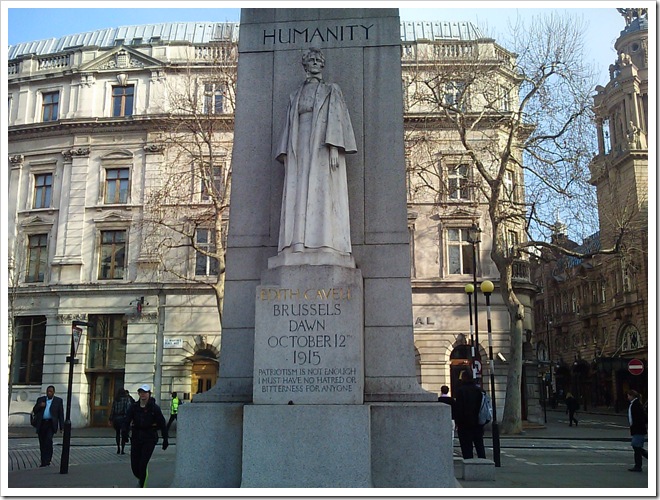
I arrived at Waterloo an hour early for a meeting last week. It was a beautiful day out, so I decided to walk to my meeting instead of taking the tube (about 40 minute walk away). While enroute I came across the below statue dedicated to Edith Cavell. I had no idea who she was but was curious. Turns out that ‘humanity’ is the right word for her, although they could add ‘noble’ and many other words:

Nurse Cavell helped hundreds of soldiers from the Allied forces to escape occupied Belgium to the neutral Netherlands, in violation of German military law. She was arrested on 3 August 1915 and charged with harbouring Allied soldiers, not for espionage. She was held in prison for 10 weeks, the last two in solitary confinement [2], and court-martialled. The British Government said they could do nothing to help her – Sir Horace Rowland of the Foreign Office said, "I am afraid that it is likely to go hard with Miss Cavell; I am afraid we are powerless." The sentiment was echoed by Lord Robert Cecil, Under-Secretary for Foreign Affairs. "Any representation by us", he advised, "will do her more harm than good."

The United States, which had not yet joined the war, did not agree. Hugh S. Gibson, First Secretary of the American legation at Brussels, made clear to the German government that executing Cavell would further harm their nation’s already damaged reputation. Later, he wrote:

"We reminded him (Baron von der Lancken) of the burning of Louvain and the sinking of the Lusitania, and told him that this murder would stir all civilized countries with horror and disgust. Count Harrach broke in at this with the rather irrelevant remark that he would rather see Miss Cavell shot than have harm come to one of the humblest German soldiers, and his only regret was that they had not ‘three or four English old women to shoot.’"

Baron von der Lancken stated that Cavell should be pardoned because of her complete honesty, and because she had helped save so many lives, including those of German as well as Allied soldiers. However, the German military acted quickly to execute Cavell so higher authorities would not issue the pardon.[3]

She made no defence, admitting her actions, and was ordered to be executed by firing squad at 6am on 12 October, less than ten hours after sentence was passed.

The night before her execution she told the Anglican chaplain, Reverend H. Stirling Gahan,[4] who had been allowed to see her and to give her Holy Communion, "Patriotism is not enough, I must have no hatred or bitterness towards anyone." These words are inscribed on her statue in St Martin’s Place, near Trafalgar Square in London.

IMAG0046

THE AIRPORT IQ TEST


I believe that there could be an IQ test based on airport check in. It would have common sense questions such as:

  • You are allowed to bring canisters of gasoline on the aircraft as you never know if the gauges are right and the crew may need it:   A. True B. False

Recently, the woman ahead of me in the security line up (It was 6:05 am) was crying and pleading with the security staff. She was in hysterics. There was no way she could check the item that they had just examined. No way! Do you know what they do in luggage check in – they will destroy it – she wailed – a fresh bout of tears streaming down her puffy cheeks.  

Had there been an IQ test based on airport check in, she would have failed this question:

While boarding an airplane, which item are you not allowed to bring as a carry-on item?

A. Toothbrush

B. Flight of the Conchords doll

C. Your new bright pink shirt

D. A pair of freshly sharpened figure skates.

She would not have answered D.

While in Paris the other week I witnessed another act of airport stupidity. A North American tourist (decked in gold,  bright red lip stick, big hair and obnoxious track suit clothing) was standing in the line at security with her stuffed Gucci bags, getting more and more agitated. Her husband clearly knew what was going on and was becoming increasingly uncomfortable – shooting her quick glances.

She was in line 3, with approximately 3 people between her and the X-ray. She kept looking over at line 1 where 3 guards were standing and talking. There were no people in line 1, it had a fancy carpet and was separated from line 2 and 3 by a red velvet rope. I now started to observe, wondering ‘How long?’.

Not long. She mumbled something to her husband in an exasperated tone and started to lumber through line 2 (which is cumbersome with all the bags – and no ability to say ‘excuse me’), plucked the velvet rope off the hook and proceeded to the X-Ray machine in line 1, with husband in tow. The French guard gave her one look as she walked up and proceeded to put her stuff on the conveyor belt. The guard pointed – back in line – with not a word of English.

Now, this is where it got funny. What was she going to do? We are all looking at them with a smile on our face. Do you traipse back to line 3? Go to the end of the line? Nope. She just walked over to the rope, plucked it off the hook and decided to insert herself (and her poor husband) 3rd from the front of the line. OK, that ticked me off a bit. But what happened next made up for it.

As soon as she was back in line, the French security guard walked over to line 2 and asked the person BEHIND the woman to come over to security. Two minutes later she walked back and took the person in FRONT of the woman and her husband. You should have seen the woman’s face. I burst out laughing.

So what question did this woman fail?

When in France, you should recognize that the locals love tourists, love when you speak English to them, are focused on customer service and love when tourists take liberties (circle one)  A. True. B. False.

You have to admit, the French are the masters of the snub. All hail the French.

RICHARD TEMPLAR RULE NO. 4: HOLD EFFECTIVE MEETINGS – NO REALLY EFFECTIVE


A couple weeks ago I churned through an easy read by Richard Templar, The Rules of Work. Written in a conversational style, filled with anecdotes and very simple – conventional business wisdom, although I don’t agree with everything in there (he is a little too calculating). A book I would definitely recommend to graduates and younger staff members, or to a few who have forgotten some of the basics.

I am now whipping through The Rules of Management (sense a theme?). I love Rule No. 4 on meetings:

To be effective you shouldn’t allow anyone to reminisce, ramble, rabbit on, refuse to shut up or relax. Keep ‘em moving fast and get them out of the door as soon as you can.Rules of Management: The Definitive Guide to Managerial Success (The Rules Series)

You don’t do ‘any other business’ – ever. If it’s that important it should be on the agenda. If it isn’t, then it shouldn’t be there at all. ‘Any other business’ is invariably someone trying to get something over on someone else.

Hold all meetings at the end of the day rather than at the beginning. Everyone’s anxious to be off home and it keeps meeting shorter; at the beginning of the day everyone has ages to digress and chat.

… Useful tip – never schedule meetings to begin exactly on the hour, always say 3:10 rather than 3 o’clock.

The end of day idea is brilliant (for large meetings) and the 3:10 feature is one that I wish was in Outlook. How is it possible for me to be on time when I am back to back in the calendar? If Outlook had a feature defaulting to 50 minute meetings it would make a world of difference.

PS: I also read David Allen’s Ready for Anything while on vacation and was quite disappointed. Hundreds of pages of ‘buy into Getting Things Done and you will be more successful’. Got it, believe in GTD, use GTD, didn’t need to read 52 reasons of why I should continue to use it.

CLOSING OUT PARIS

As we walked back to our hotel, we came across this monument which I have had a tough time puzzling out. It says ‘memorial national de la guerre d’algerie’ which I assume is a monument to the Algerian War which is worth reading about here. A few tidbits:

The Algerian War remains a contentious event today. According to historian Benjamin Stora, doctor in history and sociology and teacher at Paris VII, and one of the leading historians of the Algerian war, memories concerning the war remain fragmented, with no common ground to speak of:

"There is no such thing as a History of the Algerian War, there is just a multitude of histories and personal paths through it. Everyone involved considers that they lived through it in their own way, and any attempt to take in the Algerian War globally is immediately thrown out by the protagonists."[41]

Stora further points out that "The phase of memorial reconciliation between the two sides of the sea is still a long way off."[41] This was recently illustrated by the UMP‘s vote of the February 23, 2005 law on colonialism, which asserted that colonialism had globally been "positive." Thus, a teacher in one of the elite’s high school of Paris can declare:

"Yes, colonisation has had positive effects. After all, we did give to Algeria modern infrastructures, a system of education, libraries, social centers… There were only 10% Algerian students in 1962? This is not much, of course, but it is not nothing either!"[42]

2008 December 29 Walking Back to Paris Hotel  _MG_2811

As we walked back to the hotel, we stopped at the Ferris wheel in the Place de la Concorde. The sun was going down and it was a great way to end the trip.

2008 December 29 In The Paris Ferris Wheel _MG_2850

2008 December 29 In The Paris Ferris Wheel _MG_2852

2008 December 29 In The Paris Ferris Wheel _MG_2865

So much still to see. Wonderful city.

A MESSAGE TO PRESIDENT OBAMA: METRIC AS AN ECONOMIC STIMULUS


Like anyone else in the world who reads a newspaper, I could not help but notice the US budget with the many placeholders for pet political projects.

My message to President Obama: Implement metric. Think about it. The US will be spending all kinds of money on bridges, pet projects and other stimuli, so why not metric? If the US government were to impose a quick conversion to metric, it would have a huge economic impact, businesses and government agencies around the country began working on the project. A few impacts:

  • Computers systems would need to be prepared, replaced or revamped. Think Y2K – which had a WW cost estimated at $300B.
  • Across the country, signs would need to be changed from miles to KM.
  • School books would need to be reprinted, education programs would need to be updated.
  • Every piece of product packaging that included weight or volume would need updating.

The impact would be huge. President Obama, think about it. You know where you can reach me if you need more ideas ….

MORE PARIS

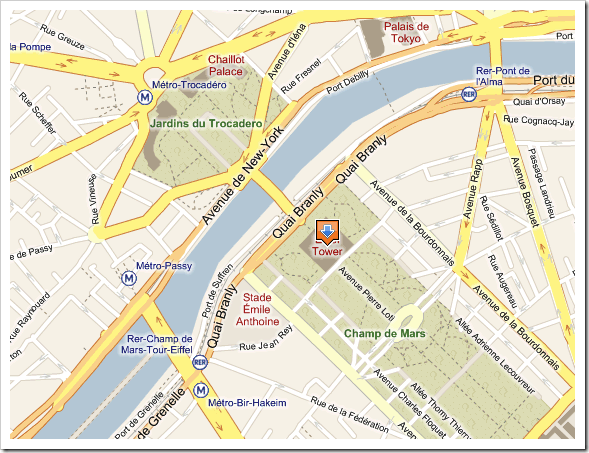
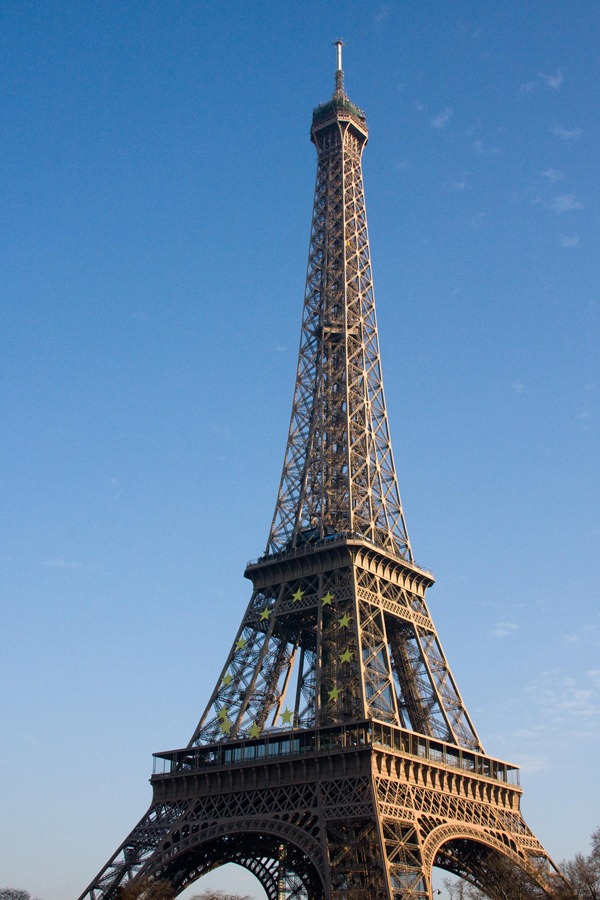
After the Louvre we headed to the Eiffel Tower (of course). We did not feel like fighting the crowds and were unable to get a reservation in the tower restaurant (despite an amazing effort from the Concierge). Exiting the metro at Trocadero (Paris has an amazing subway system), we enjoyed the view across the river.

image

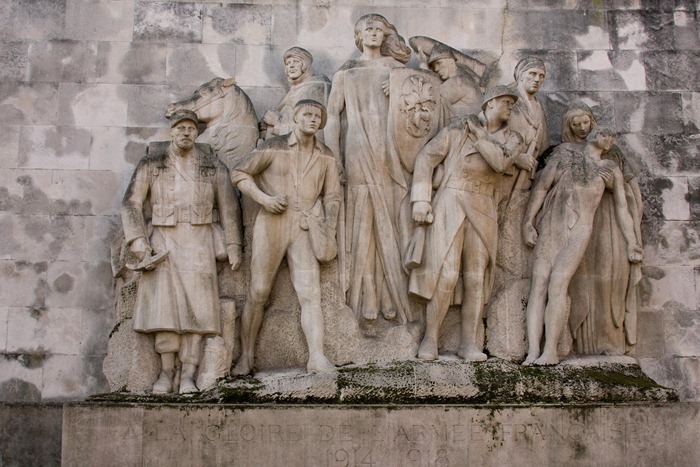
As you exit the metro, you come across a WWI monument to the people who fought the war.

2008 December 29 Touring around Paris  _MG_2628

As we looked  down on the Eiffel tower from the Trocadero, we did not realize the importance of the location:

For the Exposition Internationale of 1937, the old Palais du Trocadéro was demolished and replaced by the Palais de Chaillot which now tops the hill. It was designed in classicizing "moderne" style by architects Louis-Hippolyte Boileau, Jacques Carlu and Léon Azéma. Like the old palais, the palais de Chaillot features two wings shaped to form a wide arc: indeed, these wings were built on the foundations of those of the former building. However, unlike the old palais, the wings are independent buildings and there is no central element to connect them: instead, a wide esplanade leaves an open view from the place du Trocadéro to the Eiffel Tower and beyond.

The buildings are decorated with quotations by Paul Valéry, and they now house a number of museums:

      2008 December 29 Touring around Paris  _MG_2633

    2008 December 29 Touring around Paris  _MG_2629

    I never knew who Foch was. Interesting quote from him:

    He advocated peace terms that would make Germany unable to ever pose a threat to France again. His words after the Treaty of Versailles, "This is not a peace. It is an armistice for 20 years" would prove prophetic.

    2008 December 29 Touring around Paris  _MG_2642

    2008 December 29 Paris Boat Ride  _MG_2786

    2008 December 29 Paris Boat Ride  _MG_2799

    Enjoying a baguette, in the sun on a brisk December day in front of the Eiffel tower was a magical experience. We then headed down to the river and enjoyed a boat ride – a Paris must do. A few sights captured below.

    Alexander III bridge:

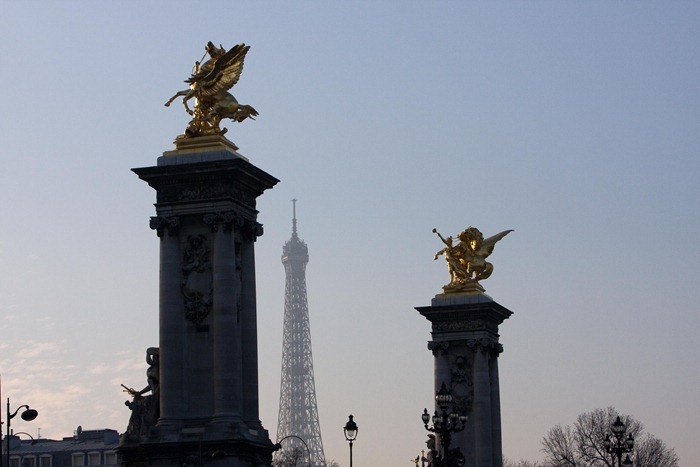
    Pont Alexandre III is an arch bridge that spans the Seine, connecting the Champs-Élysées quarter and the Invalides and Eiffel Tower quarter, widely regarded as the most ornate, extravagant bridge in Paris[1] [2].

    The bridge, with its exuberant Art Nouveau lamps, cherubs, nymphs and winged horses at either end, was built between 1896 and 1900. It is named after Tsar Alexander III, who had concluded the Franco-Russian Alliance in 1892. His son Nicholas II laid the foundation stone in October 1896. The style of the bridge reflects that of the Grand Palais, to which it leads on the right bank.

    2008 December 29 Paris Boat Ride  _MG_2652

    2008 December 29 Paris Boat Ride  _MG_2655

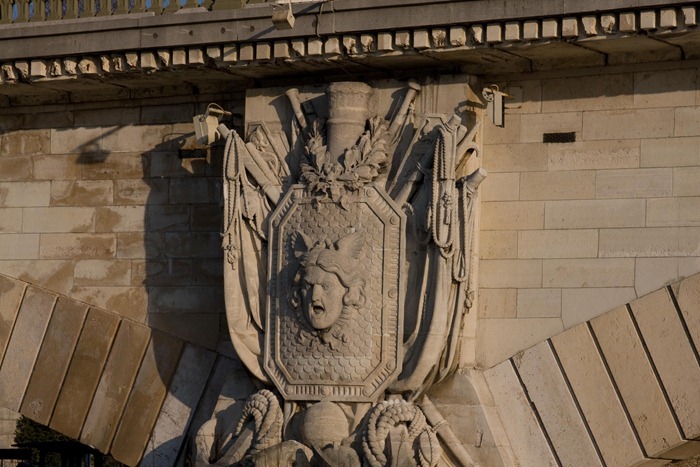
    Not the kind of detail you would ever see on a Canadian bridge.

    2008 December 29 Paris Boat Ride  _MG_2774

    2008 December 29 Paris Boat Ride  _MG_2782

     2008 December 29 Paris Boat Ride  _MG_2784

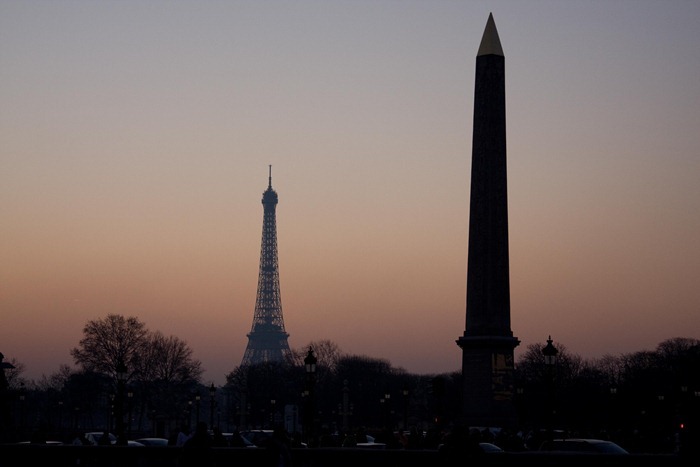
    Another Egyptian obelisk liberated, the Obelisk of Luxor in the Place de la Concorde:

    The center of the Place is occupied by a giant Egyptian obelisk decorated with hieroglyphics exalting the reign of the pharaoh Ramses II. It is one of two the Egyptian government gave to the French in the nineteenth century. The other one stayed in Egypt, too difficult and heavy to move to France with the technology at that time. In the 1990s, President François Mitterrand gave the second obelisk back to the Egyptians.

    The obelisk once marked the entrance to the Luxor Temple. The viceroy of Egypt, Mehemet Ali, offered the 3,300-year-old Luxor Obelisk to France in 1831. The obelisk arrived in Paris on December 21, 1833. Three years later, on October 25, 1836, King Louis-Philippe had it placed in the center of Place de la Concorde, where a guillotine used to stand during the Revolution.

    2008 December 29 Paris Boat Ride  _MG_2658

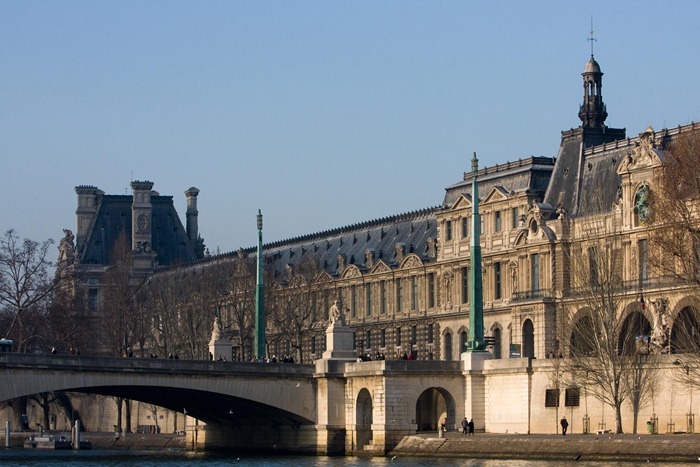
    The Louvre.

    2008 December 29 Paris Boat Ride  _MG_2681

    2008 December 29 Paris Boat Ride  _MG_2777

    The architecture of old European cities is breathtaking.

    2008 December 29 Paris Boat Ride  _MG_2693

    2008 December 29 Paris Boat Ride  _MG_2673

    2008 December 29 Paris Boat Ride  _MG_2770

    2008 December 29 Paris Boat Ride  _MG_2761

    Notre Dame. We did not take the time to visit, the boys are all ‘churched’ out.

    2008 December 29 Paris Boat Ride  _MG_2721

    2008 December 29 Paris Boat Ride  _MG_2714

    And it was finally time to start walking back to the hotel.

    LOCAL PAPERS & CREATIVITY WITH COWS


    One of my favourite parts of travelling has now become the local paper. It gives you a real feel for the nation, the local events, culture and different perspectives.

    While in Dubai, I read the Gulf News each morning. A few highlights that I kept with me:

    A few nights ago, on the way back from a lovely weekend, my car broke down. My wife and I had to wait three hours before the car got towed. We were desperate and more than 100 kilometres away from home. A while later, two cars stopped and the drivers – both Emirati men – offered to drive us home, knowing quite well that they would have to drive a long way. I thank those men and more such Emiratis for making this country a safe, lovely and special place to live. Each time I recall the incident, I feel amazed.

    • Dubai Modern High School is raising fees by 90%. Parents are not rejoicing.
    • The cost of war in the Middle East is estimated at $12,000,000,000,000. The military expenditure versus health care is shocking (2004 numbers): Egypt: $3B on military, $2.2B on health care. Lebanon: $4.4B on military, $3.2B on health care. Oman: $12B on military, $2.4B on health care. Syria: $6.4B on military, $2.2B on health. Wars are good for the military industrial complex, bad for humanity. After watching the documentary Why We Fight, I cannot help but hear Eisenhower’s warning and how it has come true:

    On January 17, 1961, Eisenhower gave his final televised Address to the Nation from the Oval Office.[49] In his farewell speech to the nation, Eisenhower raised the issue of the Cold War and role of the U.S. armed forces. He described the Cold War saying: "We face a hostile ideology global in scope, atheistic in character, ruthless in purpose and insidious in method…" and warned about what he saw as unjustified government spending proposals and continued with a warning that "we must guard against the acquisition of unwarranted influence, whether sought or unsought, by the military-industrial complex… Only an alert and knowledgeable citizenry can compel the proper meshing of the huge industrial and military machinery of defense with our peaceful methods and goals, so that security and liberty may prosper together."

    Heartstoppingly accurate and scary.

    • Iman warns about celebrating Valentine’s Day. Of course, this was surrounded by a special insert covering 20 local Valentines love stories and ads about what you should get that special someone.
    • India approves a soft drink made of cow urine.

    The new drink, to be known as Gau Jal or Cow Water, is being developed in the Indian holy city of Haridwar by the RSS’ Cow Protection Department and should be ready for marketing in six months.

    Fascinating stuff.

    DRIVING IN ENGLAND – SUNNINGHILL

    I often tell friends about driving in the UK. It is an amazing country, buildings that are full of history which leads to some interesting challenges. How do you travel down roads that are built for horses, not parking and cars?

    The answer is …. like this:


    PASSCHENDAELE


    I was told recently that if you fly over the north of France from Britain you can still see the trenches of WWI – fields upon fields of trenches of hell. I came across the Canadian film Passchendaele by chance the other day. Being a Canadian film, you never know what you will get – and I was surprised. It was incredibly moving. The final scene says it all, a small town grave yard with white tombstones crossing up and over the hill.

    File:Chateau Wood Ypres 1917.jpg

    The Sunday Telegraph had an article a few month back on Canada’s contributions to the world, wars and peace keeping.        Salute to a brave and modest nation, Sunday Telegraph:

    Until the deaths of Canadian soldiers killed in Afghanistan, probably almost no one outside their home country had been aware that Canadian troops are deployed in the region. And as always, Canada will bury its dead, just as the rest of the world, as always will forget its sacrifice, just as it always forgets nearly everything Canada ever does.. It seems that Canada’s historic mission is to come to the selfless aid both of its friends and of complete strangers, and then, once the crisis is over, to be well and truly ignored. Canada is the perpetual wallflower that stands on the edge  of the hall, waiting for someone to come and ask her for a dance. A fire breaks out, she risks life and limb to rescue her fellow dance-goers, and suffers serious injuries. But when the hall is repaired and the dancing resumes, there is Canada, the wallflower still, while those she once helped glamorously cavort across the floor, blithely neglecting her yet again.

    That is the price Canada pays for sharing the North American continent with the United States, and for being a selfless friend of Britain in two global conflicts. For much of the 20th century, Canada was torn in two different directions: It seemed to be a part of the old world, yet had an address in the new one, and that divided identity ensured that it never fully got the gratitude it deserved. Yet it’s purely voluntary contribution to the cause of freedom in two world wars was perhaps the greatest of any democracy.
    Almost 10% of Canada ‘s entire population of seven million people  served in the armed forces during the First World War, and nearly 60,000 died.

    The great Allied victories of 1918 were spearheaded by Canadian troops, perhaps the most capable soldiers in the entire British order of battle. Canada was repaid for its enormous sacrifice by downright neglect, it’s  unique contribution to victory being absorbed into the  popular Memory as somehow or other the work of the ‘British.’  The Second World  War provided a re-run. The Canadian navy began the war with a half dozen vessels, and ended up policing nearly half of the Atlantic against U-boat attack.  More than 120 Canadian warships participated in the Normandy landings, during which 15,000 Canadian soldiers went ashore on D-Day alone. Canada finished the war with the third-largest navy and the fourth largest air force in the world.

    The world thanked Canada with the same sublime indifference as it had  the previous time.   Canadian participation in the war was acknowledged in film only if it was necessary to give an American actor a part in a campaign inwhich  the United States had clearly not participated – a  touching scrupulousness which, of course, Hollywood has since abandoned, as it has any notion of a separate Canadian identity. So it is a general rule that actors and filmmakers arriving in Hollywood keep their nationality – unless, that is, they are Canadian. Thus Mary Pickford, Walter Huston, Donald Sutherland, Michael J. Fox, William Shatner, Norman Jewison, David Cronenberg, Alex Trebek, Art Linkletter and Dan Aykroyd have in the popular perception become American, and Christopher Plummer, British.   It is as if, in the very act of becoming famous, a Canadian ceases to  be Canadian, unless she is Margaret Atwood, who is as  unshakably Canadian as a moose, or Celine Dion, for whom Canada has proved quite unable to find any takers.

    Moreover, Canada is every bit as querulously alert to the achievements of its sons and daughters as the rest of the world is completely unaware of them. The Canadians proudly say  of themselves – and are unheard by anyone else – that  1% of the world’s population has provided 10% of the world’s peacekeeping forces. Canadian soldiers in the past half century have been the greatest peacekeepers on Earth – in 39 missions on UN mandates, and six on  non-UN peacekeeping duties, from Vietnam to East Timor, from Sinai to Bosnia. Yet the only foreign engagement that has entered the popular non-Canadian imagination was the sorry affair in  Somalia, in which out-of-control paratroopers murdered two Somali infiltrators. Their regiment was then disbanded in disgrace – a uniquely Canadian act of self-abasement for which, naturally, the Canadians received no international credit. So who today in the United States knows about the stoic and selfless friendship its northern neighbour has given it in Afghanistan?   Rather like Cyrano de Bergerac, Canada repeatedly does honourable things for honourable motives, but instead of being thanked for it, it remains something of a figure of fun. It is the  Canadian way, for which Canadians should be proud, yet such honour comes at a high cost. This past year more grieving Canadian families knew that cost all too tragically well.

    Lest we forget.

    GOODBYE TO GLIB GURUS AND THEIR GOBBLEDEGOOK


    A colleague forwarded me a great article from the The Times Online this week.  So good, that I cut and pasted the whole thing for future reference. I have highlighted a few points that really stuck out for me.

    While I do not agree with all of the points, the article makes a strong case for balance. Like in all things, text book learning does not translate into aptitude and knowing a lot of management theory does not create great managers, leaders or businesses.

    Reading it, I was left with a couple thoughts:

    • Where have the billions of dollars of investment into Sarbanes Oxley gone and what was it for? The points made on compliance in the below article support Lois Frankel’s paradox of control (from the book Overcoming Your Strengths):

    It was the first year that I decided to invite a large group of relatives and friends for Thanksgiving dinner. Being the independent woman that I am, I wanted to prepare and serve the meal by myself. As more people came into the kitchen to help, I became increasingly frustrated with my inability to maintain control of the situation. My mother was telling me to do one thing to the turkey, a friend was telling me to do another to the stuffing, and still someone else was telling me how to cook the vegetables. Finally, heeding my own guidance to others that the paradox of control is the more control you have the more you give away, I decided to let everyone do what they wanted. I was just positive, however, that this meal would wind up a disaster.

    No one was more surprised than I was when it turned out to be one of the best Thanksgiving dinners ever to come out of my kitchen.

    • Management theory is not about a pretty box, with a bow that can be textbook implemented to ensure success. If it causes you to step back from your business and apply a percentage of the learning to make your business better – that is success. And if 0% is applicable but it made you step back, assess and think, that is a benefit too.

    Good article. Enjoy.


    Goodbye to glib gurus and their gobbledegook

    The credit crunch is showing management theory for the hollow, jargon-filled sham it always was. But at last the tide is turning

    Andrew Billen

    It was John Humphrys on the Today programme who last autumn summed up the tragedy of Baby P. Exasperated by an apologist for Haringey Council, who smugly claimed that it had followed procedures, he thundered: “And the end of this perfect paper trail is a dead baby.”

    Such is Humphrys’ range that a few weeks later he was interrogating Sir Michael Lyons, the chairman of the BBC Trust, about Russell Brand’s naughty phone call to Andrew Sachs. Was the answer, he asked satirically, more “compliance procedures”? It surely must have been, for the corporation is currently echoing to the clang of stable doors being belatedly bolted (that and the Teletubbies theme tune, for a senior BBC staffer has been told to watch every episode to ensure that it meets “current compliance” procedures).

    “What they don’t understand,” one of the BBC’s most respected producers explained to me, “is that the more compliance you put in, the more likely [controversy] is to happen because it takes away the innate sense of personal responsibility that everybody in the BBC once had.”

    Of course, it is not only social services and the BBC who today wade so deep in management theory that they can barely do their jobs. Schools last year received 6,000 pages of theory and guidelines from Whitehall. The result? Primary school teachers, busy reading and filling in forms, no longer have time to read books to their charges. In hospitals, doctors long ago took the hint that the State will value them more for meeting targets than for treating patients, so they order ambulances into “holding patterns” in car parks for fear that, if patients are admitted to A&E too early, the target that all must be treated within four hours may be missed. Cynical? They are acting no more venally than the Kent policeman who arrested a child for throwing a slice of cucumber from his sandwich at another youngster. The PC, lamented the Police Federation of England and Wales in 2007, needed to meet his mop-up target.

    We know, of course, that bureaucracy works first in duplicate, then in triplicate and thus unto infinity, but what is happening now is no accidental proliferation of red tape. In the past two decades, management theory, once rejected in Britain by both management and unions, has been deliberately imposed on almost every aspect of commercial and public life. Resistance, from the policeman’s beat to the chalk face, has been widespread but futile.

    The Wall Street Journal columnist Thomas Frank, who has studied the cult of management in books such as One Market Under God, savours the paradox on our behalf. Millionaire management theorists such as Tom Peters, author of The Pursuit of Wow!, may believe that they are cool “but the public has always regarded these guys as a joke. You think of that book Who Moved My Cheese? There are parodies of it all over the web. People don’t trust this stuff. They think it’s silly.”

    Management theory was born, naturally, in America. Its father was Frederick Winslow Taylor, the time-and motion man who died in 1915 with, legend has it, a stopwatch in his hand. A mechanical engineer, he believed that workers should be made to do small, specialised, repetitive tasks. Their work rate could be ratcheted up by pouring extra dollars into their wage packets. In 1914, 16,000 people flocked to New York to hear him relay such insights.

    The realism of Taylor was quickly countered by the “human relations” school of management theory, led by touchy-feelier theorists such as Elton Mayer, who believed that if you treated the workers like family, they might treat you like family back.

    But it was James Oscar McKinsey, a Chicago accountancy professor, who turned management theory into money by founding a company of consultants who claimed not merely to heal unhealthy companies but to make healthy ones great. McKinsey died in 1937, but his “fellow visionary” Marvin Bower continued to advise McKinsey and Company until his death five years ago – by which time it was serving seven out of ten of Fortune magazine’s most admired companies. By the Fifties it was almost mandatory in the US, if you wished to run a company, to get a masters degree in business administration – an MBA. Preferably it would be bestowed by Harvard Business School, where, currently, 1,800 students are beavering away, trying not to think too hard about the economic triumphs achieved by such notable alumni as George W. Bush and Rick Wagoner, the chairman of General Motors.

    “What you get from Harvard Business School,” says Radio 4’s In Business presenter Peter Day, “is a wonderful network of people who were there with you and a set of tools that you can then use and bamboozle people with for the rest of your life. It is a habit of thought – conventional responses to conventional situations. Harvard teaches very much on a case-study basis, so it is always telling people how to respond to things that happened in the past. No wonder that when something like the credit crunch comes along, huge numbers of highly skilled people in compartmentalised worlds are unable to respond to it.”

    But what do they teach? Come the Sixties, all schools united in their loathing for the comfortable, profitable Fifties business culture as described by William H. Whyte in his 1956 book The Organization Man. This was a world in which white-collared workers were beholden to their employers. “They are wry about it, to be sure; they talk of the ‘treadmill’, the ‘rat race’, of the inability to control one’s direction,” Whyte wrote. “But they have no great sense of plight; between themselves and organization they believe they see an ultimate harmony…”

    Harmony! This life of job stability, quality health insurance and pension plans looked like commercial death to the theorists. “Tom Peters would say that you have to turn loose market forces at every level of the firm,” says Frank, who, when not writing for The Wall Street Journal, edits a journal of dissent called The Baffler. “There is this cult of destruction that you see in American management theory – creative destruction, with the emphasis on destruction.” The cult’s credo is reduced ad absurdum in the title of one book of popular management theory ubiquitous in American airport bookstores: If it Ain’t Broke…Break it!

    At its bleakest, this social Darwinian philosophy, as advocated by the McKinsey consultants who dreamt up the phrase “the war for talent”, requires managers to rank their employees each year. Some 20 per cent are “A players” who must be handsomely rewarded. The next 70 per cent, the Bs, will be less well paid. The bottom 10 per cent, the Cs, will be fired.

    Hard? Certainly. Fair? Only possibly. But does it work? On the contrary. In 2004, a survey of 200 human resource professionals reported that “forced ranking” resulted in lower production, scepticism, damaged morale and reduced collaboration. As the authors of the new book Hard Facts: Dangerous Half-Truths and Total Nonsense point out, there is no reason why 10 per cent of your workforce should every year become incompetent.

    “Forced ranking” is a fad that is fading – but it is hard to keep up, there are so many. Amazon.co.uk is selling 11 books with a combination of the words “management” and “fad” in their title, the snappiest of which is Fad Surfing in the Boardroom. These volumes promise to separate the wheat from the chaff for the bemused manager. The trouble is, there is so much corn in the field that even the high priests become confused. For a while McDonald’s taught its managers the American psychologist Abraham Maslow’s hierarchy of needs, a pyramid building upwards from “breathing, food and water” to an apex of “self-actualization” (as a burger house manager?). Yet by the time of his death in 1970, Maslow himself had admitted that some employees simply did not choose to “self-actualise” in the workplace and might resent being expected to do so. Peter Drucker, perhaps the most respected of all the gurus, who died in 2005, eventually concluded that, contrary to what he had once believed, the volunteering sphere offered more personal fulfilment that the workplace.

    Performance reviews, in which staff are yearly taken into a room by their manager and told how they are doing, are increasingly regarded as the least effective way of communicating between boss and worker. If you learn anything new at your review, the latest thinking goes, your boss has not been managing you correctly. In the City, bonuses – long since elevated into a culture – are finally being recognised as one of the very motors of investment banks’ disastrous recklessness. Sitting next to them in the dock are “targets”, which, as the former chairman of the Audit Commission, James Strachan, was telling anyone who would listen as long ago as 2003, were a “sure-fire way” of failing to improve services in schools and hospitals (he resigned three years later).

    The comical ingenuity of doctors in cheating over targets was dramatised ruthlessly by one of their former colleagues, Jed Mercurio, in his BBC drama series Bodies. One obstetrician on the show, frightened of his morbidity score rising above target, simply began refusing to treat very sick patients. “Doctors end up becoming more and more cynical about the way the NHS is governed,” he says. “It’s a very dangerous mindset for a workforce to get into.”

    Yet Mercurio acknowledges the need for someone to watch over the medical professionals. Margaret Thatcher, when she threw millions of pounds in extra funding towards the police, was determined that the quid pro quo would be accountability: from that moment, Gene Hunt started to become an historical figure. Equally, there are few greater critics of management theory than David Craig, a former management consultant turned apostate who has written Plundering the Public Sector, a book castigating the Government for squandering billions on consultancies. He, too, acknowledges that efficiency needs to be measured: “KPI [key performance indicators] are absolutely fabulous if used by effective management. But if you have incompetent, ineffective management and policies that only want to give the illusion of progress, they are a disaster and demotivate everyone in the organisation.”

    It was in 1995, while working with Gemini, then a struggling consultancy, that Craig helped to come up with the concept of organisational transformation. “We published a book called Transforming the Organization,” he says. “But it was a con, something we dreamt up to try to sell bigger money-making projects to companies. It took three or four years, then everyone started picking up on it. And Tony Blair bought it when McKinsey sold it to him. Suddenly all he would talk about was “transformation of the public service”.

    Those, such as Day, Frank and Craig, who have watched management theory transform itself into a religion wonder whether its false gods should take responsibility for the current economic downturn. Target-related bonuses generated greed, which generated irresponsibility. Compartmentalisation – that old Taylorist panacea – left bosses with no overall view of what was going on. Older hands predicted that no good would come of it.

    In The Puritan Gift, published last year, the septuagenarian Scottish brothers William and Kenneth Hopper, respectively a banker and an engineer-turned-industrial consultant, argued that for 200 years the puritan foundations of America kept its businesses emphasising craft, financial responsibility and the sublimation of private interest to the group. Young men would rise through a company to the top, gaining deep personal knowledge of the business. In the 1970s, however, a new breed of “professional managers” arrived, armed with MBAs. They were trained to manage anything – a charity or a chemical company – but they lacked “domain knowledge”. The founding fathers’ gift was squandered. Managers who knew all about management but nothing else left the incomprehensible science of sub-prime mortgages to the boffins in their labs.

    The economy is now exercising its traditional revenge. At McKinsey & Company in London, bonuses have been cut by a third. Consultants once hired out to companies for £8,000 a week now write on websites of having been “benched” for months. Like the unluckier employees of the companies they advised, they now uneasily await a call from the HR department – this time their own.

    If there is hope, it may lie not in the private sector, which will sooner or later seek new potions from the witch doctors, but with the state toilers who were never in it for bonuses in the first place. Last year, four English police forces decided to abandon government targets in favour of common sense. In Surrey, Mark Rowley, the acting chief constable, spoke the revolutionary words: “I want officers to apply their professional judgment and discretion to do the right thing.” As the experiment is slowly taken up by forces across the nation, older coppers remark in wistful gratitude that this is what they came into the job to do. Younger recruits accustomed, like most of their generation, to PowerPoint lectures on targets, best practice and accountability initiatives, are understandably anxious.

    It would be a brave new world without such gobbledegook in it but – to use a management theorist’s phrase – an empowered one, too. Managers would be chosen not for their ability to bandy jargon with their superiors but for their empathy, pragmatism, experience and decisiveness with their staff – who would no longer, like the former social worker on the Radio 4 Today progamme this week, spend 80 per cent of their working day filling in forms. They would not be drawn from a pool of professional managers but from among the people who do the work. And, once chosen, they would be allowed to do the job or replaced. This brave new world would cease to be managed. It would begin to be led.

    Management by numbers

    The gurus know how to count…

    Michael Porter’s Five Forces

    Kenichi Ohmae’s 3 Cs – Commitment, Creativity, Competition

    Peter Senge’s Five Disciplines

    W. Edwards Deming’s Fourteen Points

    David Kolb’s Four Factors

    Rensis Likert’s System 4

    Management by acronym

    They also like to spell things out…

    AVA = Activity Value Analysis

    BPR = Business Process Re-engineering

    CBA = Cost-Benefit Analysis

    TQM = Total Quality Management

    Management by cliché

    But best of all they like a snappy phrase

    Management by Walking About

    (Tom Peters)

    Who Moved My Cheese?

    (Spencer Johnson)

    Theory X and Theory Y

    (Douglas McGregor)

    The Managerial Grid

    (Robert Blake and Jane Mouton)

    In Search of Excellence

    (Peters again)

    If it ain’t broke… break it!

    (Robert J. Kriegel)

    The Pursuit of Wow!

    (Is there no end to Peters’s phrase-making?)

    GETTING A DRIVERS LICENSE


    We all have those fond (or not so fond) memories of getting our first drivers licence. Sitting in the car with our white knuckled parent beside us as we moved down the road, inches away from a crash. In today’s society, I would imagine that most of that is gone thanks to the abundance of driving schools.

    One of the fringe benefits of being Canadian is that when you come to the UK you simply hand in your old license and they swap it for a UK license. No drivers test. No need to prove that you know how to get around a round-about and that you are not that person who was in the wrong lane for exiting, but tried to exit anyway cutting off 15 people. No need to prove that you have not come out of a driveway and run headlong into traffic the wrong way until you overcame the instinct to drive on the right. No need to prove that you are not the person who completely scraped up the rims on their rental car learning the hard way that UK roads were built for horses, not cars and are therefore rather tight.

    Nope. Nothing to prove, they just hand it over. Please note, none of these things happened to me (smile).

    But if you are American, different story. Drivers courses. Written tests and the worst penalty: a £400 fee. I guess this is Britain’s way of slowly recouping some of the war debt (The last payment being made in 2007).

    But it could be worse. I now say to my American friends ‘at least we are not in China’:

    If someone’s intestines are protruding from an open abdominal wound, should you: A. Put them back in place; B. Do nothing; or, C. Cover them with some kind of container and fasten it around the body?

    The above is not from a first-year medical school exam, but is one of the 100 questions that both locals and foreigners could find on China’s written driver’s licence exam. (The answer, by the way, is C.)
    Test candidates are given a booklet of 800 test questions, 100 of which appear on the actual exam. While the questions dealing with traffic signs are universally understood, others have singularly Chinese characteristics

    Take the following example…

    "What should a driver do when he needs to spit while driving? A. Spit through the window. B. Spit into a piece of waste paper, then put it into a garbage can. C. Spit on the floor of the vehicle." Answer? B.

    Read the full article here.

    DAVID THOMPSON: EXPLORED & MAPPED CANADA


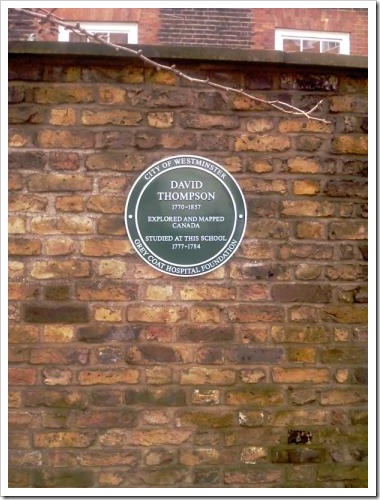
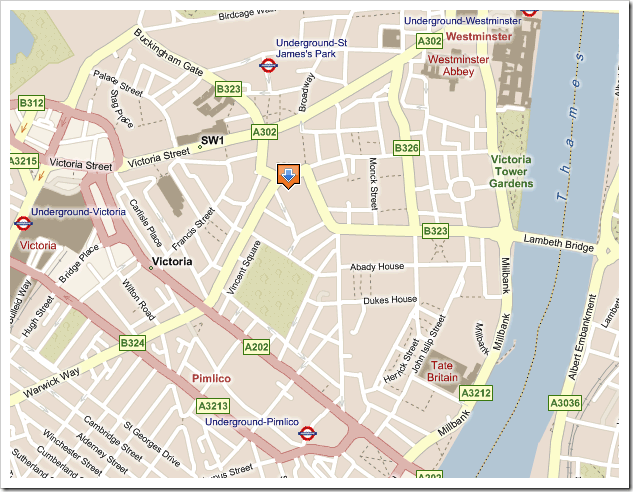
    The picture below was sent to me by a colleague as he walked down the street (thanks!). It is Grey Coat Hospital which is now a specialist language school for women.

    canada

    image

    I do not remember David Thompson from history class, so I looked him up:

    David Thompson (April 30, 1770February 10, 1857) born Dafydd ap Thomas,[1] was an English-Canadian fur trader, surveyor, and map-maker, known to some native peoples as "Koo-Koo-Sint" or "the Stargazer". Over his career he mapped over 3.9 million square kilometres of North America and for this has been described as the "greatest land geographer who ever lived."[2]

    Thompson was born in Westminster to recent Welsh migrants , David and Ann Thompson. When Thompson was two, his father died and the financial hardship of this occurrence resulted in his and his brother’s placement in the Grey Coat Hospital, a school for the disadvantaged of Westminster. He eventually graduated to the Grey Coat mathematical school and was introduced to basic navigation skills which would form the basis of his future career. In 1784, at the age of fourteen, he entered a seven-year apprenticeship with the Hudson’s Bay Company. He set sail on May 28th of that year, and left England forever.[3]

    I cannot even imagine sending my 14 year old son away. Different times.

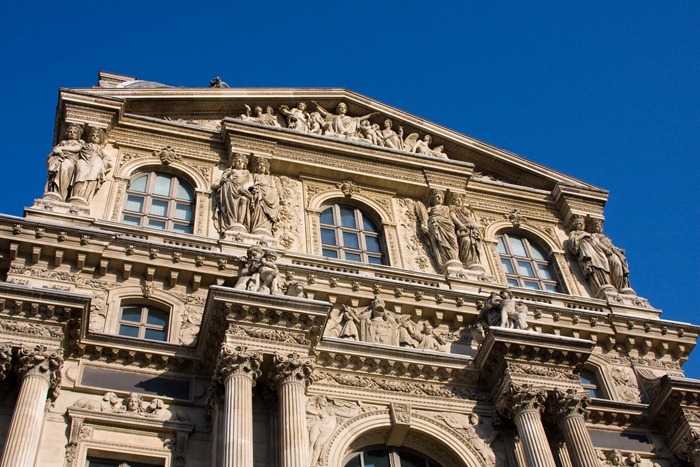
    PARIS CONTINUTED: THE LOUVRE

    Our third day in Paris was one of those days that we usually say we will never do, completely full from start to finish. The first stop was The Louvre and as one would expect, it was packed. We decided on a whirlwind tour where we agreed to hit the big three.

    2008 December 29 The Louvre  _MG_2617

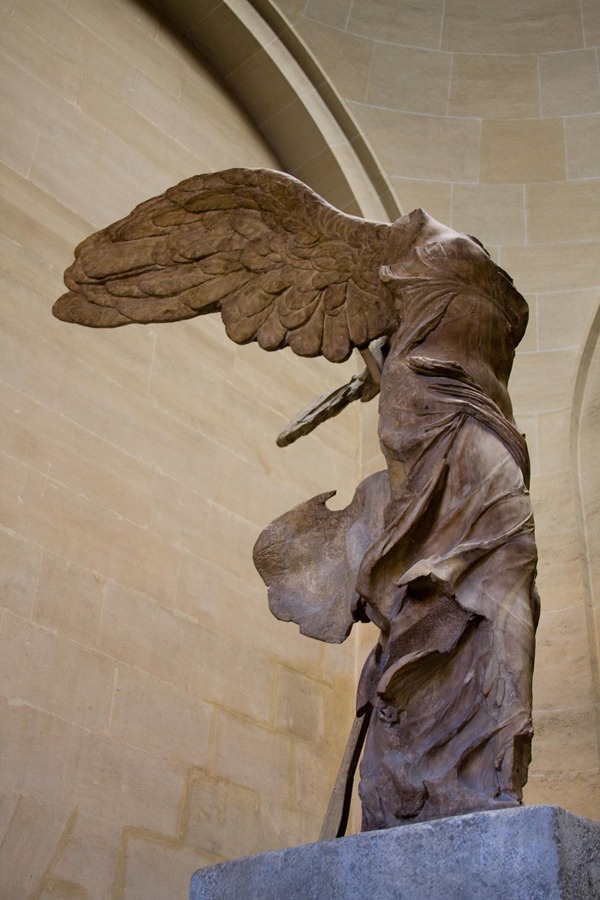
    The Winged Victory of Samothrace:

    The product of an unknown sculptor, presumably of Rhodian origin, the Victory is believed to date to between 220 and 190 BC. When first discovered on the island of Samothrace (in Greek, Σαμοθρακη — Samothraki) and published in 1863 it was suggested that the Victory was erected by the Macedonian general Demetrius I Poliorcetes after his naval victory at Cyprus between 295 and 289 BC. The Samothrace Archaeological Museum continues to follow these originally established provenance and dates.[7] Ceramic evidence discovered in recent excavations has revealed that the pedestal was set up about 200 BC, though some scholars still date it as early as 250 BC or as late as 180.[8] Certainly, the parallels with figures and drapery from the Pergamon Altar (dated about 170 BC) seem strong.

    In April 1863, the Victory was discovered by the French consul and amateur archaeologist Charles Champoiseau, who sent it to Paris in the same year. The statue has been reassembled in stages since its discovery. The prow was reconstructed from marble debris at the site by Champoiseau in 1879 and assembled in situ before being shipped to Paris. Since 1884 it has dominated the Daru staircase.[9] displayed in the Louvre, while a plaster replica stands in the museum at the original location of the Sanctuary of the Great Gods on Samothrace. The discovery in 1948 of the hand raised in salute, which matched a fragment in Vienna, established the modern reconstruction — without trumpet — of the hand raised in epiphanic greeting.

    2008 December 29 The Louvre  _MG_2554

    Venus de Milo. A fascinating history:

    The Venus de Milo was discovered by a peasant named Yorgos Kentrotas in 1820, inside a buried niche within the ancient city ruins of Milos, on the Aegean island of Milos, (also Melos or Milo). The statue was found in two main pieces (the upper torso and the lower draped legs) along with several herms (pillars topped with heads), fragments of the upper left arm and left hand holding an apple, and an inscribed plinth. Olivier Voutier, a French naval officer, was exploring the island. With the help of the young farmer, Voutier began to dig around what were clearly ancient ruins. Within a few hours Voutier had uncovered a piece of art that would become renowned throughout the world. About ten days later, another French naval officer, Jules Dumont d’Urville, recognized its significance and arranged for a purchase by the French ambassador to Turkey, Charles-François de Riffardeau, marquis, later duc de Rivière.

    Twelve days out of Touloun the ship was anchored off the island of Melos. Ashore, d’Urville and [fellow officer] Matterer met a Greek peasant, who a few days earlier while ploughing had uncovered blocks of marble and a statue in two pieces, which he offered cheaply to the two young men. It was of a naked woman with an apple in her raised left hand, the right hand holding a draped sash falling from hips to feet, both hands damaged and separated from the body. Even with a broken nose, the face was beautiful. D’Urville the classicist recognized the Venus of the Judgement of Paris. It was, of course, the Venus de Milo. He was eager to acquire it, but his practical captain, apparently uninterested in antiquities, said there was nowhere to store it on the ship, so the transaction lapsed. The tenacious d’Urville on arrival at Constantinople showed the sketches he had made to the French ambassador, the Marquis de Riviére, who sent his secretary in a French Navy vessel to buy it for France. Before he could take delivery, French sailors had to fight Greek brigands for possession. In the mêlée the statue was roughly dragged across rocks to the ship, breaking off both arms, and the sailors refused to go back to search for them.[2]

    News of the discovery took longer than normal to get to the French ambassador. The peasant grew tired of waiting for payment and was pressured into selling to a local priest, who planned to present the statue as a gift to a translator working for the Sultan in Constantinople (present day Istanbul, Turkey).

    The French ambassador’s representative arrived just as the statue was being loaded aboard a ship bound for Constantinople and persuaded the island’s chief citizens to annul the sale and honor the first offer.

    Upon learning of the reversal of the sale, the translator had the chiefs whipped and fined but was eventually reprimanded by the Sultan after the French ambassador complained to him about the mistreatment of the island citizenry. The citizens were reimbursed and ceded all future claims to the statue in gratitude.

    2008 December 29 The Louvre  _MG_2591

    And last but not least, the Mona Lisa: which was protected by glass as it has been vandalized twice (acid thrown on it once, a rock another time).

    2008 December 29 The Louvre  _MG_2564

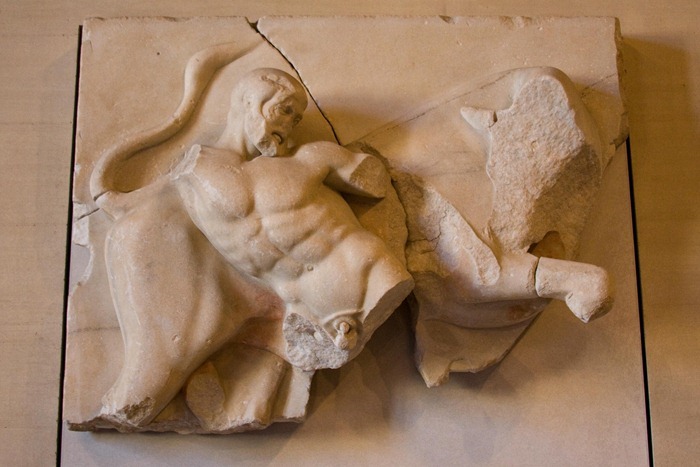
    We did not have a lot of time (and it was just too busy), and we passed by a thousand great pieces (which means we definitely need to go back). One noteworthy part for me was when we passed the Greek and Egyptian displays (having been there, we skipped past). It left me reflecting upon the comments of our guides in those countries and how their history no longer belonged to them. Each went on to explain how large parts of their history is in the museums of the world (Britain and England in particular). Consider the following ….

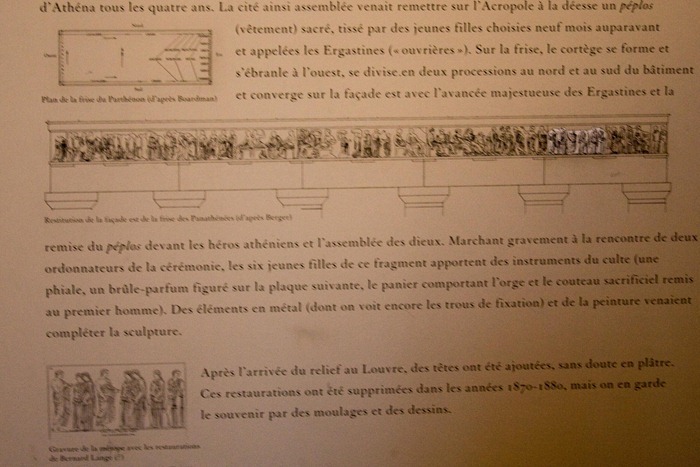
    From the Parthenon in Athens, hundreds of statues were taken (the second picture being where this would reside had it been left behind):

    2008 December 29 The Louvre  _MG_2589

    2008 December 29 The Louvre  _MG_2588

    2008 December 29 The Louvre  _MG_2580

    A sphinx …. (well over 6 feet high):

    2008 December 29 The Louvre  _MG_2600

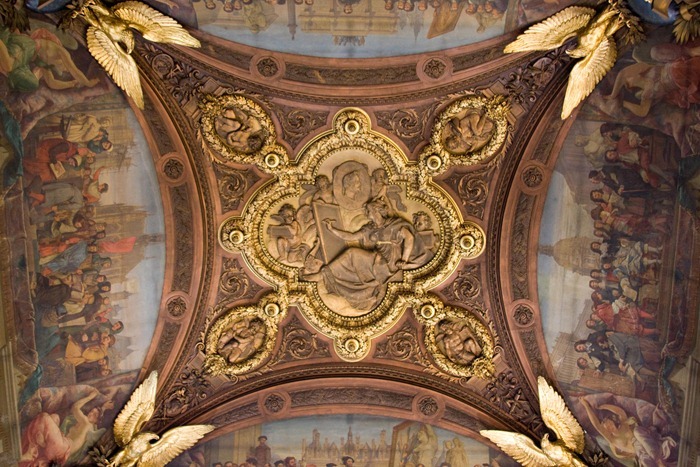
    Of course. You need to look up. This is just the roof …

    2008 December 29 The Louvre  _MG_2569

    How it looks before they go on display:

    2008 December 29 The Louvre  _MG_2577

    And that was just the morning.

    RHS WISLEY: LET THE BUTTERFLIES GO!


    I have been remiss on finishing out a number of our recent UK adventure logs. One that came to mind today is our trip on the 18th of January to the Royal Horticultural Society Wisley garden.

    I remembered the visit thanks to a friend sharing that Canada is getting pounded by another –15 degree spat of weather. This weekend was 10 and sunny, we played tennis. Which brings me to RHS Wisley which is a lovely garden a short drive away. On a beautiful January day we walked the gardens, drawn to the event of the day – the release of 1,000 butterflies.

    In the office, when I shared my weekend, I had several people reply in shock ‘WON’T THE DIE?’. To provide clarity, it was the releasing of the butterflies within the greenhouses.

     2009 01 18 Royal Wisley  _MG_2934

    2009 01 18 Royal Wisley  _MG_2944

    2009 01 18 Royal Wisley  _MG_2963

    2009 01 18 Royal Wisley  _MG_2968


    2009 01 18 Royal Wisley  _MG_2954

    In the end I counted about 20 butterflies. I am sure they were hiding.

    I don’t miss the snow and –15. I do miss my garden. A wonderful day. To my Canadian friends, if you can, get down to the Niagara Falls Butterfly Conservatory, it is amazing.

    A POSITIVE WORD: MARCH 2009 HARVARD BUSINESS REVIEW


    It seems like everywhere we go and everything we read is focused on one thing – the negative state of the economy. Unfortunately, negativity sells. It goes back to what one of my favourite mentors would often said:

    ‘Make 1 person happy and they will tell 5 people, make one person unhappy and they will tell 250’.

    We all face different times with new challenges. As leaders, one of the best leadership articles that I have read over the past months is only a couple paragraphs in March issue of HBR titled Performance Incentives for Tough Times. In the end, it is all about managers recognizing great performance:

    Abundant evidence indicates that employee behaviour is a function of its consequences. People do what brings praise and avoid what doesn’t. And good performance will probably decline unless it’s acknowledged.

    Leaders need to remember, people leave managers, not companies.

    I also enjoyed the article Learning from Heroes:

    Like Hercules, Luke Skywalker, and Jack Welch, we all struggle with five recurring challenges as we journey through work and life: We wander without knowing where we’re going. Data and circumstances confuse us. Fear blocks us from acting. Change paralyzes us. And despite our best intentions, we talk more than we listen.

    An examination of business writing from the past 30 years shows that these challenges emerge again and again—and the best books offer simple yet profound lessons for overcoming them: Find a clear purpose. Be aware that past experience and a mass of information can interfere with wise decisions. Maintain a bias toward action. Be open to change. Seek feedback.

    Feel the force Luke. It is quite simple …..