
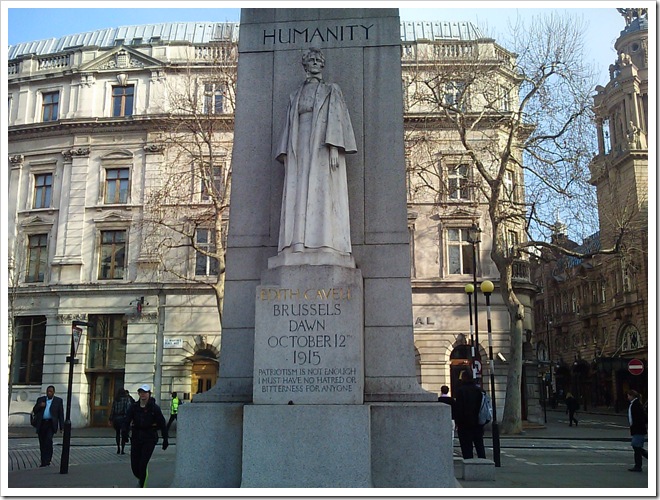
I arrived at Waterloo an hour early for a meeting last week. It was a beautiful day out, so I decided to walk to my meeting instead of taking the tube (about 40 minute walk away). While enroute I came across the below statue dedicated to Edith Cavell. I had no idea who she was but was curious. Turns out that ‘humanity’ is the right word for her, although they could add ‘noble’ and many other words:
Nurse Cavell helped hundreds of soldiers from the Allied forces to escape occupied Belgium to the neutral Netherlands, in violation of German military law. She was arrested on 3 August 1915 and charged with harbouring Allied soldiers, not for espionage. She was held in prison for 10 weeks, the last two in solitary confinement [2], and court-martialled. The British Government said they could do nothing to help her – Sir Horace Rowland of the Foreign Office said, "I am afraid that it is likely to go hard with Miss Cavell; I am afraid we are powerless." The sentiment was echoed by Lord Robert Cecil, Under-Secretary for Foreign Affairs. "Any representation by us", he advised, "will do her more harm than good."
The United States, which had not yet joined the war, did not agree. Hugh S. Gibson, First Secretary of the American legation at Brussels, made clear to the German government that executing Cavell would further harm their nation’s already damaged reputation. Later, he wrote:
"We reminded him (Baron von der Lancken) of the burning of Louvain and the sinking of the Lusitania, and told him that this murder would stir all civilized countries with horror and disgust. Count Harrach broke in at this with the rather irrelevant remark that he would rather see Miss Cavell shot than have harm come to one of the humblest German soldiers, and his only regret was that they had not ‘three or four English old women to shoot.’"
Baron von der Lancken stated that Cavell should be pardoned because of her complete honesty, and because she had helped save so many lives, including those of German as well as Allied soldiers. However, the German military acted quickly to execute Cavell so higher authorities would not issue the pardon.[3]
She made no defence, admitting her actions, and was ordered to be executed by firing squad at 6am on 12 October, less than ten hours after sentence was passed.
The night before her execution she told the Anglican chaplain, Reverend H. Stirling Gahan,[4] who had been allowed to see her and to give her Holy Communion, "Patriotism is not enough, I must have no hatred or bitterness towards anyone." These words are inscribed on her statue in St Martin’s Place, near Trafalgar Square in London.
 Michael Weening: a few pictures